Special Meeting Sample For School In New York
Description



Get your form ready online
Our built-in tools help you complete, sign, share, and store your documents in one place.
Make edits, fill in missing information, and update formatting in US Legal Forms—just like you would in MS Word.
Download a copy, print it, send it by email, or mail it via USPS—whatever works best for your next step.
Sign and collect signatures with our SignNow integration. Send to multiple recipients, set reminders, and more. Go Premium to unlock E-Sign.
If this form requires notarization, complete it online through a secure video call—no need to meet a notary in person or wait for an appointment.
We protect your documents and personal data by following strict security and privacy standards.

Make edits, fill in missing information, and update formatting in US Legal Forms—just like you would in MS Word.

Download a copy, print it, send it by email, or mail it via USPS—whatever works best for your next step.

Sign and collect signatures with our SignNow integration. Send to multiple recipients, set reminders, and more. Go Premium to unlock E-Sign.

If this form requires notarization, complete it online through a secure video call—no need to meet a notary in person or wait for an appointment.

We protect your documents and personal data by following strict security and privacy standards.
Looking for another form?



Form popularity
FAQ
The goal of the meeting is to decide if your child needs special education services. The criteria can vary from state to state. But no matter what standards your child's school uses, it can't make the decision ahead of time. That's called “pre-determination,” and the special education law IDEA doesn't allow for that.
The intake process is designed to obtain the student's education history; determine current education status; assess the student's strengths, weaknesses, interests, aptitudes and learning styles for the purpose of developing an appropriate Personalized Education Plan (PEP) for all students.
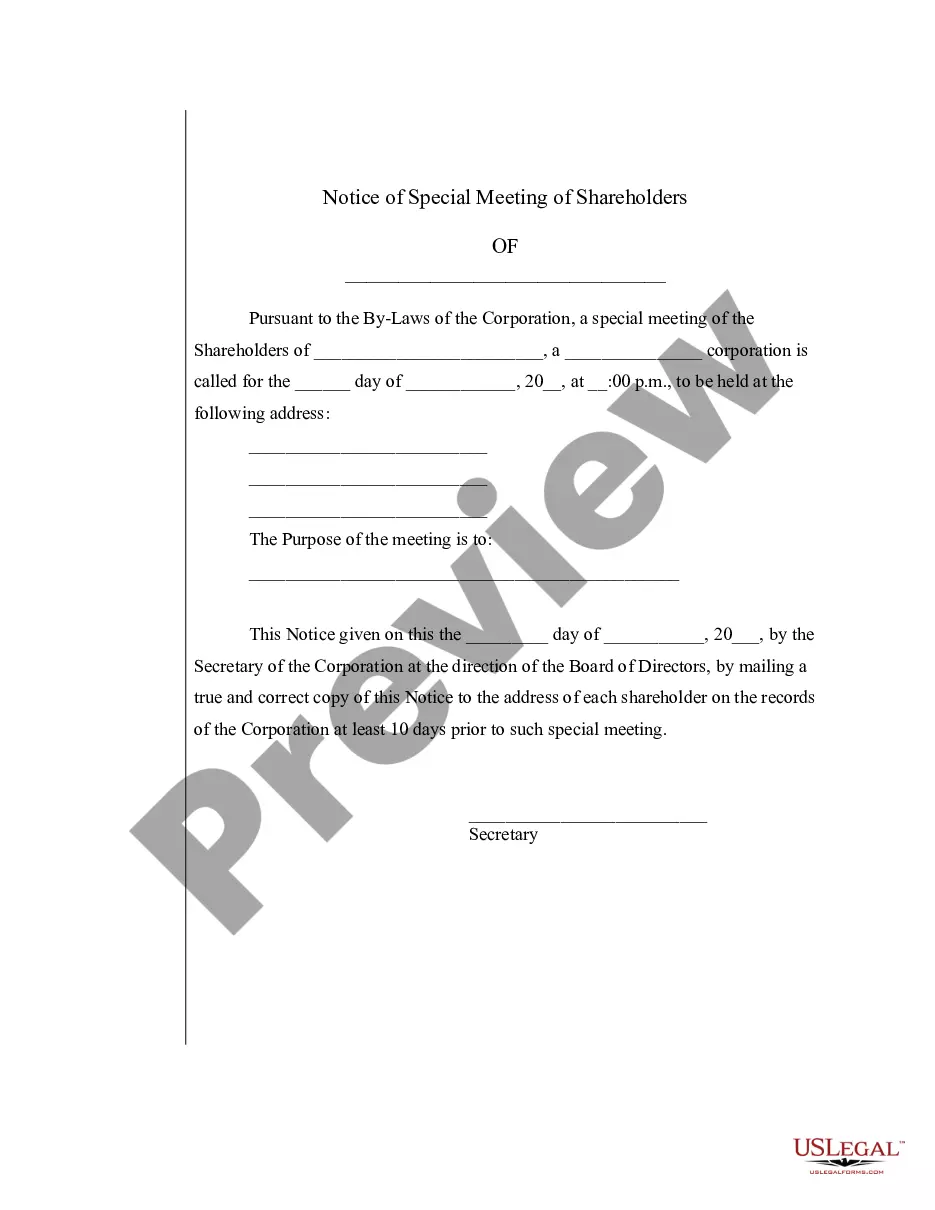
Ing to section () of the bylaws of the organization, the board of directors hereby gives notice of a special meeting which will take place on (date) at (time) at (meeting location). Board members are encouraged to attend. The purpose of the meeting is to discuss an emergency data breach.
“I hardly know your child” or “I have only had your child for a couple of weeks and am still getting to know him.” As soon as this statement is made it conveys the impression that you should not be part of the IEP team because you do not know the child sufficiently to develop the IEP to meet the child's needs.
The IEP meeting is one of the most important parts of the special education process. In this meeting, school staff and parents come together to discuss, develop, and review a student's IEP. They make sure the IEP meets the student's needs. There are rules for IEP meetings. They cover who must attend and what happens.
A proper meeting notice should include: Date, Time, and Venue: Clear details on when and where the meeting will take place. Purpose of the Meeting: A brief description of the meeting's objectives. Agenda: An outline of topics to be discussed; this helps attendees prepare for the meeting.
The purpose of an IEP meeting is for the IEP team to work collaboratively to identify the special education services and supports that will be delivered to the student, based on her unique needs. This process produces a written record, the IEP itself, which formalizes these services and supports.
Special education refers to a range of services that help kids with disabilities learn. It's not a “one size fits all” approach — special education is tailored to meet the needs of individual kids. Kids who qualify for special education have an IEP.
As you can see, there are a lot of topics covered in school board meetings. These topics range from new facility projects to curriculum changes and testing requirements. While some of these topics may seem straightforward, others can be quite complex.
Every school district has a CPSE and a CSE that decides a child's special education needs and serv ices. The CPSE is responsible for children with disabilities ages 3-5. The CSE is responsible for chil dren with disabilities ages 5-21.

