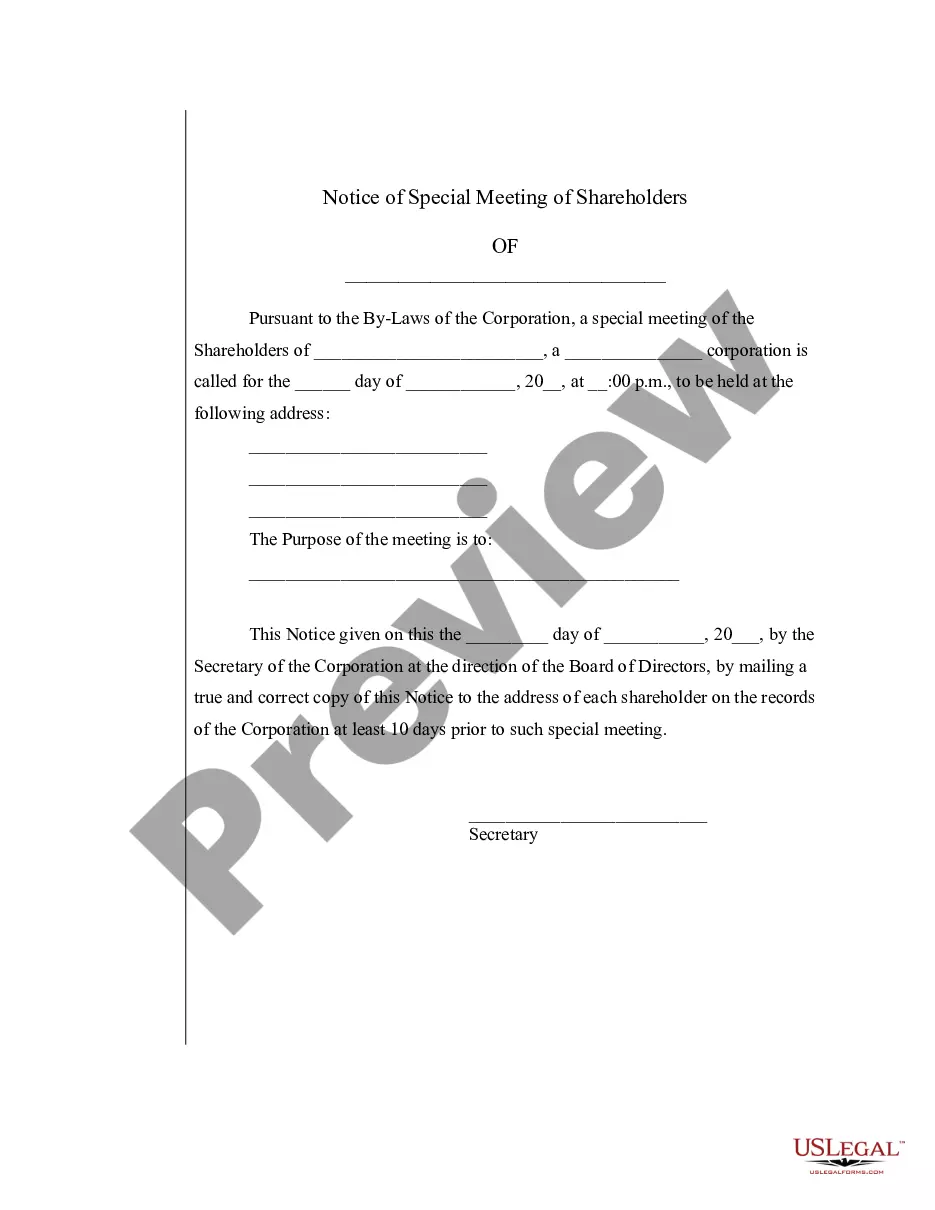
Special Meeting Sample With Client In Harris
Description



Get your form ready online
Our built-in tools help you complete, sign, share, and store your documents in one place.
Make edits, fill in missing information, and update formatting in US Legal Forms—just like you would in MS Word.
Download a copy, print it, send it by email, or mail it via USPS—whatever works best for your next step.
Sign and collect signatures with our SignNow integration. Send to multiple recipients, set reminders, and more. Go Premium to unlock E-Sign.
If this form requires notarization, complete it online through a secure video call—no need to meet a notary in person or wait for an appointment.
We protect your documents and personal data by following strict security and privacy standards.

Make edits, fill in missing information, and update formatting in US Legal Forms—just like you would in MS Word.

Download a copy, print it, send it by email, or mail it via USPS—whatever works best for your next step.

Sign and collect signatures with our SignNow integration. Send to multiple recipients, set reminders, and more. Go Premium to unlock E-Sign.

If this form requires notarization, complete it online through a secure video call—no need to meet a notary in person or wait for an appointment.

We protect your documents and personal data by following strict security and privacy standards.
Looking for another form?




Form popularity
FAQ
Harris County is divided into four commissioner court precincts.
Over 150 state agencies and departments serve Texans' everyday needs, including driver services, public health information, and more.
Harris County Department of Education has compiled a listing of all 25 county school districts' contact information and calendars, including holidays and beginning and end dates.
Welcome to the Harris County Services Portal, where you can find links to services that are provided online by Harris County's more than 70 departments.
The 67 Harris County District Courts include 24 Civil District Courts, 29 Criminal District Courts, 11 Family District Courts, and 3 Juvenile District Courts.
Criteria are the measurable dimensions of objectives. Criteria are used to compare how close different proposed policy alternatives will come to meeting the goals of solving the problem. Criteria set the rules to follow in analyzing and comparing different proposed policy alternatives (solutions).
Provide relevant, concise background. Don't assume policy makers or staff have any previous knowledge of the topic. Catch them up to speed as briefly as possible. What is the issue being briefed and what is the significance of it to the reader? The more direct the significance, the more effective the memo.
Create an outline with an understanding of memo expectations/structure: - Start with problem/data (1/2 memo), end with options/solution (1/2 memo). - Recommendations can be nuanced (more than 1) but must advise decision maker. - Articulate an understanding of trade-offs, counterarguments.
For a 3-page memo, the executive summary is roughly 1 paragraph and should summarize your key points. As space is limited, you should have only the most essential information in your executive summary: the problem/issue, your analysis, and the solution(s).
How to write a proposal letter Introduce yourself and provide background information. State your purpose for the proposal. Define your goals and objectives. Highlight what sets you apart. Briefly discuss the budget and how funds will be used. Finish with a call to action and request a follow-up.

