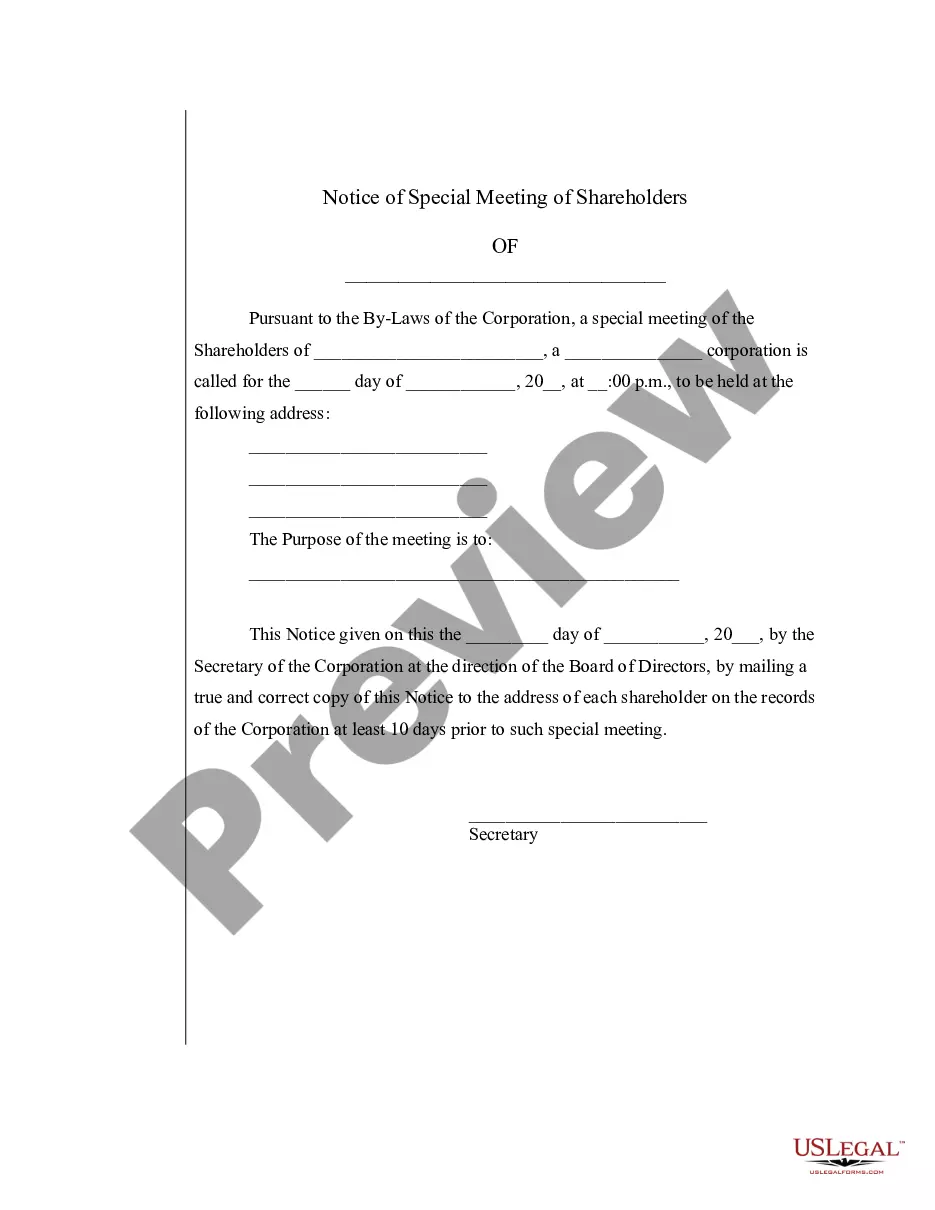
Special Meeting Sample Format In Collin
Description



Get your form ready online
Our built-in tools help you complete, sign, share, and store your documents in one place.
Make edits, fill in missing information, and update formatting in US Legal Forms—just like you would in MS Word.
Download a copy, print it, send it by email, or mail it via USPS—whatever works best for your next step.
Sign and collect signatures with our SignNow integration. Send to multiple recipients, set reminders, and more. Go Premium to unlock E-Sign.
If this form requires notarization, complete it online through a secure video call—no need to meet a notary in person or wait for an appointment.
We protect your documents and personal data by following strict security and privacy standards.

Make edits, fill in missing information, and update formatting in US Legal Forms—just like you would in MS Word.

Download a copy, print it, send it by email, or mail it via USPS—whatever works best for your next step.

Sign and collect signatures with our SignNow integration. Send to multiple recipients, set reminders, and more. Go Premium to unlock E-Sign.

If this form requires notarization, complete it online through a secure video call—no need to meet a notary in person or wait for an appointment.

We protect your documents and personal data by following strict security and privacy standards.
Looking for another form?








Form popularity
FAQ
How to plan meetings Establish your goal and if it requires a meeting. Decide on a format. Create a preliminary agenda. Assign roles. Select a time and a place. Invite your team. Seek advice and opinions. Finalise the agenda and share the resources.
I am writing to schedule a meeting to purpose of your meeting. If the time works for you, I would like to meet at time on date at place. Please confirm whether that works for you or if another time and place is better. I look forward to our meeting.
For example, a company may call a special meeting to discuss a major decision, such as a merger or acquisition. A school board may call a special meeting to address a specific issue, such as a budget shortfall.
What to include in a meeting agenda The purpose, goals, and objectives of the meeting. Points to be discussed, including time reserved for asking questions after each point. Timeframes for each point (including questions afterward) Name of person leading each action point. Final question round.
Meeting Planning Steps Determine the Purpose of the Meeting. Set Goals for Your Meeting. Identify Who Should Attend the Meeting. Notify Attendees in Advance. Prepare the Content for Your Meeting. Define the Duration of Your Meeting. Create a Meeting Agenda. Write Meeting Minutes.
7 Step Meeting Process Clarify Aim/Purpose. Assign Roles. Review Agenda. Work through Agenda. Review meeting record. Plan Next Steps and Next Agenda. Evaluate.
New students are issued a username and password for CougarWeb as well as a campus wide identification number (CWID) at the completion of admission. If you do not have your username and password, take a picture ID to the Admissions and Records Office at a campus near you or e-mail admissions@collin.
Step 1: Go to collin.onelogin and login with your username and password. Step 2: Click on the Office 365 icon. Step 3: Click on the Outlook icon. Step 4: Sign in with your Collin username @collin (Ex:Cougar1@Collin) and password.
A: Student ID's are available at any Student Engagement Office, as well as room A145 on the Technical Campus. For additional information about Student Engagement office locations, click here.
Step 1: Go to collin.onelogin and login with your username and password. Step 2: Click on the Office 365 icon. Step 3: Click on the Outlook icon. Step 4: Sign in with your Collin username @collin (Ex:Cougar1@Collin) and password.

