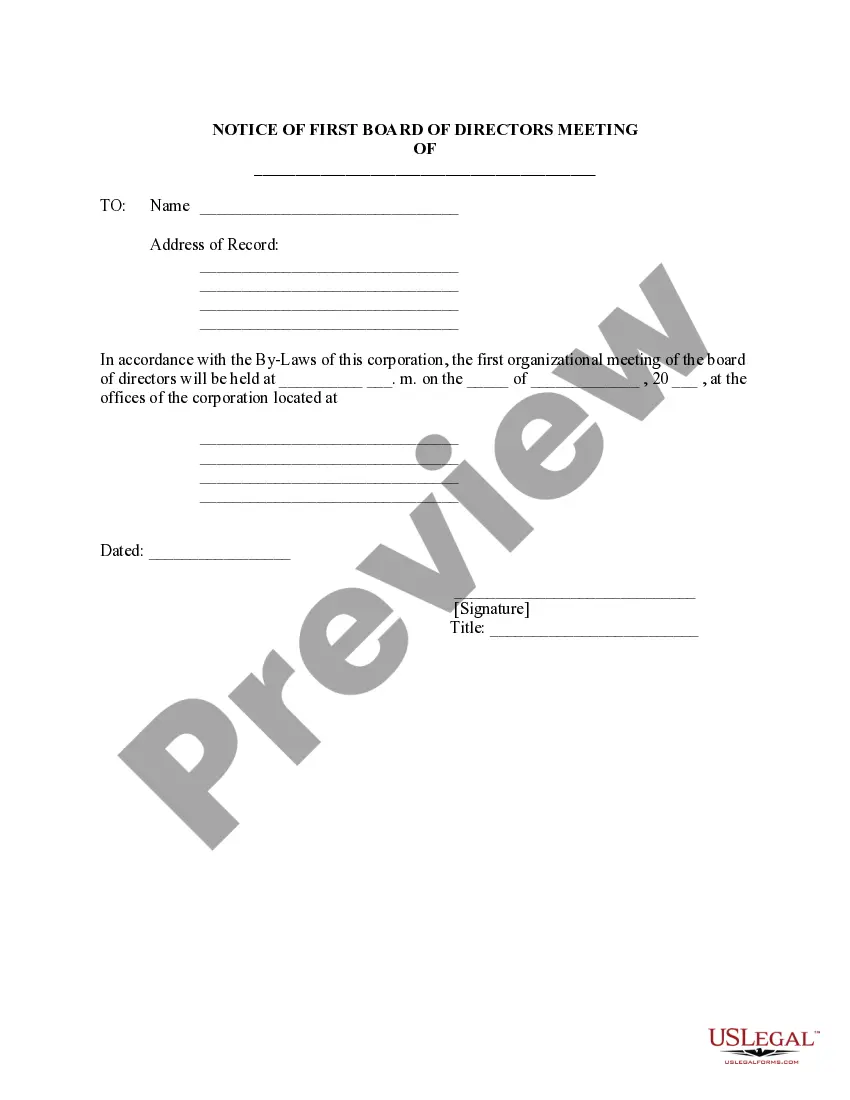
Notice Stockholders Meeting For Board In Phoenix
Description


Get your form ready online
Our built-in tools help you complete, sign, share, and store your documents in one place.
Make edits, fill in missing information, and update formatting in US Legal Forms—just like you would in MS Word.
Download a copy, print it, send it by email, or mail it via USPS—whatever works best for your next step.
Sign and collect signatures with our SignNow integration. Send to multiple recipients, set reminders, and more. Go Premium to unlock E-Sign.
If this form requires notarization, complete it online through a secure video call—no need to meet a notary in person or wait for an appointment.
We protect your documents and personal data by following strict security and privacy standards.

Make edits, fill in missing information, and update formatting in US Legal Forms—just like you would in MS Word.

Download a copy, print it, send it by email, or mail it via USPS—whatever works best for your next step.

Sign and collect signatures with our SignNow integration. Send to multiple recipients, set reminders, and more. Go Premium to unlock E-Sign.

If this form requires notarization, complete it online through a secure video call—no need to meet a notary in person or wait for an appointment.

We protect your documents and personal data by following strict security and privacy standards.
Looking for another form?




Form popularity
FAQ
Board resolutions deal with operational and management decisions, while shareholder resolutions address more significant, often strategic, matters affecting the company.
A shareholders' meeting is a meeting held by the shareholders of a company to discuss the arrangements of the company or to vote in the election of board members.
As provided in sub-section (1) of section 101, a general meeting may be called by giving not less than 21 clear days' notice in writing or through electronic mode in such manner as may be prescribed.
(i) Date, time and place of meeting; (ii) Purpose of the meeting; (iii) Notice of any special business to be conducted; (iv) Nature of special business in sufficient details; (v) The text of any special resolution or by-law to be submitted to the meeting; and (vi) Any additional details required by the by-laws or ...
In shareholders' meetings, this means aligning the agenda with shareholder rights and interests. In board meetings, the agenda should focus on strategic and oversight matters.
Shareholders are the individuals or entities that own company shares, giving them control over that company. The members of the board don't control the company (unless they are also shareholders), but they make the day-to-day decisions of the business. In a startup context, a board member may be the CEO, CTO, or CMO.
A general meeting can be called by the company directors or shareholders. A minimum notice period of 14 days is required for calling a general meeting in a private limited company. The notice must be sent to every member and director, and any persons entitled to a share on the death or bankruptcy of a shareholder.
The requirements for giving notice of shareholder meetings are strictly regulated under the Corporations Act 2001 (Cth). Generally, companies must provide at least 21 days' written notice for a meeting, though longer periods may be specified in the company constitution.
In essence, shareholders' meetings are about the ownership and broader governance of the company, while directors' meetings focus on the operational oversight and management of the company. Both play crucial roles in corporate governance but cater to different aspects and stakeholders within the organization.

