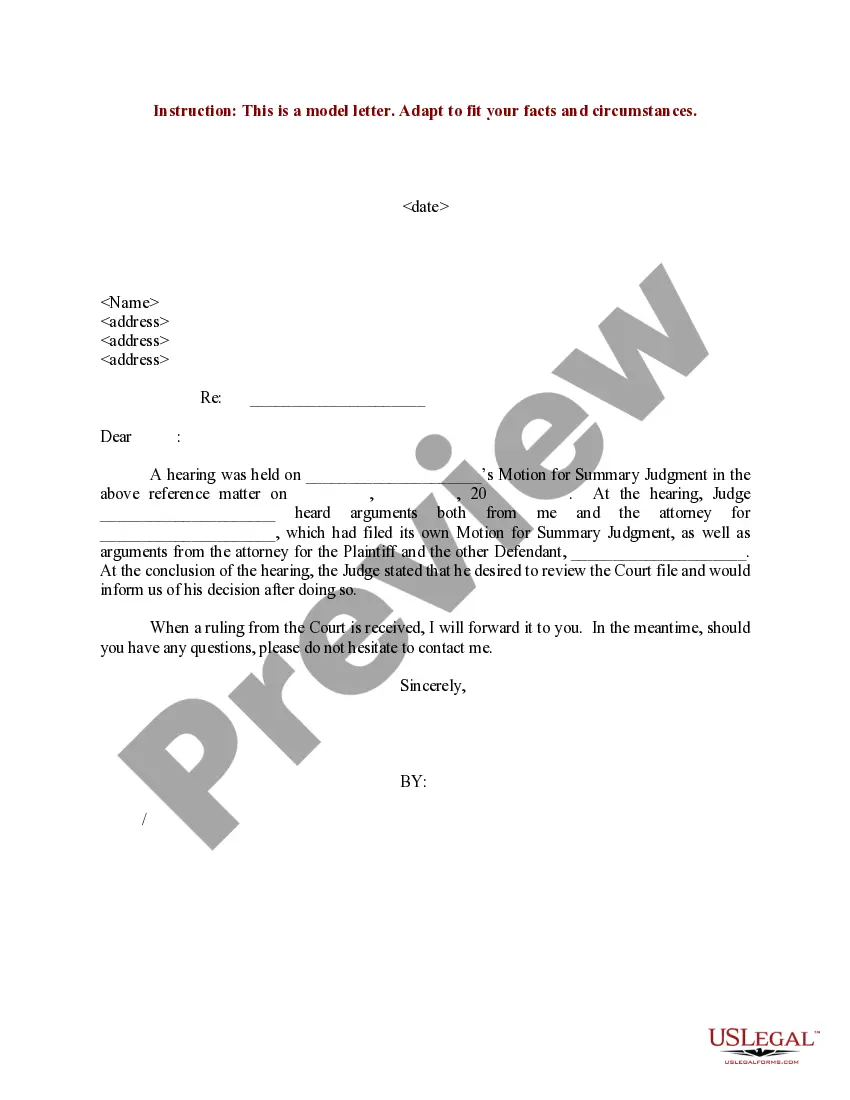
Letter Concerning Hearing Without Consent In North Carolina
Description
Get your form ready online
Our built-in tools help you complete, sign, share, and store your documents in one place.
Make edits, fill in missing information, and update formatting in US Legal Forms—just like you would in MS Word.
Download a copy, print it, send it by email, or mail it via USPS—whatever works best for your next step.
Sign and collect signatures with our SignNow integration. Send to multiple recipients, set reminders, and more. Go Premium to unlock E-Sign.
If this form requires notarization, complete it online through a secure video call—no need to meet a notary in person or wait for an appointment.
We protect your documents and personal data by following strict security and privacy standards.

Make edits, fill in missing information, and update formatting in US Legal Forms—just like you would in MS Word.

Download a copy, print it, send it by email, or mail it via USPS—whatever works best for your next step.

Sign and collect signatures with our SignNow integration. Send to multiple recipients, set reminders, and more. Go Premium to unlock E-Sign.

If this form requires notarization, complete it online through a secure video call—no need to meet a notary in person or wait for an appointment.

We protect your documents and personal data by following strict security and privacy standards.
Looking for another form?









Form popularity
FAQ
There are three common types of recording laws: (1) Race Statutes, (2) Notice Statutes, and (3) Race-Notice Statutes. North Carolina falls into the first category and is, what many refer to as, a pure-race state.
California law says that any recording made without someone's permission is illegal. This means the recording can't be used as evidence in any kind of legal case, including a divorce or custody battle. Plus, the person who made the recording could face criminal charges.
California requires the consent of all parties, with a minimum consent being the notification that the parties are being recorded in a confidential conversation with an audible beep at particular intervals throughout the recording. Without permission, an individual can face imprisonment and fines.
A probable cause hearing is a formal adversarial proceeding before a district court judge, but the rules of evidence are less strict and the burden of proof is lower – requiring only a “fair probability” that a crime was committed and the defendant committed it.
(g) If after the first appearance before a district court judge a defendant with consent of counsel desires to waive his right to a probable‑cause hearing, he may do so in writing filed with the court signed by defendant and his counsel. Upon waiver the defendant must be bound over to the superior court.
FAQs about Getting Criminal Charges Dismissed in NC You could get charges dropped after an indictment if there is insufficient evidence to support a conviction. This might happen if the court suppresses key evidence and the prosecution no longer has enough evidence to prove all the elements of an offense.
Additionally, the Rule 24 hearing is an opportunity for the trial judge to make certain that assistant counsel has been appointed, if the case is going to be tried as a death penalty case and if “second chair” has not been appointed, to set up a scheduling order and to begin to address any known or anticipated problems ...
Except when the hearing is scheduled by calendar call, the judge must notify the parties of the hearing's date, time, and place at least 14 days before the hearing. The notice is sent by regular, first-class mail, unless the judge determines that circumstances require service by certified mail or other means.
Rule 5 of the North Carolina Rules of Civil Procedure requires that a notice of hearing be served on each attorney of record or unrepresented party in a case. G.S. 1A-1, Rule 5(a). Rule 5 also requires that Notices of Hearing be filed with the court "either before service or within five days after service." G.S.
Notice of hearing; waiver; permissible form of notice and waiver. (a) The clerk of court, upon the request of the plaintiff, shall issue a notice to the defendant setting a time and place for a hearing before the clerk which shall not be less than 10 days from the date of service of said notice upon the defendant.