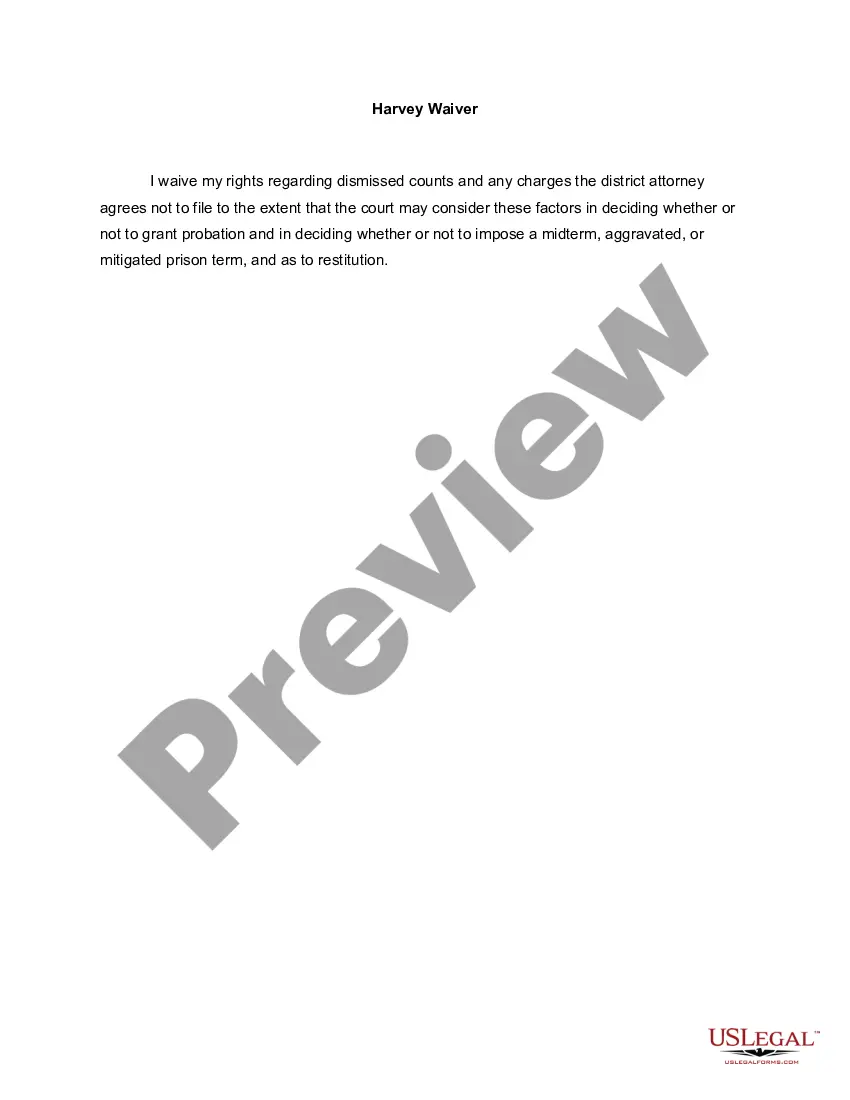
Harvey Waiver
What this document covers
The Harvey waiver is a legal document that allows the court to consider previously dismissed charges during sentencing in a criminal case. In the absence of this waiver, a sentencing court cannot factor in dismissed counts as part of the plea bargain. The form is named after the California case, People v. Harvey (1979). This waiver is essential for defendants who wish to give the court the ability to review the entire context of their case when determining penalties or probation eligibility.
Key parts of this document
- Defendant's waiver of rights concerning dismissed counts.
- Permission for the court to consider these dismissed charges in sentencing decisions.
- Specification that the waiver applies to charges not filed per district attorney agreement.
- Implications for sentencing options, including probation and prison terms.
- Consideration for restitution based on dismissed counts.
When to use this document
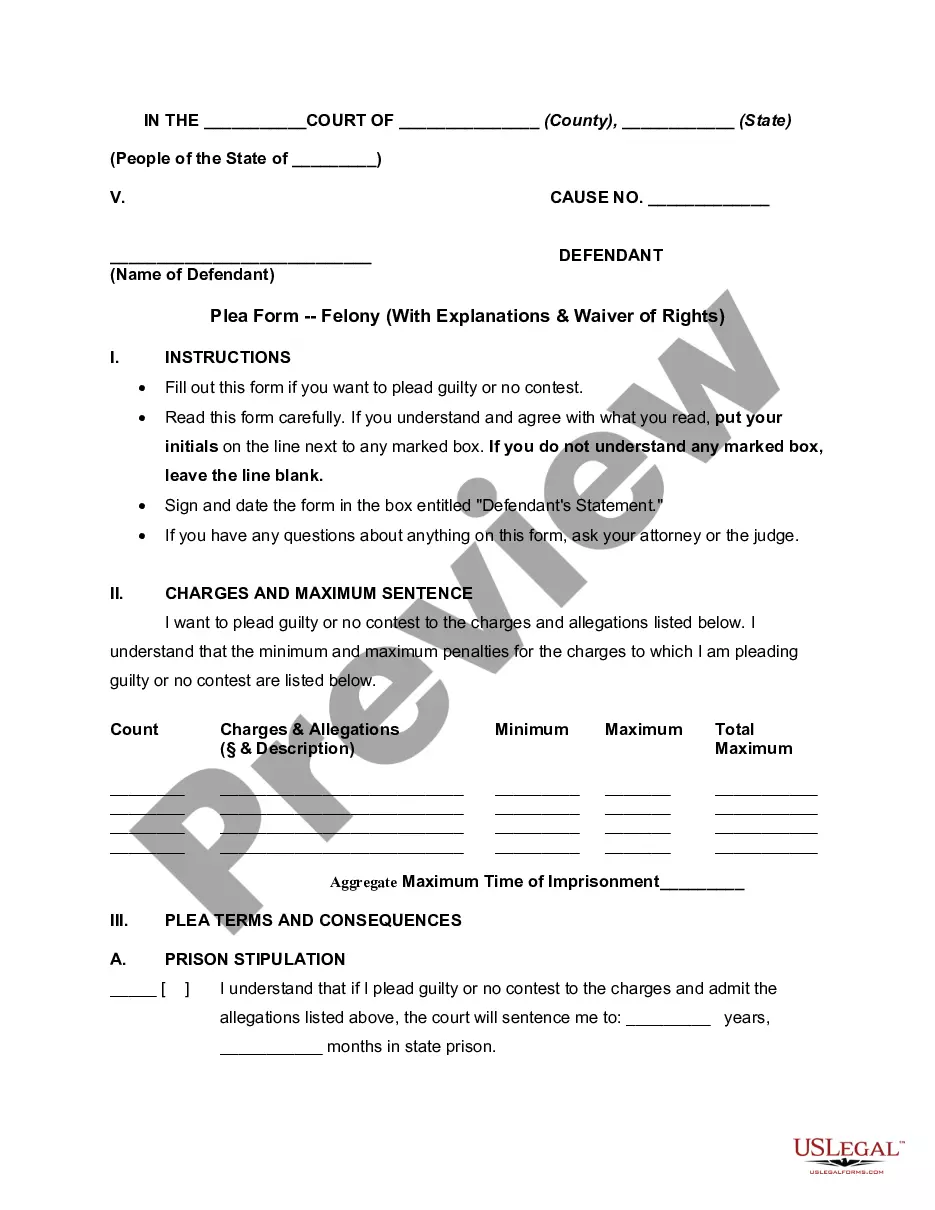
This form is typically used when a defendant has reached a plea bargain in a criminal case and wishes to allow the court to consider dismissed charges during sentencing. It is particularly relevant when the nature of the dismissed counts may impact the court's decision regarding probation or the length of imprisonment.
Who should use this form
- Defendants in a criminal case who are negotiating plea deals.
- Individuals looking to gain favorable consideration in sentencing.
- Legal representatives handling the sentencing phase of a criminal case on behalf of their clients.
Completing this form step by step
- Enter the defendant's full name and case number at the top of the form.
- Review the waiver text and ensure it reflects your understanding of the rights being waived.
- Provide your signature and date at the end of the form.
- If applicable, have your attorney sign to affirm the waiver.
- Ensure all required copies are made for court submission.
Notarization requirements for this form
This form usually doesn’t need to be notarized. However, local laws or specific transactions may require it. Our online notarization service, powered by Notarize, lets you complete it remotely through a secure video session, available 24/7.
Get your form ready online
Our built-in tools help you complete, sign, share, and store your documents in one place.
Make edits, fill in missing information, and update formatting in US Legal Forms—just like you would in MS Word.
Download a copy, print it, send it by email, or mail it via USPS—whatever works best for your next step.
Sign and collect signatures with our SignNow integration. Send to multiple recipients, set reminders, and more. Go Premium to unlock E-Sign.
If this form requires notarization, complete it online through a secure video call—no need to meet a notary in person or wait for an appointment.
We protect your documents and personal data by following strict security and privacy standards.

Make edits, fill in missing information, and update formatting in US Legal Forms—just like you would in MS Word.

Download a copy, print it, send it by email, or mail it via USPS—whatever works best for your next step.

Sign and collect signatures with our SignNow integration. Send to multiple recipients, set reminders, and more. Go Premium to unlock E-Sign.

If this form requires notarization, complete it online through a secure video call—no need to meet a notary in person or wait for an appointment.

We protect your documents and personal data by following strict security and privacy standards.
Common mistakes
- Failing to provide complete and accurate information in the defendant's section.
- Not having the form signed by an attorney when required.
- Neglecting to review the implications of the waiver before signing.
- Submitting the form without creating required copies for personal records.
Advantages of online completion
- Immediate access to a reliable and accurate legal document template.
- Ability to customize the form to meet specific needs or state requirements.
- Convenient download options for easy printing and filing.
Looking for another form?


Form popularity
FAQ
In the California Legal system a Cruz waiver is simply plea agreement, in which a defendant is released from jail and legally agrees that if they fail to appear at sentencing, a greater term (maximum allowable sentence) can be imposed by the sentencing court even if the new sentence is greater than the original plea
The base amount of restitution ordered typically cannot be waived. Any interest that collects can be waived.
In a Nutshell: A Harvey waiver is an agreement by defendant to waive any objection to restitution being calculated based on dismissed charges and charges that defendant was conviction for in a case with the intention by the prosecutor and court that the victim will receive restitution in full.
What happens at a restitution hearing? The judge will hear evidence related to restitution. The judge may ask you to show proof of your losssuch as receipts, bills, or estimates for repairsand to answer questions about the following issues in court: Did you experience a financial loss?
A Harvey waiver is a stipulation, or an agreement, by a defendant that any charges dismissed in his case can be considered against him at sentencing.
You can go to the court directly and ask the judge to forgive (vacate or dismiss) or reduce your debts. If you get your conviction dismissed, the court can forgive any remaining fines and fees you owe, including restitution fines (but the court CANNOT forgive your victim restitution).
An Arbuckle Waiver is an agreement to be sentenced by a judge other than the judge who accepted your guilty plea.