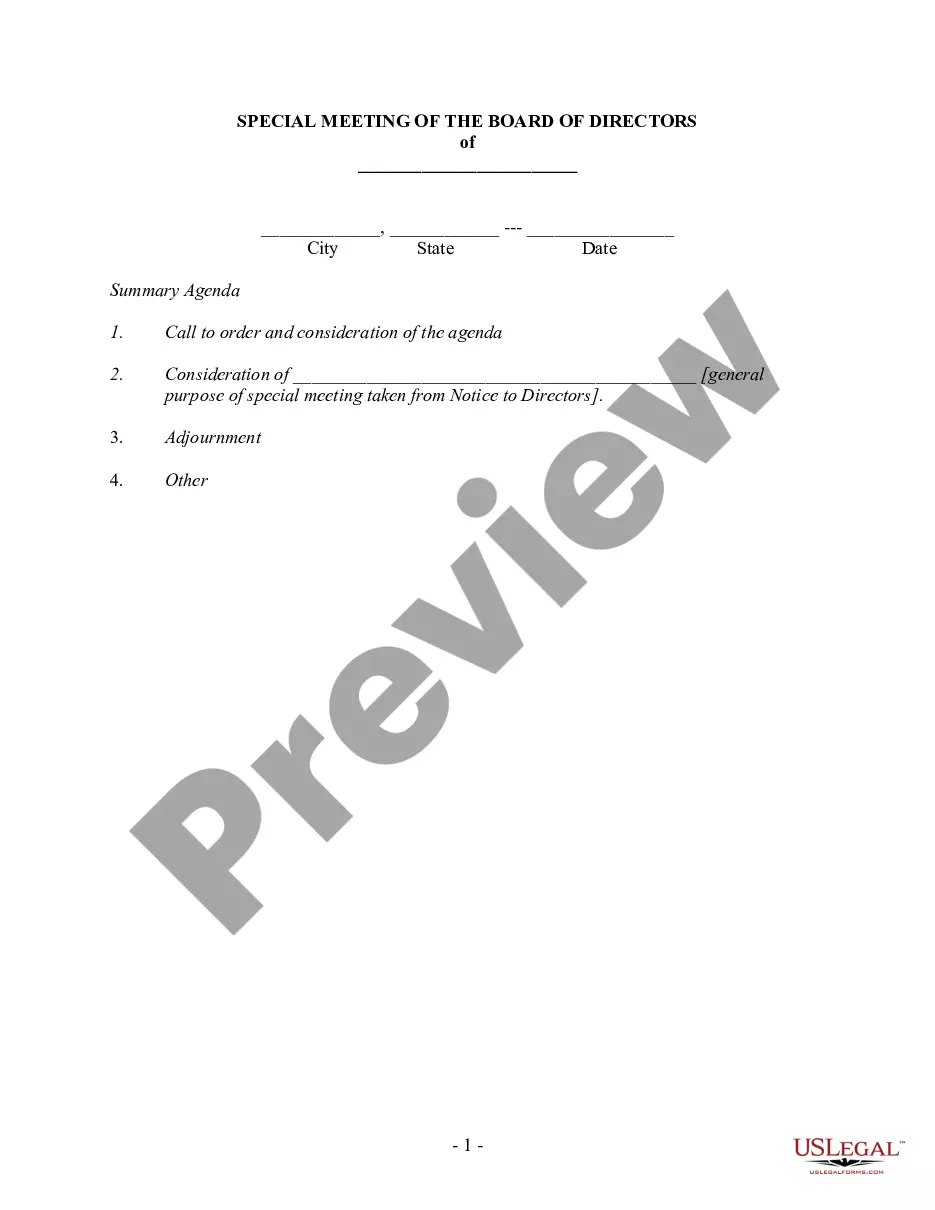
Annual Board Directors Template With Multiple Directors In Mecklenburg
Description



Get your form ready online
Our built-in tools help you complete, sign, share, and store your documents in one place.
Make edits, fill in missing information, and update formatting in US Legal Forms—just like you would in MS Word.
Download a copy, print it, send it by email, or mail it via USPS—whatever works best for your next step.
Sign and collect signatures with our SignNow integration. Send to multiple recipients, set reminders, and more. Go Premium to unlock E-Sign.
If this form requires notarization, complete it online through a secure video call—no need to meet a notary in person or wait for an appointment.
We protect your documents and personal data by following strict security and privacy standards.

Make edits, fill in missing information, and update formatting in US Legal Forms—just like you would in MS Word.

Download a copy, print it, send it by email, or mail it via USPS—whatever works best for your next step.

Sign and collect signatures with our SignNow integration. Send to multiple recipients, set reminders, and more. Go Premium to unlock E-Sign.

If this form requires notarization, complete it online through a secure video call—no need to meet a notary in person or wait for an appointment.

We protect your documents and personal data by following strict security and privacy standards.
Looking for another form?
Form popularity
FAQ
It is important to remember that board reports should be simple and easy to read. One way to do this is to format written content into brief paragraphs, bullet points or numbered lists. Sometimes, reports can look like a collection of memos with this simple structure.
Most board meeting agendas follow a classic meeting structure: Calling meeting to order – ensure you have quorum. Approve the agenda and prior board meeting minutes. Executive and committee reports – allow 25% of time here for key topic discussion. Old/new/other business. Close the meeting and adjourn.
A board report serves as a concise summary of critical business information presented to the board. It provides an overview of the performance, financial status, strategic initiatives, and risks within the organization. Such information makes directors more well-informed.
Ing to Section 134(3) of the Companies Act, 2013 ('Act'), the board's report should include the following information: The annual return extract as provided under Section 92(3) of the Act. Number of board meetings. Directors' responsibility statement as prescribed under Section 134(5) of the Act.
Reports should cover recent, current, and upcoming projects along with a financial review and recommendations. In addition to the above, board reports should also give information on sales, marketing, finance, and production and should relay data in an engaging way.
An effective board report should include a three to six page financial report that breaks down the company's financial performance. It should also discuss non-financial aspects and variances from past projections.
What Goes Into a Report for the Board of Directors? Date. Name of committee. Name of committee chair. Names of committee members. The objective of the committee. Summary of recent accomplishments and current activities. List of activities in progress and upcoming events. Financial impact.
Mark Jerrell, Chair and District 4. First elected in 2018. Leigh Altman, Vice Chair and At Large. First elected in 2020. Arthur Griffin, At Large. First elected in 2022. Yvette Townsend-Ingram, At Large. First elected in 2024. Elaine Powell, District 1. Vilma D. George Dunlap, District 3. Laura Meier, District 5.
The terms “Annual General Meeting” and “annual meeting” are frequently used interchangeably, though they can have distinct meanings. An AGM specifically refers to a formal meeting held by organizations, such as corporations or nonprofits, where key issues are discussed.
A general meeting is a meeting of a company's shareholders. This is different to a board meeting, which is a meeting of the company's directors. General meetings are used to consider company matters and to make decisions (ie to vote on company resolutions) on these matters.

