Listing Agreement Document Format In Chicago
Description
Get your form ready online
Our built-in tools help you complete, sign, share, and store your documents in one place.
Make edits, fill in missing information, and update formatting in US Legal Forms—just like you would in MS Word.
Download a copy, print it, send it by email, or mail it via USPS—whatever works best for your next step.
Sign and collect signatures with our SignNow integration. Send to multiple recipients, set reminders, and more. Go Premium to unlock E-Sign.
If this form requires notarization, complete it online through a secure video call—no need to meet a notary in person or wait for an appointment.
We protect your documents and personal data by following strict security and privacy standards.

Make edits, fill in missing information, and update formatting in US Legal Forms—just like you would in MS Word.

Download a copy, print it, send it by email, or mail it via USPS—whatever works best for your next step.

Sign and collect signatures with our SignNow integration. Send to multiple recipients, set reminders, and more. Go Premium to unlock E-Sign.

If this form requires notarization, complete it online through a secure video call—no need to meet a notary in person or wait for an appointment.

We protect your documents and personal data by following strict security and privacy standards.
Looking for another form?








Form popularity
FAQ
Although net listings are legal in Illinois, most brokerages don't allow them due to the potential abuse involved.
Because real estate agents have a fiduciary duty to serve their client's interest, net listings are widely considered unethical and illegal in all but three states: California, Texas, and Florida.
In California, net listing agreements are legal but can only be used with highly sophisticated or independently represented clients. Texas also makes net listings legal but stipulates that a net agreement holds the agent in a position of power.
Because a net listing can create a clear conflict of interest between the broker's fiduciary responsibility to the seller and the broker's profit motive, net listings are legal in Illinois but not recommended due to the potential for fraud.
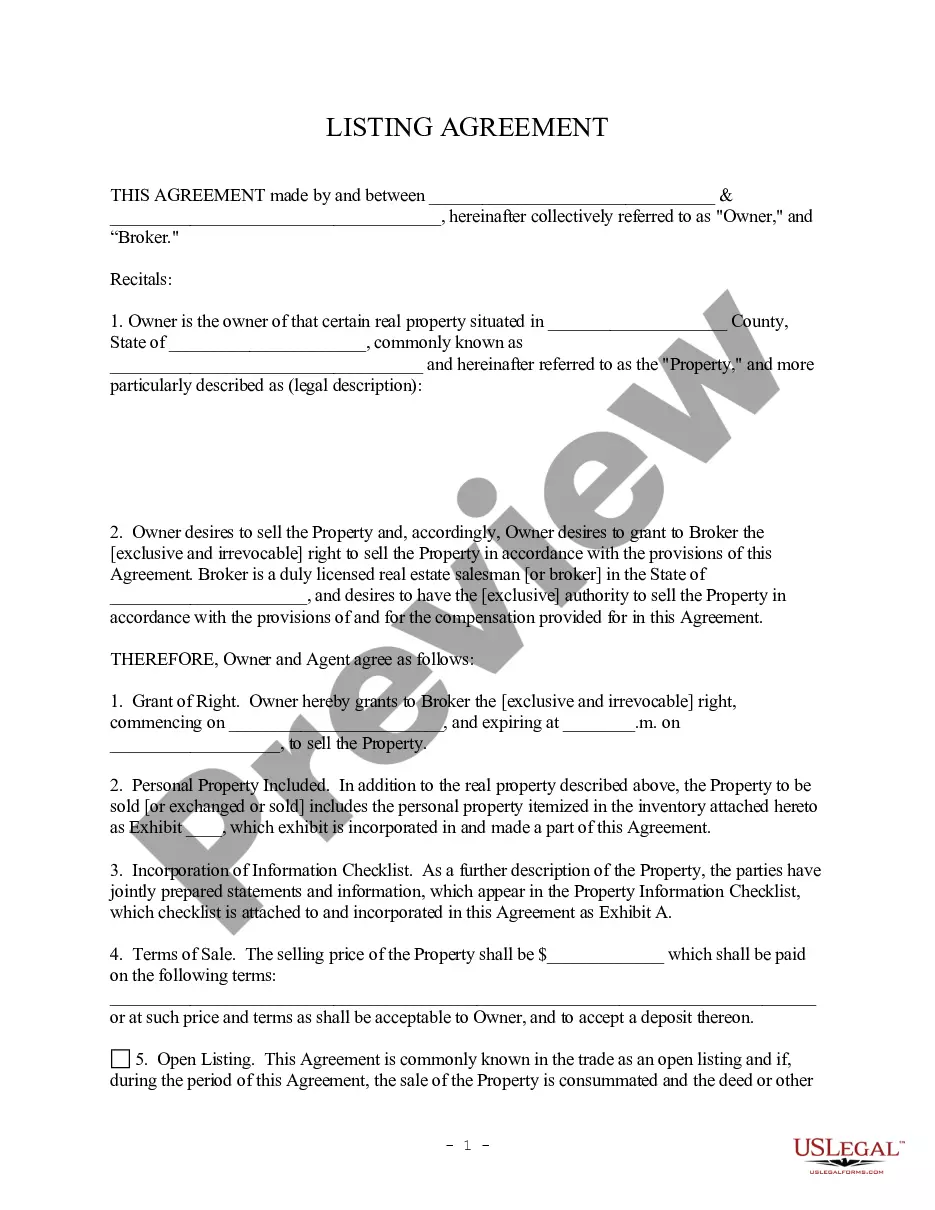
“Listing agreement” means a written contract between a seller of real property or a business opportunity and a real estate broker by which the broker has been authorized to sell the real property or find or obtain a buyer, including rendering other services for which a real estate license is required to the seller ...
With an exclusive buyer agency agreement, you pledge to work with only one buyer's agent – the one offering you the buyer agency agreement. If you don't want to work with one agent exclusively, you can ask for a nonexclusive arrangement.
An exclusive listing is a type of real estate listing agreement in which a single broker is appointed as the seller's sole agent. In an exclusive agency listing, the seller retains the right to sell the property, with no obligation to the broker.
"Listing agreement" means a written contract between a seller of real property or a business opportunity and a real estate broker by which the broker has been authorized to sell the real property or find or obtain a buyer, including rendering other services for which a real estate license is required to the seller ...
The purpose of a real estate listing agreement is to establish a contractual relationship between a property owner (seller) and a real estate broker. It authorizes the broker to act on the seller's behalf to sell the property under specified terms and conditions.

