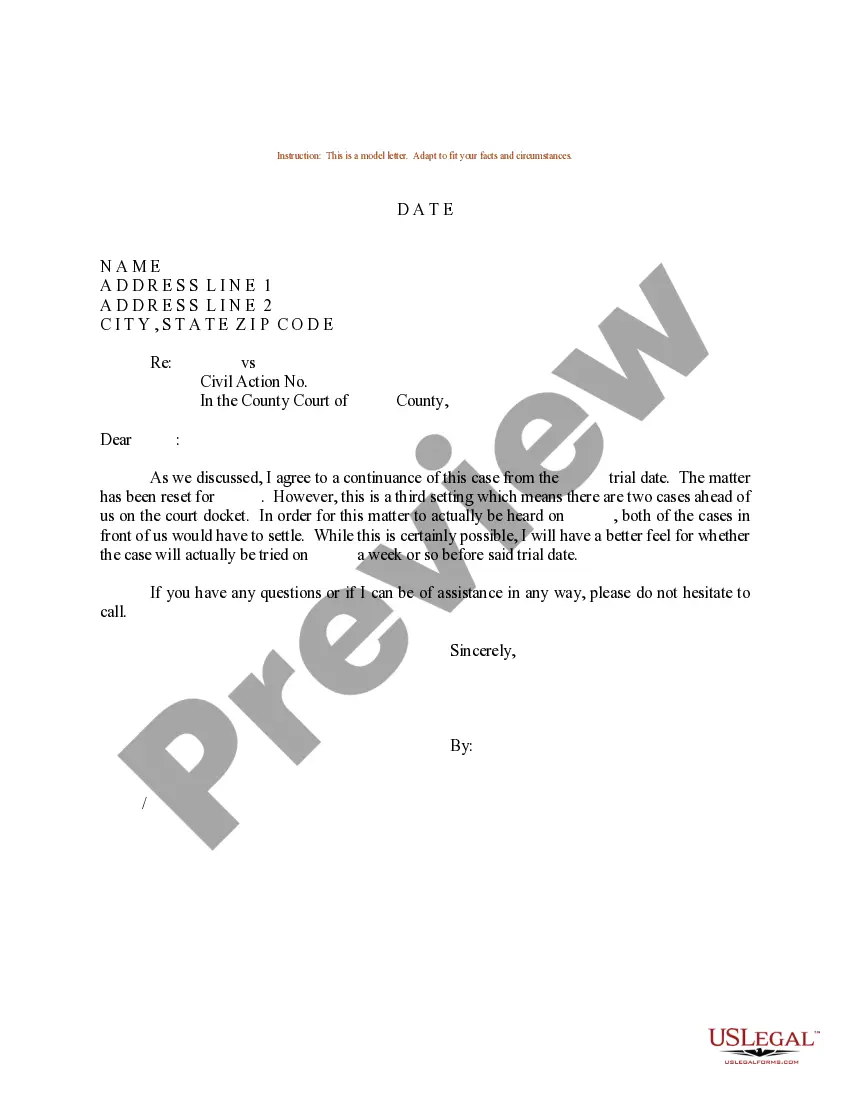
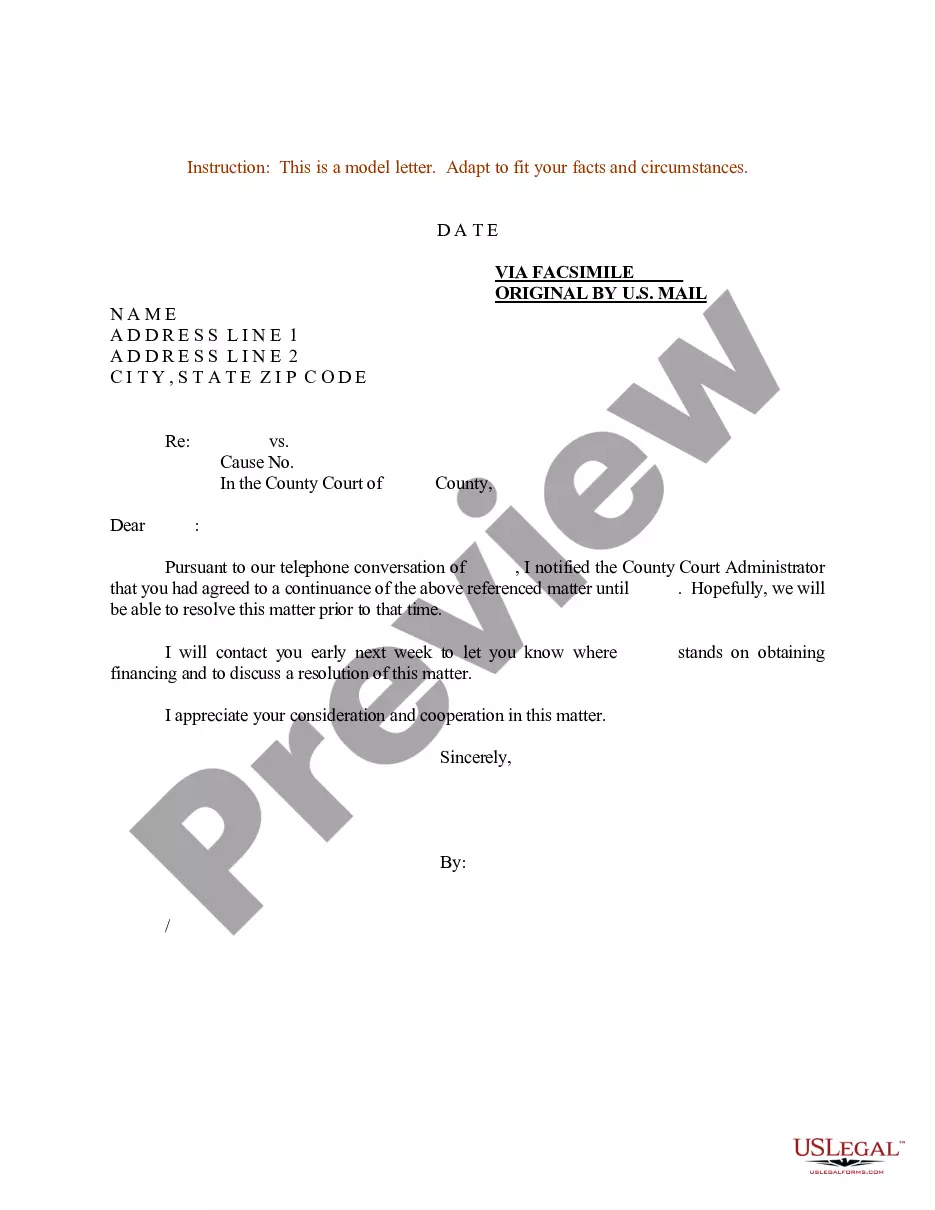
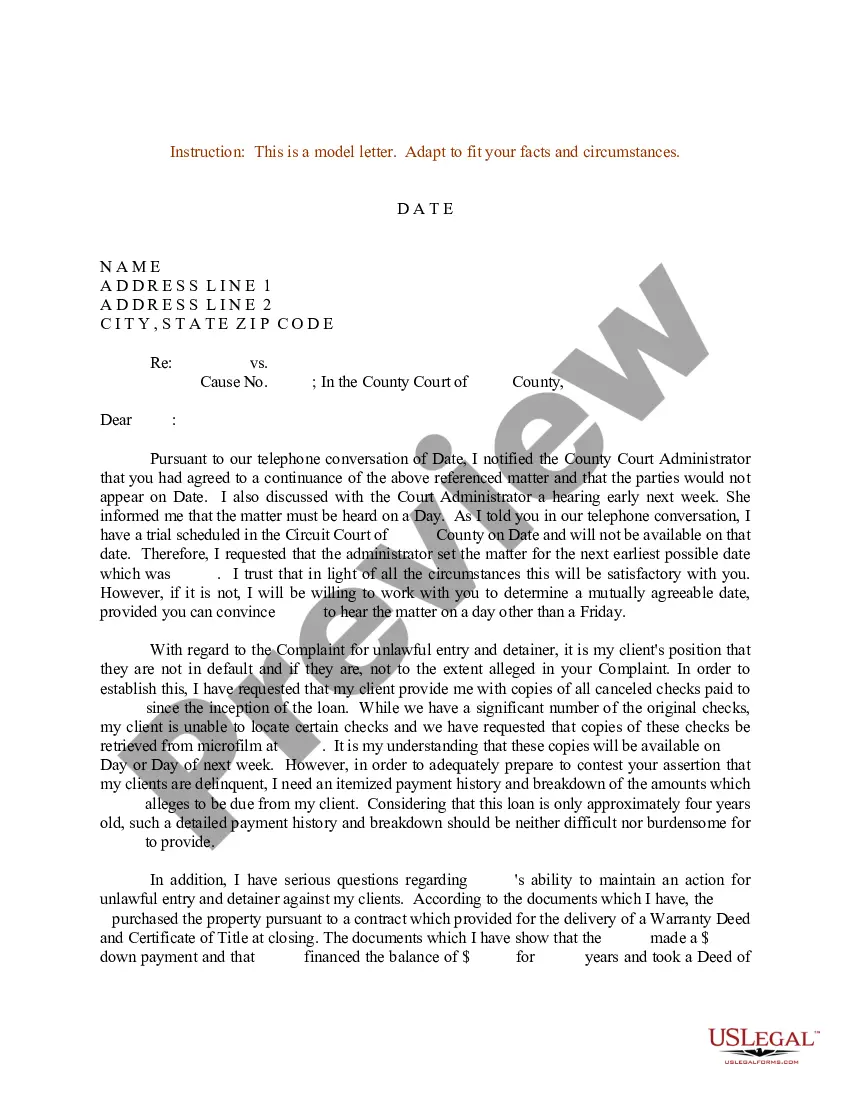
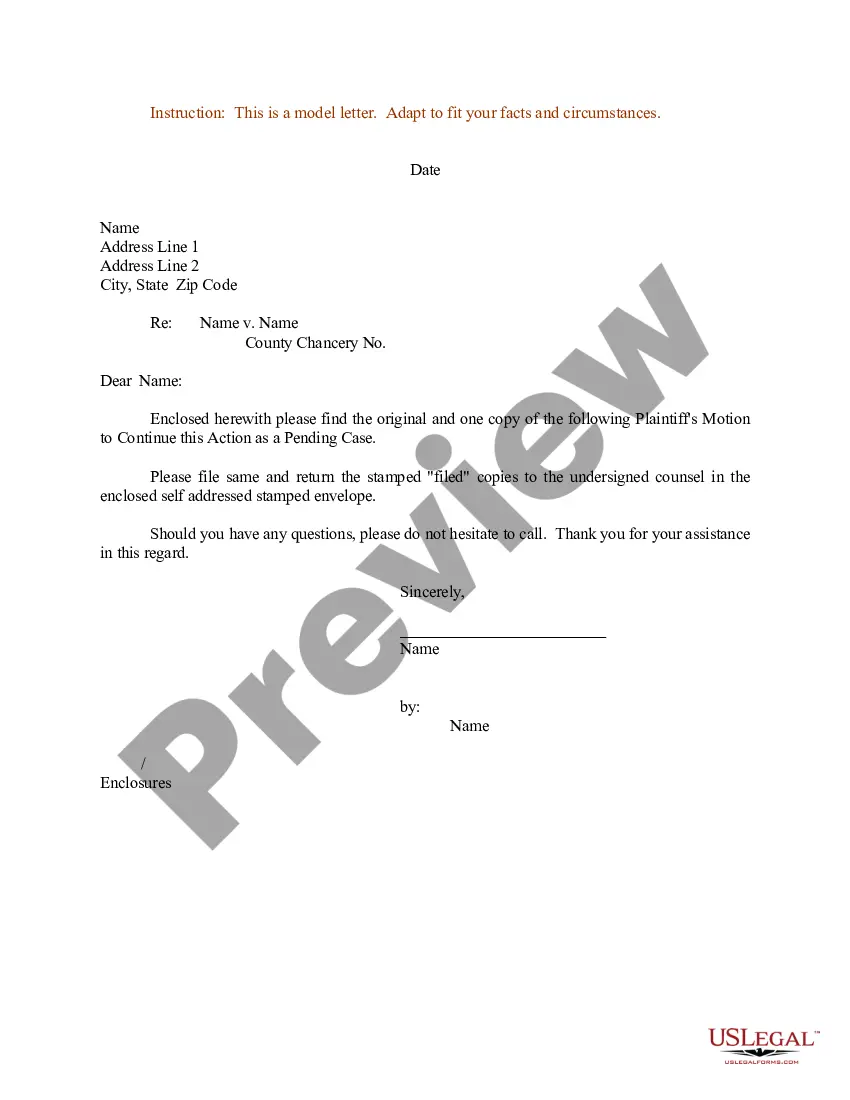
Trial Continuance Without Notice In Travis
Description

Get your form ready online
Our built-in tools help you complete, sign, share, and store your documents in one place.
Make edits, fill in missing information, and update formatting in US Legal Forms—just like you would in MS Word.
Download a copy, print it, send it by email, or mail it via USPS—whatever works best for your next step.
Sign and collect signatures with our SignNow integration. Send to multiple recipients, set reminders, and more. Go Premium to unlock E-Sign.
If this form requires notarization, complete it online through a secure video call—no need to meet a notary in person or wait for an appointment.
We protect your documents and personal data by following strict security and privacy standards.

Make edits, fill in missing information, and update formatting in US Legal Forms—just like you would in MS Word.

Download a copy, print it, send it by email, or mail it via USPS—whatever works best for your next step.

Sign and collect signatures with our SignNow integration. Send to multiple recipients, set reminders, and more. Go Premium to unlock E-Sign.

If this form requires notarization, complete it online through a secure video call—no need to meet a notary in person or wait for an appointment.

We protect your documents and personal data by following strict security and privacy standards.
Looking for another form?







Form popularity
FAQ
Some of the reasons that might necessitate a continuance include: You need additional time to secure an attorney to represent you in court. You need more time to gather evidence because the other side has been stalling on discovery requests. You need more time to locate witnesses who are critical to your case.
Continuance Without a Finding (CWOF) is common in cases where the evidence supports a guilty finding. This is when the defendant acknowledges guilt for pleading purposes, but the court does not enter a guilty finding. Instead, it continues the case which will be dismissed upon completion of certain conditions.
Usually, significant reasons could be a sudden illness (backed by medical reports), an unforeseen emergency (supported by relevant documentation), or perhaps a vital witness being unavailable (with necessary proof). In these situations, judges might consider postponing to ensure fairness and justice during the trial.
How Many Continuances Are Allowed? Typically, there's no limit on the number of continuances that a defendant can request. That said, a judge won't look favorably on repeated requests, especially if they appear to be delay tactics. Repeated requests, made without good cause, will be denied.
I would like this Court to continue the hearing because: EXPLAIN REASON. PETITIONER/PLAINTIFF, v. RESPONDENT/DEFENDANT. I RESPECTFULLY REQUEST that the Court grant my Request for Continuance.
Valid reasons could include medical emergencies or unforeseen scheduling conflicts. Absence of party. If a party involved in the case is unable to appear in court due to involuntary or uncontrollable circumstances, such as sudden illness, their counsel may request a continuance.
Continuance is what a court may grant to delay proceedings until a later date. Parties in a suit or the judge themselves may wish to have a continuance granted in order to prepare for proceedings.
Even if the other party does not agree, you may still contact the court to request a continuance of the hearing date.
An act or instance of continuing; continuation: a continuance of war. Synonyms: prolongation, extension, persistence. a remaining in the same place, condition, etc.
Either party may set a hearing and notify the other party. To set a hearing, contact the Court Operations Officer at (512) 854-9241. It is recommended that you consult an attorney or have an attorney represent you.

