Simple Agreement For Future Equity Example With Balance Sheet In Alameda
Description






Get your form ready online
Our built-in tools help you complete, sign, share, and store your documents in one place.
Make edits, fill in missing information, and update formatting in US Legal Forms—just like you would in MS Word.
Download a copy, print it, send it by email, or mail it via USPS—whatever works best for your next step.
Sign and collect signatures with our SignNow integration. Send to multiple recipients, set reminders, and more. Go Premium to unlock E-Sign.
If this form requires notarization, complete it online through a secure video call—no need to meet a notary in person or wait for an appointment.
We protect your documents and personal data by following strict security and privacy standards.

Make edits, fill in missing information, and update formatting in US Legal Forms—just like you would in MS Word.

Download a copy, print it, send it by email, or mail it via USPS—whatever works best for your next step.

Sign and collect signatures with our SignNow integration. Send to multiple recipients, set reminders, and more. Go Premium to unlock E-Sign.

If this form requires notarization, complete it online through a secure video call—no need to meet a notary in person or wait for an appointment.

We protect your documents and personal data by following strict security and privacy standards.
Looking for another form?







Form popularity
FAQ
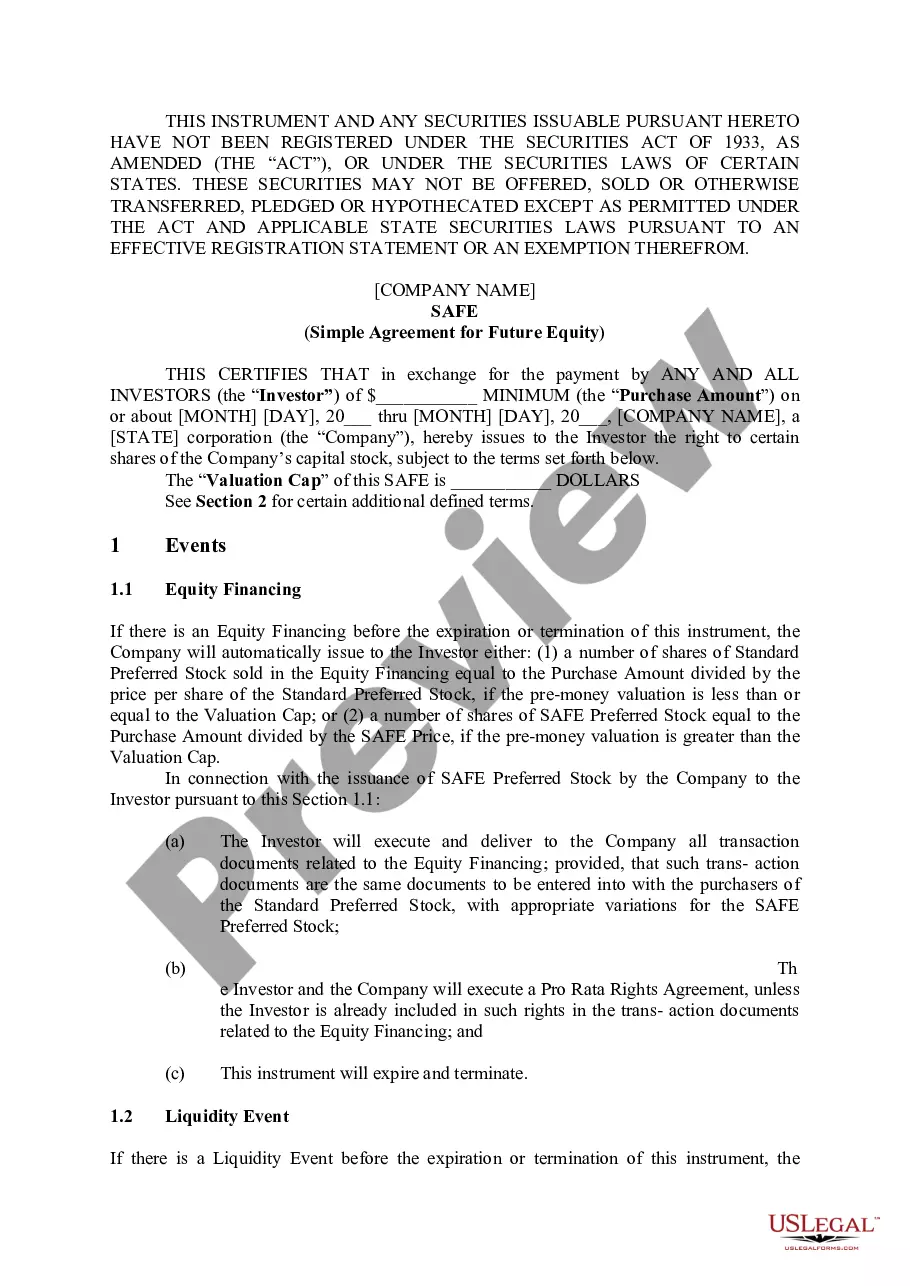
The Discount Rate is calculated as 100% minus the percent discount the SAFE investors are entitled to. For example, if SAFE investors are entitled to a discount of 20% (they can buy Standard Preferred Stock 20% cheaper than subsequent investors), the Discount Rate is 80% = 100% - 20%.
A Simple Agreement for Future s is a contract between a blockchain developer and a buyer, who contributes a certain amount of capital for the promise of an equal amount of s when the project meets specific goals. An SAFT is similar to an SAFE, which is for equity.
They are accounted for as equity on the balance sheet. When the Simple Agreement for Future Equity converts to preferred stock, the accounting entries are that the SAFE entry is removed and the amount is credited to preferred equity (ignoring any APIC implications).
For example, if a SAFE has a valuation cap of $10 million, and your startup's next financing round values the company at $15 million, the SAFE investor's equity will be calculated based on the $10 million cap, not the $15 million valuation.
SAFEs were first developed by Y Combinator in 2013 as an alternative to convertible notes. A SAFE agreement is a type of convertible instrument, but unlike debt instruments, SAFEs do not accrue interest or have a maturity date, making them an attractive fundraising option for early-stage startups.
The equity method is typically applied when a company's ownership interest in another company is valued at 20%–50% of the stock in the investee. The equity method requires the investing company to record the investee's profits or losses in proportion to the percentage of ownership.
The Discount Rate is calculated as 100% minus the percent discount the SAFE investors are entitled to. For example, if SAFE investors are entitled to a discount of 20% (they can buy Standard Preferred Stock 20% cheaper than subsequent investors), the Discount Rate is 80% = 100% - 20%.
