Deed Texas Property With Exemptions
Description

Get your form ready online
Our built-in tools help you complete, sign, share, and store your documents in one place.
Make edits, fill in missing information, and update formatting in US Legal Forms—just like you would in MS Word.
Download a copy, print it, send it by email, or mail it via USPS—whatever works best for your next step.
Sign and collect signatures with our SignNow integration. Send to multiple recipients, set reminders, and more. Go Premium to unlock E-Sign.
If this form requires notarization, complete it online through a secure video call—no need to meet a notary in person or wait for an appointment.
We protect your documents and personal data by following strict security and privacy standards.

Make edits, fill in missing information, and update formatting in US Legal Forms—just like you would in MS Word.

Download a copy, print it, send it by email, or mail it via USPS—whatever works best for your next step.

Sign and collect signatures with our SignNow integration. Send to multiple recipients, set reminders, and more. Go Premium to unlock E-Sign.

If this form requires notarization, complete it online through a secure video call—no need to meet a notary in person or wait for an appointment.

We protect your documents and personal data by following strict security and privacy standards.
Looking for another form?









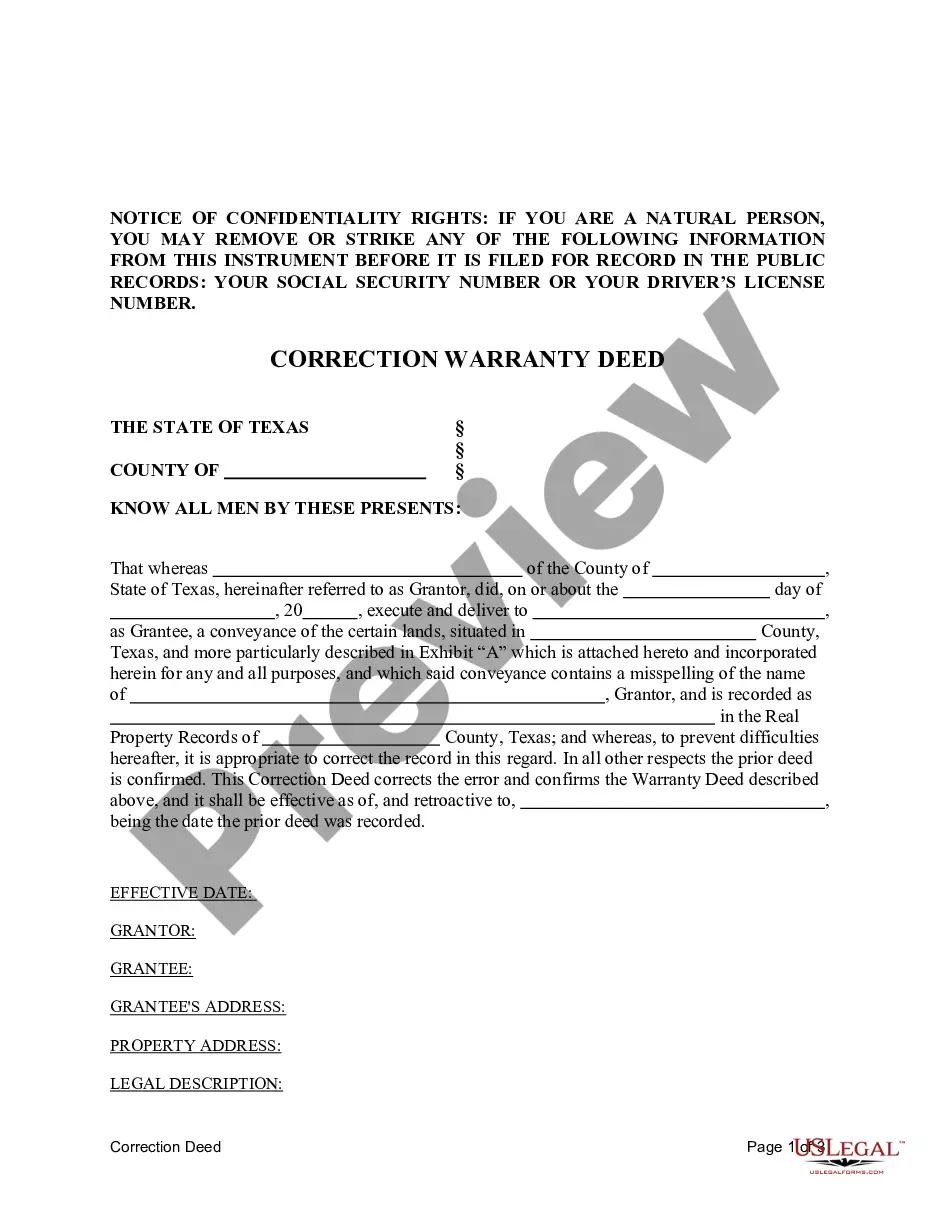
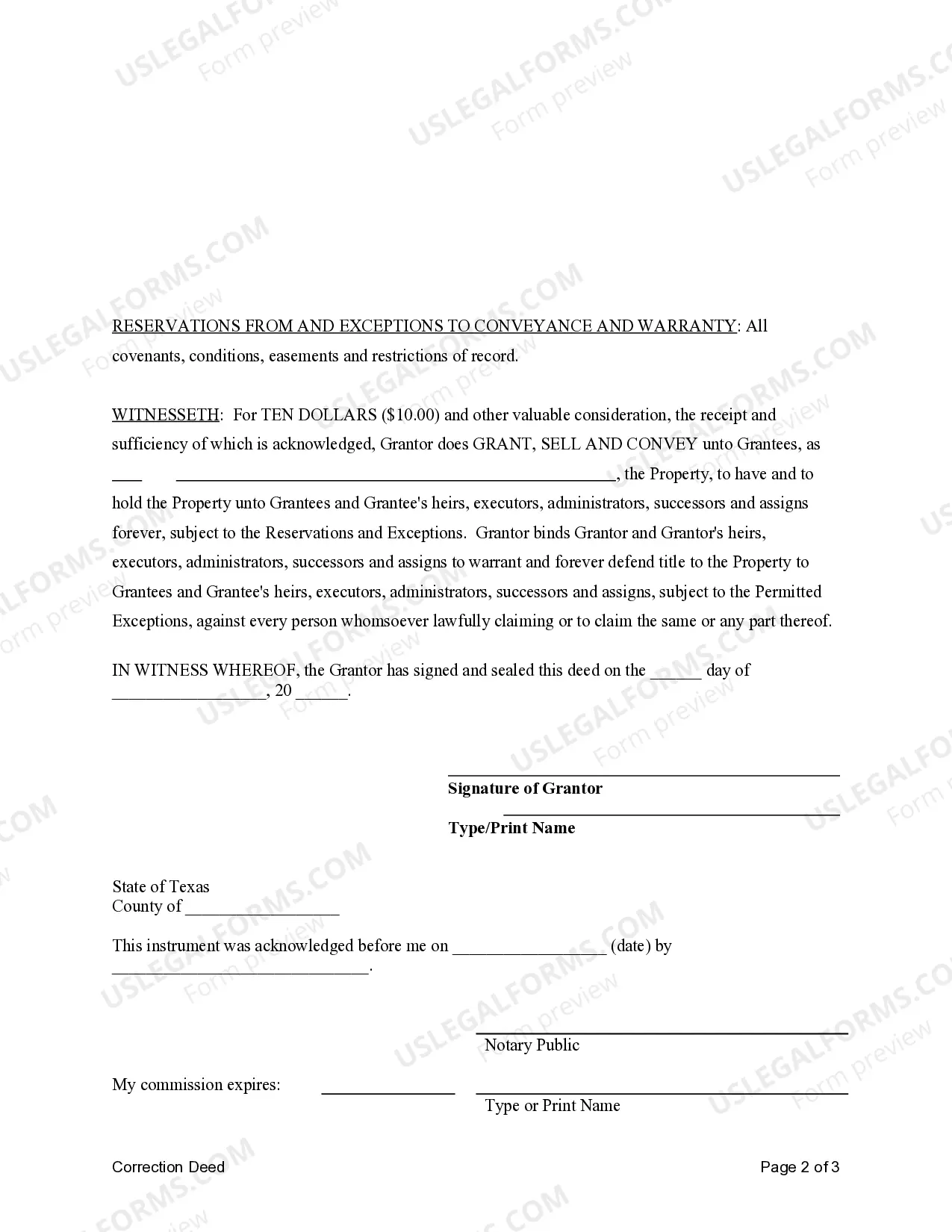
How to fill out Texas Correction Warranty Deed?
Legal documents handling can be daunting, even for the most experienced professionals.
When you are looking for a Deed Texas Property With Exemptions and lack the time to search for the correct and current version, the process may be stressful.
Access a repository of articles, guides, manuals, and resources related to your situation and requirements.
Save time and effort searching for the forms you need, and use US Legal Forms’ advanced search and Review feature to locate Deed Texas Property With Exemptions and obtain it.
Take advantage of the US Legal Forms online catalog, supported by 25 years of experience and reliability. Transform your routine document management into a smooth and user-friendly process today.
- If you have a subscription, Log In to your US Legal Forms account, search for the form, and acquire it.
- Visit the My documents tab to review the documents you've saved and manage your folders as desired.
- If this is your first time with US Legal Forms, create a free account for unlimited access to all library benefits.
- After accessing the necessary form, ensure it is the right one by previewing it and reviewing its details.
- Confirm that the sample is valid in your state or county.
- Select Buy Now when you are ready.
- Choose a monthly subscription plan.
- Pick the format you need, and Download, fill out, sign, print, and send your document.
- Access state- or county-specific legal and business documents.
- US Legal Forms covers any needs you may have, from personal to commercial paperwork, in one location.
- Utilize cutting-edge tools to complete and manage your Deed Texas Property With Exemptions.
Form popularity
FAQ
To get your property deed in Texas, you typically need to obtain it from the county clerk's office where the property is located. You can also check online databases or use platforms like USLegalForms for assistance in acquiring or transferring a deed. Properly managing your property deed is essential, especially when considering how to deed Texas property with exemptions.
Property tax exemptions in Texas work by reducing the taxable value of your property, thereby lowering your tax bill. To receive these exemptions, you must apply through your local appraisal district, providing necessary documentation. Using a service like USLegalForms can simplify the process of understanding and applying for exemptions when you deed Texas property with exemptions.
The homestead exemption in Texas can significantly reduce your property taxes by exempting a portion of your home's assessed value. For instance, the standard exemption can reduce your property value by $25,000 for school taxes. This reduction is beneficial when you deed Texas property with exemptions, as it helps lower your overall tax liability.
In Texas, various groups may qualify for property tax exemptions, including homeowners, seniors, disabled individuals, and veterans. Additionally, some properties used for agriculture or charitable purposes may also be eligible. Understanding your eligibility is crucial when you consider how to deed Texas property with exemptions.
A property tax exemption reduces the amount of property tax you owe. In Texas, exemptions can lower the assessed value of your property, which in turn lowers your tax bill. To maximize your benefits, it's essential to understand how to deed Texas property with exemptions and apply for any qualifying exemptions available.
In Texas, you may claim ownership of land through a process called adverse possession, which generally requires you to occupy the land continuously for a period of ten years. This occupation must be open, notorious, and without permission from the original owner. To ensure you properly deed Texas property with exemptions, consider consulting legal resources or platforms like USLegalForms.
A property may be exempt from property tax for several reasons, including its use for charitable purposes, being owned by a non-profit organization, or qualifying as a homestead. In Texas, certain exemptions can significantly reduce the tax burden on a property owner. This is particularly important when you consider how exemptions can affect the overall costs associated with a deed for Texas property with exemptions. By understanding these exemptions, you can better navigate the complexities of property ownership and benefit from potential savings.
Filing a claim for a homeowners property tax exemption usually involves completing an application form and submitting it to your local tax authority. Make sure to include all required documents to avoid delays. Using US Legal Forms can simplify this process, ensuring you have the necessary paperwork in order to protect your deed to Texas property with exemptions.
To obtain a property tax exemption in Missouri, you typically need to complete an application and provide the necessary documentation to your local assessor’s office. Ensure you meet all eligibility requirements before applying. For a smoother process, consider using US Legal Forms to access the right forms and guidance related to your deed to Texas property with exemptions.
If property is not claimed to be exempt, it may be subject to standard property taxes, which can be higher than if exemptions were applied. This may lead to increased financial burdens for the homeowner. It's crucial to understand the exemptions available to you, especially when dealing with your deed to Texas property. US Legal Forms can help you identify and apply for the exemptions you qualify for.