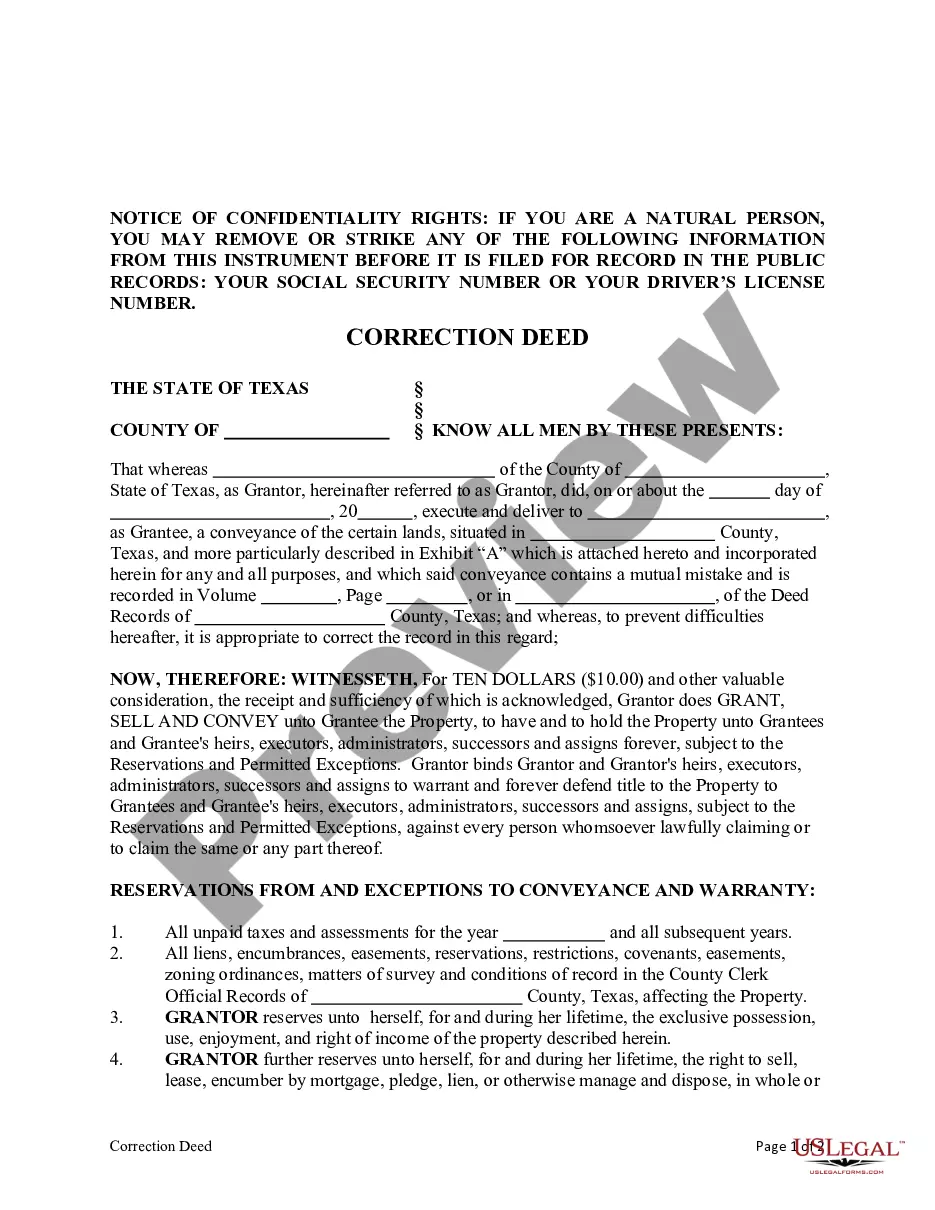
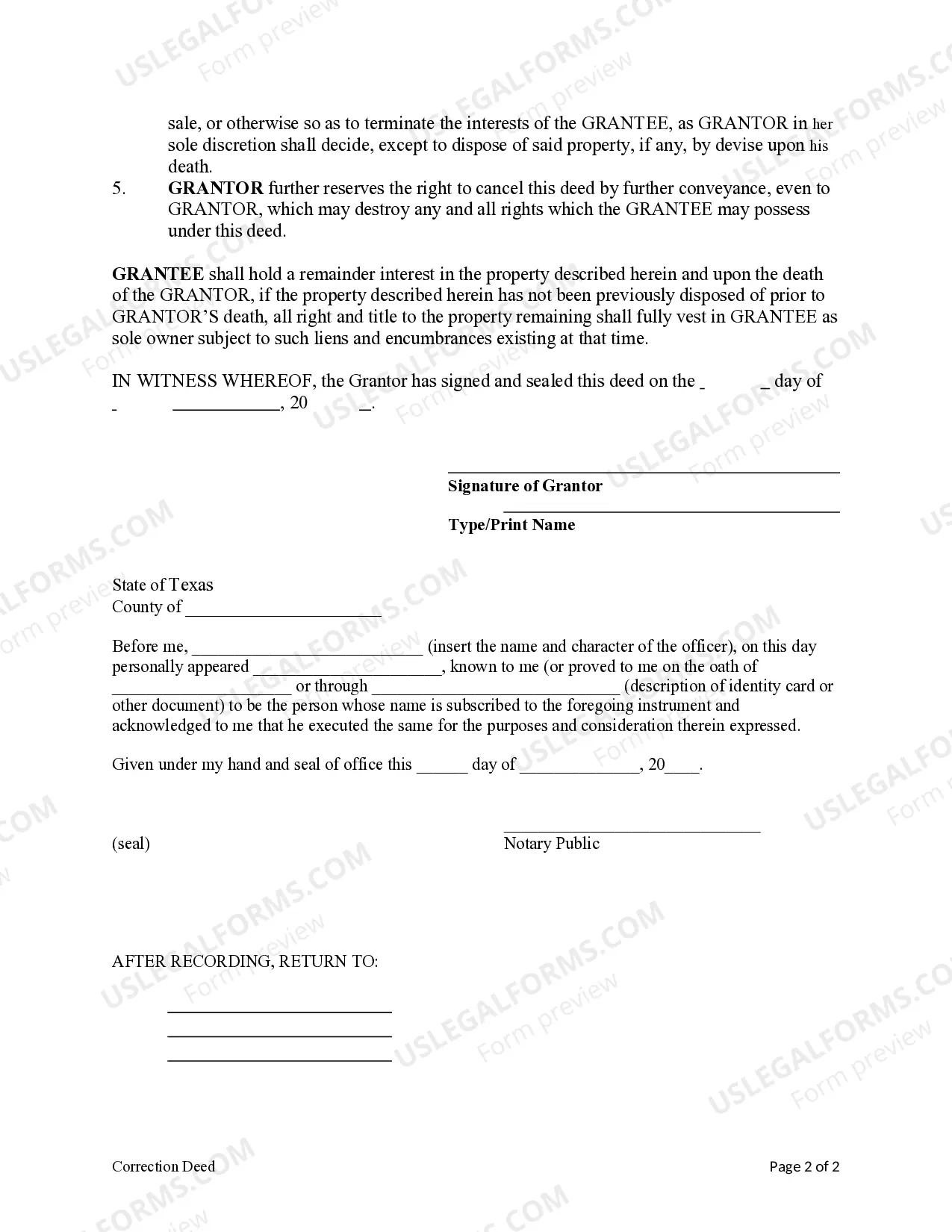
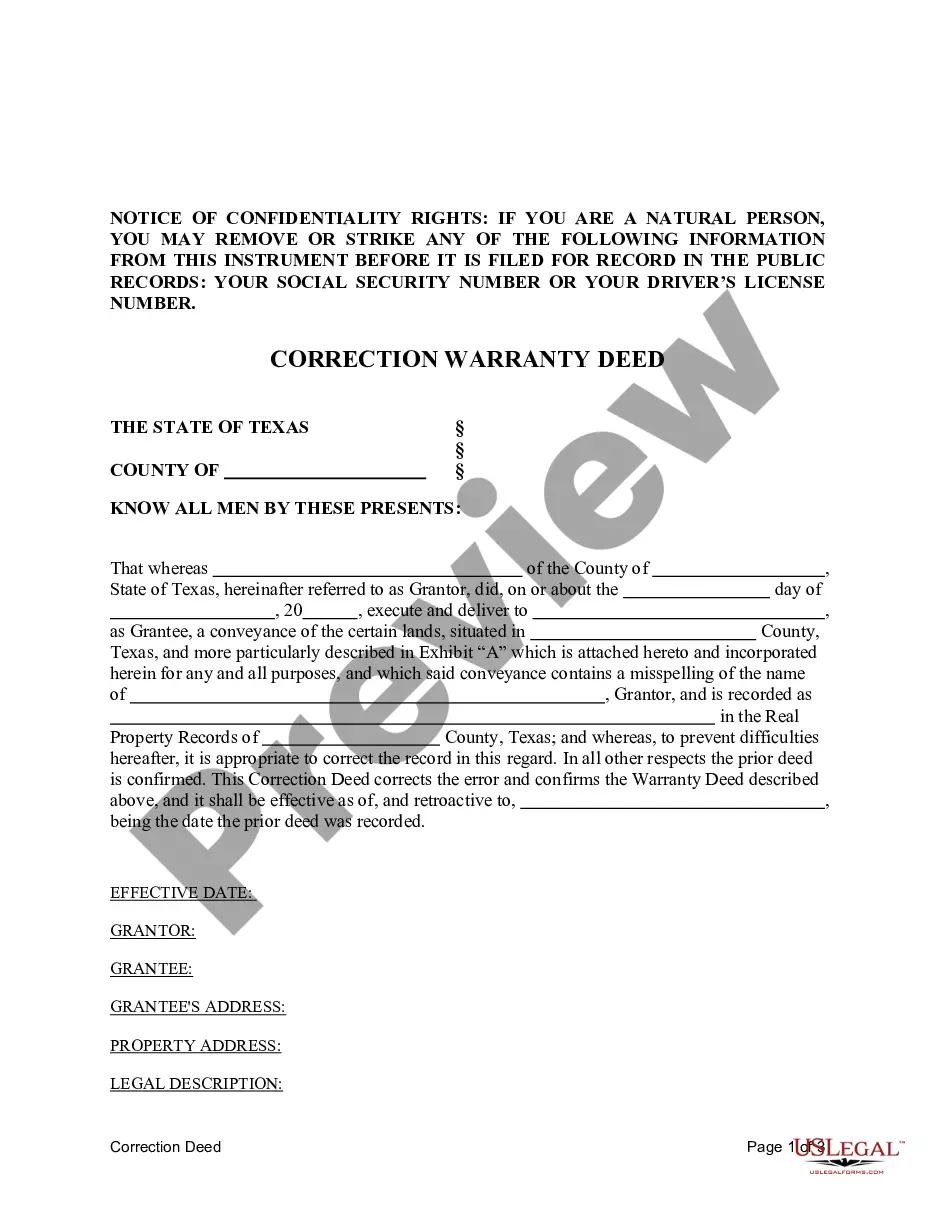
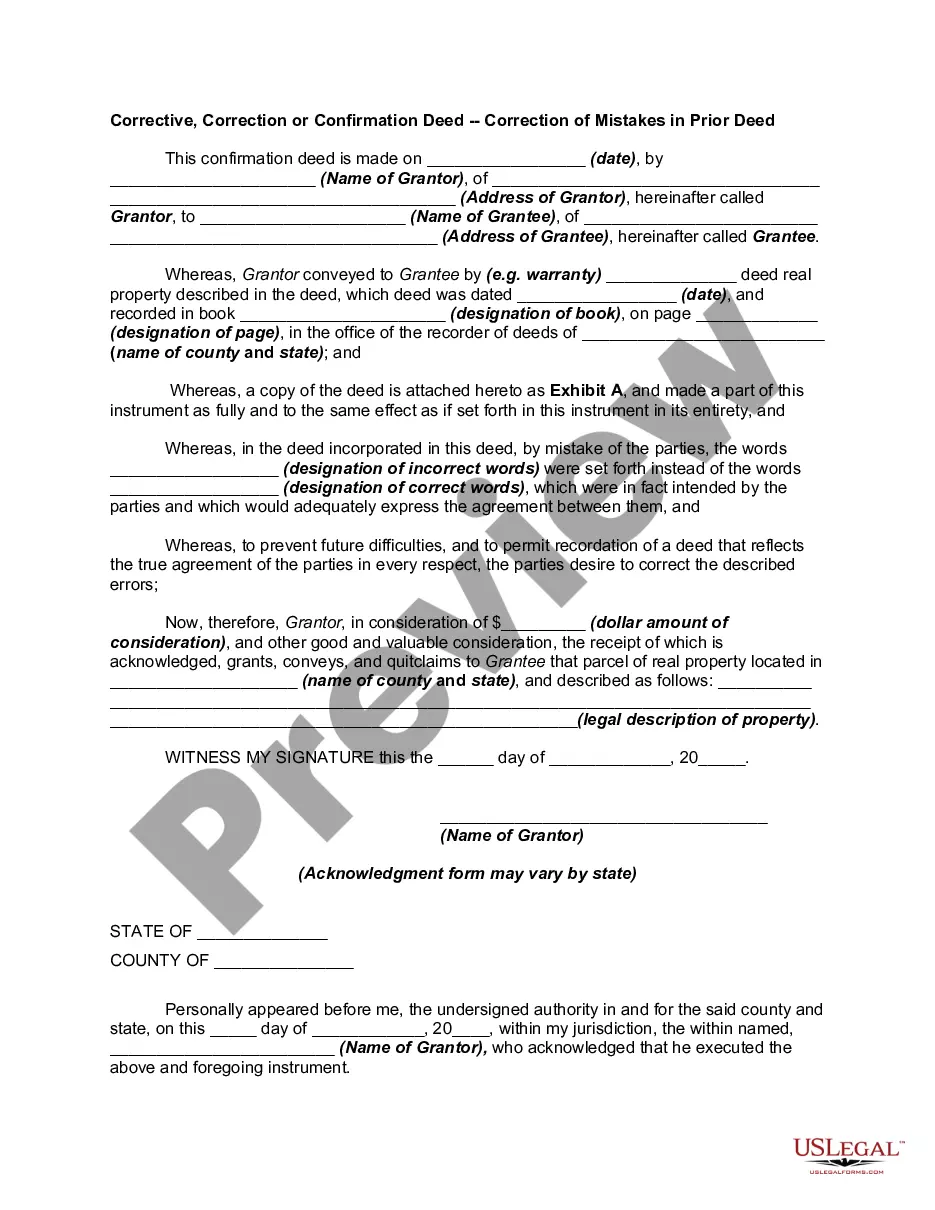
Correction Deed Form Texas With Example
Description

Get your form ready online
Our built-in tools help you complete, sign, share, and store your documents in one place.
Make edits, fill in missing information, and update formatting in US Legal Forms—just like you would in MS Word.
Download a copy, print it, send it by email, or mail it via USPS—whatever works best for your next step.
Sign and collect signatures with our SignNow integration. Send to multiple recipients, set reminders, and more. Go Premium to unlock E-Sign.
If this form requires notarization, complete it online through a secure video call—no need to meet a notary in person or wait for an appointment.
We protect your documents and personal data by following strict security and privacy standards.

Make edits, fill in missing information, and update formatting in US Legal Forms—just like you would in MS Word.

Download a copy, print it, send it by email, or mail it via USPS—whatever works best for your next step.

Sign and collect signatures with our SignNow integration. Send to multiple recipients, set reminders, and more. Go Premium to unlock E-Sign.

If this form requires notarization, complete it online through a secure video call—no need to meet a notary in person or wait for an appointment.

We protect your documents and personal data by following strict security and privacy standards.
Looking for another form?


How to fill out Texas Correction Deed - Prior Deed From An Individual To An Individual?
Creating legal documents from the ground up can occasionally feel overwhelming.
Some situations may entail extensive research and significant financial investments.
If you’re looking for a simpler and more economical method of preparing Correction Deed Form Texas With Example or any other paperwork without the hassle, US Legal Forms is always available to assist you.
Our virtual repository of over 85,000 current legal documents encompasses nearly every aspect of your financial, legal, and personal affairs. With just a few clicks, you can promptly access forms compliant with state and county regulations, meticulously compiled for you by our legal experts.
Verify that the template you select meets your state and county requirements. Select the appropriate subscription plan to acquire the Correction Deed Form Texas With Example. Download the file, then fill it out, authenticate it, and print it. US Legal Forms enjoys an excellent reputation and over 25 years of experience. Join us today and make document completion a straightforward and efficient process!
- Utilize our platform whenever you require a dependable service through which you can swiftly find and download the Correction Deed Form Texas With Example.
- If you're already familiar with our site and have previously established an account, you can simply Log In to your account, find the form, and download it immediately or retrieve it later from the My documents section.
- Don’t possess an account? No problem. Registering takes only a few minutes, and you’ll be able to explore the library.
- Before you proceed to download the Correction Deed Form Texas With Example, adhere to these recommendations.
- Examine the document preview and descriptions to ensure you have located the correct form.
Form popularity
FAQ
To make corrections in a sale deed, utilize a correction deed form Texas with example that accurately reflects the intended changes. Clearly state the corrections needed, and ensure the document is properly signed and notarized. Once complete, file it with the county clerk to update the official records, securing the corrected information.
A correction deed typically resembles a standard deed but includes a clear statement indicating it is a correction deed. It outlines the specific changes being made, along with references to the original deed. You can find templates and examples of a correction deed form Texas with example on the USLegalForms platform, which can make the process easier.
Yes, a correction deed in Texas must be notarized to be legally valid. Notarization serves as a verification of the signatures on the document, ensuring authenticity. When you use the correction deed form Texas with example, be sure to include a notary section for proper execution.
To correct a name on a deed in Texas, you should use a correction deed form Texas with example that specifically addresses the name error. Fill out the form with the correct name, and reference the original deed to clarify the mistake. After signing and notarizing the document, file it with the county clerk to update the public record.
In Texas, any property owner or their authorized agent can file a correction deed. This includes individuals, corporations, or representatives who have the legal right to make changes to the deed. It's essential to ensure that the correction deed form Texas with example is accurate and properly filled out to avoid any legal complications.
It is important to remember that although Section 5.028 only requires a correction deed making nonmaterial changes to be executed by a person who has personal knowledge of facts relevant to the correction, Section 5.029 requires correction deeds making material changes to be executed by all parties to the original ...
A correction deed is a deed that serves to correct or negate a mistake made between parties whom have contracted an original deed agreement. The mistake can encompass minor things such as the misspelling of a name or major terms such as the price of the land.
Section 5.028 - Correction Instruments: Nonmaterial Corrections (a) A person who has personal knowledge of facts relevant to the correction of a recorded original instrument of conveyance may prepare or execute a correction instrument to make a nonmaterial change that results from a clerical error, including: (1) a ...
Generally, all parties who signed the prior deed must sign the correction deed in the presence of a notary, who will acknowledge its execution. Then record it in the country court records system to make it valid.
(a) A correction instrument that complies with Section 5.028 or 5.029 may correct an ambiguity or error in a recorded original instrument of conveyance to transfer real property or an interest in real property, including an ambiguity or error that relates to the description of or extent of the interest conveyed.