Permanent Managing Conservatorship Form Texas
Description
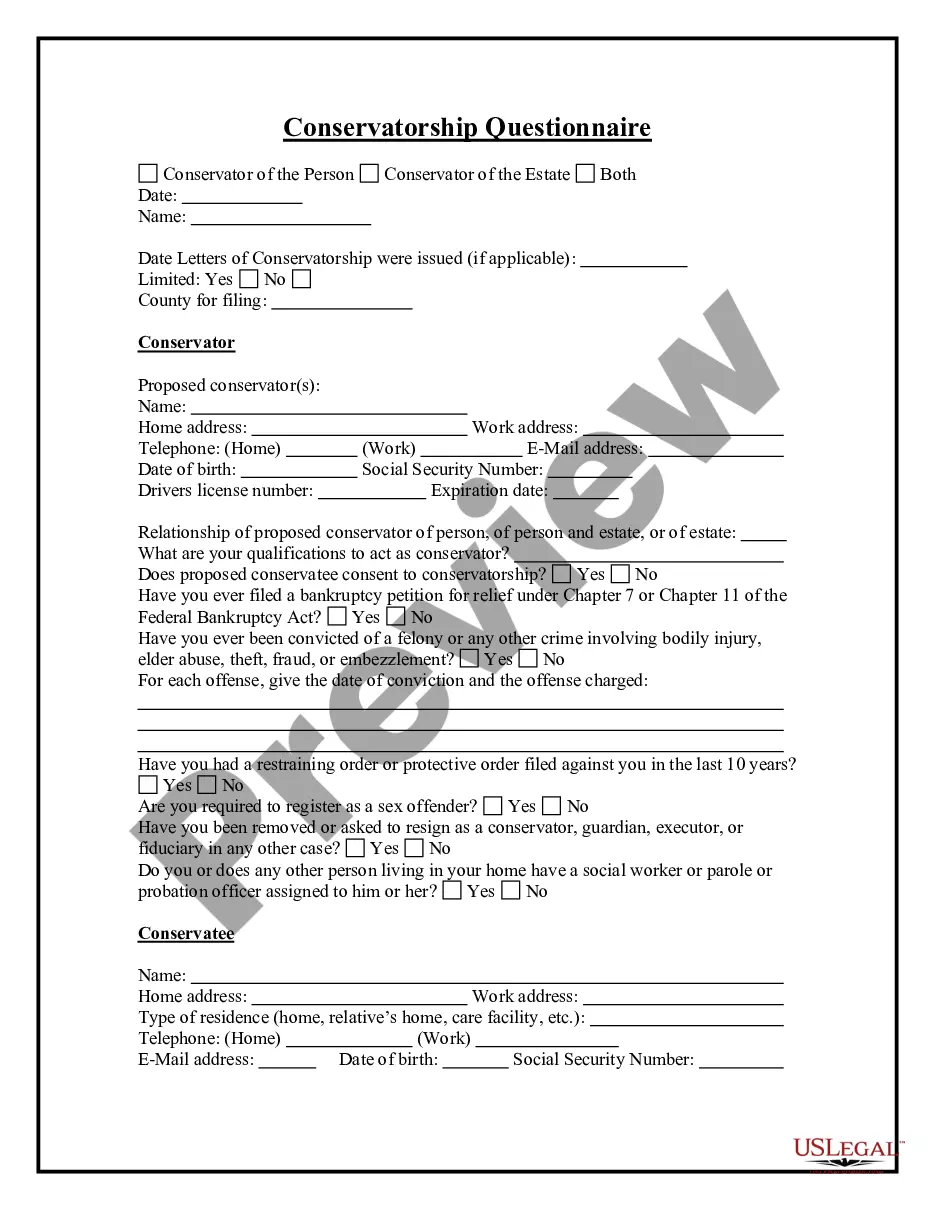
Get your form ready online
Our built-in tools help you complete, sign, share, and store your documents in one place.
Make edits, fill in missing information, and update formatting in US Legal Forms—just like you would in MS Word.
Download a copy, print it, send it by email, or mail it via USPS—whatever works best for your next step.
Sign and collect signatures with our SignNow integration. Send to multiple recipients, set reminders, and more. Go Premium to unlock E-Sign.
If this form requires notarization, complete it online through a secure video call—no need to meet a notary in person or wait for an appointment.
We protect your documents and personal data by following strict security and privacy standards.

Make edits, fill in missing information, and update formatting in US Legal Forms—just like you would in MS Word.

Download a copy, print it, send it by email, or mail it via USPS—whatever works best for your next step.

Sign and collect signatures with our SignNow integration. Send to multiple recipients, set reminders, and more. Go Premium to unlock E-Sign.

If this form requires notarization, complete it online through a secure video call—no need to meet a notary in person or wait for an appointment.

We protect your documents and personal data by following strict security and privacy standards.
Looking for another form?
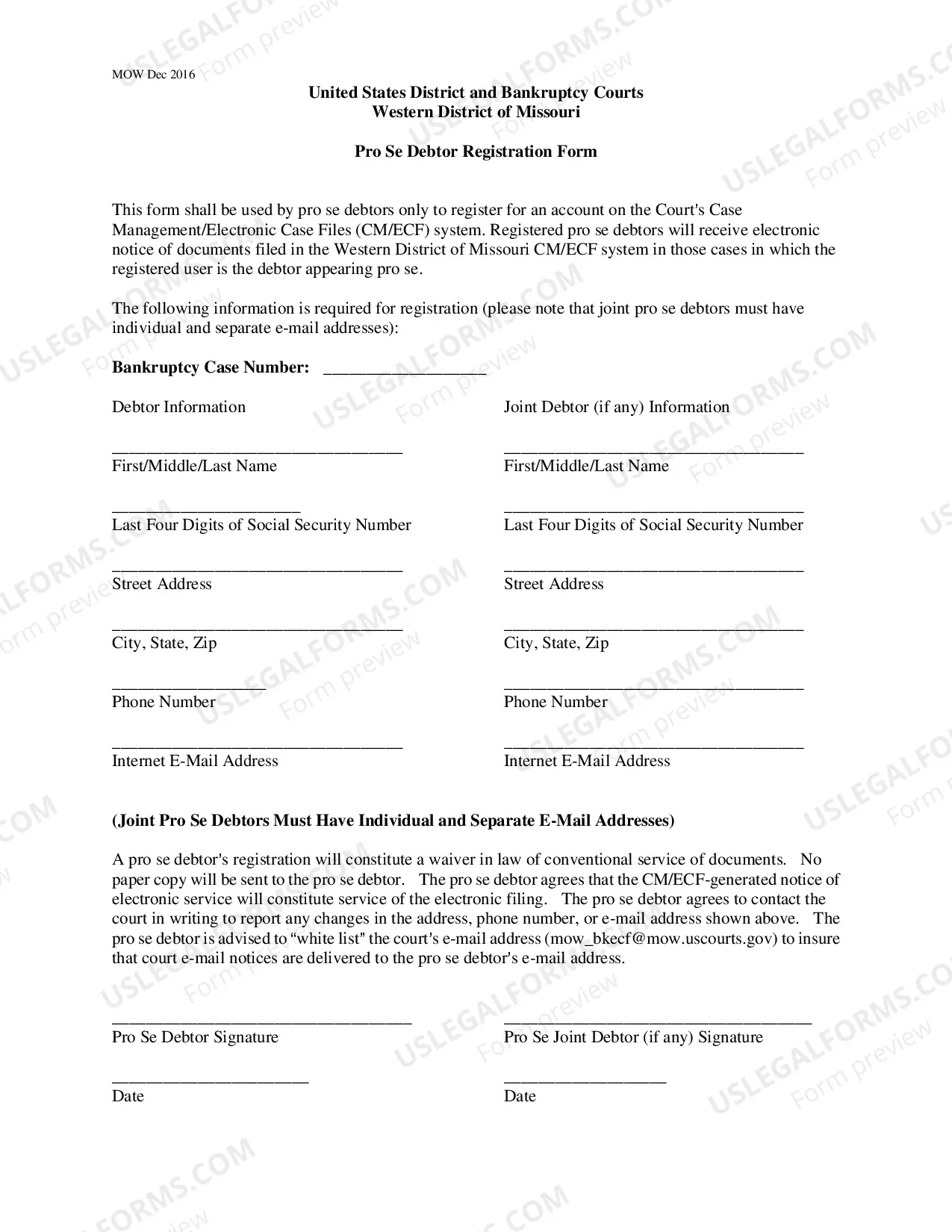
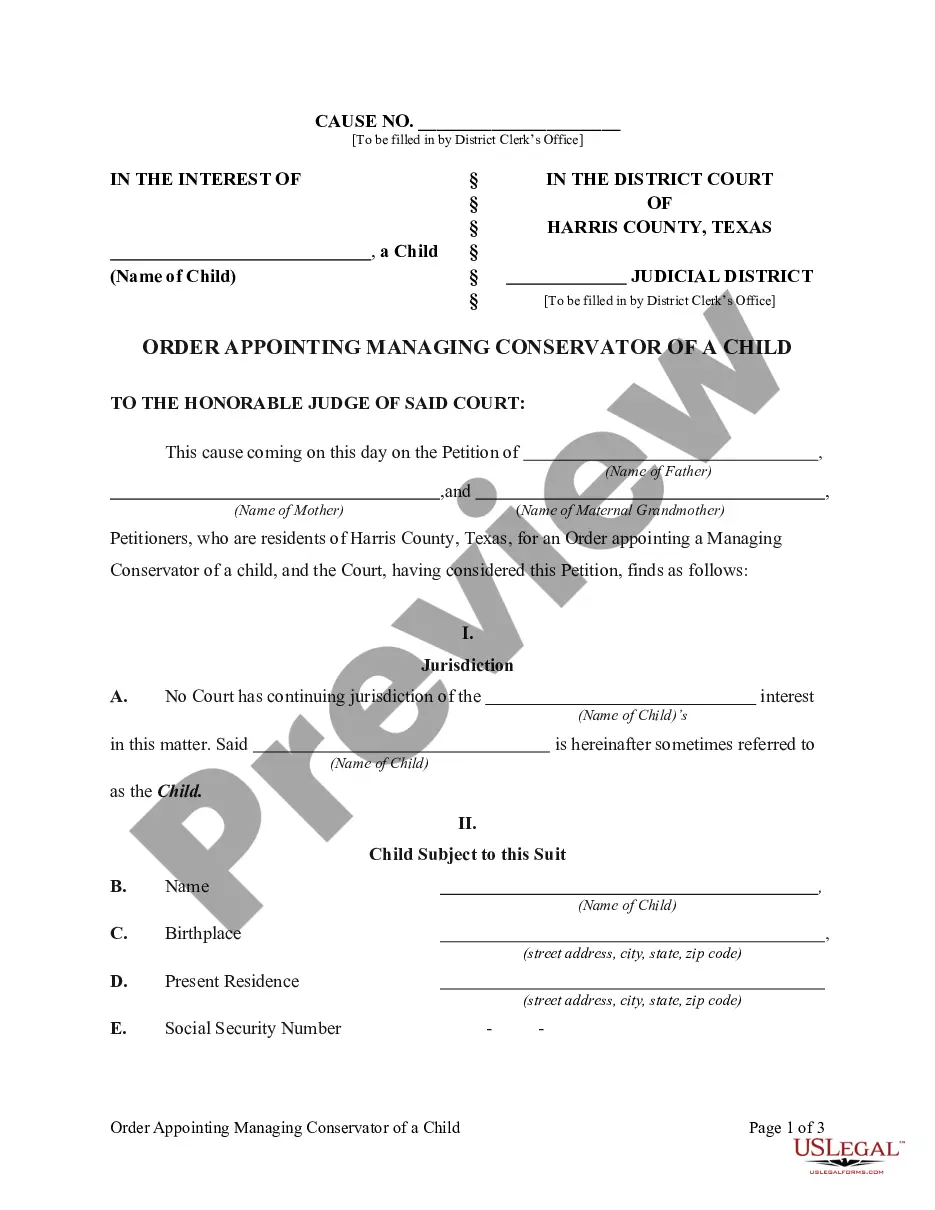
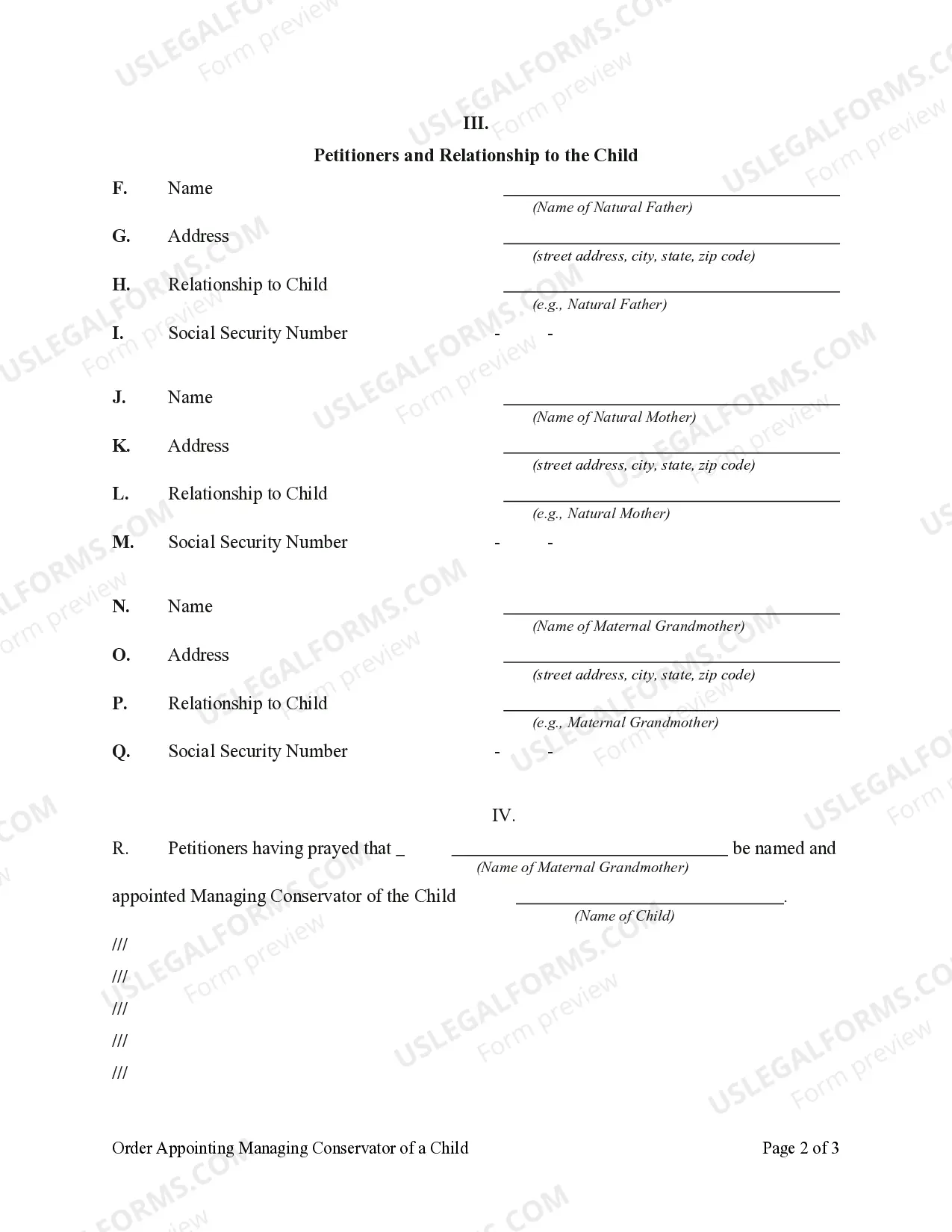
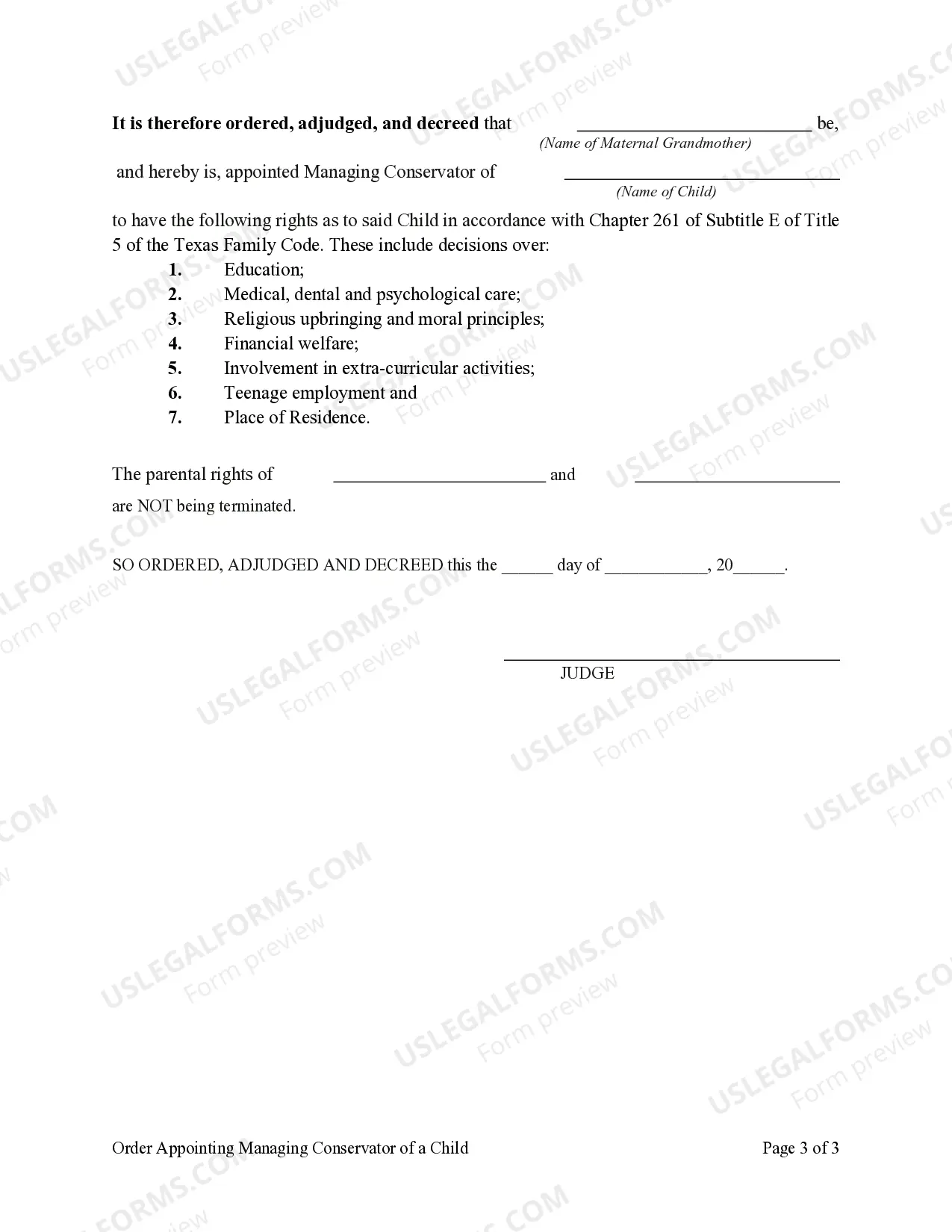
How to fill out Texas Order Appointing Managing Conservator Of A Child?
Securing a reliable location to obtain the latest and suitable legal templates is a significant part of navigating bureaucracy. Finding the correct legal documents requires accuracy and meticulousness, which is why it is essential to source samples of the Permanent Managing Conservatorship Form Texas solely from trustworthy providers, such as US Legal Forms. An incorrect template will squander your time and delay your current situation. With US Legal Forms, you have minimal concerns. You can access and review all the information regarding the document’s applicability and significance for your case and in your locality.
Take into account the outlined steps to finalize your Permanent Managing Conservatorship Form Texas.
Once you have the form on your device, you can modify it using the editor or print it and fill it out by hand. Eliminate the hassle that comes with your legal documentation. Explore the extensive US Legal Forms catalog to discover legal templates, verify their relevance to your situation, and download them instantly.
- Use the catalog navigation or search bar to locate your template.
- Examine the form’s description to ensure it meets the criteria of your state and area.
- Check the form preview, if accessible, to confirm that the form is indeed the one you seek.
- Continue searching and find the correct document if the Permanent Managing Conservatorship Form Texas does not fulfill your requirements.
- Once you are certain about the form’s applicability, download it.
- If you are a registered user, click Log in to verify your identity and access your chosen forms in My documents.
- If you do not possess an account yet, click Buy now to acquire the form.
- Select the pricing option that aligns with your needs.
- Proceed with the registration to complete your acquisition.
- Finalize your purchase by choosing a payment method (credit card or PayPal).
- Select the document format for downloading the Permanent Managing Conservatorship Form Texas.
Form popularity
FAQ
To obtain sole managing conservatorship in Texas, you must demonstrate to the court that it is in the child's best interest. This typically involves filing a petition and providing evidence of your ability to provide a stable and supportive environment. Utilizing resources like the Permanent managing conservatorship form Texas can simplify the process. It is advisable to consult with legal professionals to navigate the complexities of the court system effectively.
When the Texas Child Protective Services (CPS) has temporary managing conservatorship, it means that the state temporarily assumes legal responsibility for a child due to concerns about their safety or well-being. This arrangement allows CPS to make immediate decisions regarding the child's care. However, it is a temporary status, and the ultimate goal is to either reunite the child with their family or establish a more permanent solution, often involving forms like the Permanent managing conservatorship form Texas.
Permanent conservatorship in Texas refers to a legal arrangement where a court grants an individual or entity the authority to make decisions for a child on a long-term basis. This can include decisions about education, healthcare, and general welfare. To establish permanent conservatorship, you often need to fill out a Permanent managing conservatorship form Texas. This process ensures the child's best interests are prioritized and maintained.
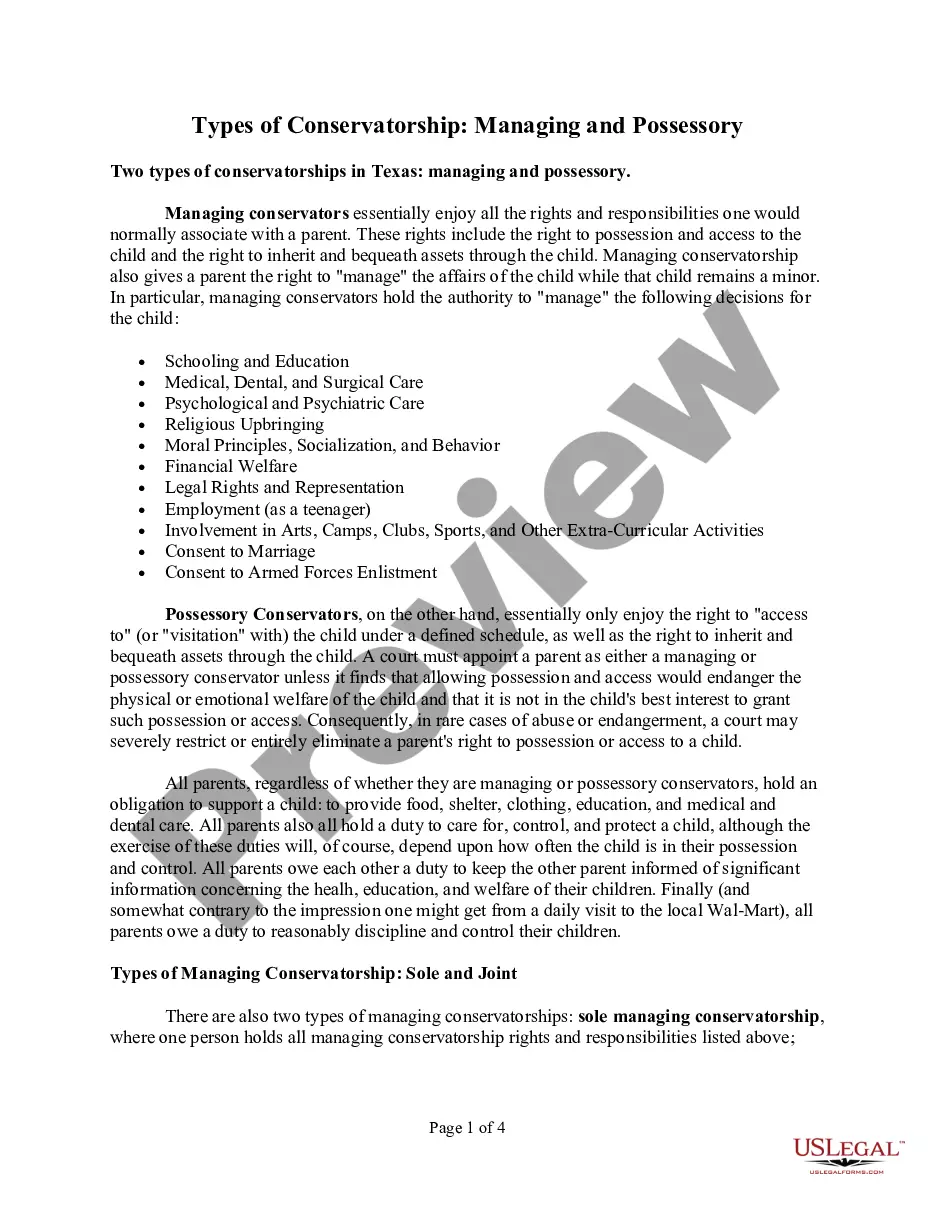
In Texas, there are several types of conservators, including sole managing conservators, joint managing conservators, and possessory conservators. Each type defines the level of authority and responsibility concerning a child's welfare. Understanding these distinctions is important, and utilizing a permanent managing conservatorship form Texas can help clarify your role and rights within this framework.
Permanent managing conservatorship in Texas refers to a legal arrangement where one party is granted the authority to make decisions concerning a child's care and upbringing. This type of conservatorship typically arises in situations where a child cannot remain with their biological parents. To navigate this process smoothly, using a permanent managing conservatorship form Texas is vital, as it lays the foundation for the legal framework governing the child’s needs.
A permanent managing conservator is an individual appointed by the court to oversee the welfare and daily decisions of a child. This designation is crucial as it grants the conservator significant authority regarding the child's upbringing. In Texas, obtaining a permanent managing conservatorship form is an essential step in this legal process, ensuring that the rights and responsibilities are clearly defined.
Joint managing conservatorship (JMC) is when the rights and duties of a parent are shared by both parties. However, exclusive right to make certain decisions (like where the child lives) may be awarded to one party. 1. JMC can be established either by an agreement from the parents or a court order.
Reasons a judge might name a parent (or nonparent) sole managing conservator include: family violence by the other parent, child abuse or neglect by the other parent, alcohol or drug abuse by the other parent, or. absence of the other parent in the child's life.
Being awarded a sole managing conservatorship in Texas is generally what people think of when they hear the term ?sole custody,? or ?full custody.? A sole managing conservator has the exclusive right to make decisions regarding raising the child. These rights include: Education decisions for the child.