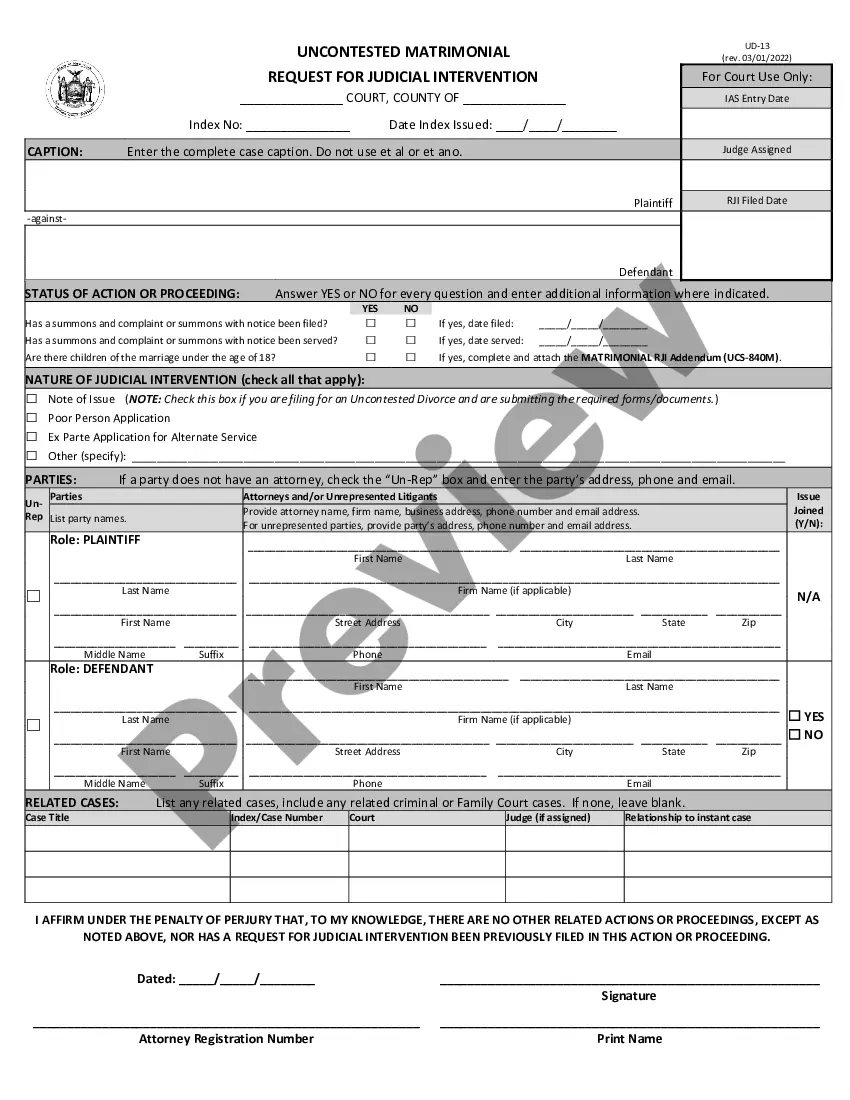
Request For Judicial Intervention With Example
Description
Get your form ready online
Our built-in tools help you complete, sign, share, and store your documents in one place.
Make edits, fill in missing information, and update formatting in US Legal Forms—just like you would in MS Word.
Download a copy, print it, send it by email, or mail it via USPS—whatever works best for your next step.
Sign and collect signatures with our SignNow integration. Send to multiple recipients, set reminders, and more. Go Premium to unlock E-Sign.
If this form requires notarization, complete it online through a secure video call—no need to meet a notary in person or wait for an appointment.
We protect your documents and personal data by following strict security and privacy standards.

Make edits, fill in missing information, and update formatting in US Legal Forms—just like you would in MS Word.

Download a copy, print it, send it by email, or mail it via USPS—whatever works best for your next step.

Sign and collect signatures with our SignNow integration. Send to multiple recipients, set reminders, and more. Go Premium to unlock E-Sign.

If this form requires notarization, complete it online through a secure video call—no need to meet a notary in person or wait for an appointment.

We protect your documents and personal data by following strict security and privacy standards.
Looking for another form?







How to fill out New York RJI Matrimonial Addendum?
It’s clear that you cannot become a legal expert overnight, nor can you swiftly learn how to draft a Request For Judicial Intervention With Example without possessing a specific set of skills.
Assembling legal documents is a lengthy process that necessitates a certain level of education and expertise. So why not entrust the creation of the Request For Judicial Intervention With Example to the professionals.
With US Legal Forms, one of the largest collections of legal templates, you can find everything from court documents to templates for internal communication.
You can regain access to your forms from the My documents tab at any time. If you are an existing client, you can easily Log In and locate and download the template from the same section.
Regardless of the objective of your documents—be it financial, legal, or personal—our website has you covered. Give US Legal Forms a try now!
- Identify the document you require by utilizing the search bar at the top of the page.
- Preview it (if this option is available) and review the accompanying description to see if the Request For Judicial Intervention With Example is what you need.
- Restart your search if you require a different form.
- Create a free account and choose a subscription plan to purchase the template.
- Select Buy now. Once the payment is processed, you can obtain the Request For Judicial Intervention With Example, fill it out, print it, and send or mail it to the appropriate individuals or organizations.
Form popularity
FAQ
If either party believes that the intervention of a judge is necessary, a document called a ?Request for Judicial Intervention? (?RJI?) must be filed with the county clerk, and an additional fee of $95.00 must be paid.
The RJI is a request for the court to become involved in the matter and will result in the assignment of a judge, who will then preside over the action until its end. The court will not accept motions, orders to show cause, requests for court conferences, or any other papers until an RJI is filed.
Upon the filing of an RJI, cases are identified by action type and then assigned at random by the computer to a Justice from among those designated to handle cases of that type. Each case is generally assigned to an IAS Justice for its life, including for trial purposes, except for City cases.
Supreme Court cases are not assigned to a Judge until one of the parties files a Request for Judicial Intervention (RJI) form and pays the filing fee.
The RJI is a request for the court to become involved in the matter and will result in the assignment of a judge, who will then preside over the action until its end. The court will not accept motions, orders to show cause, requests for court conferences, or any other papers until an RJI is filed.