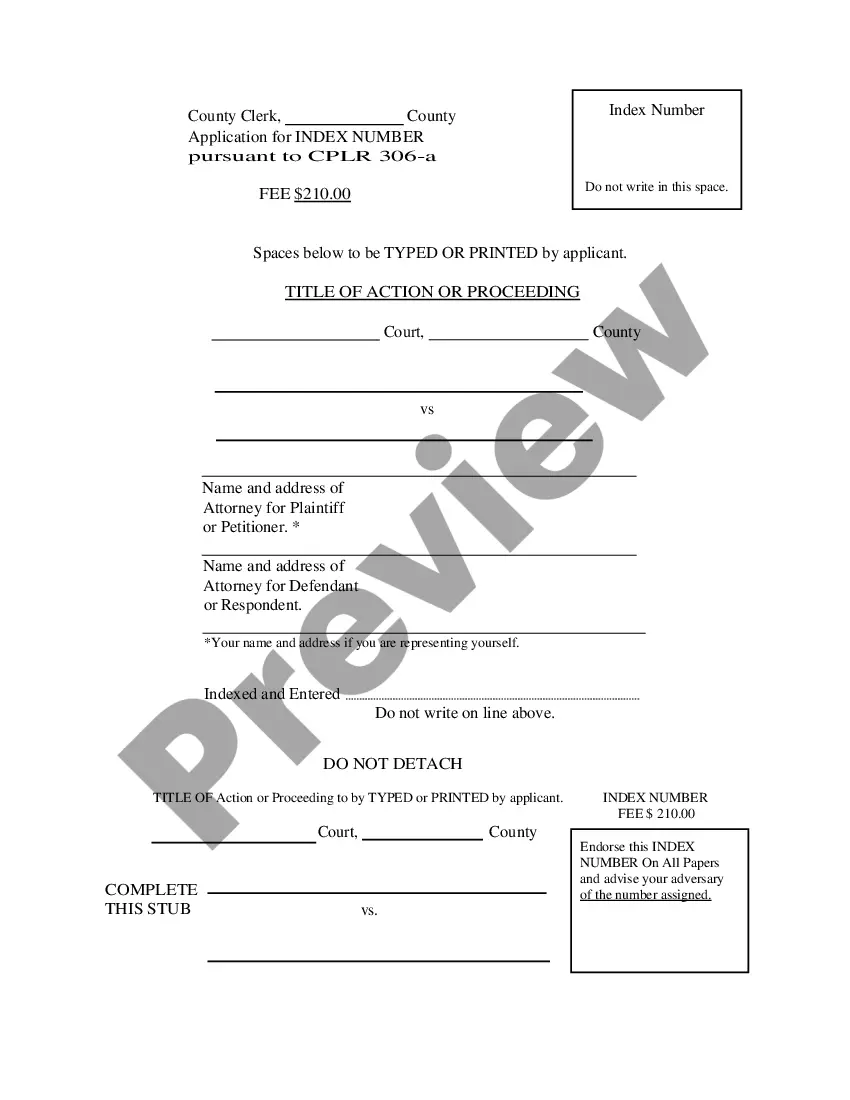
Official New York form used for obtaining index number assignments.
Cplr Rules
Instant download
This website is not affiliated with any governmental entity
Public form
Description
Get your form ready online
Our built-in tools help you complete, sign, share, and store your documents in one place.
Built-in online Word editor
Make edits, fill in missing information, and update formatting in US Legal Forms—just like you would in MS Word.
Export easily
Download a copy, print it, send it by email, or mail it via USPS—whatever works best for your next step.
E-sign your document
Sign and collect signatures with our SignNow integration. Send to multiple recipients, set reminders, and more. Go Premium to unlock E-Sign.
Notarize online 24/7
If this form requires notarization, complete it online through a secure video call—no need to meet a notary in person or wait for an appointment.
Store your document securely
We protect your documents and personal data by following strict security and privacy standards.

Make edits, fill in missing information, and update formatting in US Legal Forms—just like you would in MS Word.

Download a copy, print it, send it by email, or mail it via USPS—whatever works best for your next step.

Sign and collect signatures with our SignNow integration. Send to multiple recipients, set reminders, and more. Go Premium to unlock E-Sign.

If this form requires notarization, complete it online through a secure video call—no need to meet a notary in person or wait for an appointment.

We protect your documents and personal data by following strict security and privacy standards.
Looking for another form?
How to fill out New York Application For Index Number?
Identifying a reliable location to acquire the latest and applicable legal samples is half the challenge of navigating bureaucracy.
Finding the appropriate legal documents requires accuracy and meticulousness, which is why it is essential to source Cplr Rules exclusively from reputable providers, such as US Legal Forms.
Eliminate the hassle associated with your legal documentation. Explore the extensive US Legal Forms catalog to discover legal samples, evaluate their relevance to your situation, and download them instantly.
- Utilize the library navigation or search bar to find your template.
- Check the form’s description to verify if it meets your state and county's requirements.
- Preview the form, if accessible, to confirm that the template is indeed what you need.
- Continue your search and find the suitable document if the Cplr Rules does not satisfy your needs.
- When you are confident about the form’s applicability, download it.
- If you are a registered user, click Log in to verify and access your chosen templates in My documents.
- If you don’t have an account yet, click Buy now to acquire the template.
- Select the pricing option that suits your needs.
- Proceed to register to finalize your purchase.
- Complete your purchase by selecting a payment method (credit card or PayPal).
- Choose the document format for downloading Cplr Rules.
- Once you have the form on your device, you can edit it with the editor or print it and fill it out manually.
Form popularity
FAQ
Writing a motion sample involves stating the purpose of the motion clearly and including relevant facts and legal arguments. Begin with a caption that identifies the court, case number, and parties. Follow the CPLR rules to ensure your motion meets all legal requirements. For templates and guidance, the US Legal Forms platform can provide valuable resources to help you draft an effective motion.
To fill out an affidavit form, begin by reading the form carefully to understand what information is required. Provide accurate details such as your name, the names of the parties involved, and the specifics of the service performed. Ensure you follow the CPLR rules to guarantee compliance. If you need a structured example, US Legal Forms offers a variety of templates to assist you.
To write an affidavit of service, start by clearly stating your name, address, and relationship to the case. Include the detailed account of how service was executed, specifying the time, date, and method of delivery. It is important to follow CPLR rules to ensure your affidavit is legally sound. For guidance, you can find useful resources on the US Legal Forms platform.
Filling an affidavit of service involves gathering the necessary information such as the names of the parties, the date of service, and the method of delivery. You should clearly document the details of how and when the service was completed. Adhering to CPLR rules is crucial for the affidavit to hold up in court. For ease, you might want to use templates from the US Legal Forms platform.
Yes, an affidavit of service in New York must be notarized to be considered valid. The notarization adds a layer of credibility and ensures compliance with CPLR rules. Make sure the notary public witnesses your signature when you complete the affidavit. If you need assistance, US Legal Forms offers notary services that can streamline this process.
Responding to a statement of material facts in New York requires you to admit, deny, or state a lack of knowledge regarding each fact presented. It is important to be clear and concise while following the CPLR rules. This response should be filed along with your answer to the complaint. For detailed examples and templates, the US Legal Forms platform can be a valuable resource.
To fill out an affidavit of service in New York, you need to provide specific details including the names of the parties involved, the date of service, and the method used for service. Ensure that you clearly indicate where and how the documents were delivered. Following the CPLR rules is essential to validate the affidavit. If you're unsure, consider using the US Legal Forms platform for templates and guidance.
CPLR is not a statute; it is a collection of rules designed to govern civil procedure in New York courts. While it derives its authority from statutes enacted by the New York legislature, CPLR rules provide the specific procedures that must be followed in civil cases. This distinction is vital for anyone involved in legal proceedings, as understanding CPLR rules can greatly influence the outcome of a case. If you need assistance navigating these rules, consider leveraging UsLegalForms for comprehensive legal resources.
To look up New York state laws, you can start by visiting the official New York State Legislature website, where you’ll find a comprehensive database of statutes. Additionally, many legal research platforms, including UsLegalForms, provide user-friendly features for searching laws and regulations. You can also access public libraries or legal databases for more detailed inquiries. Knowing how to find these resources empowers you to better understand and utilize the CPLR rules relevant to your needs.
A statute and a rule are not the same, though they are closely related. A statute refers to a law enacted by a legislative body, while a rule typically outlines procedures for enforcing those laws. CPLR rules serve to clarify and implement the statutory provisions that govern civil procedures in New York. Understanding this distinction can help you navigate legal processes more effectively.