Ntldr Is Missing Press Any Key To Restart
Description
Get your form ready online
Our built-in tools help you complete, sign, share, and store your documents in one place.
Make edits, fill in missing information, and update formatting in US Legal Forms—just like you would in MS Word.
Download a copy, print it, send it by email, or mail it via USPS—whatever works best for your next step.
Sign and collect signatures with our SignNow integration. Send to multiple recipients, set reminders, and more. Go Premium to unlock E-Sign.
If this form requires notarization, complete it online through a secure video call—no need to meet a notary in person or wait for an appointment.
We protect your documents and personal data by following strict security and privacy standards.

Make edits, fill in missing information, and update formatting in US Legal Forms—just like you would in MS Word.

Download a copy, print it, send it by email, or mail it via USPS—whatever works best for your next step.

Sign and collect signatures with our SignNow integration. Send to multiple recipients, set reminders, and more. Go Premium to unlock E-Sign.

If this form requires notarization, complete it online through a secure video call—no need to meet a notary in person or wait for an appointment.

We protect your documents and personal data by following strict security and privacy standards.
Looking for another form?


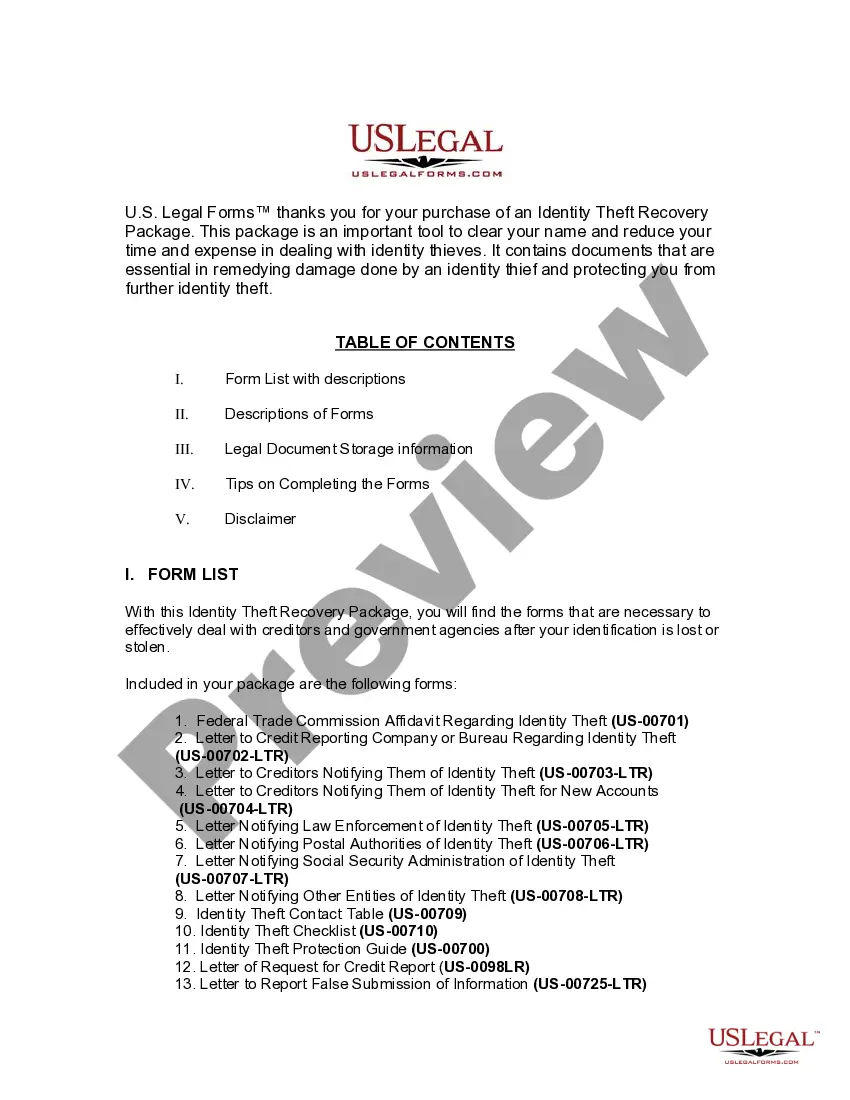
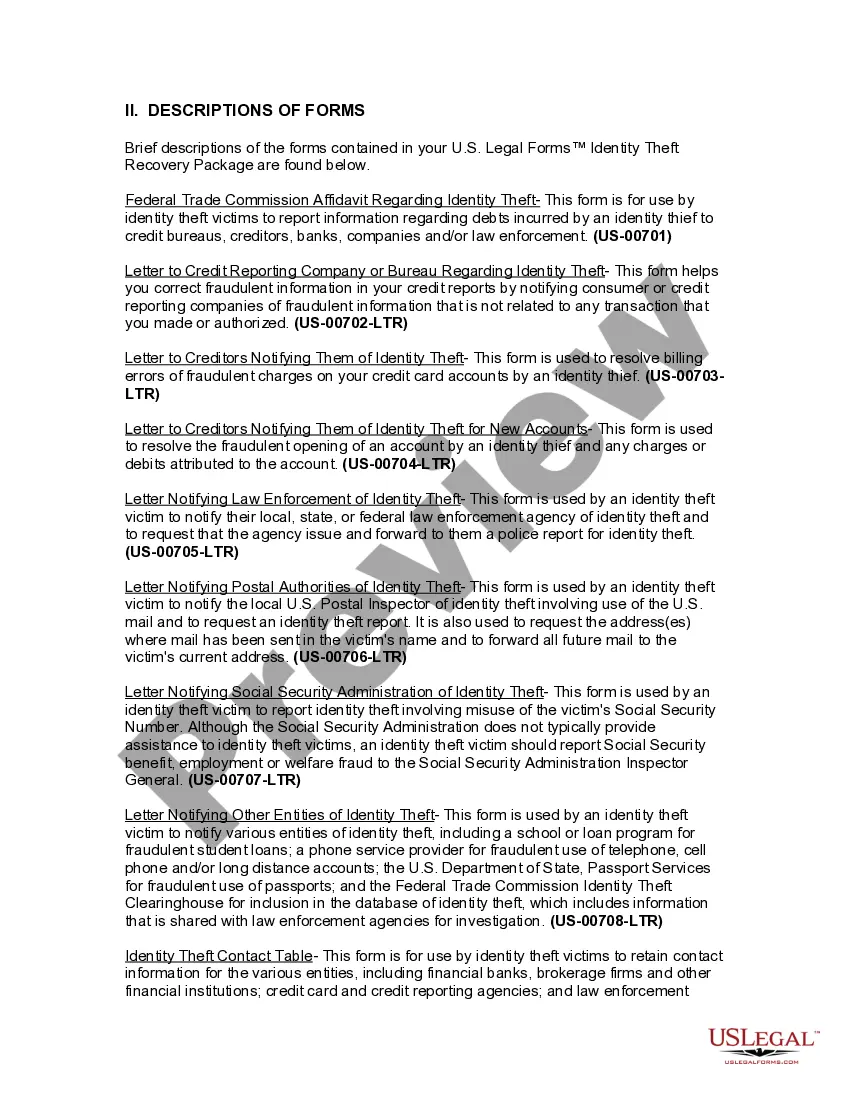
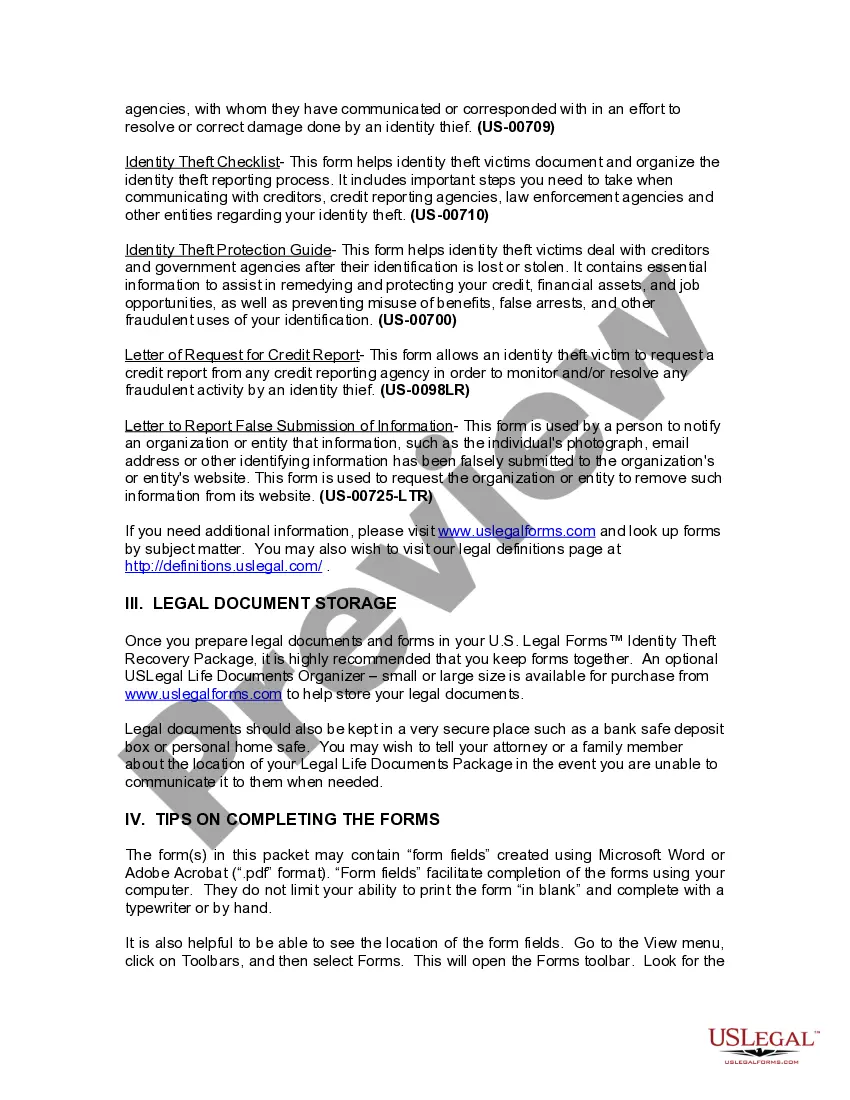
How to fill out New Mexico Identity Theft Recovery Package?
- If you're a returning user, log in to your account and download your desired form template by clicking the Download button. Ensure your subscription remains valid. If it’s expired, renew it as per your payment plan.
- For first-time users, start by checking the Preview mode and form description. Make sure the selected template aligns with your requirements and complies with local laws.
- If the chosen template doesn't meet your needs, utilize the Search feature above to find an appropriate form that suits your situation.
- After selecting the right document, click the Buy Now button and choose your preferred subscription plan. Registration is required to access the full range of documents.
- Complete your purchase by entering your credit card information or using your PayPal account to finalize the subscription.
- Finally, download your desired form. Save it to your device to fill it out, and access it anytime through the My Forms section of your profile.
With US Legal Forms, you benefit from a robust collection of documents, outpacing competitors, and access to over 85,000 fillable forms.
Ensure your legal documents are accurate and compliant by utilizing US Legal Forms to guide you through the process. Start today and streamline your legal documentation needs!
Form popularity
FAQ
NTLDR stands for NT Loader, which is a vital component in booting Windows NT-based operating systems. It loads the operating system kernel and handles startup operations. When you encounter the message 'Ntldr is missing press any key to restart', it typically indicates that this file is corrupt or missing, preventing Windows from starting properly. Understanding the role of NTLDR can help you troubleshoot boot issues more effectively.
To fix the 'NTLDR is missing' error, first ensure that your system's BIOS is set to boot from the correct hard drive. If everything checks out, boot your computer using Windows installation media and access the repair options. From there, you can copy a fresh NTLDR file from the installation CD, or run repair utilities. It's essential to address this error promptly, as ignoring it can cause data access issues.
Restoring the NTLDR file in Windows XP can be accomplished by using the Windows installation CD. Boot from the CD, select the recovery console, and then copy the NTLDR file from the CD to your system drive. Make sure to check that your hard drive is functioning well since a damaged hard drive can lead to the error 'Ntldr is missing press any key to restart.'
To fix the 'bootmgr is missing press ctrl alt del to restart' error, start by checking your hard drive connections and ensure everything is plugged in properly. Then, try using the Windows installation media to access the repair options and run Startup Repair. If that doesn't work, you may need to rebuild the Boot Configuration Data (BCD). Remember, if you could replace or repair NTLDR, that might also help alleviate this issue.
Several factors can lead to the 'Ntldr is missing press any key to restart' error. Common causes include corrupted files, damaged hard drives, or incorrect BIOS settings. Sometimes, it might also happen if there are multiple operating systems improperly configured on your computer. Identifying the specific cause helps in implementing the right solution to restore normal functionality.
To resolve the 'Ntldr is missing press any key to restart' issue, you can start by checking your boot order in BIOS. Ensure that the primary hard drive is set to boot first. If that doesn't work, consider using a Windows installation disk to repair the boot sector or replace the missing NTLDR file. Additionally, platforms like US Legal Forms can provide legal guidance for complications arising from data loss or hardware failure.
NTLDR stands for 'New Technology Loader.' It is an essential component of the Windows operating system that helps boot your computer. When you encounter the error 'Ntldr is missing press any key to restart,' it often indicates that your system cannot find this loader. Understanding this term is crucial as it points to a deeper issue within your boot process.
The NTLDR file is located in the root directory of your primary hard drive, which is typically drive C. If you see the message 'Ntldr is missing press any key to restart', it's a sign that your system cannot access this essential file. You can often find NTLDR alongside other critical boot files like boot.ini and ntdetect. Ensuring these files are intact and correctly configured is vital for a successful boot.
The message 'Ntldr is missing press any key to restart' often appears if the NTLDR file is accidentally deleted or if the system cannot find the boot partition. This issue can arise during or after the installation of Windows XP due to improper configurations or incompatible hardware. To resolve this, you may need to check the integrity of your installation media and ensure that all files, including NTLDR, are properly in place.
If you encounter the message 'Ntldr is missing press any key to restart', it’s essential to first check your system's boot configuration. Restart your computer and enter the BIOS settings to ensure that your hard drive is recognized. If it is, you might need to repair the Windows installation using a bootable USB or CD. You can use tools available at US Legal Forms to guide you through the repair process and prevent future occurrences.