Account For Trust
Description


Get your form ready online
Our built-in tools help you complete, sign, share, and store your documents in one place.
Make edits, fill in missing information, and update formatting in US Legal Forms—just like you would in MS Word.
Download a copy, print it, send it by email, or mail it via USPS—whatever works best for your next step.
Sign and collect signatures with our SignNow integration. Send to multiple recipients, set reminders, and more. Go Premium to unlock E-Sign.
If this form requires notarization, complete it online through a secure video call—no need to meet a notary in person or wait for an appointment.
We protect your documents and personal data by following strict security and privacy standards.

Make edits, fill in missing information, and update formatting in US Legal Forms—just like you would in MS Word.

Download a copy, print it, send it by email, or mail it via USPS—whatever works best for your next step.

Sign and collect signatures with our SignNow integration. Send to multiple recipients, set reminders, and more. Go Premium to unlock E-Sign.

If this form requires notarization, complete it online through a secure video call—no need to meet a notary in person or wait for an appointment.

We protect your documents and personal data by following strict security and privacy standards.
Looking for another form?


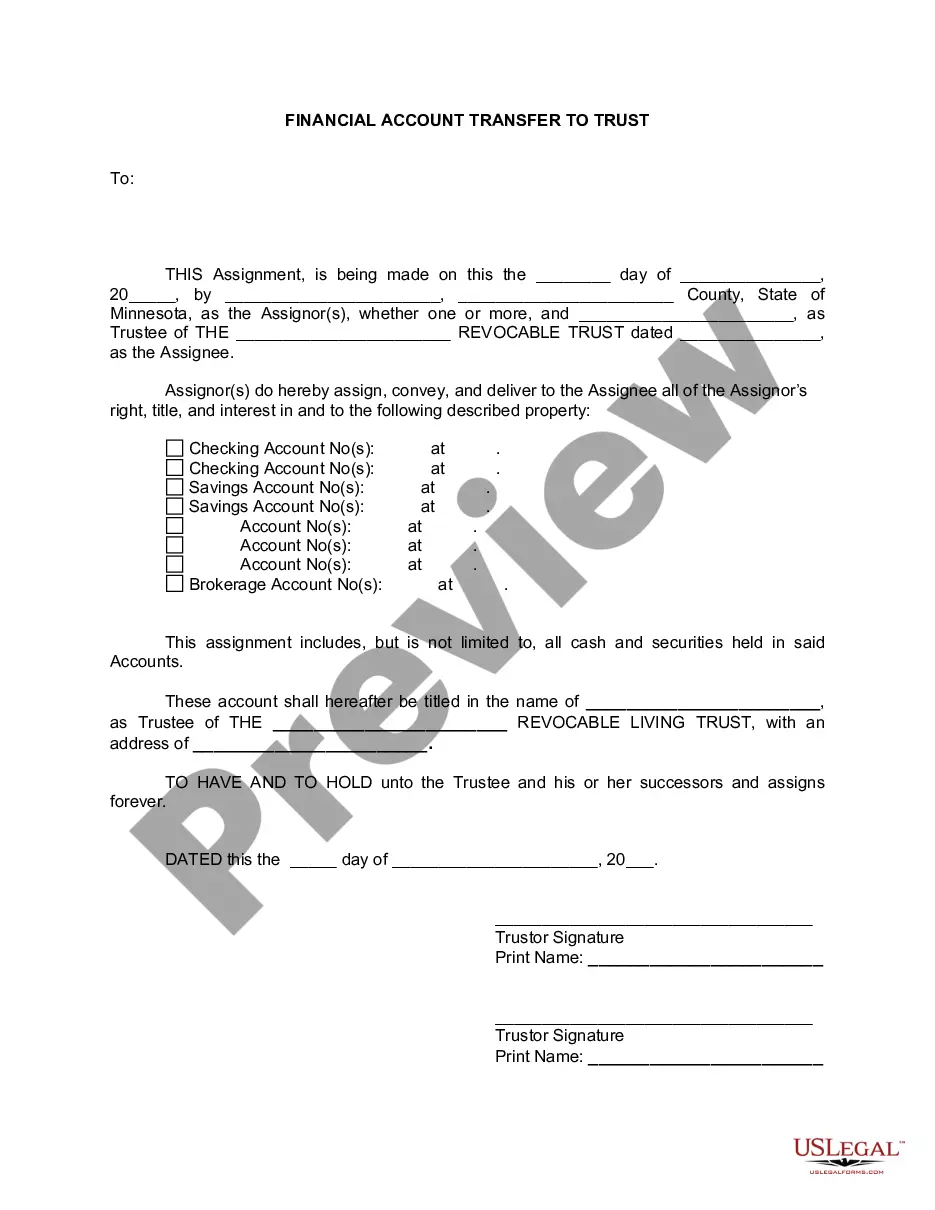
How to fill out Minnesota Financial Account Transfer To Living Trust?
- If you're a returning user, log into your account and verify your subscription is active. Click the Download button to retrieve your required form template.
- For first-time users, explore the Preview mode and form descriptions to select the appropriate template that fits your legal needs and local jurisdiction.
- If the form doesn’t meet your criteria, utilize the Search tab to find a better-suited template.
- Once satisfied with your choice, proceed by clicking the Buy Now button and select your preferred subscription plan, ensuring you create an account for full access.
- Finish your purchase by entering your payment details through credit card or PayPal to activate your subscription.
- After the transaction, download your form and save it on your device. You can also access it later in the My Forms section of your profile.
Following these steps ensures you account for trust and utilize the robust features of US Legal Forms effectively.
Start simplifying your legal tasks today with US Legal Forms' extensive collection of documents. Trust in the process and act now!
Form popularity
FAQ
The downside of putting assets in a trust includes the potential complexity and privacy concerns. When you account for trust, all transactions and asset allocations are recorded and accessible, limiting privacy. Furthermore, creating a trust can involve considerable paperwork and legal fees. Using services such as US Legal Forms can help streamline the setup process and reduce frustration.
One potential downfall of having a trust involves the costs associated with setting it up and maintaining it. If not structured properly, a trust may lead to tax complications or unintended outcomes. It's crucial to have a clear plan when you account for trust to maximize its benefits. Working with professionals or platforms like US Legal Forms can help navigate these complexities.
When you account for trust, you typically include various assets such as real estate, bank accounts, investments, and personal property. Trust accounts can hold both tangible and intangible assets, providing flexibility in managing wealth. By placing these assets in a trust account, your loved ones may benefit from organized management and protection. Utilizing resources like US Legal Forms can assist in outlining these assets clearly.
Deciding whether your parents should account for trust is important for their financial future. A trust allows for controlled management of assets while providing a clear plan for distribution after passing. It can also help avoid probate, ensuring that their wishes are honored without lengthy delays. Consulting with a trust specialist or using a platform like US Legal Forms can simplify this process.
The purpose of a trust account is to manage and protect assets on behalf of another person or entity. It ensures that assets are handled according to the specific wishes of the trust creator. A well-structured account for trust can facilitate smoother transitions of wealth, helping beneficiaries receive funds under defined circumstances.
When a bank account is in trust for someone, it means that the funds in that account are intended to benefit the specified individual or group, managed by a trustee. This setup illustrates a legal and financial commitment to safeguard and distribute assets. Essentially, it establishes clear ownership and usage rules for the assets held.
Choosing the right account for trust depends on your specific needs, but generally, a high-interest trust savings account or a trust checking account is ideal. These accounts not only secure your funds but also maximize potential growth through interest. Consider consulting with financial advisors to find the most suitable account for your trust.
The best type of bank account for a trust is typically a dedicated trust account that offers features suited for managing trust assets. Look for accounts that provide flexibility, transparency, and easy management options. An account for trust ensures that the funds are maintained separately from personal accounts, adhering to legal requirements.
Having an account in trust means that the account is designated to manage and safeguard funds for someone else. The trustee oversees the account, ensuring that the funds are used as intended based on the terms of the trust. This arrangement provides a powerful way to ensure financial security for your beneficiaries.
An account in trust serves to hold assets for the benefit of a designated beneficiary. This setup ensures that the assets are managed according to specific terms outlined in a trust document. Ultimately, using an account for trust helps in protecting your valuables until they are properly distributed.