Transfer Death Beneficiary With Ira
Description


Get your form ready online
Our built-in tools help you complete, sign, share, and store your documents in one place.
Make edits, fill in missing information, and update formatting in US Legal Forms—just like you would in MS Word.
Download a copy, print it, send it by email, or mail it via USPS—whatever works best for your next step.
Sign and collect signatures with our SignNow integration. Send to multiple recipients, set reminders, and more. Go Premium to unlock E-Sign.
If this form requires notarization, complete it online through a secure video call—no need to meet a notary in person or wait for an appointment.
We protect your documents and personal data by following strict security and privacy standards.

Make edits, fill in missing information, and update formatting in US Legal Forms—just like you would in MS Word.

Download a copy, print it, send it by email, or mail it via USPS—whatever works best for your next step.

Sign and collect signatures with our SignNow integration. Send to multiple recipients, set reminders, and more. Go Premium to unlock E-Sign.

If this form requires notarization, complete it online through a secure video call—no need to meet a notary in person or wait for an appointment.

We protect your documents and personal data by following strict security and privacy standards.
Looking for another form?







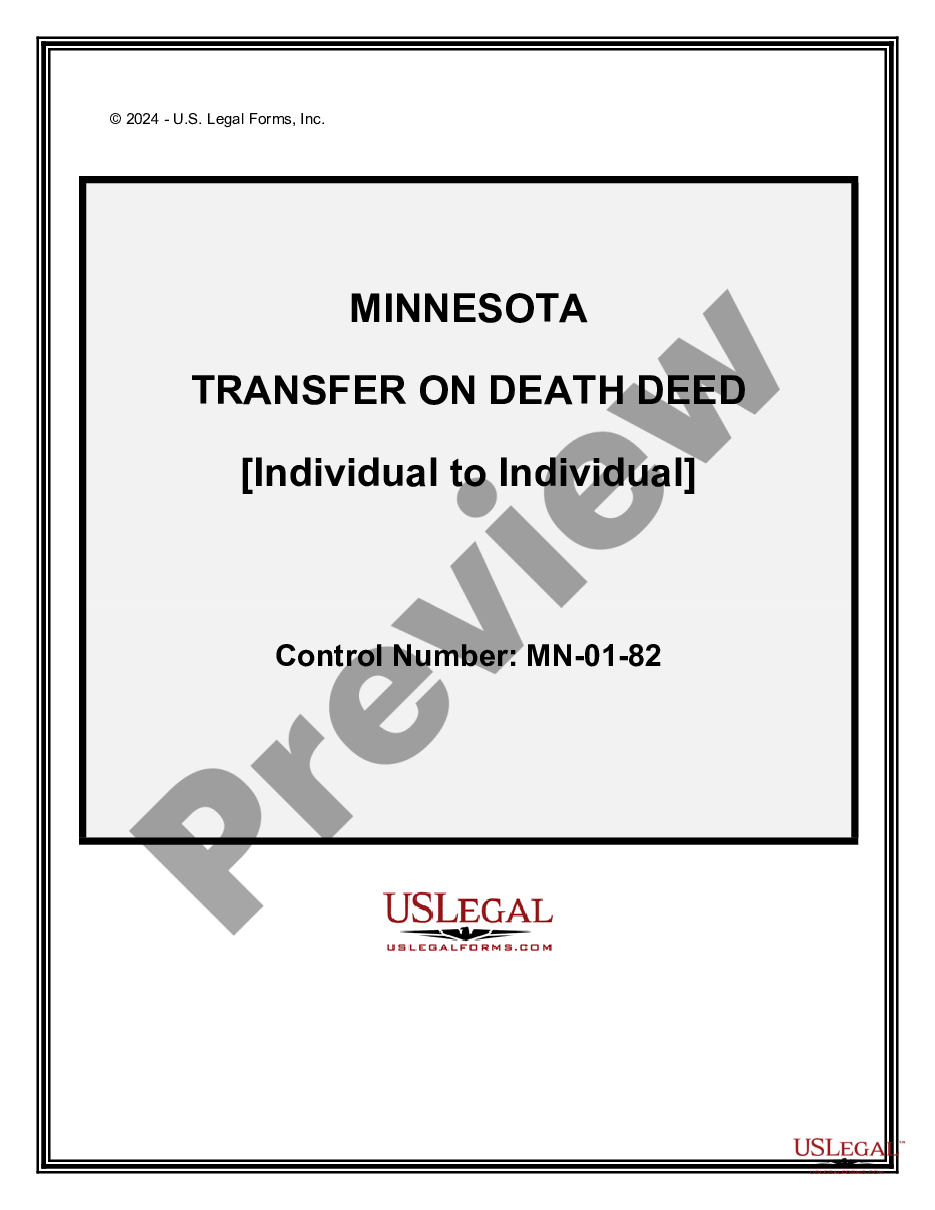
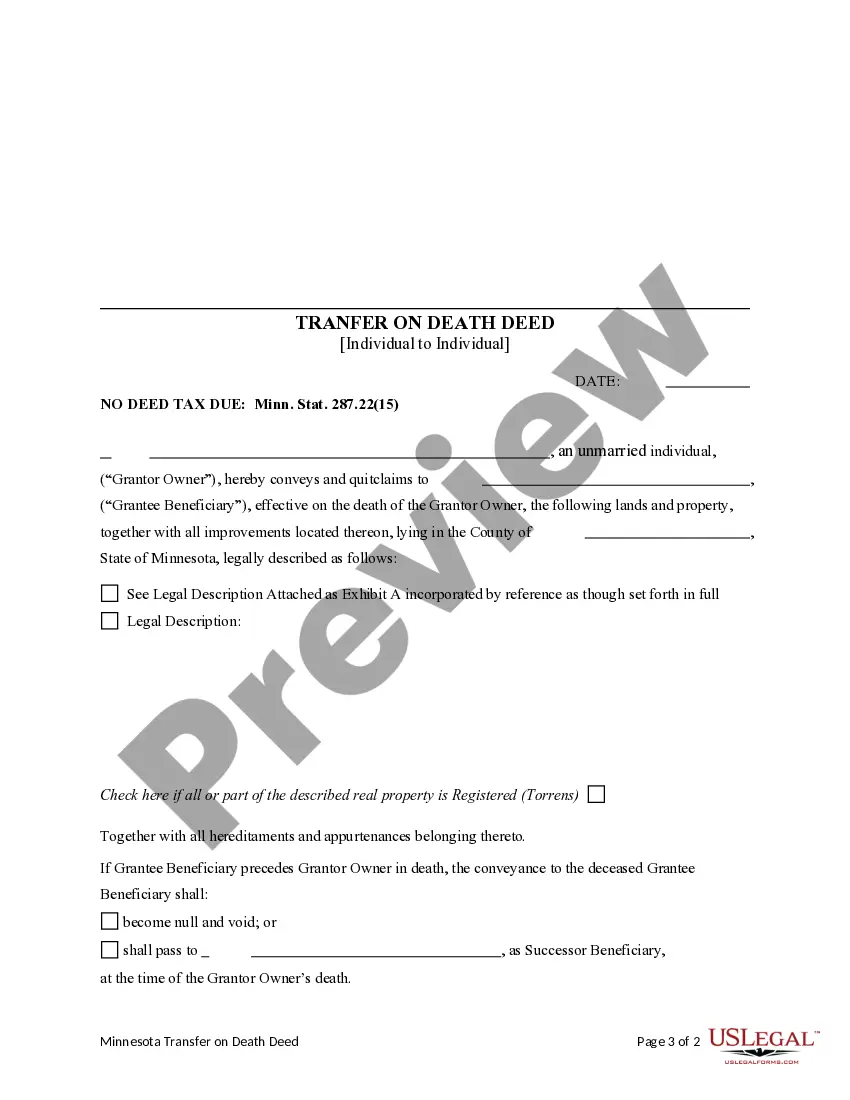
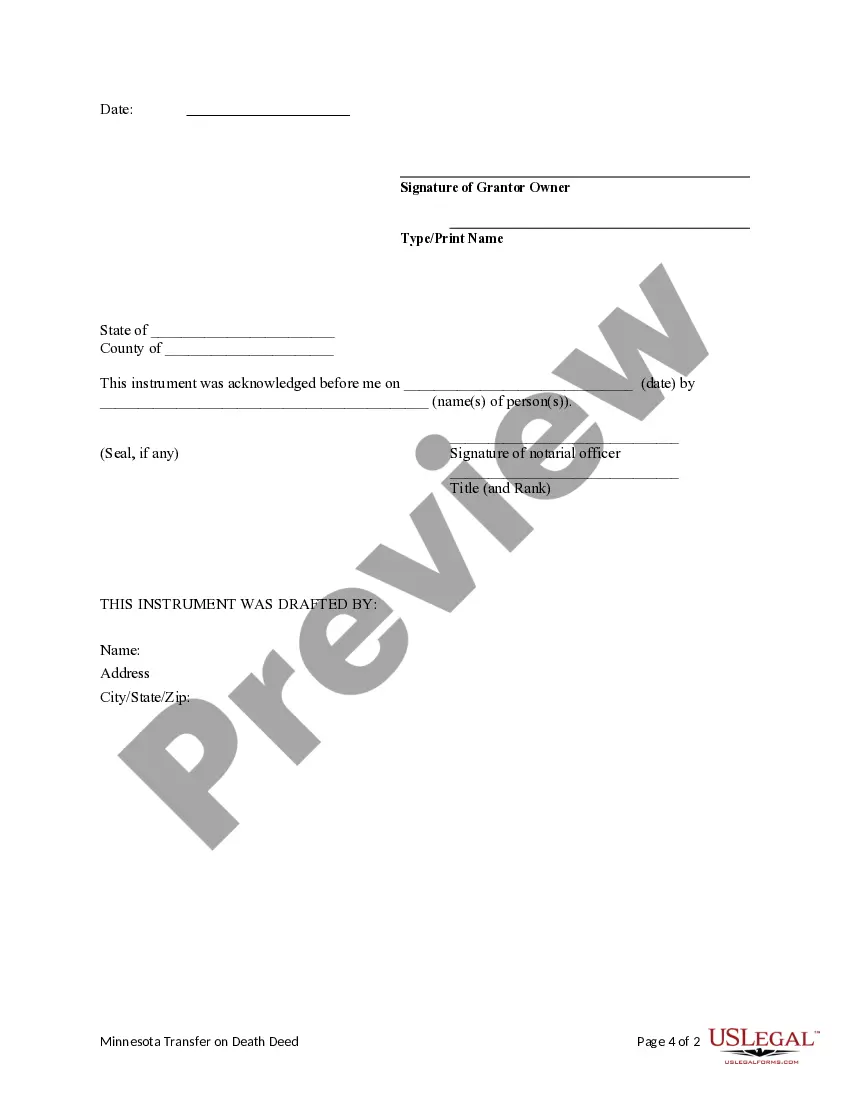
How to fill out Minnesota Transfer On Death Deed - Individual To Individual?
- If you are a returning user, log in to your account and download the required form template by clicking the Download button. Ensure your subscription is active, and renew if necessary.
- For first-time users, start by exploring the Preview mode and reading the form description to confirm you selected the correct template that meets local jurisdiction requirements.
- Should you need a different form, use the Search tab to find the right document that fits your requirements.
- Proceed to purchase the document by clicking on the Buy Now button, selecting your preferred subscription plan, and registering an account to access the library.
- Complete your purchase by entering your credit card information or using PayPal for payment.
- Download the form onto your device for completion and access it later via the My Forms menu in your profile.
By following these straightforward steps, you can efficiently obtain the necessary forms to manage your IRA beneficiary transfers confidently.
US Legal Forms provides an unparalleled selection of over 85,000 legal forms along with expert assistance, making it a valuable resource for all legal documentation needs. Start your hassle-free legal journey today!
Form popularity
FAQ
When someone with an IRA passes away and has designated a beneficiary, the IRA transfers directly to that beneficiary. This process avoids probate and can simplify the inheritance. It's important to ensure the beneficiary information is up to date, allowing for a smooth transfer as you navigate the legal requirements.
After receiving a death beneficiary with an IRA, the best strategy involves understanding your options, which include cashing out or rolling the IRA into your own or another inherited IRA. Evaluate your long-term financial goals and tax implications before making a decision. Using US Legal Forms can help simplify the paperwork involved in these transitions.
To transfer a death beneficiary with an IRA to another person, you will likely need to complete a transfer request form provided by your financial institution. Ensure that the new beneficiary is eligible based on IRS rules. It is important to initiate the process promptly to avoid complications and ensure everything aligns with legal requirements.
To transfer a death beneficiary with IRA, you need to ensure the process aligns with IRS rules. Start by notifying the financial institution holding the IRA about the account holder's passing. It is typically best to set up a beneficiary IRA in your name, allowing you to take distributions according to your lifestyle. For guidance, consider using US Legal Forms, which offers reliable resources to help streamline the transfer process.
If a beneficiary of an IRA dies, the account holder should promptly review the beneficiary designation. They may need to update the IRA with either an alternate beneficiary or account for this change in their estate plan. This attention to detail is essential for navigating the complexities of the transfer death beneficiary with IRA while ensuring seamless transitions.
An IRA cannot have a true Transfer on Death designation as defined by non-retirement accounts. Instead, you must name beneficiaries on the IRA account directly to facilitate the transfer upon death. This is crucial for implementing the transfer death beneficiary with IRA effectively and ensures compliance with IRS requirements.
The primary downside of a Transfer on Death designation is limited control and flexibility in asset management. Once the TOD is established, the assets automatically transfer upon death, which can leave surviving heirs with tax burdens or unwanted assets. Thus, understanding the implications of the transfer death beneficiary with IRA is vital for planning.
Choosing between Transfer on Death (TOD) or a named beneficiary depends on individual circumstances and goals. A TOD designation simplifies the process, allowing for a quick transfer to the named beneficiary. However, for IRAs, you must designate a beneficiary to align with the transfer death beneficiary with IRA strategy, often providing better tax advantages than a plain TOD.
To transfer an IRA after death, beneficiaries must submit a death certificate and any required paperwork to the financial institution. They will either transfer ownership of the IRA to the beneficiary's name or distribute funds according to the terms of the will. This process is essential for adhering to IRS regulations revolving around the transfer death beneficiary with IRA.
The rules for IRA death distribution often hinge on whether the beneficiary is a spouse or non-spouse. Spouses typically have more options, including rolling the IRA into their own. Non-spouse beneficiaries must follow specific withdrawal rules, adhering to the established timeline to ensure compliance with the transfer death beneficiary with IRA process.