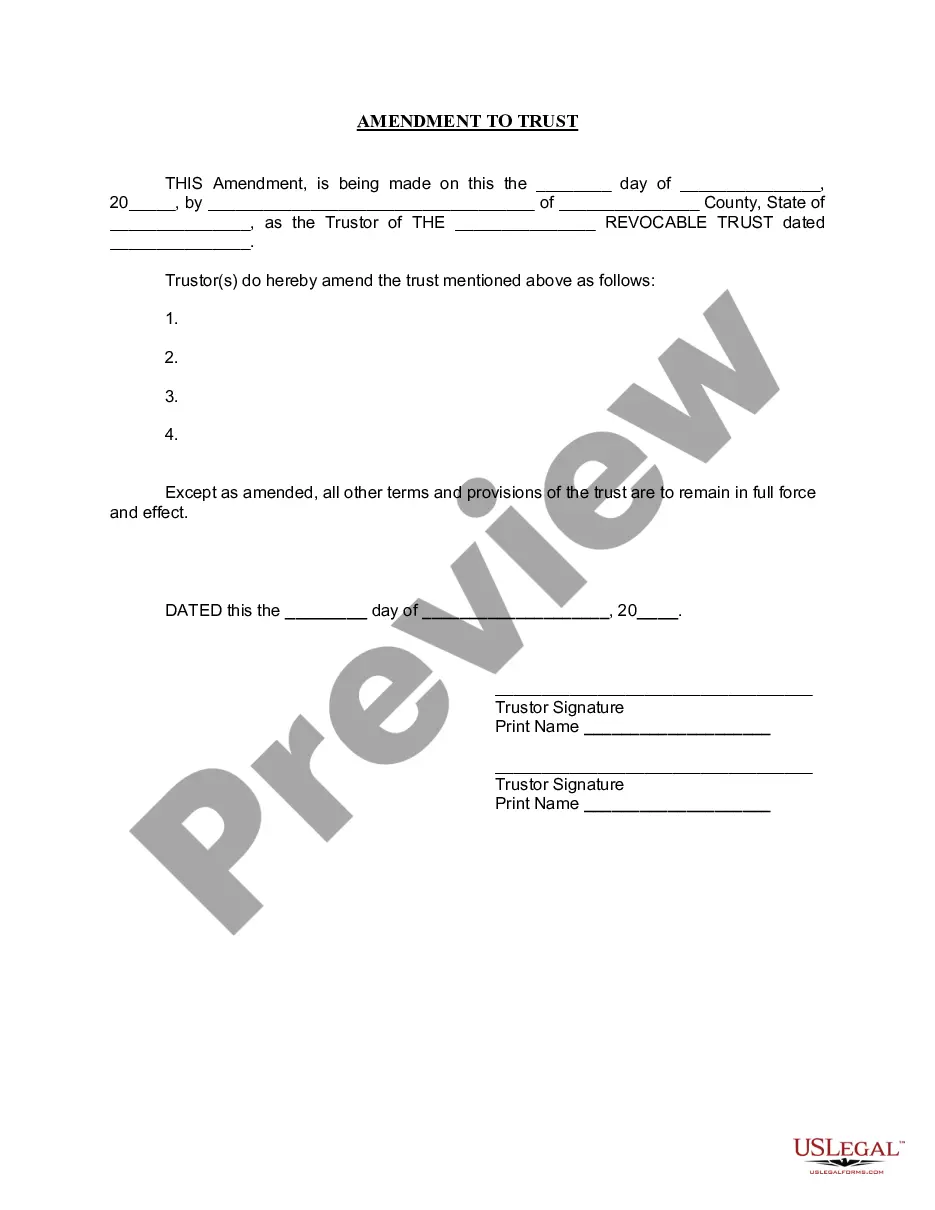
Amendment Form For Living Trust
Description



Get your form ready online
Our built-in tools help you complete, sign, share, and store your documents in one place.
Make edits, fill in missing information, and update formatting in US Legal Forms—just like you would in MS Word.
Download a copy, print it, send it by email, or mail it via USPS—whatever works best for your next step.
Sign and collect signatures with our SignNow integration. Send to multiple recipients, set reminders, and more. Go Premium to unlock E-Sign.
If this form requires notarization, complete it online through a secure video call—no need to meet a notary in person or wait for an appointment.
We protect your documents and personal data by following strict security and privacy standards.

Make edits, fill in missing information, and update formatting in US Legal Forms—just like you would in MS Word.

Download a copy, print it, send it by email, or mail it via USPS—whatever works best for your next step.

Sign and collect signatures with our SignNow integration. Send to multiple recipients, set reminders, and more. Go Premium to unlock E-Sign.

If this form requires notarization, complete it online through a secure video call—no need to meet a notary in person or wait for an appointment.

We protect your documents and personal data by following strict security and privacy standards.
Looking for another form?








How to fill out Michigan Amendment To Living Trust?
- Visit the US Legal Forms website.
- If you're a returning user, log in to your account to download the needed template directly.
- If you're new to our service, first preview the available forms and their descriptions to select one that fits your local jurisdiction and requirements.
- In case you don’t find the right template, utilize the Search tab to locate a specific form that meets your criteria.
- Once you’ve found the proper document, click on the 'Buy Now' button and choose a subscription plan that works for you.
- Provide payment details through your credit card or PayPal account to complete the purchase.
- After payment, download your amendment form for living trust. You can find it anytime in the My Forms section of your profile.
In conclusion, US Legal Forms simplifies the document creation process, ensuring you can easily update your living trust as needed. With access to over 85,000 legal forms and expert guidance, your legal needs are covered.
Start your journey today by visiting US Legal Forms and secure your amendment form for living trust!
Form popularity
FAQ
A trust amendment changes specific parts of the trust while the rest of the trust remains intact. In contrast, a trust restatement replaces the entire trust document with a new one, incorporating all changes. Choosing between an amendment form for living trust and a restatement depends on the extent of changes you require.
An amendment to the trust agreement is a legal document that modifies specific terms of an existing trust. This amendment form for living trust allows changes such as altering beneficiaries, updating trustee information, or changing distribution terms. Keeping these amendments updated is crucial for effective trust management.
Yes, you can amend your trust by yourself, but it’s important to follow the correct legal procedures. Utilizing an amendment form for living trust simplifies this process and ensures all necessary details are included. However, if you have complex changes or multiple beneficiaries, consulting with a legal professional can be beneficial.
To amend a trust, you typically need a completed amendment form for living trust, signed by the trustor. The trustor should specify the changes they wish to make clearly within the form. It’s also wise to have the signatures notarized to ensure the amendment holds legal weight.
In most cases, an amendment to a trust does not need to be recorded. The amendment form for living trust simply needs to be signed by the trustor and kept with the original trust documents. However, certain situations may require you to notify beneficiaries or pertinent parties, so it’s best to consult legal advice tailored to your situation.
Amending a trust is generally a straightforward process, especially when you use an amendment form for living trust. This form allows you to clearly articulate your desired changes without needing to rewrite the entire trust. However, being detailed and precise in your amendments is essential, so consider seeking professional help if you have complex changes.
While it's not strictly necessary to hire a lawyer for trust amendments, consulting one can provide valuable guidance. Using an amendment form for living trust can streamline the process, making it easier to complete changes on your own. However, professional advice can help you avoid errors and ensure your amendments meet legal standards.
One significant mistake parents often make is not updating their trust after significant life changes, such as births or divorces. Failing to amend the trust can lead to unintended distributions, leaving your family's financial future uncertain. To avoid this, regularly review and utilize an amendment form for living trust, ensuring that your intentions align with your current family dynamics.
A codicil is specific to wills and serves to modify certain aspects without rewriting the entire document. In contrast, an amendment for a living trust allows you to change or add terms within the trust itself. Utilizing an amendment form for living trust simplifies this process, ensuring clarity in your intentions while maintaining the trust's original framework.
When you update a trust, it is commonly referred to as amending the trust. This process involves making changes to the trust's terms or provisions to better reflect your current wishes. To effectively navigate this, you can use an amendment form for living trust. This form ensures that your amendments are legally recognized and properly documented.