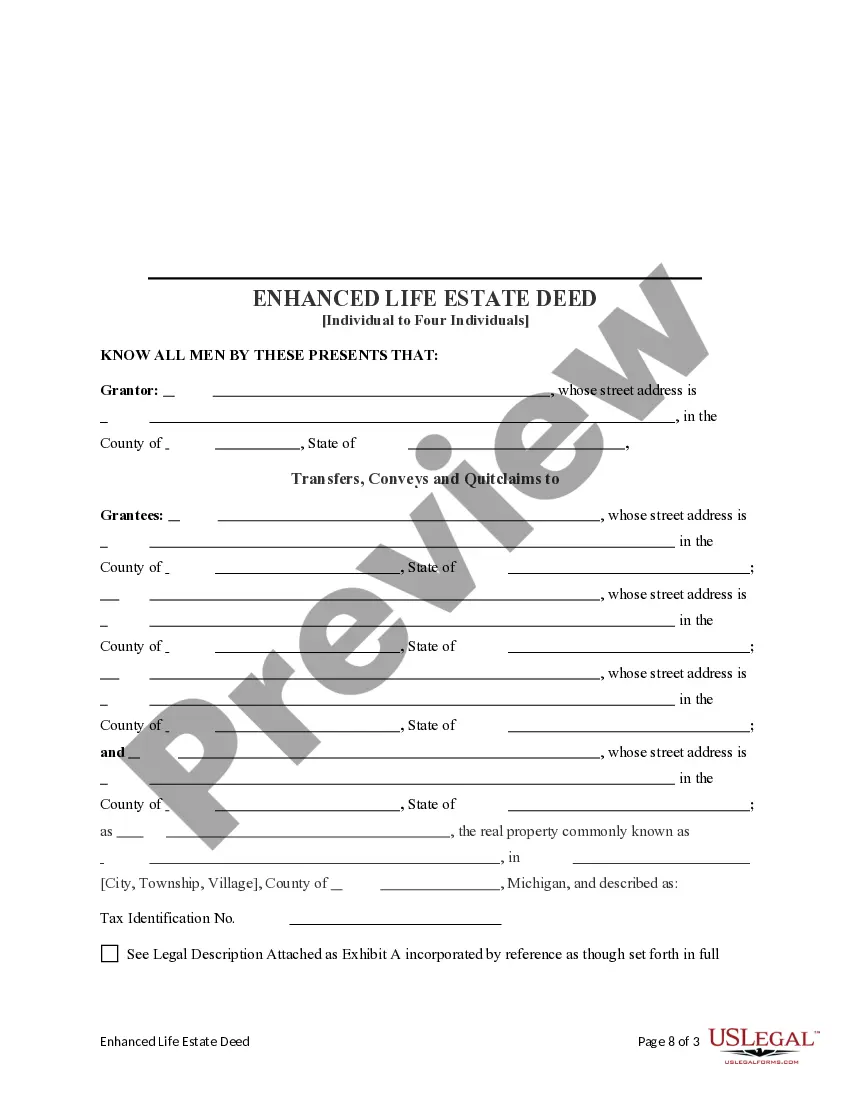
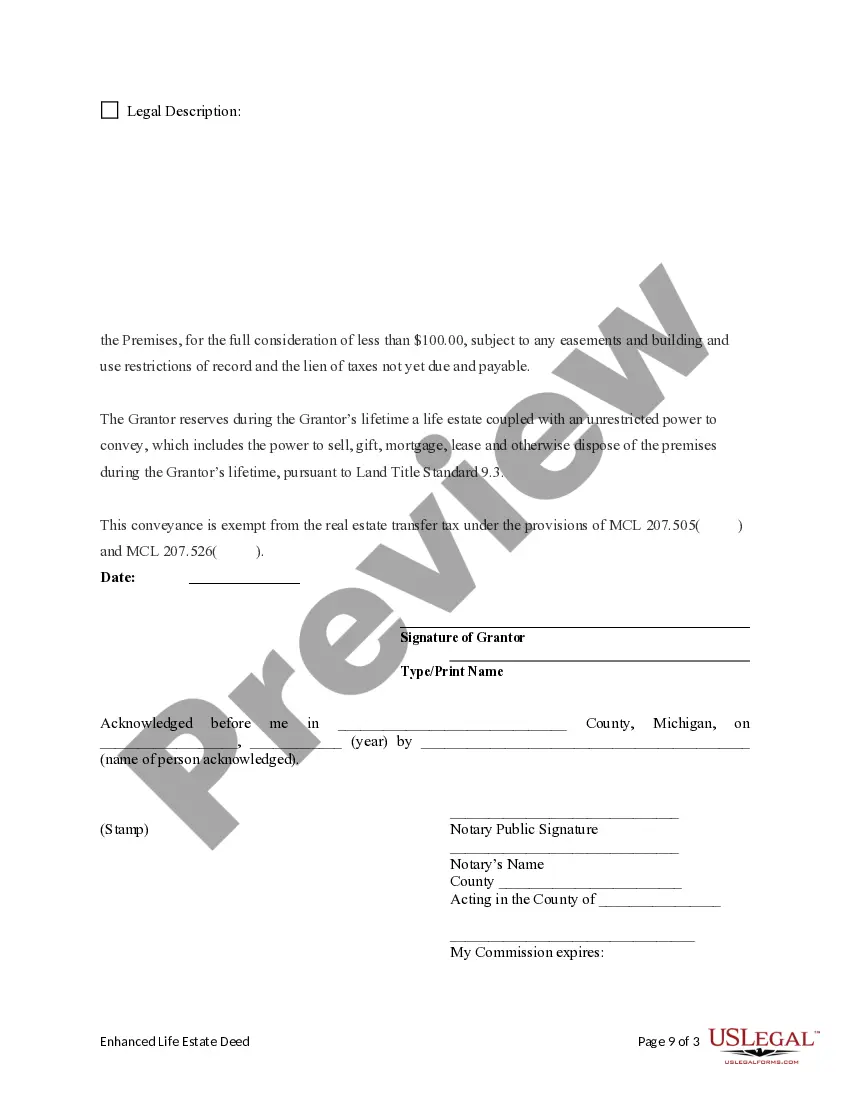
Enhanced Life Estate Deed Example
Description

Get your form ready online
Our built-in tools help you complete, sign, share, and store your documents in one place.
Make edits, fill in missing information, and update formatting in US Legal Forms—just like you would in MS Word.
Download a copy, print it, send it by email, or mail it via USPS—whatever works best for your next step.
Sign and collect signatures with our SignNow integration. Send to multiple recipients, set reminders, and more. Go Premium to unlock E-Sign.
If this form requires notarization, complete it online through a secure video call—no need to meet a notary in person or wait for an appointment.
We protect your documents and personal data by following strict security and privacy standards.

Make edits, fill in missing information, and update formatting in US Legal Forms—just like you would in MS Word.

Download a copy, print it, send it by email, or mail it via USPS—whatever works best for your next step.

Sign and collect signatures with our SignNow integration. Send to multiple recipients, set reminders, and more. Go Premium to unlock E-Sign.

If this form requires notarization, complete it online through a secure video call—no need to meet a notary in person or wait for an appointment.

We protect your documents and personal data by following strict security and privacy standards.
Looking for another form?
How to fill out Michigan Enhanced Life Estate Or Lady Bird Deed - Individual To Four Individuals?
The Improved Life Estate Deed Sample you observe on this page is a versatile legal template crafted by experienced attorneys in adherence to federal and state statutes and regulations.
For over 25 years, US Legal Forms has delivered individuals, businesses, and legal practitioners with more than 85,000 validated, state-specific documents for any professional and personal occasion. It’s the quickest, easiest, and most reliable method to acquire the paperwork you require, as the service ensures the utmost level of data protection and anti-malware safeguards.
Subscribe to US Legal Forms to access verified legal templates for all of life's situations at your convenience.
- Search for the document you require and examine it.
- Register and Log In.
- Obtain the editable template.
- Complete and sign the documents.
- Re-download your forms as needed.
Form popularity
FAQ
The ELE deed is designed to enable a grantor to retain title to real property for the duration of the grantor's lifetime and transfer the real property to a named beneficiary upon the grantor's death without the need to go through probate.
As of now, South Carolina law does not permit the use of TOD deeds to transfer ownership of real estate. Instead, other estate planning tools, such as joint tenancy or a living trust, can be used to avoid probate for real estate.
The Florida Enhanced Life Estate Deed Unlike standard-life-estate-deed beneficiaries, the beneficiaries named in an enhanced life estate deed do not get the property immediately upon the deed's execution. Instead, the property is transferred upon the death of the deed's creator.
For starters, lady bird deeds are not recognized in South Carolina. This means that our clients in South Carolina are not able to take advantage of this loophole whereas clients in North Carolina can. ingly, in South Carolina individuals are more likely to have a traditional life estate deed recommended to them.
A grantor of a lady bird deed retains part of the ownership as an enhanced life estate in the property during their lifetime. In other words, a lady bird deed functions as a quit claim deed that only becomes effective after death under Florida law.