Llc Stands For Limited Liability Corporation
Description

Get your form ready online
Our built-in tools help you complete, sign, share, and store your documents in one place.
Make edits, fill in missing information, and update formatting in US Legal Forms—just like you would in MS Word.
Download a copy, print it, send it by email, or mail it via USPS—whatever works best for your next step.
Sign and collect signatures with our SignNow integration. Send to multiple recipients, set reminders, and more. Go Premium to unlock E-Sign.
If this form requires notarization, complete it online through a secure video call—no need to meet a notary in person or wait for an appointment.
We protect your documents and personal data by following strict security and privacy standards.

Make edits, fill in missing information, and update formatting in US Legal Forms—just like you would in MS Word.

Download a copy, print it, send it by email, or mail it via USPS—whatever works best for your next step.

Sign and collect signatures with our SignNow integration. Send to multiple recipients, set reminders, and more. Go Premium to unlock E-Sign.

If this form requires notarization, complete it online through a secure video call—no need to meet a notary in person or wait for an appointment.

We protect your documents and personal data by following strict security and privacy standards.
Looking for another form?
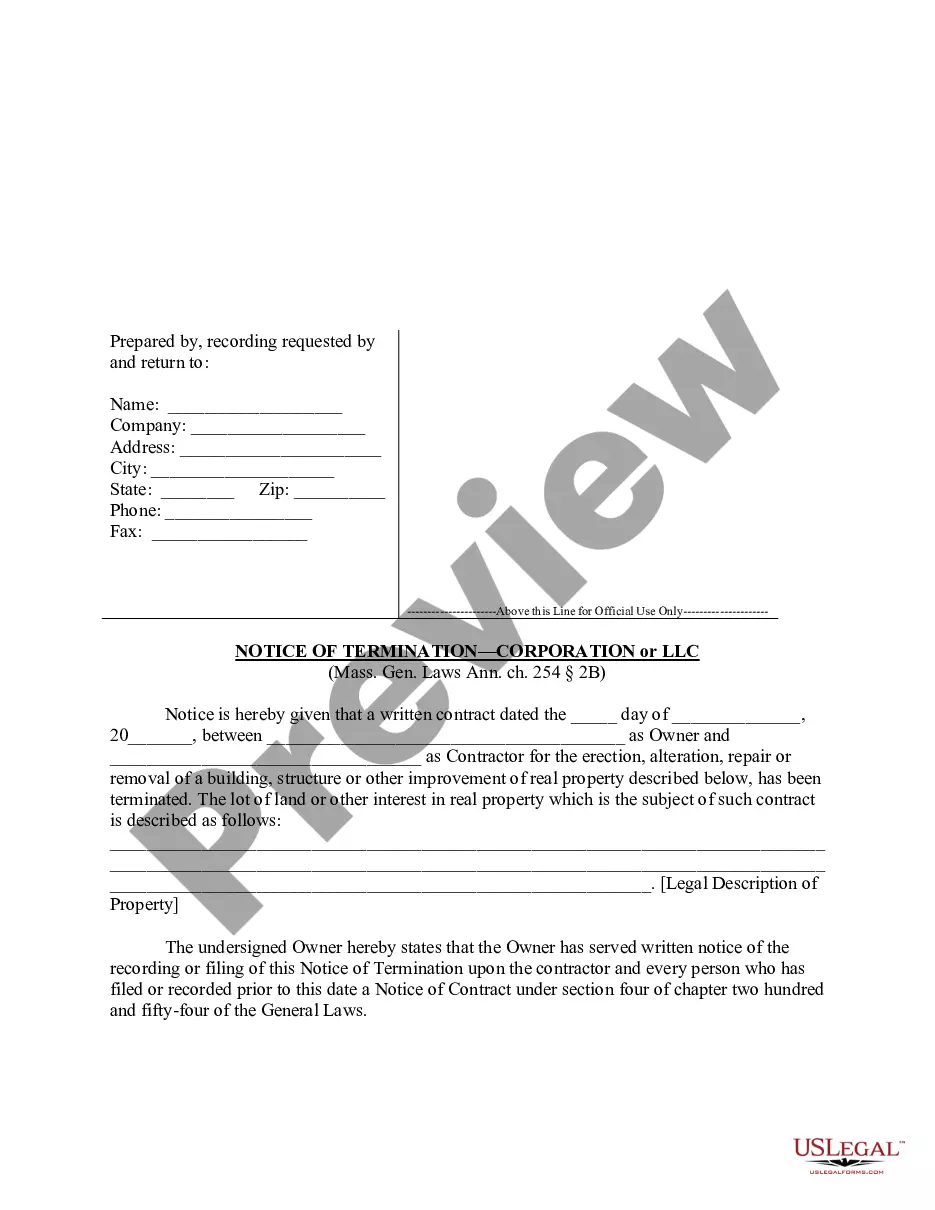
How to fill out Massachusetts Notice Of Termination By Corporation Or LLC?
- If you are a returning user, simply log in to your account and find the form template you need. Ensure your subscription is active; if it isn't, renew it according to your plan.
- For first-time users, begin by browsing the Preview mode. Check the form descriptions carefully to select the appropriate document that aligns with your local jurisdiction.
- If you encounter any discrepancies, utilize the Search tab to explore other relevant templates before proceeding.
- Click on the Buy Now button to purchase the document, and choose a subscription plan that fits your needs. Creating an account will grant you access to the extensive resources available.
- Provide your payment details through credit card or PayPal, ensuring your purchase is processed smoothly.
- Once your transaction is complete, download your selected form and save it on your device. Access it anytime via the My Forms section of your profile.
US Legal Forms offers a robust collection of more than 85,000 fillable and editable legal forms, surpassing many competitors. This extensive library not only streamlines document preparation but also assures users of premium expert assistance, ensuring accuracy and legal compliance.
Take the stress out of legal documentation—start your journey with US Legal Forms today!
Form popularity
FAQ
To file an LLC as an S Corp, you need to complete IRS Form 2553 after your LLC has been established. This election allows your LLC to be taxed as an S corporation, which can provide tax benefits. It's essential to ensure that you meet certain criteria, such as having fewer than 100 shareholders and being a domestic entity. For a streamlined process, consider using uslegalforms, which offers resources and guidance for filing your LLC correctly.
An LLC can generate various types of income, such as profits from sales, services, or investments. The income earned by an LLC is typically reported on the personal tax returns of the members unless the LLC elects a specific tax classification. This pass-through taxation helps members avoid double taxation, which is a significant benefit of the LLC structure. Understanding that LLC stands for limited liability corporation can help clarify its advantages in wealth building.
An LLC can elect to be taxed as either an S corporation or a C corporation. However, it is inherently a separate legal structure under state law, known as the limited liability corporation. This means that you have the flexibility to choose the tax treatment that best suits your business needs, providing options that align with your financial goals. It's important to consult a tax advisor to make the right choice as you move forward.
Yes, an LLC does count as a business. It provides a formal structure for operating a business while protecting your personal assets from liability. By registering an LLC, you create a distinct legal entity that can conduct business activities, enter contracts, and own property. Therefore, understanding that LLC stands for limited liability corporation is crucial in recognizing its role as a legitimate business entity.
If you own an LLC, you are commonly referred to as a member. LLCs can have multiple members, or they can be a single-member LLC. This structure provides flexibility in management and ownership. Remember, LLC stands for limited liability corporation, which highlights the legal protections you have as a member.
An LLC stands for limited liability corporation, although it is often referred to as a limited liability company. This structure combines the benefits of a corporation's liability protection with the tax flexibility of a partnership. When considering your options, it's crucial to understand how this designation affects your business's legal and financial responsibilities. US Legal Forms can guide you through the setup, ensuring you make informed choices.
Choosing between an LLC and a corporation depends on your business needs. An LLC stands for limited liability corporation, offering flexibility in management and tax benefits. On the other hand, a corporation typically provides more structure and the ability to raise capital through stock sales. Evaluate your goals, and consider using US Legal Forms to help you navigate the decision-making process.
You can ascertain whether your LLC is classified as an S Corp or a C Corp by reviewing your tax filings. If your LLC elected to be treated as an S Corp, it would file IRS Form 1120S, while a C Corp would file Form 1120. Additionally, be mindful of the characteristics of each classification, since they have different tax implications. For comprehensive assistance, consider using US Legal Forms to help navigate these options.
To determine if your LLC has elected S Corp status, review your IRS tax filings. If your LLC filed Form 2553 with the IRS and it was approved, then your LLC is classified as an S corporation for tax purposes. It's also essential to ensure that you meet all the criteria needed for S Corp status. If you're unsure, consulting with a tax professional can provide clarity.
No, your LLC is not automatically classified as an S Corp. An LLC stands for limited liability corporation, and it can choose to be taxed as an S corporation by making an election with the IRS. However, you need to meet specific requirements to elect S Corp status, including having allowable shareholders and adhering to limits on the number of shareholders. Therefore, you must actively choose this classification.