Louisiana Katrina
Description
Get your form ready online
Our built-in tools help you complete, sign, share, and store your documents in one place.
Make edits, fill in missing information, and update formatting in US Legal Forms—just like you would in MS Word.
Download a copy, print it, send it by email, or mail it via USPS—whatever works best for your next step.
Sign and collect signatures with our SignNow integration. Send to multiple recipients, set reminders, and more. Go Premium to unlock E-Sign.
If this form requires notarization, complete it online through a secure video call—no need to meet a notary in person or wait for an appointment.
We protect your documents and personal data by following strict security and privacy standards.

Make edits, fill in missing information, and update formatting in US Legal Forms—just like you would in MS Word.

Download a copy, print it, send it by email, or mail it via USPS—whatever works best for your next step.

Sign and collect signatures with our SignNow integration. Send to multiple recipients, set reminders, and more. Go Premium to unlock E-Sign.

If this form requires notarization, complete it online through a secure video call—no need to meet a notary in person or wait for an appointment.

We protect your documents and personal data by following strict security and privacy standards.
Looking for another form?


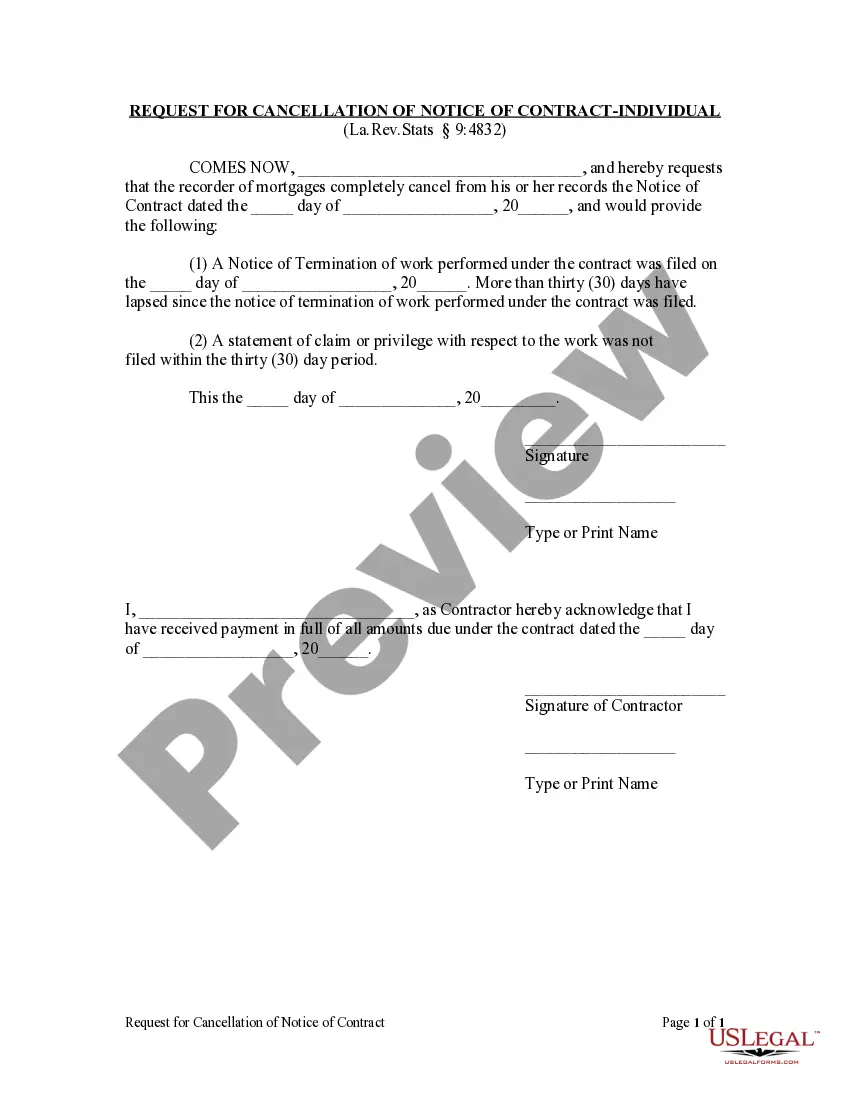
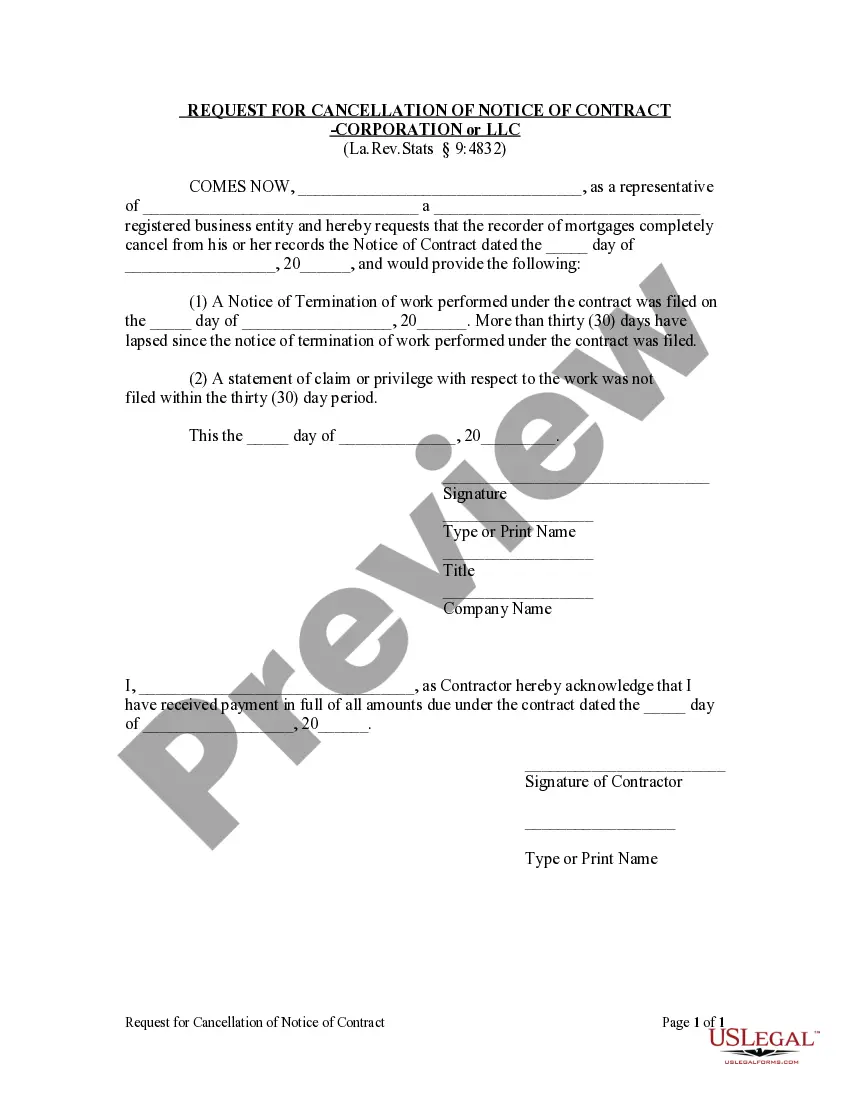
How to fill out Louisiana Request For Cancellation Of Notice Of Contract - Individual?
- If you're returning, log in to your account to access previously downloaded templates. Ensure your subscription is still active; if not, renew it based on your current plan.
- For first-time users, start by exploring the Preview mode to understand the selection of documents available. Look for Louisiana katrina forms that fit your legal needs and jurisdiction requirements.
- If you require a different form than the one presented, utilize the Search tab to find alternative templates relevant to your case.
- Once you've identified the required form, click the Buy Now button and examine the subscription options available. You will need to create an account to access the full library.
- Complete your purchase by entering your payment details, either through credit card or PayPal.
- After purchasing, download your chosen form to your device. You can also access it later from the My Forms section of your profile.
By following these steps, you can secure the legal documents you need quickly and effectively. US Legal Forms not only offers a robust collection but also the support of premium experts, ensuring that your documentation is accurate and legally compliant.
Ready to get started? Visit US Legal Forms today and experience the convenience of having over 85,000 legal forms at your fingertips!
Form popularity
FAQ
Filing an extension in Louisiana involves submitting a request to the state tax office, typically using Form R-540EXT. You can easily complete this process online or through mail. For those still facing challenges related to Louisiana Katrina, the USLegalForms platform provides helpful resources and templates to guide you through the necessary paperwork.
Hurricane Katrina is classified as a Category 5 storm in terms of its intensity before landfall. In Louisiana, it caused catastrophic damage and remains a pivotal event in the state's history. The aftermath reshaped policies and preparedness for future storms in Louisiana.
New Orleans was the city most severely impacted by Hurricane Katrina. The floodwaters inundated neighborhoods, displacing thousands of residents. This disaster left a lasting mark on Louisiana’s cultural heritage and community structure.
The Road Home program provides grants to Louisiana residents affected by Hurricane Katrina. It aims to assist homeowners in rebuilding or repairing their damaged properties. If you're navigating the aftermath of Louisiana Katrina, this program can be a vital resource to help restore your home.
Hurricane Katrina was classified as a Category 5 storm before it made landfall in Louisiana. However, when it struck New Orleans, it had weakened to a Category 3. Despite this reduction, the impact of Louisiana Katrina was devastating, causing extensive flooding and damage throughout the region.
While the majority of New Orleans has bounced back since Hurricane Katrina, low-lying areas can still face flooding during heavy rain and tropical storms. Ongoing efforts to improve drainage and restore wetlands are essential to mitigate future water issues. Exploring these areas can provide insight into both the recovery process and the challenges Louisiana still faces.
Unfortunately, the search for missing individuals from Hurricane Katrina continues. As of recent reports, there are still over 1,800 bodies unaccounted for since the tragedy. This statistic highlights the severity of Louisiana Katrina and underscores the importance of resources and systems in place for those affected.
Louisiana has made significant strides in recovery since Hurricane Katrina struck in 2005. Many neighborhoods in New Orleans have been rebuilt, and infrastructure improvements are visible throughout the state. However, some areas still feel the lingering effects of Louisiana Katrina, reminding visitors of the resilience and ongoing efforts of the local community.
To reach areas affected by Hurricane Katrina, you can start by flying into major airports like Louis Armstrong New Orleans International Airport. From there, you can easily access New Orleans and the surrounding regions, where the impact of Louisiana Katrina is still evident. You may also consider renting a car for more flexibility as you explore the recovery sites and historical markers related to the disaster.
Yes, many residents left New Orleans after Hurricane Katrina, seeking safety and stability elsewhere. The population of New Orleans significantly decreased in the aftermath, as the city faced immense destruction. Those who returned found a city that was rebuilding but still in recovery, highlighting the ongoing effects of Louisiana Katrina on its communities.