Kansas At Will
Description

Get your form ready online
Our built-in tools help you complete, sign, share, and store your documents in one place.
Make edits, fill in missing information, and update formatting in US Legal Forms—just like you would in MS Word.
Download a copy, print it, send it by email, or mail it via USPS—whatever works best for your next step.
Sign and collect signatures with our SignNow integration. Send to multiple recipients, set reminders, and more. Go Premium to unlock E-Sign.
If this form requires notarization, complete it online through a secure video call—no need to meet a notary in person or wait for an appointment.
We protect your documents and personal data by following strict security and privacy standards.

Make edits, fill in missing information, and update formatting in US Legal Forms—just like you would in MS Word.

Download a copy, print it, send it by email, or mail it via USPS—whatever works best for your next step.

Sign and collect signatures with our SignNow integration. Send to multiple recipients, set reminders, and more. Go Premium to unlock E-Sign.

If this form requires notarization, complete it online through a secure video call—no need to meet a notary in person or wait for an appointment.

We protect your documents and personal data by following strict security and privacy standards.
Looking for another form?

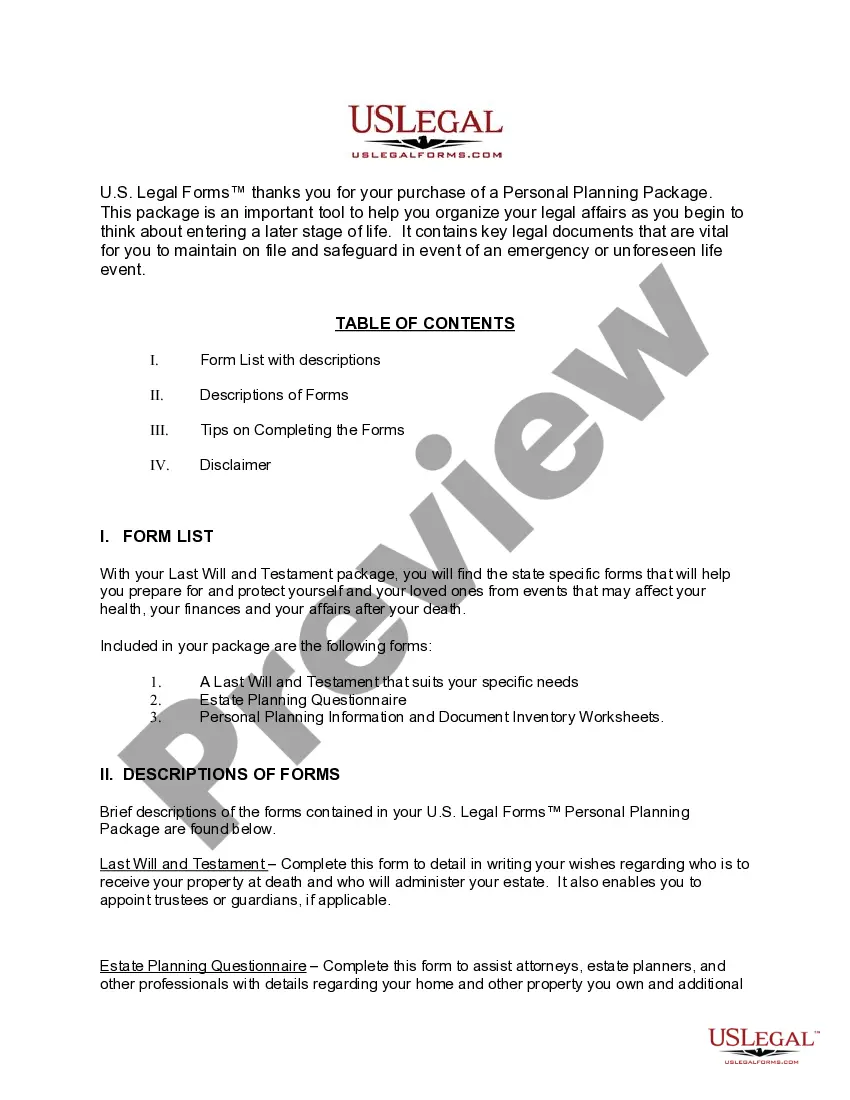
How to fill out Kansas Last Will And Testament Package?
Handling legal paperwork can be daunting, even for the most experienced experts.
When you're looking for a Kansas At Will and lack the time to dedicate to finding the correct and up-to-date version, the process can be stressful.
US Legal Forms caters to all your requirements, ranging from personal to corporate documents, all in one location.
Leverage advanced tools to complete and manage your Kansas At Will.
Here are the steps to follow after downloading the necessary form: Confirm this is the correct form by previewing it and reviewing its details. Ensure that the template is accepted in your state or county. Click Buy Now when you are prepared. Select a monthly subscription plan. Locate the format you need, and Download, complete, sign, print, and submit your document. Enjoy the US Legal Forms online catalog, supported by 25 years of experience and reliability. Transform your everyday document management into a simple and user-friendly process today.
- Access a valuable database of articles, guides, and resources pertinent to your circumstances and requirements.
- Save time and energy searching for the documents you require, and utilize US Legal Forms’ advanced search and Preview feature to locate Kansas At Will and acquire it.
- If you hold a monthly subscription, Log In to your US Legal Forms account, search for the document, and obtain it.
- Check your My documents tab to review the documents you have previously downloaded and manage your files as needed.
- If this is your first time using US Legal Forms, create an account to gain unlimited access to all the benefits of the library.
- A robust online form repository can revolutionize how individuals manage these scenarios effectively.
- US Legal Forms is a frontrunner in digital legal documentation, featuring over 85,000 state-specific legal forms available to you at any moment.
- With US Legal Forms, you can access state- or county-specific legal and business templates.
Form popularity
FAQ
The most common types of employment forms to complete are: W-4 form (or W-9 for contractors) I-9 Employment Eligibility Verification form. State Tax Withholding form.
At-will Employment in Kansas Under the doctrine of at-will employment, either the employer or the employee can terminate the employment relationship at any time. It can be for any reason, and no advance notice is required unless some kind of agreement exists that states otherwise.
New Hire Paperwork: Kansas Form K-4. To continue reading, register for free access now. Kansas Certificate of Tax Clearance. To continue reading, register for free access now. Non-Smoking Policy. ... Pay Notification. ... Other New Hire Paperwork. ... Future Developments. ... Additional Resources.
A valid will in Kansas must be: In writing. Signed at the end by the person making the will (testator) or by someone else in the presence of and at the express direction of the testator. Signed by two or more competent witnesses who saw the testator sign the will or heard him or her acknowledge the will.
Although a last will and testament is not legally required, without a will, state laws (called laws of intestacy) will determine the distribution of the deceased's assets.