Indiana Implied Consent Card Format
Description

Get your form ready online
Our built-in tools help you complete, sign, share, and store your documents in one place.
Make edits, fill in missing information, and update formatting in US Legal Forms—just like you would in MS Word.
Download a copy, print it, send it by email, or mail it via USPS—whatever works best for your next step.
Sign and collect signatures with our SignNow integration. Send to multiple recipients, set reminders, and more. Go Premium to unlock E-Sign.
If this form requires notarization, complete it online through a secure video call—no need to meet a notary in person or wait for an appointment.
We protect your documents and personal data by following strict security and privacy standards.

Make edits, fill in missing information, and update formatting in US Legal Forms—just like you would in MS Word.

Download a copy, print it, send it by email, or mail it via USPS—whatever works best for your next step.

Sign and collect signatures with our SignNow integration. Send to multiple recipients, set reminders, and more. Go Premium to unlock E-Sign.

If this form requires notarization, complete it online through a secure video call—no need to meet a notary in person or wait for an appointment.

We protect your documents and personal data by following strict security and privacy standards.
Looking for another form?




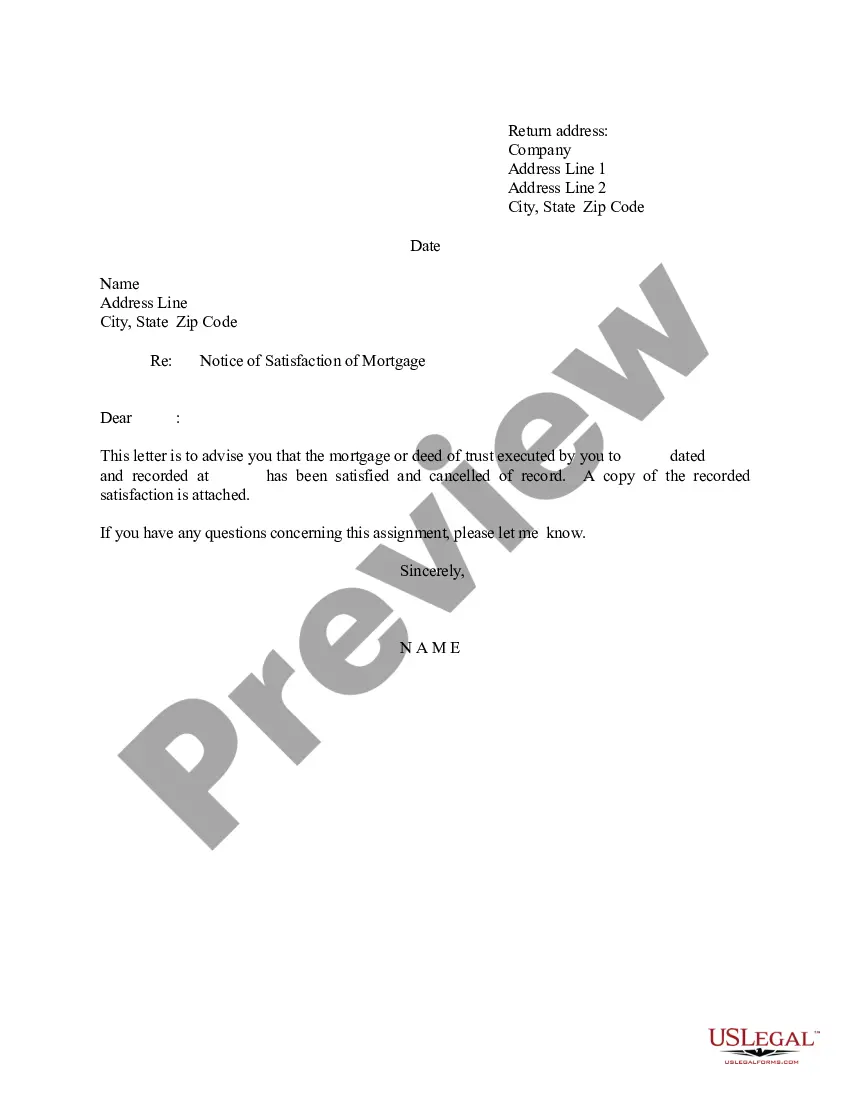
How to fill out Indiana Satisfaction, Cancellation Or Release Of Mortgage Package?
Regardless of whether it is for commercial reasons or personal matters, everyone is required to handle legal circumstances at some point in their lives.
Completing legal paperwork demands meticulous focus, starting from choosing the correct form template. For example, if you select an incorrect version of the Indiana Implied Consent Card Template, it will be rejected when you submit it. Thus, it is essential to have a reliable source of legal documents like US Legal Forms.
With an extensive US Legal Forms catalog available, you do not need to waste time searching for the correct template online. Utilize the library’s user-friendly navigation to find the suitable form for any occasion.
- Obtain the template you require by using the search bar or directory navigation.
- Review the form’s details to ensure it fits your circumstance, state, and locality.
- Click on the form’s preview to inspect it.
- If it is not the correct document, return to the search feature to find the Indiana Implied Consent Card Template you need.
- Acquire the file when it meets your requirements.
- If you possess a US Legal Forms account, simply click Log in to access previously stored templates in My documents.
- If you do not yet have an account, you can get the form by clicking Buy now.
- Select the appropriate pricing option.
- Complete the account registration form.
- Choose your payment method: you can utilize a credit card or PayPal account.
- Select the document format you desire and download the Indiana Implied Consent Card Template.
- Once it is saved, you can fill out the form using editing software or print it and complete it manually.
Form popularity
FAQ
Implied consent is indeed a form of consent, specifically tailored to situations involving driving. In Indiana, this means that by using the roads, you consent to testing for alcohol and drugs if suspected of impairment. The Indiana implied consent card format is designed to clarify this concept for drivers, making it easier to understand their rights and obligations. Utilizing platforms like uslegalforms can provide you with valuable resources to navigate these legal requirements effectively.
Yes, implied consent remains a valid form of consent, particularly in the context of driving. When you operate a vehicle in Indiana, you are implicitly agreeing to abide by the state’s laws, including submitting to chemical tests when required. The Indiana implied consent card format reinforces this agreement, ensuring that drivers understand their obligations. Awareness of this concept can significantly impact your legal standing in the event of a traffic stop.
Yes, Indiana has established implied consent laws that mandate drivers to consent to sobriety tests if suspected of driving under the influence. This means that by driving on Indiana roads, you are automatically agreeing to these tests. The Indiana implied consent card format is essential for law enforcement and drivers alike, ensuring clarity in these situations. Familiarizing yourself with these laws can help you make informed decisions on the road.
Yes, implied consent laws are generally considered constitutional in the United States, including Indiana. These laws require drivers to consent to chemical tests for intoxication when operating a vehicle. By obtaining a driver's license, individuals agree to this condition, making the Indiana implied consent card format a crucial aspect of compliance. Understanding the constitutional basis helps drivers navigate their rights and responsibilities.
What is DUI Implied Consent? Under Indiana law (I.C. 9-30-6), when you obtain a driver's license, you give consent to submit to chemical testing if the police have probable cause to believe you are operating a vehicle while intoxicated.
The laws regarding implied consent in Indiana are located in Indiana Code 9-30-6. Generally, this law means that any person who chooses to operate a vehicle in Indiana is also giving their consent to submit to a certified chemical test.
What is DUI Implied Consent? Under Indiana law (I.C. 9-30-6), when you obtain a driver's license, you give consent to submit to chemical testing if the police have probable cause to believe you are operating a vehicle while intoxicated.
The laws regarding implied consent in Indiana are located in Indiana Code 9-30-6. Generally, this law means that any person who chooses to operate a vehicle in Indiana is also giving their consent to submit to a certified chemical test.
In Indiana, the requirement to obtain informed consent is imposed by statute. Indiana Code Sec. 34-18-13-3 requires Indiana physicians to obtain their patient's ?informed consent? before any ?treatment, procedure test, or examination? is performed by the physician.