Action For Reconveyance Philippines
Description
Get your form ready online
Our built-in tools help you complete, sign, share, and store your documents in one place.
Make edits, fill in missing information, and update formatting in US Legal Forms—just like you would in MS Word.
Download a copy, print it, send it by email, or mail it via USPS—whatever works best for your next step.
Sign and collect signatures with our SignNow integration. Send to multiple recipients, set reminders, and more. Go Premium to unlock E-Sign.
If this form requires notarization, complete it online through a secure video call—no need to meet a notary in person or wait for an appointment.
We protect your documents and personal data by following strict security and privacy standards.

Make edits, fill in missing information, and update formatting in US Legal Forms—just like you would in MS Word.

Download a copy, print it, send it by email, or mail it via USPS—whatever works best for your next step.

Sign and collect signatures with our SignNow integration. Send to multiple recipients, set reminders, and more. Go Premium to unlock E-Sign.

If this form requires notarization, complete it online through a secure video call—no need to meet a notary in person or wait for an appointment.

We protect your documents and personal data by following strict security and privacy standards.
Looking for another form?









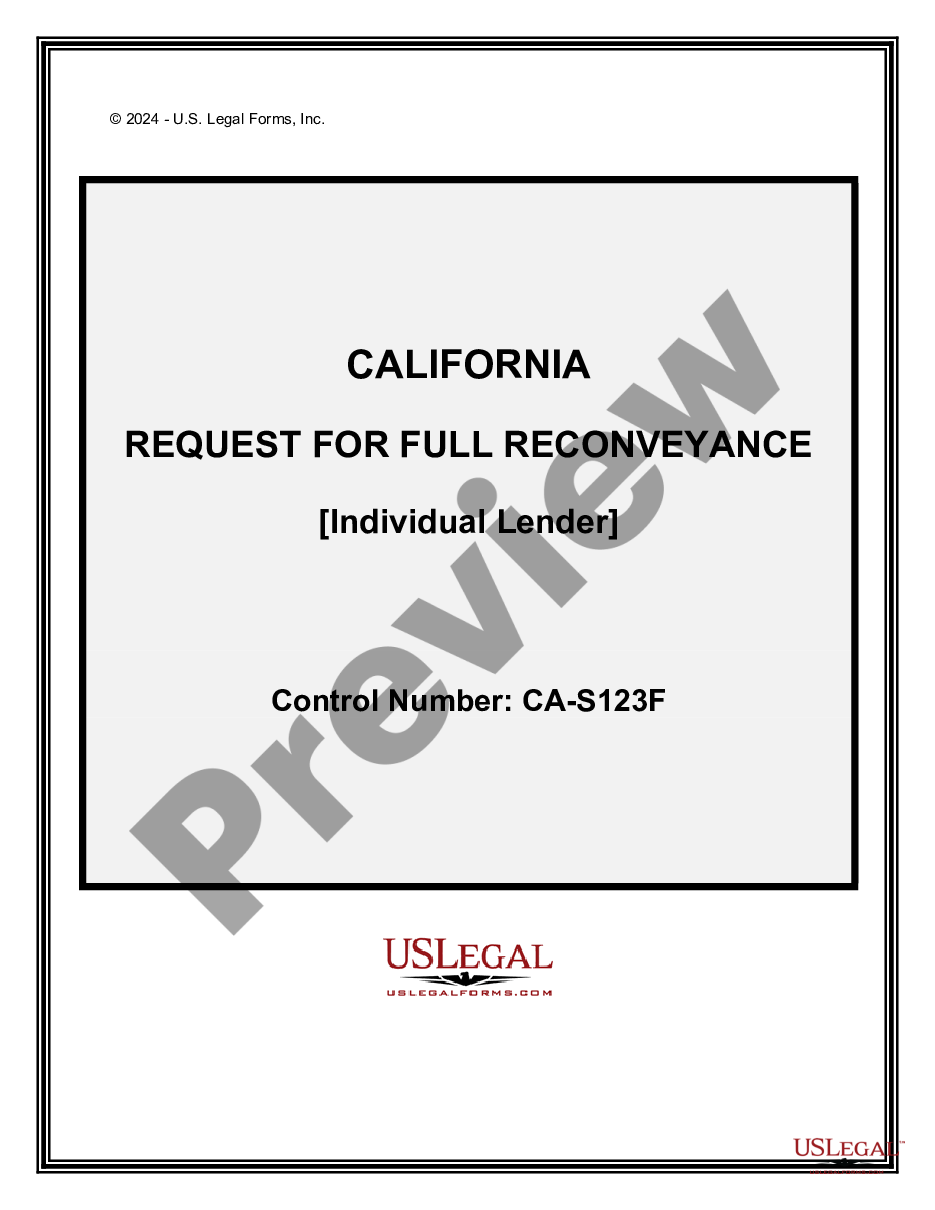
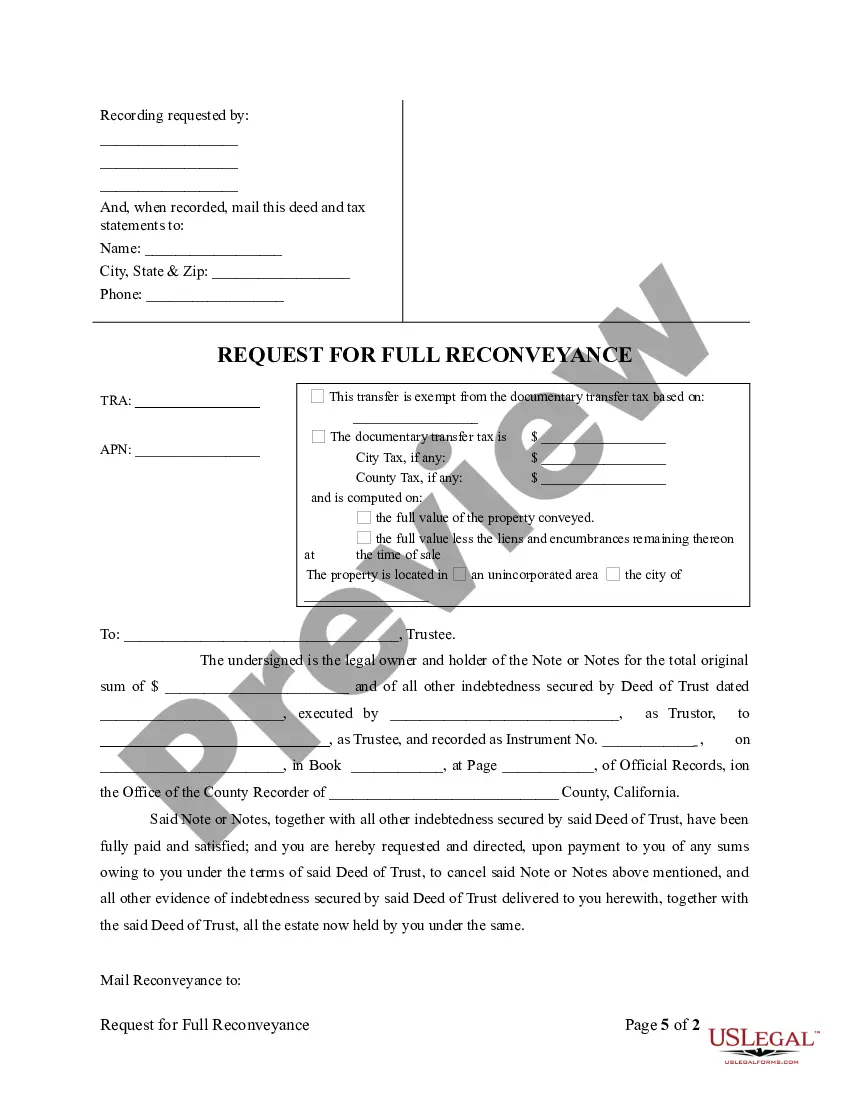
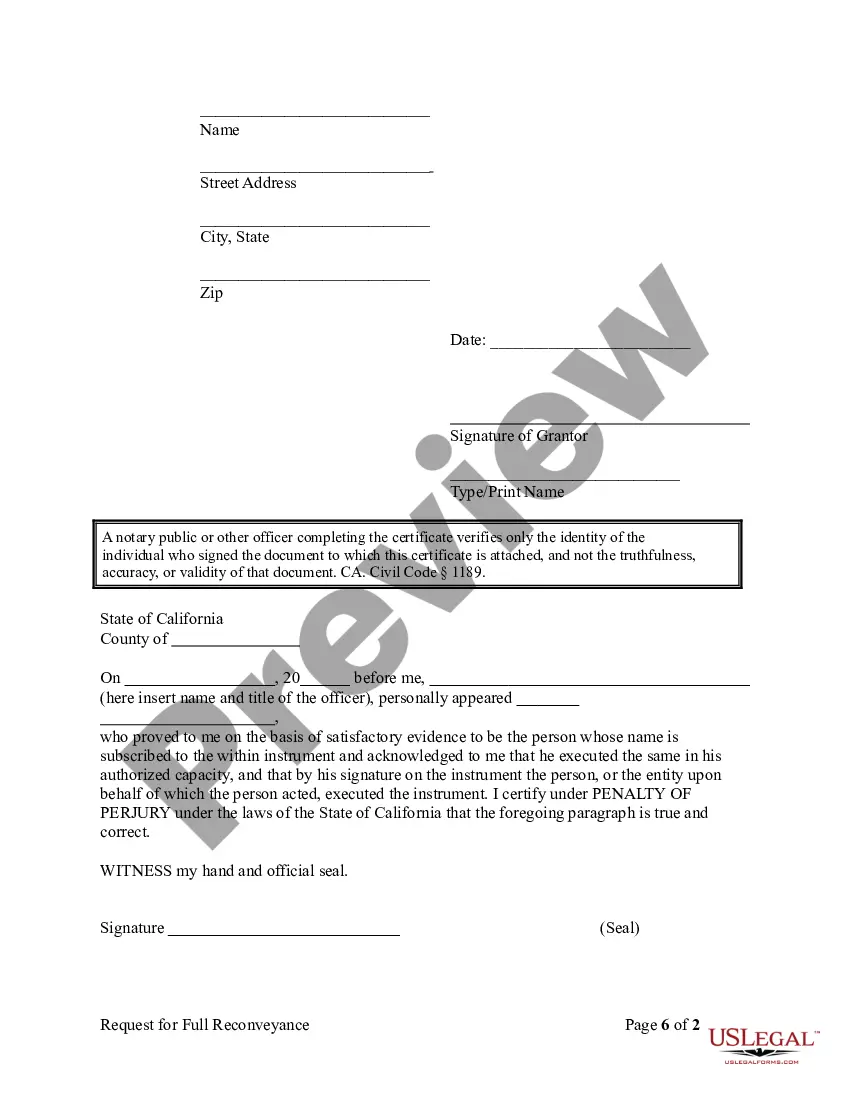
How to fill out California Request For Reconveyance Of Deed Of Trust By Individual?
- Start by logging into your US Legal Forms account. If you're a new user, register first to create an account.
- Once logged in, search for the Action for reconveyance form in the online library. Utilize the preview mode to ensure you select the right document that aligns with your local jurisdiction requirements.
- If needed, use the search functionality to find alternative templates that might better suit your needs.
- After finding the correct form, click the 'Buy Now' button to select your preferred subscription plan. Make sure your account is set up for seamless access.
- Proceed to make your payment using a credit card or PayPal. Confirm your subscription plan to access various resources.
- Once your payment is processed, download the form directly to your device. You can also find it later in the 'My Forms' section of your account.
Using US Legal Forms ensures you have access to a vast library of over 85,000 editable legal documents. This empowers users to create precise legal forms easily.
Don't wait—start using US Legal Forms today to simplify your legal document needs and ensure compliance with local requirements.
Form popularity
FAQ
Filing an adverse claim on a property in the Philippines requires you to gather necessary documents that support your claim. Next, draft a formal letter detailing your adverse claim and include evidence of your possession. Finally, submit this documentation to the Registry of Deeds while ensuring you comply with all legal requirements. Utilizing platforms like USLegalForms can simplify this process, making your action for reconveyance in the Philippines more straightforward.
In the Philippines, you must file a motion for reconsideration within 15 days from receiving the decision or order you wish to contest. This timeframe is crucial for ensuring your appeal is considered by the court. Acting promptly can significantly impact your case, particularly in matters related to property disputes and actions for reconveyance in the Philippines.
The rule on adverse claims in the Philippines allows a property owner or claimant to assert a right against a property they do not possess. This claim must be based on clear evidence and must be filed within a certain timeframe. It serves as a legal safeguard for anyone looking to protect their interests in a property, especially when pursuing an action for reconveyance in the Philippines.
To claim adverse possession in the Philippines, you must meet specific requirements. You must possess the property openly, continuously, and without the owner's permission for at least ten years. Additionally, you should demonstrate that your possession is exclusive and adverse to the rights of the true owner. Understanding these conditions is essential for any action for reconveyance in the Philippines.
The easement law in the Philippines governs the right to use someone else's property for a specific purpose, such as access or utility installation. This law aims to balance individual rights with community needs. If disputes arise from easements, the action for reconveyance Philippines can provide a framework for resolution.
An adverse claim's validity in the Philippines extends for 30 years. Within this period, the claimant must pursue their rights or risk losing them. Understanding the nuances of the action for reconveyance Philippines is vital for addressing disputes over adverse claims.
In the Philippines, property owners have rights including full control over property use, the ability to sell or lease, and the right to defend against unlawful claims. These rights are fundamental and protect the owner's interest. The action for reconveyance Philippines can be a vital tool to enforce these rights when challenged.
An adverse claim in the Philippines is a notification filed to assert rights over a property by a party who believes they have a legitimate interest. This claim can pose challenges for property owners and may lead to disputes. Knowing how to navigate the action for reconveyance Philippines can help address and resolve such claims.
The hidden treasure law in the Philippines refers to the legal framework governing the discovery and ownership of buried treasure. According to this law, the finder may keep a portion of the treasure while reporting it to authorities. Understanding your rights under this law can be essential, especially in conjunction with the action for reconveyance Philippines.
The action for reconveyance in the Philippines is a legal remedy available to individuals seeking to reclaim property that has been wrongfully transferred or misidentified. It provides a mechanism to rectify issues of title and possession over real estate. This action is particularly relevant for those involved in adverse claims or property disputes.