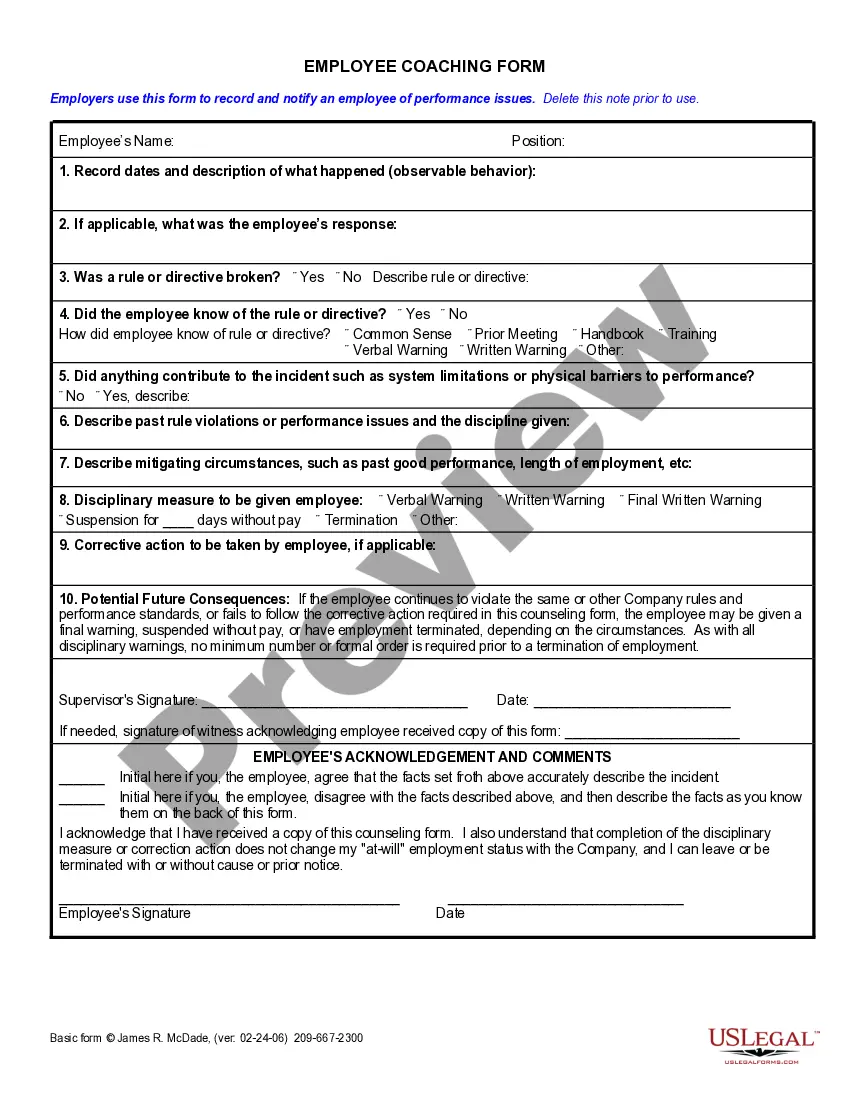
Employee Coaching Template With Time
Description
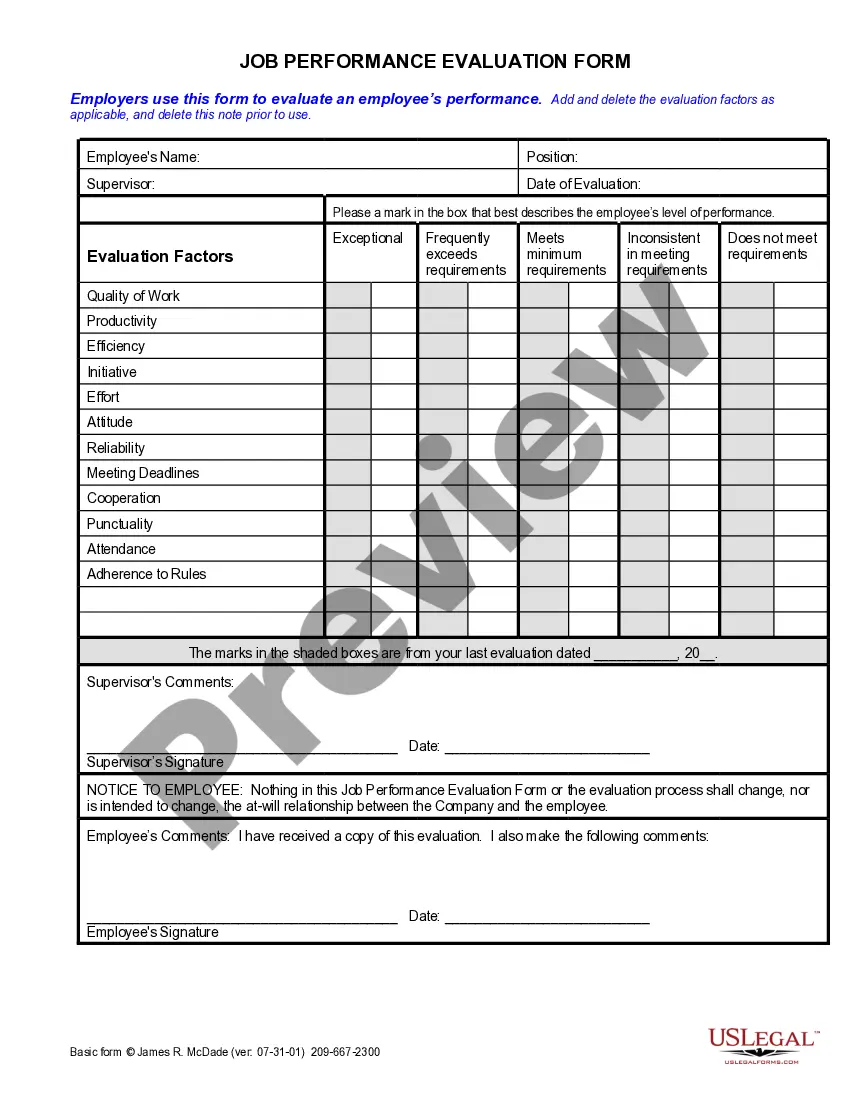
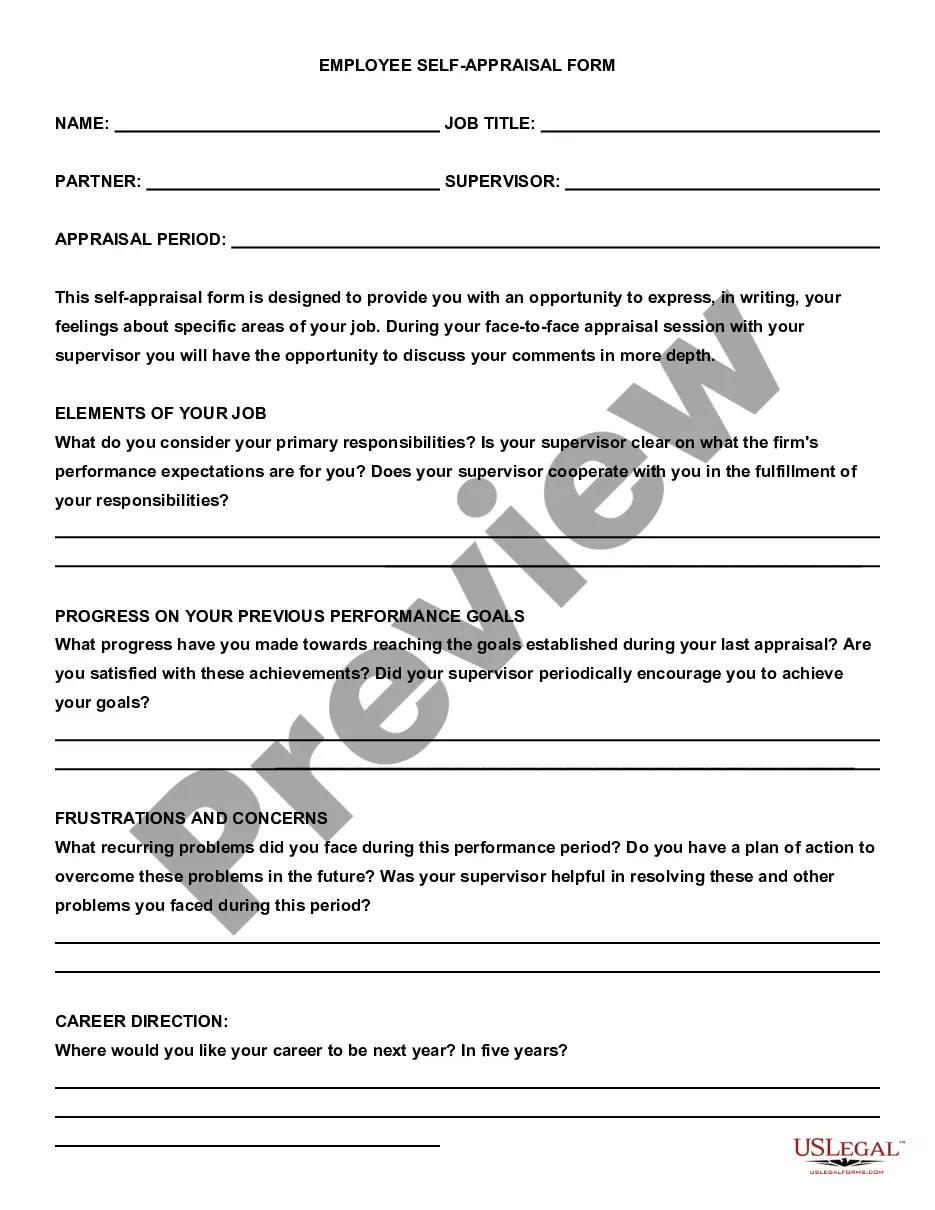
Get your form ready online
Our built-in tools help you complete, sign, share, and store your documents in one place.
Make edits, fill in missing information, and update formatting in US Legal Forms—just like you would in MS Word.
Download a copy, print it, send it by email, or mail it via USPS—whatever works best for your next step.
Sign and collect signatures with our SignNow integration. Send to multiple recipients, set reminders, and more. Go Premium to unlock E-Sign.
If this form requires notarization, complete it online through a secure video call—no need to meet a notary in person or wait for an appointment.
We protect your documents and personal data by following strict security and privacy standards.

Make edits, fill in missing information, and update formatting in US Legal Forms—just like you would in MS Word.

Download a copy, print it, send it by email, or mail it via USPS—whatever works best for your next step.

Sign and collect signatures with our SignNow integration. Send to multiple recipients, set reminders, and more. Go Premium to unlock E-Sign.

If this form requires notarization, complete it online through a secure video call—no need to meet a notary in person or wait for an appointment.

We protect your documents and personal data by following strict security and privacy standards.
Looking for another form?








How to fill out California Employee Coaching Form?
Legal documentation management can be daunting, even for the most skilled professionals.
When you are searching for an Employee Coaching Template With Time and lack the time to dedicate to finding the suitable and current version, the process can be frustrating.
Access state- or county-specific legal and business forms. US Legal Forms accommodates any requirements you might have, from personal to business documents, all in one location.
Utilize advanced tools to complete and manage your Employee Coaching Template With Time.
Here are the steps to follow after obtaining the form you seek: Validate that this is the appropriate form by previewing it and reviewing its description.
- Gain entry to a resource collection of articles, guides, manuals, and materials pertinent to your situation and requirements.
- Save time and effort in searching for the documents you need, and leverage US Legal Forms’ sophisticated search and Review tool to locate Employee Coaching Template With Time and retrieve it.
- If you possess a monthly subscription, Log In to your US Legal Forms account, find the form, and retrieve it.
- Check your My documents section to view the documents you have previously downloaded and manage your folders as you wish.
- If it’s your first encounter with US Legal Forms, create an account to gain unlimited access to all platform benefits.
- A robust online form directory could be transformative for anyone looking to navigate these scenarios effectively.
- US Legal Forms is a frontrunner in online legal documents, offering more than 85,000 state-specific legal forms at any moment.
- With US Legal Forms, you can.
Form popularity
FAQ
The 5 C's of coaching include Clarity, Communication, Commitment, Competence, and Continual Improvement. Each of these elements plays a vital role in fostering a productive coaching environment. For instance, using an employee coaching template with time can help enhance clarity and communication between the coach and the employee. By focusing on these principles, you can ensure effective coaching that leads to measurable results.
Documenting employee coaching requires you to maintain detailed records throughout the process. Use the employee coaching template with time effectively by noting key discussions, action items, and milestones reached. Regularly review and update this documentation to track progress and challenges over time. This will not only help in evaluating the coaching outcome but also serve as a valuable reference for future coaching sessions.
To fill out an employee coaching template with time, start by gathering the necessary information about the employee and the coaching goals. Clearly outline specific objectives, timelines, and actions needed for improvement. As you fill in the template, remember to keep it focused and straightforward, ensuring each section is completed fully. This approach will provide a clear roadmap for both you and the employee during the coaching process.
The 3 C's of coaching are Clarity, Communication, and Collaboration. Focusing on these elements helps to create a strong coaching relationship and fosters an environment conducive to growth. By implementing an Employee coaching template with time, you can ensure that clarity in objectives is maintained, communication flows freely, and collaboration is prioritized. This leads to a more engaged workforce and improved performance across teams.
The 7 P's of coaching include Purpose, Preparation, Process, People, Practice, Performance, and Reflection. These components create a comprehensive approach to effective coaching. By utilizing an Employee coaching template with time, you can structure each session to ensure that you cover all essential aspects. This approach not only enhances the coaching experience but also drives better results for employees and the organization.
How to create a coaching plan Establish the employees' strengths. ... Locate any areas of improvement. ... Ask the employee to evaluate their performance. ... Determine any obstacles in the way of the employee's success. ... Provide potential solutions to help the employee overcome the obstacle. ... Develop short-term and long-term goals.
How to coach employees effectively Praise achievements and growth. ... Identify any performance issues they're facing. ... Explain why this change or development is important. ... Ask the employee for their perspective. ... Identify barriers to improvement. ... Collaborate on solutions. ... Set SMART goals with them. ... Write out the action plan.
Here's a detailed breakdown of the process: Step 1: Establish Objectives. Identify what you want to accomplish in the session. ... Step 2: Develop an Agenda. ... Step 3: Identify Required Resources. ... Step 4: Plan Your Methods. ... Step 5: Prepare for Evaluation and Follow-Up.
Coaching Plans For Employees Establishing their strengths. Identifying potential development areas. Giving them a chance to self-assess their performance. Identifying obstacles that prevent them from improving their performance. Offering possible solutions to help them overcome their challenges. Helping them set goals.
Clients fill out the coaching form, providing personal details, contact information, and relevant background data. During coaching sessions, they identify their current challenges, goals, and specific areas they want to focus on.