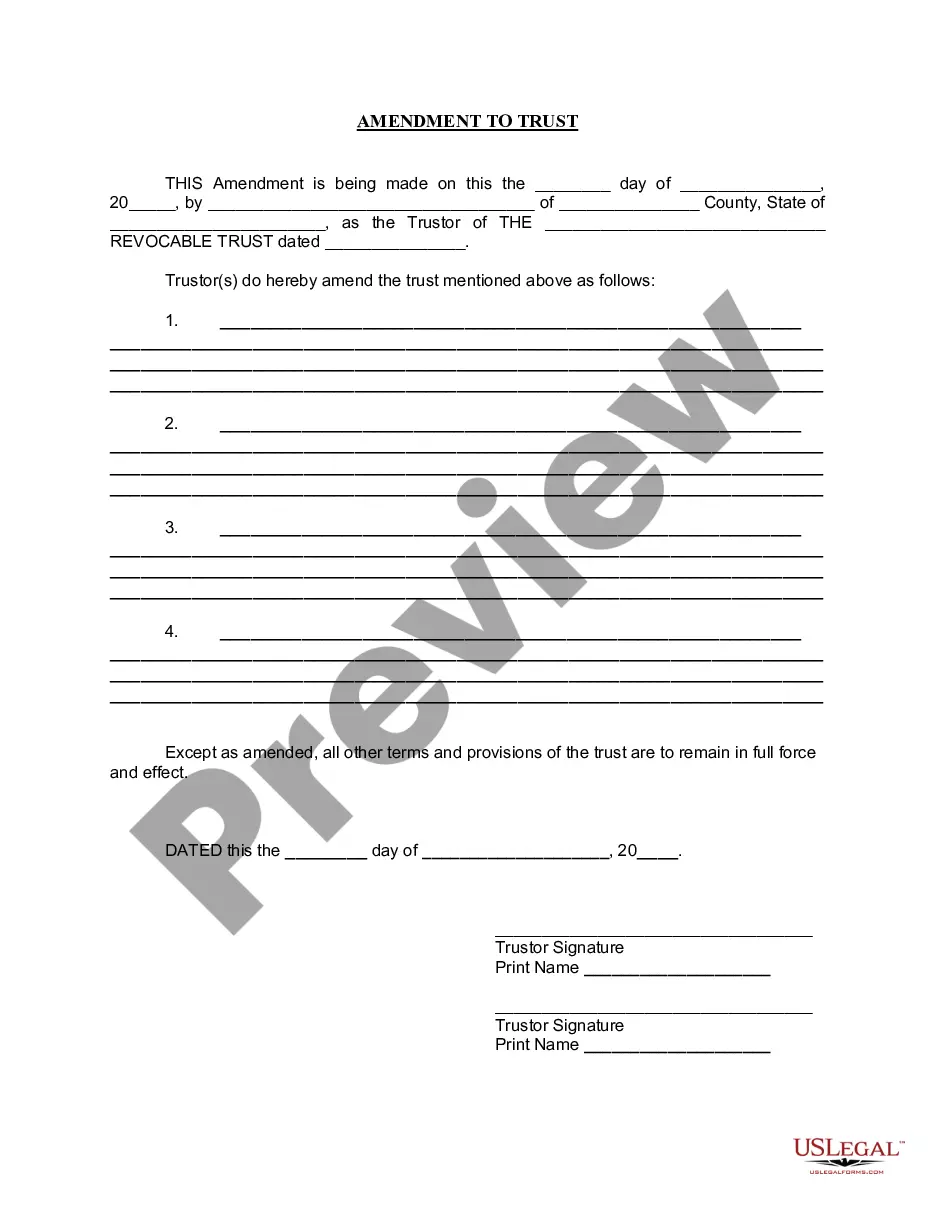
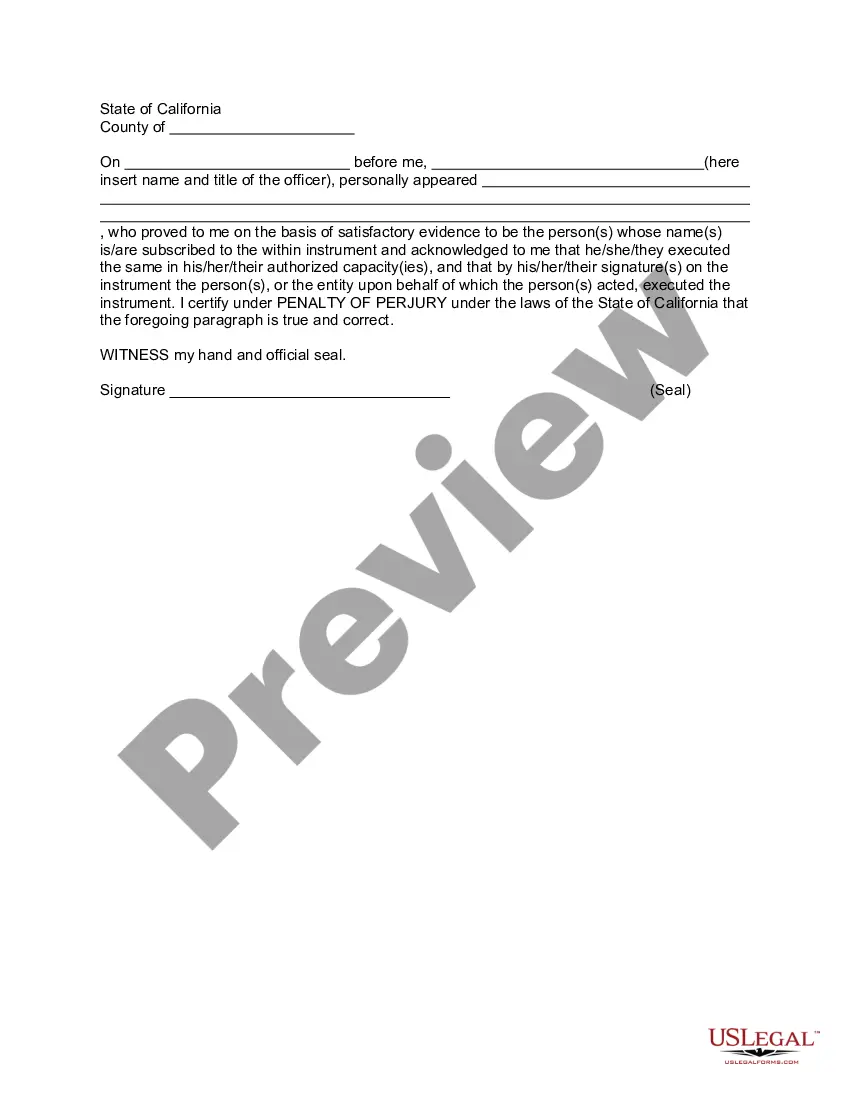
Revocable Living Trust Amendment Form California With Incapacity Clause

Description


Get your form ready online
Our built-in tools help you complete, sign, share, and store your documents in one place.
Make edits, fill in missing information, and update formatting in US Legal Forms—just like you would in MS Word.
Download a copy, print it, send it by email, or mail it via USPS—whatever works best for your next step.
Sign and collect signatures with our SignNow integration. Send to multiple recipients, set reminders, and more. Go Premium to unlock E-Sign.
If this form requires notarization, complete it online through a secure video call—no need to meet a notary in person or wait for an appointment.
We protect your documents and personal data by following strict security and privacy standards.

Make edits, fill in missing information, and update formatting in US Legal Forms—just like you would in MS Word.

Download a copy, print it, send it by email, or mail it via USPS—whatever works best for your next step.

Sign and collect signatures with our SignNow integration. Send to multiple recipients, set reminders, and more. Go Premium to unlock E-Sign.

If this form requires notarization, complete it online through a secure video call—no need to meet a notary in person or wait for an appointment.

We protect your documents and personal data by following strict security and privacy standards.
Looking for another form?


How to fill out California Amendment To Living Trust?
Legal management can be exasperating, even for seasoned experts.
When you are seeking a Revocable Living Trust Amendment Form California With Incapacity Clause and lack the opportunity to dedicate time to find the suitable and current version, the procedures can be distressing.
Gain access to a valuable repository of articles, guides, manuals, and resources pertinent to your circumstances and needs.
Save time and energy hunting for the forms you require, and employ US Legal Forms’ sophisticated search and Review feature to obtain Revocable Living Trust Amendment Form California With Incapacity Clause and secure it.
Ensure that the template is sanctioned in your state or county.
- If you have a subscription, Log In to your US Legal Forms account, look for the form, and download it.
- Check your My documents tab to view the documents you have previously acquired as well as manage your folders as you wish.
- If it's your first encounter with US Legal Forms, create a free account and gain unlimited access to all benefits of the library.
- Here are the actions to take after locating the form you require.
- Verify this is the accurate form by previewing it and reviewing its details.
- Access state- or county-specific legal and business forms.
- US Legal Forms accommodates any requirements you may possess, from personal to corporate documents, all in a single location.
- Utilize cutting-edge tools to fill out and manage your Revocable Living Trust Amendment Form California With Incapacity Clause.
Form popularity
FAQ
Indeed, a revocable trust becomes irrevocable at the grantor's death in California. However, it’s vital to manage this transition effectively by including specific provisions, such as those found in a revocable living trust amendment form California with incapacity clause. This provides guidance on how the trust should be handled when the grantor passes.
A California revocable living trust is a legal document that allows you to transfer ownership of your assets (such as property, investments, and bank accounts) into a trust (a legal document) during your lifetime, and you can change or revoke it at any time as long as you are mentally competent.
Amending a Living Trust in California Nearly all trust documents can be amended. However, some are easier to amend than others. In the case of a revocable living trust, amendments usually take on the form of additional documents written after the original trust document has been signed and notarized.
When creating a living trust, you name a successor trustee who would take over management of your trust property in the event you become incapacitated. But what qualifies as incapacity? An incapacitated individual as afore mentioned, is one who has become unable to care for himself, or make appropriate decisions.
When a revocable trust has one grantor, the trust turns irrevocable when the grantor dies or becomes incapacitated. A legal issue arises with a joint trust that determines whether a revocable trust becomes an irrevocable trust.
This means that the trust belongs to you and that only you can make changes to your trust. You will also name someone as successor Trustee to act on your behalf in the event of your incapacity. In addition, you can elect to name someone else to act as immediate Trustee, if you would prefer.