Letter Landlord Building With Adu
Description


Get your form ready online
Our built-in tools help you complete, sign, share, and store your documents in one place.
Make edits, fill in missing information, and update formatting in US Legal Forms—just like you would in MS Word.
Download a copy, print it, send it by email, or mail it via USPS—whatever works best for your next step.
Sign and collect signatures with our SignNow integration. Send to multiple recipients, set reminders, and more. Go Premium to unlock E-Sign.
If this form requires notarization, complete it online through a secure video call—no need to meet a notary in person or wait for an appointment.
We protect your documents and personal data by following strict security and privacy standards.

Make edits, fill in missing information, and update formatting in US Legal Forms—just like you would in MS Word.

Download a copy, print it, send it by email, or mail it via USPS—whatever works best for your next step.

Sign and collect signatures with our SignNow integration. Send to multiple recipients, set reminders, and more. Go Premium to unlock E-Sign.

If this form requires notarization, complete it online through a secure video call—no need to meet a notary in person or wait for an appointment.

We protect your documents and personal data by following strict security and privacy standards.
Looking for another form?








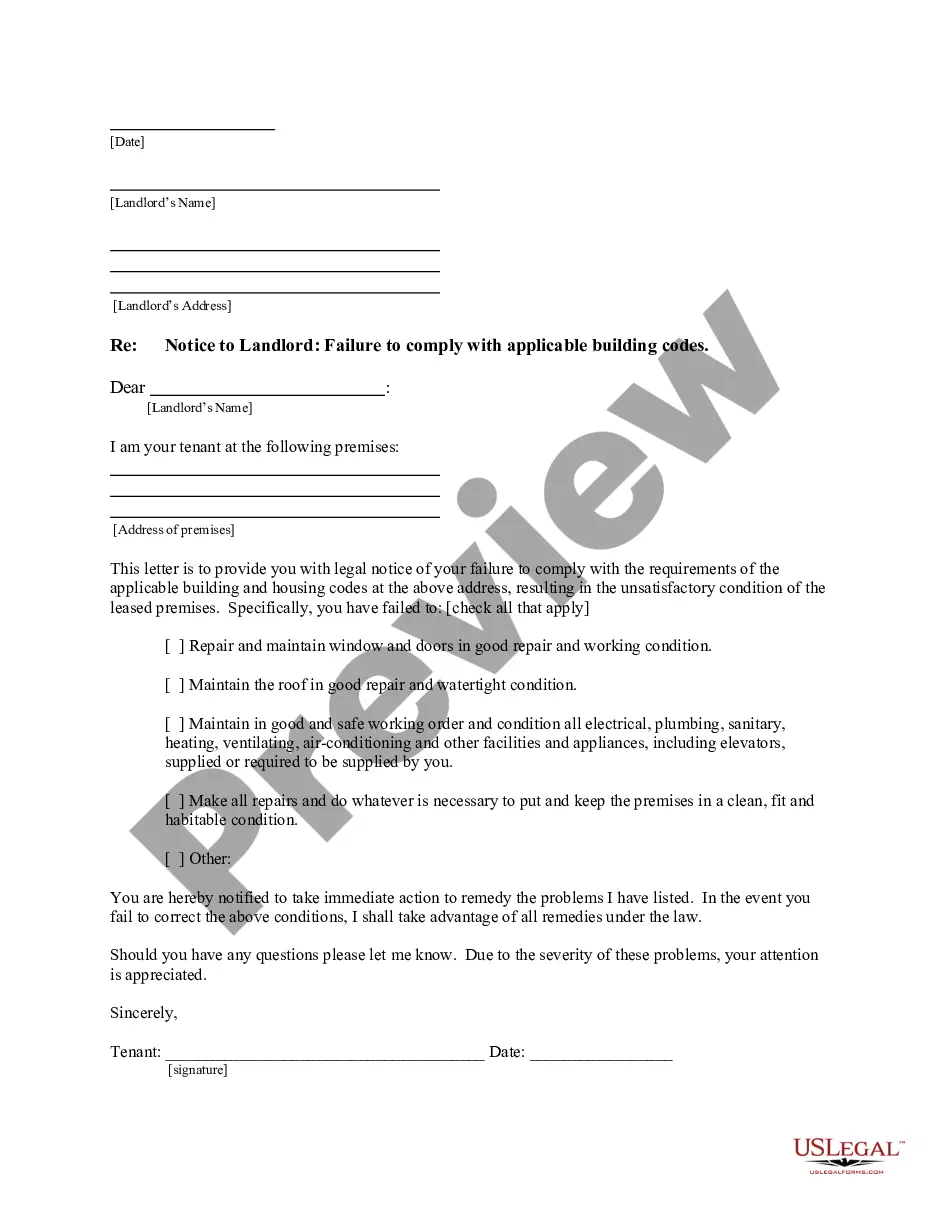
How to fill out California Letter From Tenant To Landlord For Failure Of Landlord To Comply With Building Codes Affecting Health And Safety Or Resulting In Untenantable Condition - Demand For Remedy?
- Log in to your US Legal Forms account if you're an existing user. Ensure your subscription is active to access the forms.
- For first-time users, visit the US Legal Forms website and browse their extensive library of legal documents. Check previews and descriptions to find the correct form for your needs.
- Use the search feature if you need a different form. This tool can help locate any document needed to fit your local jurisdiction requirements.
- Once you locate your desired form, click on the Buy Now button to select your subscription plan. You will need to register an account if you haven't already.
- Enter your payment details, either through a credit card or PayPal, to complete your purchase.
- After the payment process, download the letter directly to your device for further completion. Access it anytime in the My Forms section of your profile.
In conclusion, US Legal Forms empowers users with a vast selection of easily editable legal documents, providing individuals and attorneys the tools for precise legal execution. Whether you're drafting a letter or another form, their resources can simplify the process significantly.
Start accessing your legal templates today by visiting US Legal Forms!
Form popularity
FAQ
When writing a notification letter to your landlord, start with your personal information and the date. Clearly identify the subject of your notification, such as maintenance issues or building concerns related to the letter landlord building with adu. Provide any necessary details and your expectations for resolution. Conclude with your contact information, ensuring your landlord can reach you easily.
To write a formal letter to your landlord, begin with your name and address at the top of the page. Next, include the date and your landlord's name and address. Address the letter respectfully, clearly stating your purpose, whether it concerns repairs, lease details, or a letter landlord building with adu. Finish by signing your name and adding contact information for further communication.
Yes, you can put a tiny home on your property in Massachusetts, but it must comply with local zoning regulations. Obtaining a letter landlord building with adu can help clarify what is permissible on your property. Many areas allow tiny homes as ADUs, but you must adhere to size, setback, and utility provisions. Always check with your local planning department to ensure your tiny home meets all requirements.
The new law for ADUs in Massachusetts reinforces the state’s commitment to increasing housing accessibility. Homeowners are encouraged to seek a letter landlord building with adu to comply with updated zoning regulations. The law simplifies the process for creating ADUs and aims to eliminate unnecessary bottlenecks that homeowners face. This initiative is part of a broader strategy to tackle housing shortages in the state.
New laws for ADUs in 2025 aim to further promote affordable housing options across Massachusetts. Homeowners should prepare for potential updates that may ease restrictions when obtaining a letter landlord building with adu. These changes may include modifications to lot size requirements and increased height allowances for ADUs. Staying informed about these developments will ensure you can take advantage of future opportunities.
The law for ADUs in Massachusetts allows homeowners to create an auxiliary living space on their property. To legally build an ADU, you often need a letter landlord building with adu. Recent legislation encourages cities to streamline the approval process and reduce barriers for homeowners. It’s vital to review local ordinances to fully understand the requirements specific to your community.
In Massachusetts, rules for accessory dwelling units (ADUs) can vary by municipality. Generally, you need a letter landlord building with adu to ensure compliance with local zoning laws. Many cities now allow ADUs by-right, which simplifies the approval process. Additionally, check for size restrictions and setbacks specific to your area to avoid any issues.
To get a landlord letter, start by contacting your landlord directly and clearly articulating your request. It's helpful to explain why you need the letter and any specific details you require. If you plan to discuss potential improvements, like building an ADU, including this in your request can be advantageous. You can also utilize platforms like US Legal Forms to find templates for formal letters to aid your communication.
The $40,000 grant in California for ADUs is designed to assist homeowners with the costs associated with building accessory dwelling units. This grant can help enhance property value and provide additional housing options. If you plan to request this grant, consider preparing a comprehensive letter for your landlord to discuss the benefits of adding an ADU.
When writing a letter to your landlord to give notice, start by stating your intention clearly and specifying the date you plan to vacate. Include your current address and any other necessary details. A well-written letter serves as a formal communication tool, and if you plan to discuss future developments like an ADU, make sure to mention that in your correspondence.