Arkansas Transfer Deed With Life Estate
Description



Get your form ready online
Our built-in tools help you complete, sign, share, and store your documents in one place.
Make edits, fill in missing information, and update formatting in US Legal Forms—just like you would in MS Word.
Download a copy, print it, send it by email, or mail it via USPS—whatever works best for your next step.
Sign and collect signatures with our SignNow integration. Send to multiple recipients, set reminders, and more. Go Premium to unlock E-Sign.
If this form requires notarization, complete it online through a secure video call—no need to meet a notary in person or wait for an appointment.
We protect your documents and personal data by following strict security and privacy standards.

Make edits, fill in missing information, and update formatting in US Legal Forms—just like you would in MS Word.

Download a copy, print it, send it by email, or mail it via USPS—whatever works best for your next step.

Sign and collect signatures with our SignNow integration. Send to multiple recipients, set reminders, and more. Go Premium to unlock E-Sign.

If this form requires notarization, complete it online through a secure video call—no need to meet a notary in person or wait for an appointment.

We protect your documents and personal data by following strict security and privacy standards.
Looking for another form?
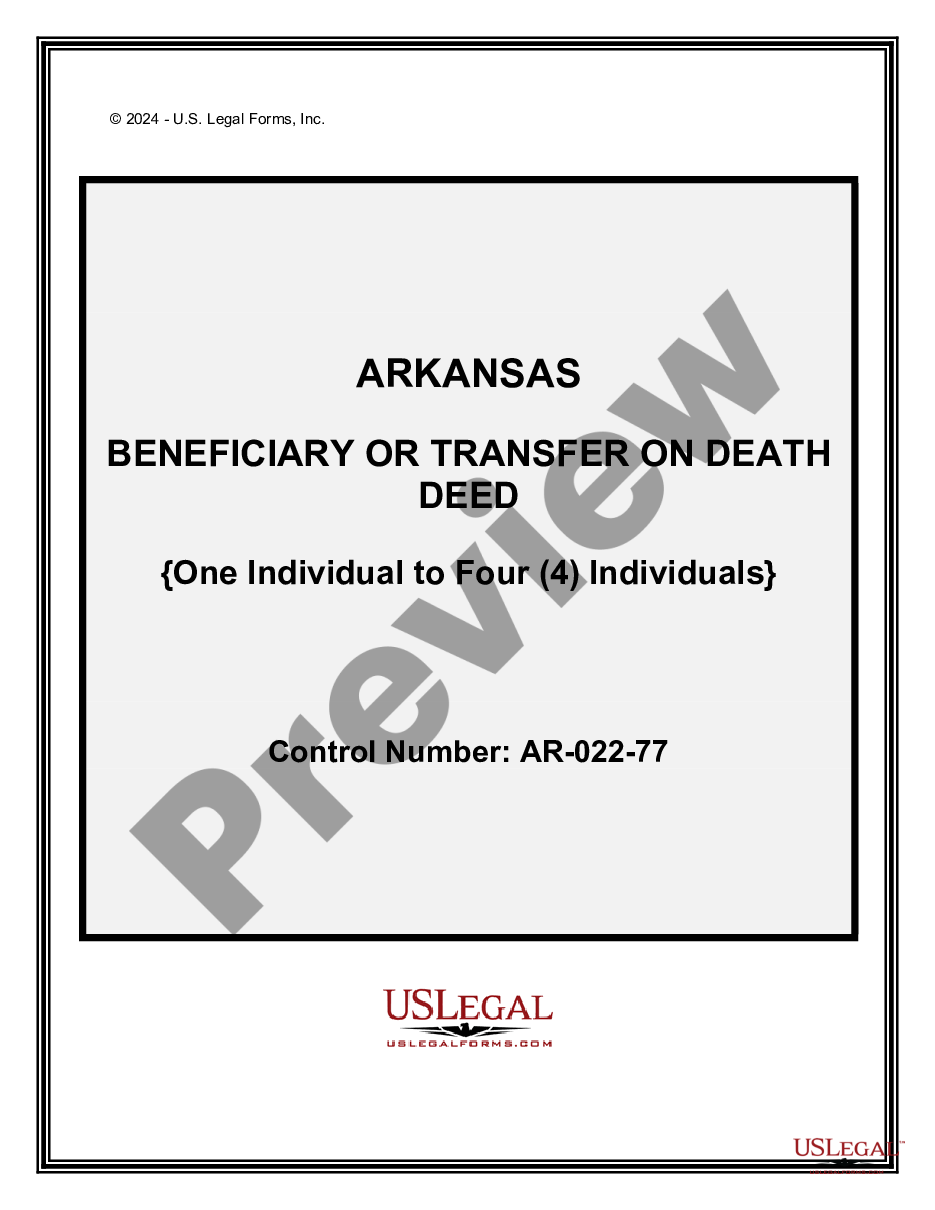
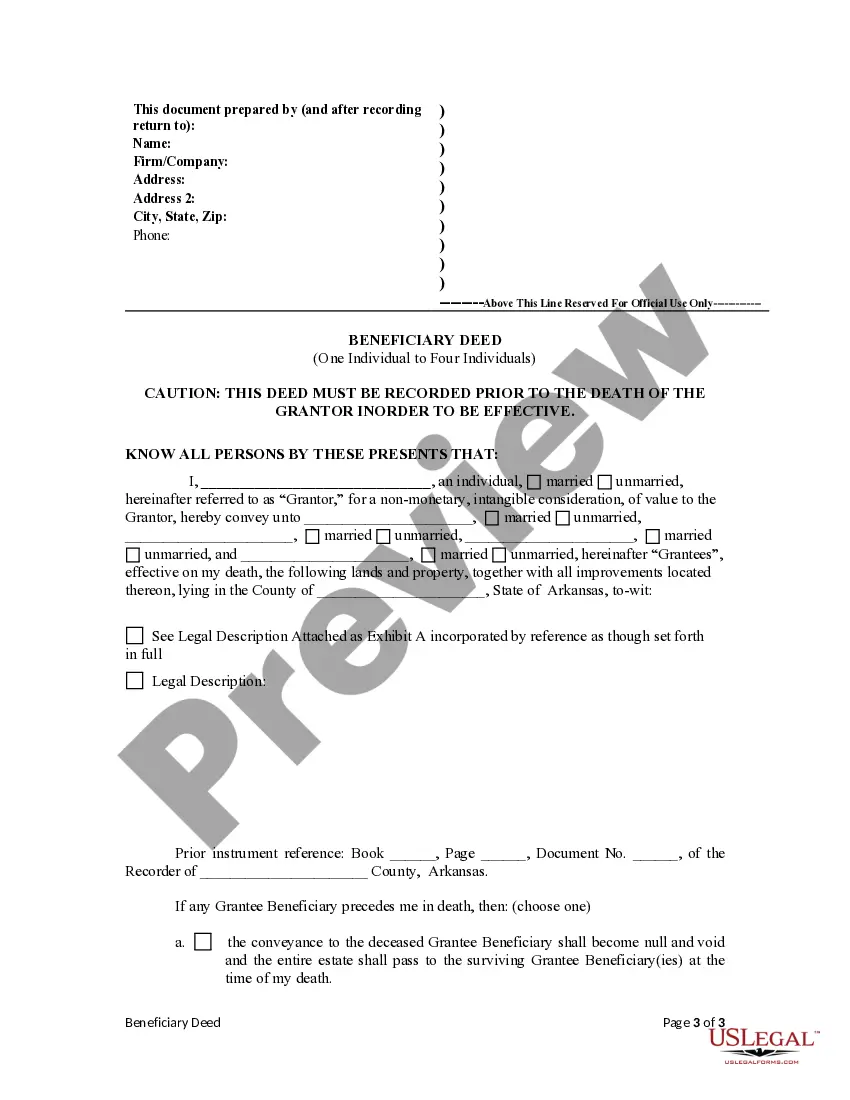
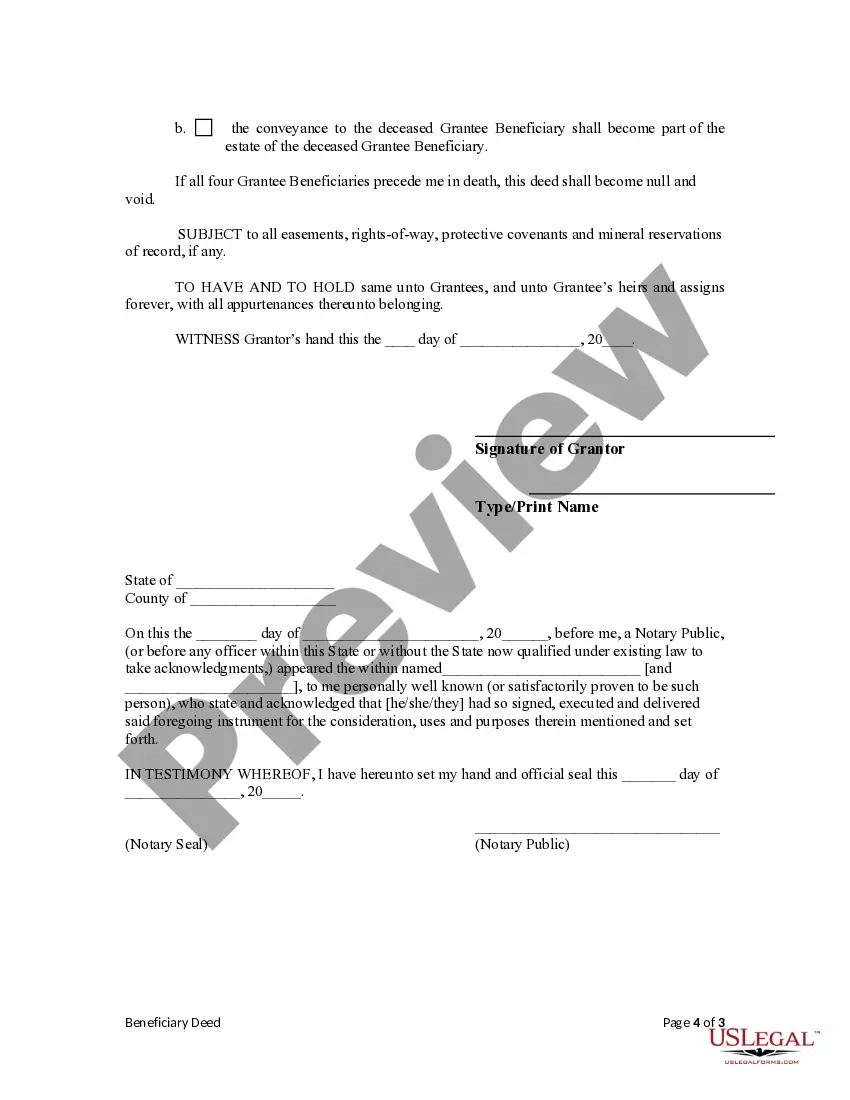
How to fill out Arkansas Transfer On Death Deed Or TOD - Beneficiary Deed For One Individual To Four Individuals?
Regardless of whether it's for professional reasons or personal issues, everyone must confront legal matters at some stage in their lives.
Completing legal documents requires meticulous care, starting from choosing the correct form template.
Choose the file format you prefer and download the Arkansas Transfer Deed With Life Estate. Once downloaded, you can fill out the form using editing tools or print it and complete it manually. With a comprehensive US Legal Forms catalog available, you won't waste time searching for the right sample online. Utilize the library’s user-friendly navigation to find the correct template for any event.
- For instance, selecting an incorrect version of the Arkansas Transfer Deed With Life Estate will lead to its rejection upon submission.
- Thus, obtaining a trustworthy source of legal documents like US Legal Forms is crucial.
- If you need an Arkansas Transfer Deed With Life Estate template, follow these straightforward steps.
- Locate the sample you require by utilizing the search bar or catalog browsing.
- Review the form’s description to make sure it aligns with your circumstances, state, and county.
- Click on the form’s preview to examine it.
- If it’s the wrong document, return to the search option to find the Arkansas Transfer Deed With Life Estate template you require.
- Download the template if it suits your needs.
- If you possess a US Legal Forms account, simply click Log in to access previously saved documents in My documents.
- In the case you don’t have an account yet, you can acquire the form by clicking Buy now.
- Choose the suitable pricing option.
- Complete the account registration form.
- Select your payment method: you can utilize a credit card or PayPal account.
Form popularity
FAQ
To transfer a property title to a family member in Arkansas, you must execute a deed, such as a warranty deed or Arkansas transfer deed with life estate, properly outlining the details of the transfer. This deed must be signed, notarized, and recorded with the county clerk to be valid. Ensuring compliance with state laws will help avoid future disputes.
To get title to the property after your death, the beneficiary must take a few administrative steps. The beneficiary can call the county clerk, circuit clerk, or recorder's office for details, but the process will likely require recording a certified copy of the death certificate. No probate is necessary.
A life estate deed is a legal document that changes the ownership of a property while allowing you to live there until death. It might be useful for those wanting to avoid the probate process in Arkansas, ensure the future ownership of their property, or even qualify for Medicaid.
Upon the owner's death, the property passes to the beneficiaries outside the Arkansas probate process. Beneficiary deeds?known in other states as transfer-on-death deeds or TOD deeds?are defined and allowed by law and have been recognized in Arkansas since 2005.
The new owner or that person's agent must submit a signed real property tax affidavit of compliance?or just affidavit of compliance?when filing a deed with the county recorder. The affidavit gives details about the transfer?including the purchase price and transfer tax amount or any exemption.
A life estate deed is a legal document that changes the ownership of a piece of real property. The person who owns the real property (in this example, Mom) signs a deed that will pass the ownership of the property automatically upon her death to someone else, known as the "remainderman" (in this example, Son).