Notice Check Bad For Your Hair
Description


Get your form ready online
Our built-in tools help you complete, sign, share, and store your documents in one place.
Make edits, fill in missing information, and update formatting in US Legal Forms—just like you would in MS Word.
Download a copy, print it, send it by email, or mail it via USPS—whatever works best for your next step.
Sign and collect signatures with our SignNow integration. Send to multiple recipients, set reminders, and more. Go Premium to unlock E-Sign.
If this form requires notarization, complete it online through a secure video call—no need to meet a notary in person or wait for an appointment.
We protect your documents and personal data by following strict security and privacy standards.

Make edits, fill in missing information, and update formatting in US Legal Forms—just like you would in MS Word.

Download a copy, print it, send it by email, or mail it via USPS—whatever works best for your next step.

Sign and collect signatures with our SignNow integration. Send to multiple recipients, set reminders, and more. Go Premium to unlock E-Sign.

If this form requires notarization, complete it online through a secure video call—no need to meet a notary in person or wait for an appointment.

We protect your documents and personal data by following strict security and privacy standards.
Looking for another form?



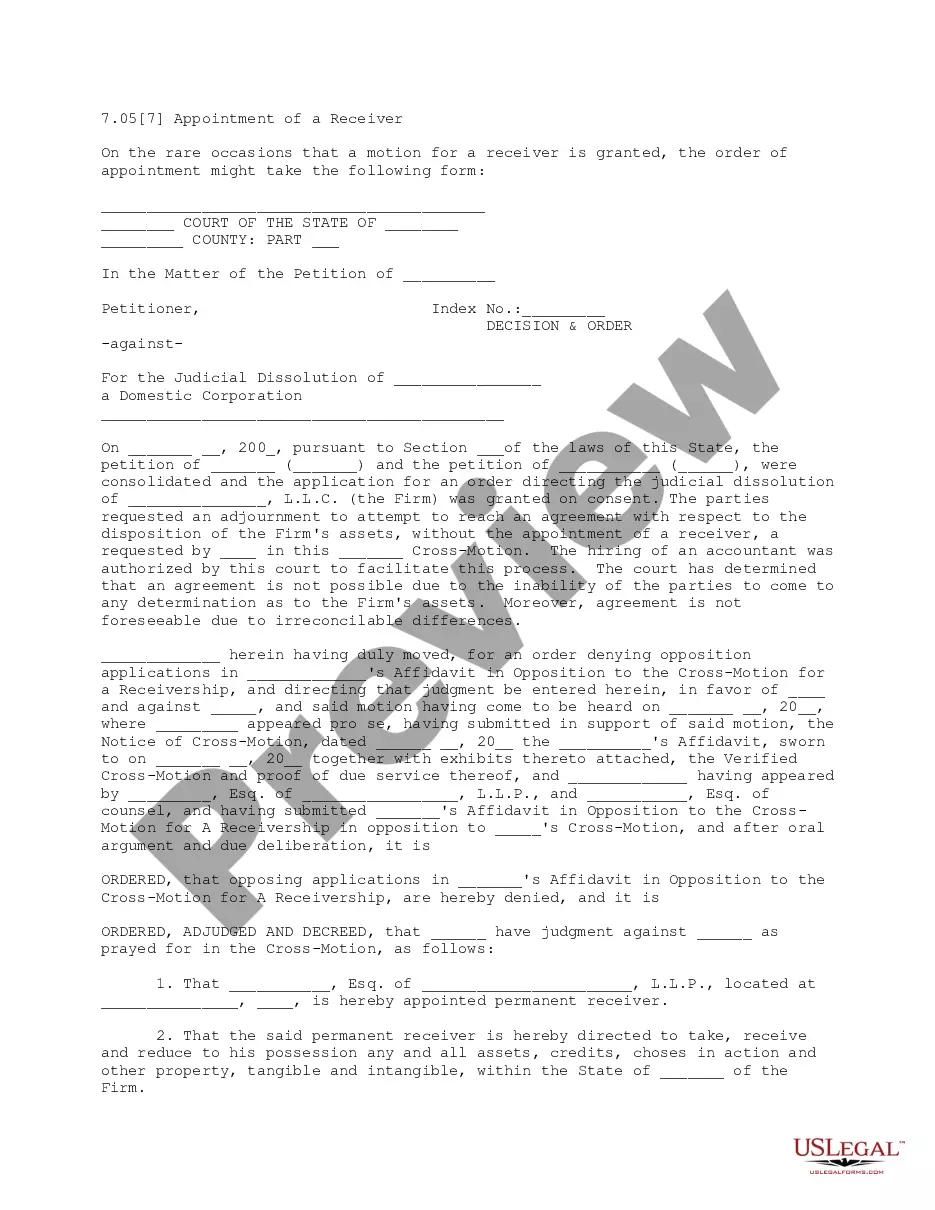

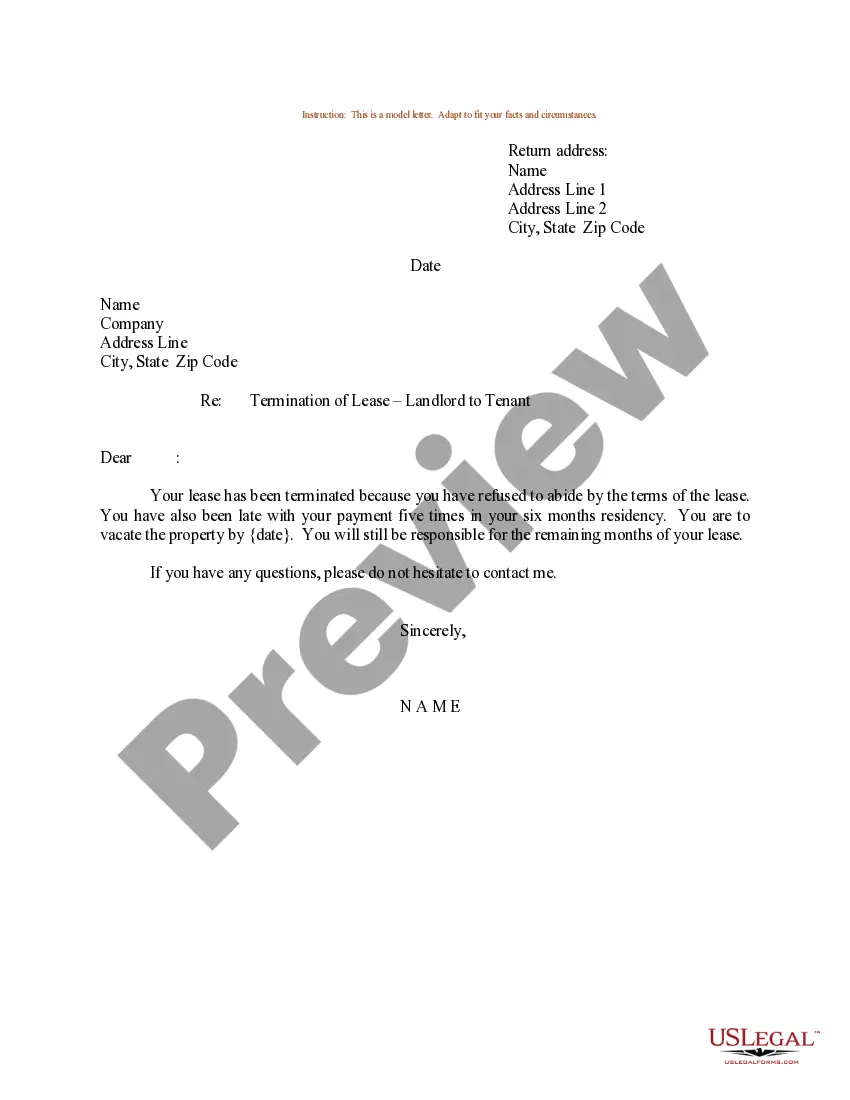
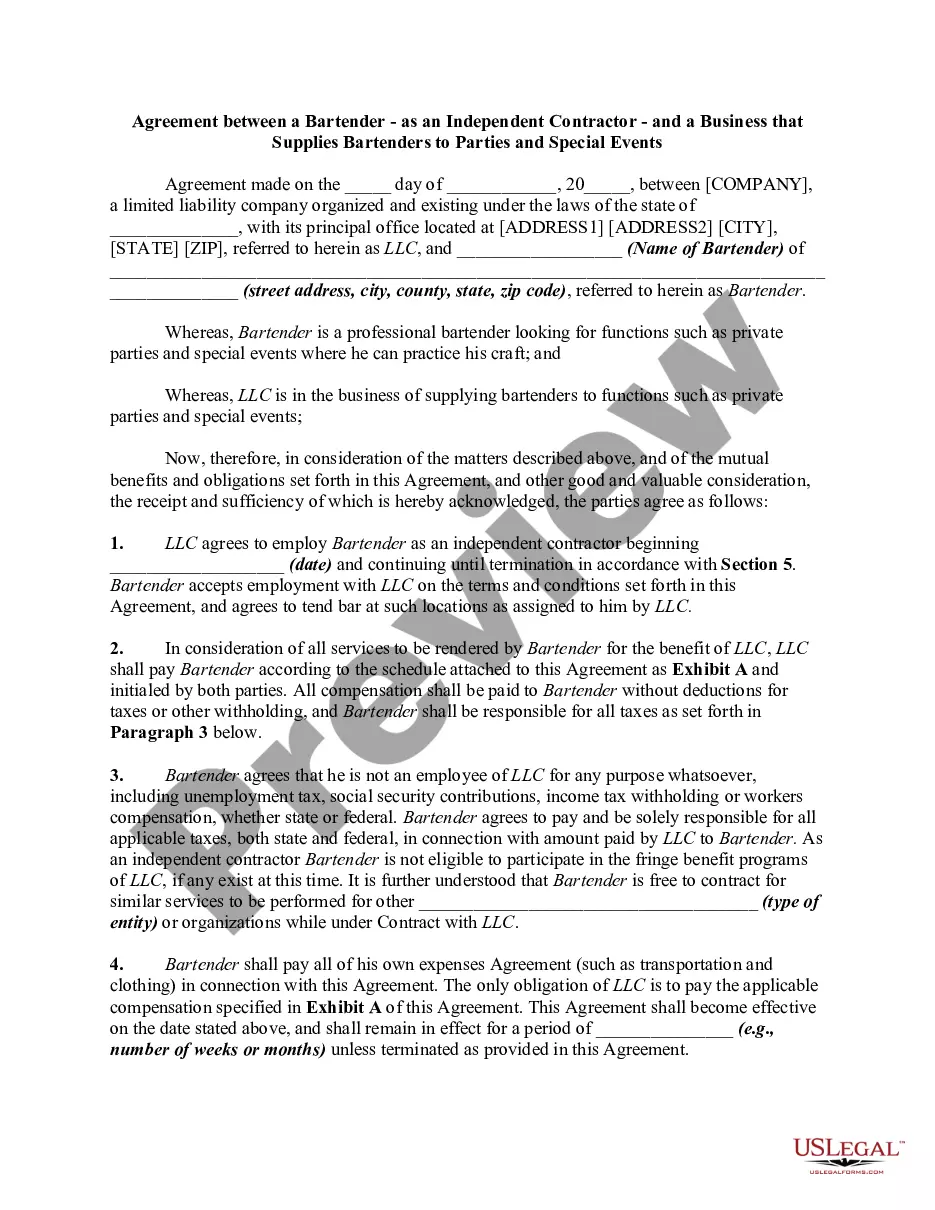
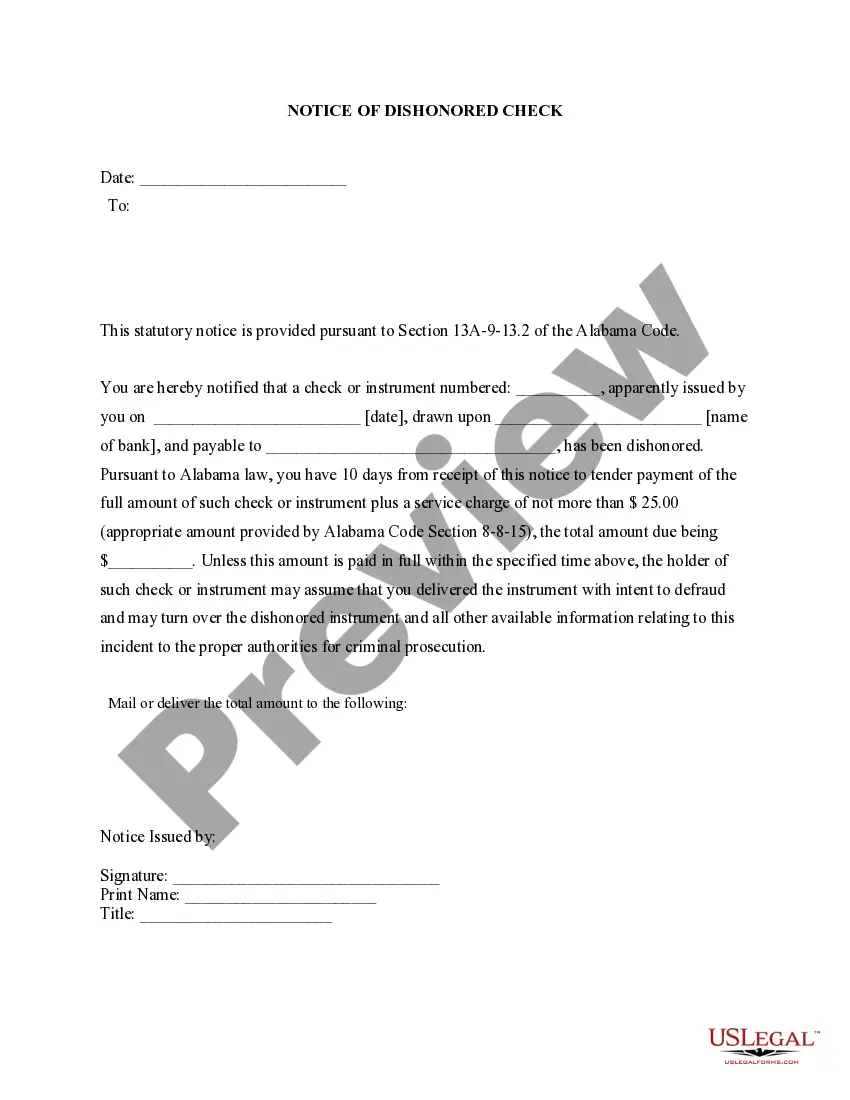
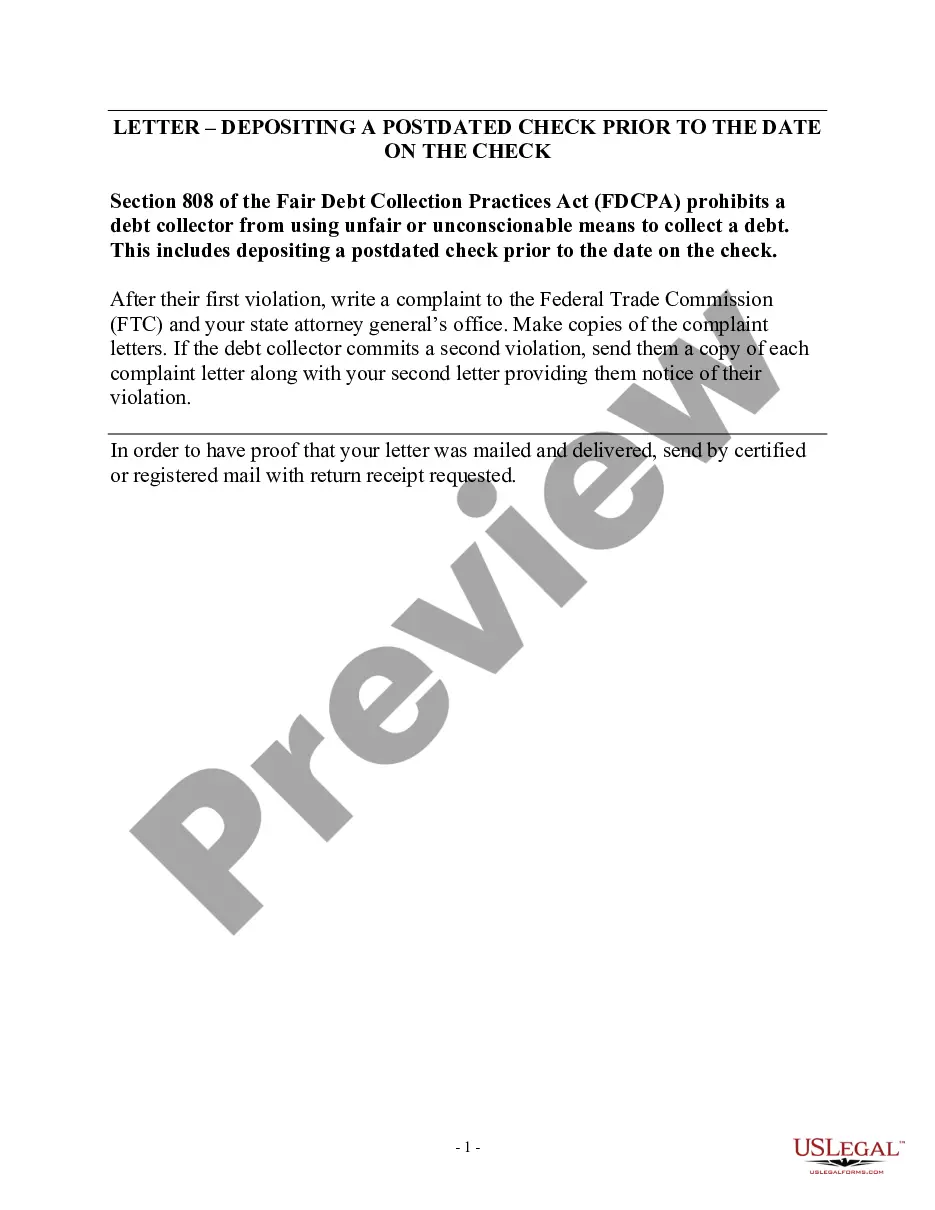
How to fill out Alabama Notice Of Dishonored Check - Civil And Criminal - Keywords: Bad Check, Bounced Check?
- If you're a returning user, log in to your account and download your desired form by clicking the Download button. Ensure your subscription is active; if not, renew it according to your payment plan.
- Check the Preview mode and description of the form to confirm it meets your needs and adheres to local jurisdiction requirements.
- If necessary, search for another template by using the Search tab to find the correct one. When you find the suitable form, proceed to the next step.
- Purchase the document by clicking the Buy Now button, selecting your preferred subscription plan, and registering an account to access the library.
- Complete your transaction by entering your credit card information or using your PayPal account to pay for the subscription.
- Download your form to your device. Access it anytime from the My Forms section of your profile.
US Legal Forms grants both individuals and attorneys quick access to a vast library of legal documents, boasting over 85,000 fillable forms. This resource is ideal for those looking to execute legal matters efficiently and accurately.
Take control of your legal needs today by visiting US Legal Forms and empowering yourself with the right tools for success!
Form popularity
FAQ
Typically, dermatologists and specialized trichologists check hair problems. These professionals are equipped to handle various conditions affecting your hair and scalp. If you notice check bad for your hair, these experts can guide you toward effective solutions and treatments tailored to your needs.
Hair problems can be diagnosed by healthcare professionals, primarily dermatologists and trichologists. They have the expertise to assess your hair and scalp health thoroughly. If you start to notice check bad for your hair, it is crucial to seek a professional opinion for the best diagnosis and treatment options.
You can check your hair's health by examining its texture, shine, and overall condition. Look for signs like brittleness, excessive shedding, or split ends, which may indicate that you notice check bad for your hair. A professional assessment can provide deeper insights, so consider visiting a dermatologist or hair care expert if you have any concerns.
For hair-related issues, you should see a dermatologist or a trichologist. Dermatologists are trained to handle various hair disorders, while trichologists specifically focus on hair and scalp conditions. If you’re concerned about problems and need to notice check bad for your hair, starting with a dermatologist is a wise choice.
Yes, dermatologists specialize in skin, hair, and nails. They can provide a thorough evaluation of your hair concerns and determine whether they are associated with medical conditions. If you notice check bad for your hair, a dermatologist can help correctly diagnose the issue and suggest appropriate treatments.
Repeat of the previous question: If your hair is excessively dry, brittle, or breaking, it may be too damaged for dye. Check for obvious signs like severe split ends and loss of shine. Notice check bad for your hair by noting how your strands respond when you gently tug at them; if they snap easily, it’s time to avoid color treatments. Prioritizing hair health will lead to better, longer-lasting results.
A bad reaction to hair dye often shows as redness, itching, or burning on the scalp. You might also notice blisters or swelling, indicating that the dye does not agree with your skin. If you experience these symptoms, it's essential to rinse the dye out immediately. Always notice check bad for your hair and skin by conducting a patch test before applying any new product.
Preparing damaged hair for color requires a gentle approach. Start by deep conditioning to restore moisture and strength. Use a leave-in treatment to protect your strands, and avoid heat styling before coloring. Additionally, notice check bad for your hair by choosing a color that is less harsh or opting for a semi-permanent dye, which can be more forgiving on damaged hair.
If your hair is excessively dry, brittle, or breaking, it may be too damaged for dye. Check for obvious signs like severe split ends and loss of shine. Notice check bad for your hair by noting how your strands respond when you gently tug at them; if they snap easily, it's time to avoid color treatments. Prioritizing hair health will lead to better, longer-lasting results.
You can spot unhealthy hair by looking for characteristics such as dryness and frizz. If your hair feels rough, looks dull, or breaks easily, it's a sign that it may not be in the best condition. Additionally, notice check bad for your hair if you observe significant hair loss or thinning. Regular inspections can help you maintain your hair's health.