Alabama Notice of Dishonored Check - Civil and Criminal - Keywords: bad check, bounced check
Understanding this form
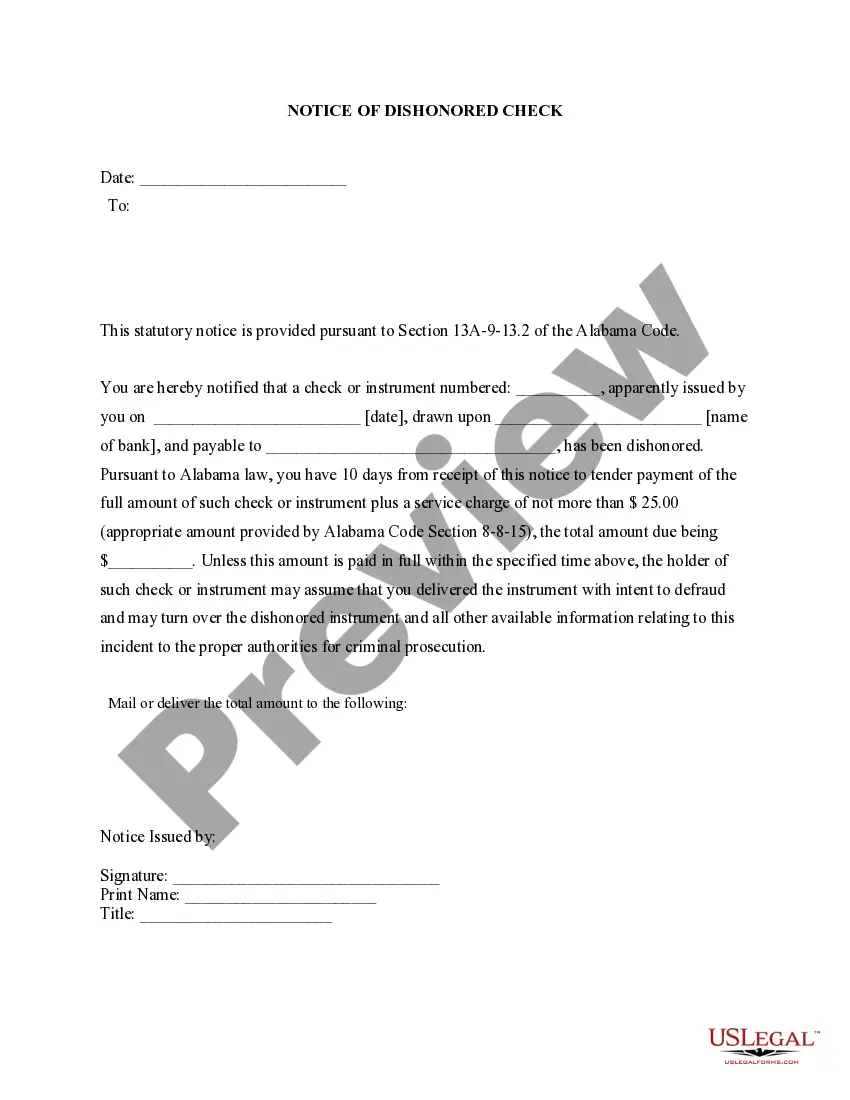
This Notice of Dishonored Check serves to inform a debtor that their check has been returned unpaid, commonly referred to as a bad check or bounced check. It is a legal document that notifies the issuer of the check that their payment has not been honored due to insufficient funds or a closed account. This notice is an essential step for the recipient, usually a business owner, to initiate recovery proceedings while adhering to state law. Unlike other similar forms, this specific notice outlines the legal requirements tied to dishonored checks within the applicable state, ensuring compliance and clarity.
Form components explained
- Notice statement identifying the check being referred to.
- Details of the check, including the check number and the date issued.
- Bank information where the check was drawn.
- Instructions for the debtor, including payment deadlines and service charges.
- Consequences of non-payment, highlighting potential legal actions.
- Signature line for the issuer of the notice.



When this form is needed
This form should be used when a check has been returned due to insufficient funds or a closed account, causing the issuer to be unable to collect payment. It is particularly relevant for businesses or individuals who have accepted checks as payment and need to formally notify the check writer of the dishonor. This notice can serve as an initial step before pursuing further legal action for recovery.
Intended users of this form
- Business owners who have received a bounced check from a customer.
- Individuals or entities who have issued a check that has been dishonored.
- Collection agencies seeking to formally notify debtors of unpaid checks.
- Lawyers or legal representatives involved in debt recovery cases.
Completing this form step by step
- Identify the parties involved by entering the debtor's name and address.
- Specify the check details: include the check number and the date it was issued.
- Fill in the name of the bank where the check was drawn.
- Enter the name of the payee who received the check.
- Calculate and enter the total amount due, including any applicable service charges.
- Provide your signature and title, confirming the notice is valid.
Does this form need to be notarized?
This form does not typically require notarization unless specified by local law. However, it is advisable to check local regulations to ensure compliance.
Get your form ready online
Our built-in tools help you complete, sign, share, and store your documents in one place.
Make edits, fill in missing information, and update formatting in US Legal Forms—just like you would in MS Word.
Download a copy, print it, send it by email, or mail it via USPS—whatever works best for your next step.
Sign and collect signatures with our SignNow integration. Send to multiple recipients, set reminders, and more. Go Premium to unlock E-Sign.
If this form requires notarization, complete it online through a secure video call—no need to meet a notary in person or wait for an appointment.
We protect your documents and personal data by following strict security and privacy standards.

Make edits, fill in missing information, and update formatting in US Legal Forms—just like you would in MS Word.

Download a copy, print it, send it by email, or mail it via USPS—whatever works best for your next step.

Sign and collect signatures with our SignNow integration. Send to multiple recipients, set reminders, and more. Go Premium to unlock E-Sign.

If this form requires notarization, complete it online through a secure video call—no need to meet a notary in person or wait for an appointment.

We protect your documents and personal data by following strict security and privacy standards.
Common mistakes
- Failing to fill in all required details accurately, such as check number or amounts.
- Not providing a clear statement of the payment deadline.
- Omitting important information about the consequences of non-payment.
- Using incorrect or outdated legal charges that do not comply with state regulations.
Advantages of online completion
- Convenience of downloading and filling out the form at any time.
- Editable format allows users to customize the details easily.
- Drafted by licensed attorneys, ensuring legal compliance and reliability.
- Accessible across devices, making it easy to manage documents on the go.
Legal use & context
- This notice helps establish a paper trail of communication with the debtor.
- It serves as a formal warning before the potential escalation to legal proceedings.
- Adhering to state laws increases the enforceability of the document.
Key takeaways
- This form is essential for notifying a debtor of a dishonored check.
- Providing accurate information is crucial for compliance and recovery.
- Utilizing this form properly can lead to successful debt recovery efforts.
Looking for another form?
Form popularity
FAQ
Writing a bad check refers to the action taken by the check writer, whereas a bounced check is the consequence of that action. When a check is deemed bad due to insufficient funds, it results in the check bouncing back to the payee. This can create various problems for both parties involved, including legal issues. Understanding the ins and outs of an Alabama Notice of Dishonored Check is key for resolving such situations effectively.
While a bad check and a bounced check often imply the same event, the terms slightly differ in context. A bad check refers to the action of writing a check without sufficient funds, while a bounced check emphasizes the result—it fails to clear at the bank. Both terms indicate legal implications and harms for the payee. Familiarizing yourself with an Alabama Notice of Dishonored Check can clarify the potential legal outcomes.
Yes, a bad check and a bounced check generally refer to the same situation. Both terms describe a check that cannot be cashed due to insufficient funds in the account of the writer. This can lead to serious consequences, including legal actions. If you find yourself dealing with a bounced check, knowing more about an Alabama Notice of Dishonored Check can help you navigate the process.
A dishonored check gets the term 'bounced' because it fails to clear at the bank, causing it to be returned to the payee. This occurs when the check writer lacks sufficient funds in their account. When this happens, financial institutions often describe the check as having bounced. Understanding the implications of an Alabama Notice of Dishonored Check is crucial for both parties involved.
Disputing a bounced check requires prompt action. First, review your records to ensure that you did not make an error in payment. Next, contact the person or business that issued the bad check to discuss the situation. If the issue isn't resolved amicably, you may consider filing an Alabama Notice of Dishonored Check - Civil and Criminal to pursue the matter legally.
In Alabama, the statute of limitations for prosecuting cases related to bad checks is generally three years. This means that if a bad check is not addressed within this timeframe, you may lose the ability to pursue legal action. Understanding this timeframe is vital when dealing with a bounced check, as it impacts the options available for recovery. Knowing your rights through resources like USLegalForms can help you take appropriate action.
Yes, it is illegal to write a bad check in Alabama. This offense falls under criminal law and can lead to severe consequences, including fines and imprisonment. The law categorizes bad checks based on the amount and intent, offering different outcomes for various scenarios. It is essential to be informed about the Alabama Notice of Dishonored Check to prevent legal issues.
Yes, you can face trouble if someone writes you a bad check. While the person who wrote the check primarily holds liability, receiving a bounced check can lead to complications in your financial transactions. Moreover, depending on circumstances, you might find yourself involved in legal matters concerning the collection of those funds. Using a service like USLegalForms can help you navigate these situations effectively.
The bad check law in Alabama refers to the legal consequences of issuing a check without sufficient funds. This law outlines both civil liabilities and potential criminal charges. Individuals who issue bad checks can face fines, restitution, and even jail time, depending on the amount. Familiarizing yourself with this law is essential for anyone managing personal or business finances.
Yes, there is a statute of limitations on bounced checks. In Alabama, this period is typically three years, meaning you must initiate any legal claim within that timeframe. Failing to act within this period may limit your ability to recover funds. Therefore, understanding the statute of limitations on bounced checks is vital for safeguarding your rights.