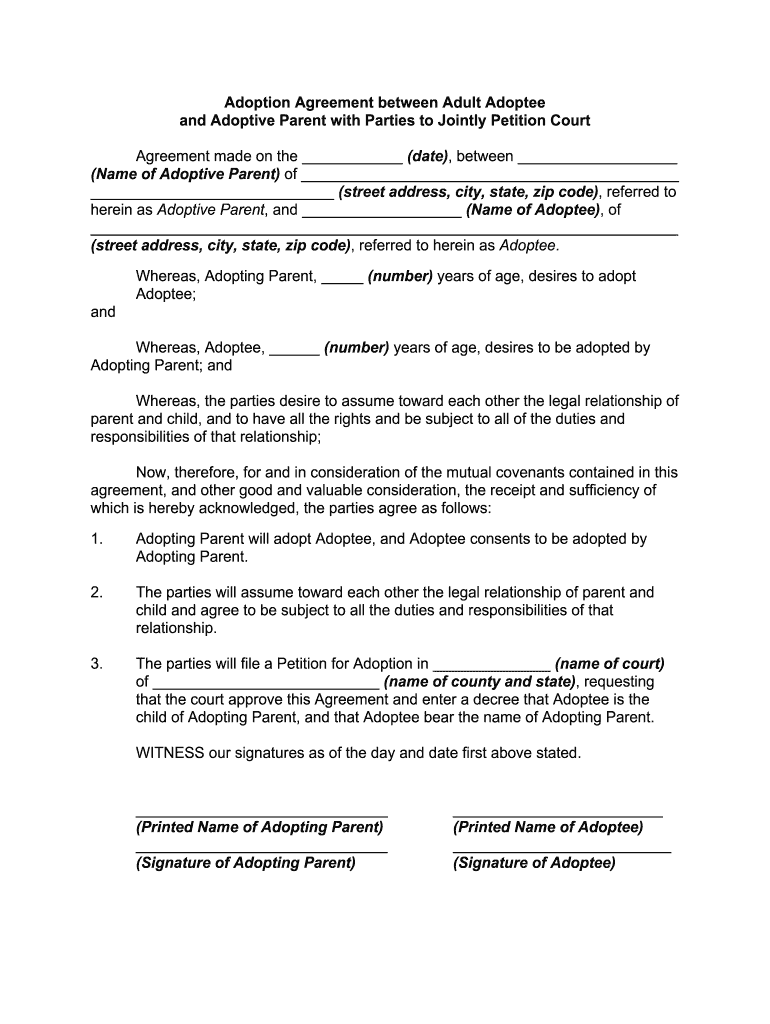
The Adoption Agreement between Adult Adoptee and Adoptive Parent is a legal document that formalizes the relationship between an adult adoptee and their adoptive parent. This form is specifically designed for adult adoptions, which involve individuals who are over the age of majority. Unlike traditional adoption forms meant for minors, this agreement allows adults to enter into a parent-child relationship legally, ensuring that both parties understand their rights and responsibilities. All states have provisions for adult adoption, but it is essential to consult local laws to ensure compliance with jurisdictional requirements.
This form should be used when an adult wishes to formalize the adoption of another adult. It is applicable in situations where an adult adoptee is seeking to establish a legal relationship with an adopting parent, which can occur for various reasons, such as inheritance rights, emotional ties, or caregiving arrangements. The adoption agreement should be prepared when both parties agree to the adoption and are ready to file a petition with the court.
This form usually doesn’t need to be notarized. However, local laws or specific transactions may require it. Our online notarization service, powered by Notarize, lets you complete it remotely through a secure video session, available 24/7.
Our built-in tools help you complete, sign, share, and store your documents in one place.
Make edits, fill in missing information, and update formatting in US Legal Forms—just like you would in MS Word.
Download a copy, print it, send it by email, or mail it via USPS—whatever works best for your next step.
Sign and collect signatures with our SignNow integration. Send to multiple recipients, set reminders, and more. Go Premium to unlock E-Sign.
If this form requires notarization, complete it online through a secure video call—no need to meet a notary in person or wait for an appointment.
We protect your documents and personal data by following strict security and privacy standards.

Make edits, fill in missing information, and update formatting in US Legal Forms—just like you would in MS Word.

Download a copy, print it, send it by email, or mail it via USPS—whatever works best for your next step.

Sign and collect signatures with our SignNow integration. Send to multiple recipients, set reminders, and more. Go Premium to unlock E-Sign.

If this form requires notarization, complete it online through a secure video call—no need to meet a notary in person or wait for an appointment.

We protect your documents and personal data by following strict security and privacy standards.
If a parent does not have Parental Responsibility (PR), the court is not required to have their consent before making an adoption order. However, if this parent has a close connection with their child, it is likely the court will want to find out their views, as well as the child's.
Generally, adoption requires the consent of both parents, provided they meet certain requirements. To gain parental rights, including the right to object to adoption, biological fathers unmarried to the mother must not only establish paternity, but also demonstrate a commitment to parenting the child.
Despite not being biologically related to the child, a non-biological parent can still obtain legal parental status by formally adopting the child. This is because a valid adoption enables a non-biological parent to gain full legal and physical custody of a child.
The biological dad has rights until they are terminated by a court. Just because he did not sign the birth certificate does not mean he is not the father and has no rights.Also, the courts generally would like to see the couple married before the other person is allowed to adopt.
Parties who can reverse an adoption usually include the birth parents, adoptive parents and the child being adopted. In order for an adoption to be reversed, a petition must usually be filed by one of these parties and the court must be convinced of a compelling reason to reverse or annul the adoption.
Under California law, a noncustodial parent's consent isn't necessary for adoption if the parent willfully fails to communicate with and to pay for the care, support, and education of the child (when they were able to do so) for a period of at least one year.
When an individual seeks to adopt a child through a private adoption, he or she petitions a court to enter an interlocutory decree, followed by a final decree in not less than one year after the child has lived with the adopting parent(s) and not less than six months after the court grants the interlocutory decree.
If a parent does not have Parental Responsibility (PR), the court is not required to have their consent before making an adoption order. However, if this parent has a close connection with their child, it is likely the court will want to find out their views, as well as the child's.
Unless he can meet at least one of the four requirements listed above, a biological father's consent to the adoption is not required. Still, notice to him is always required, unless his identity is unknown, or we cannot locate him.