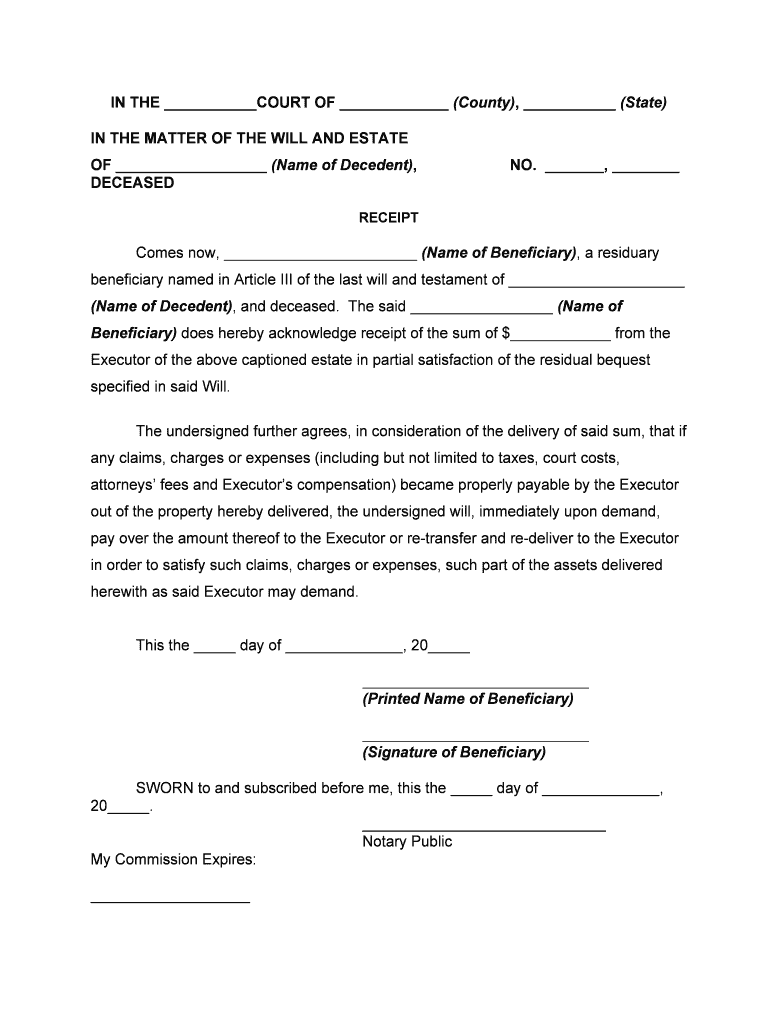
Receipt of Beneficiary for Early Distribution from Estate and Indemnity Agreement

State:
Multi-State
Control #:
US-03316BG
Format:
Word; 
Rich Text
Instant download

What this document covers

The Receipt of Beneficiary for Early Distribution from Estate and Indemnity Agreement is a legal document that beneficiaries of an estate use to acknowledge the receipt of an early distribution from the executor. This form ensures that beneficiaries consent to the distribution while protecting the executor from any future claims related to the distributed assets. Unlike other estate documents, this form allows for partial distributions before the estate is formally closed, addressing the common impatience of beneficiaries while still safeguarding the executor's position.

What’s included in this form

  • Name of the decedent and estate number.
  • Name of the beneficiary receiving the distribution.
  • Amount received by the beneficiary.
  • Agreement to indemnify the executor against claims related to the received amount.
  • Signature of the beneficiary and notary acknowledgment.

When to use this form

This form is typically used when an estate is still open but the executor has determined that a partial distribution can be made to a beneficiary. This situation often arises when estate claims have been settled, and there are no outstanding debts. It is particularly common in estates without estate tax returns needing closure. By using this form, beneficiaries can receive funds sooner while acknowledging their shared responsibility for any future claims against the estate.

Who needs this form

  • Beneficiaries who are named in a will and are entitled to receive distributions.
  • Executors seeking a legal form to document early distributions to beneficiaries.
  • Individuals managing estates that are still open but need to provide funds to beneficiaries before closing formally.

Completing this form step by step

  • Enter the name of the decedent and the estate number at the top of the form.
  • Fill out the name of the beneficiary and the amount they are receiving.
  • Have the beneficiary sign and date the form.
  • Arrange for a notary public to witness the beneficiary's signature and provide the necessary notarization.
  • Keep a copy for estate records and provide the original to the executor.

Notarization guidance

This form must be notarized to be legally valid. US Legal Forms provides secure online notarization powered by Notarize, allowing you to complete the process through a verified video call.

Get your form ready online

Our built-in tools help you complete, sign, share, and store your documents in one place.

Built-in online Word editor

Make edits, fill in missing information, and update formatting in US Legal Forms—just like you would in MS Word.

Export easily

Download a copy, print it, send it by email, or mail it via USPS—whatever works best for your next step.

E-sign your document

Sign and collect signatures with our SignNow integration. Send to multiple recipients, set reminders, and more. Go Premium to unlock E-Sign.

Notarize online 24/7

If this form requires notarization, complete it online through a secure video call—no need to meet a notary in person or wait for an appointment.

Store your document securely

We protect your documents and personal data by following strict security and privacy standards.

Form selector

Make edits, fill in missing information, and update formatting in US Legal Forms—just like you would in MS Word.

Form selector

Download a copy, print it, send it by email, or mail it via USPS—whatever works best for your next step.

Form selector

Sign and collect signatures with our SignNow integration. Send to multiple recipients, set reminders, and more. Go Premium to unlock E-Sign.

Form selector

If this form requires notarization, complete it online through a secure video call—no need to meet a notary in person or wait for an appointment.

Form selector

We protect your documents and personal data by following strict security and privacy standards.

Common mistakes

  • Failing to enter the correct name of the decedent or beneficiary.
  • Not specifying the exact amount distributed.
  • Neglecting to obtain notarization if required by local law.
  • Allowing the beneficiary to sign without understanding their obligations related to future claims.

Benefits of completing this form online

  • Convenient access to a legally vetted template.
  • Editable format allows for customization to fit specific estate needs.
  • Ensures compliance with common legal requirements across jurisdictions.

Quick recap

  • This form allows for the early distribution of estate assets to beneficiaries with appropriate legal precautions.
  • It serves as an acknowledgment of receipt and includes provisions to indemnify the executor against potential claims.
  • Notarization is required for the form to be valid, and it is advisable to understand the indemnity clause thoroughly before signing.

Looking for another form?

This field is required
Ohio
Select state

Form popularity

FAQ

You could request the court approve final account and the share for the beneficiary that will not sign can be deposited with the County Treasurer. Once this is done and all other disbursements and receipts are tendered to the court you can close estate. You should seek legal advice.

A Receipt, Release, Refunding and Indemnification Agreement is a probate tool that allows the executor to distribute estate funds to a beneficiary with the promise from the beneficiary to return the funds if it later turns out they were distributed in error.

Where a person is a Residuary Beneficiary, they are entitled to receive a full account of the Estate assets and how they have been distributed in order to see how their share has been calculated. The Estate Accounts do not have to be provided until the Estate administration has been finalised.

States vary, but the deadline is commonly within 30 or 60 days of the settlor's death. How long does a trustee have to notify beneficiaries? This is partially because creditors against the estate need time to become aware of the process and make any claims against the estate.

Under Probate Code section 16004.5, a Trustee cannot require a beneficiary to sign a release in exchange for making a distribution of Trust assets, provided that the Trust distribution is required to be made as stated in the Trust document.

Before distributing assets to beneficiaries, the executor must pay valid debts and expenses, subject to any exclusions provided under state probate laws.The executor must maintain receipts and related documents and provide a detailed accounting to estate beneficiaries.

All taxes and liabilities paid from the estate, including medical expenses, attorney fees, burial or cremation expenses, estate sale costs, appraisal expenses, and more. The executor should keep all receipts for any services or transactions needed to liquidate the assets of the deceased.

Beneficiaries often must sign off on the inheritance they receive to acknowledge receipt of the distribution. For example, if you inherit a portion of real estate from the decedent, you must sign a deed accepting that real estate.

Trusted and secure by over 3 million people of the world’s leading companies

Receipt of Beneficiary for Early Distribution from Estate and Indemnity Agreement