Florida Final Notice of Forfeiture and Request to Vacate Property under Contract for Deed
What is this form?
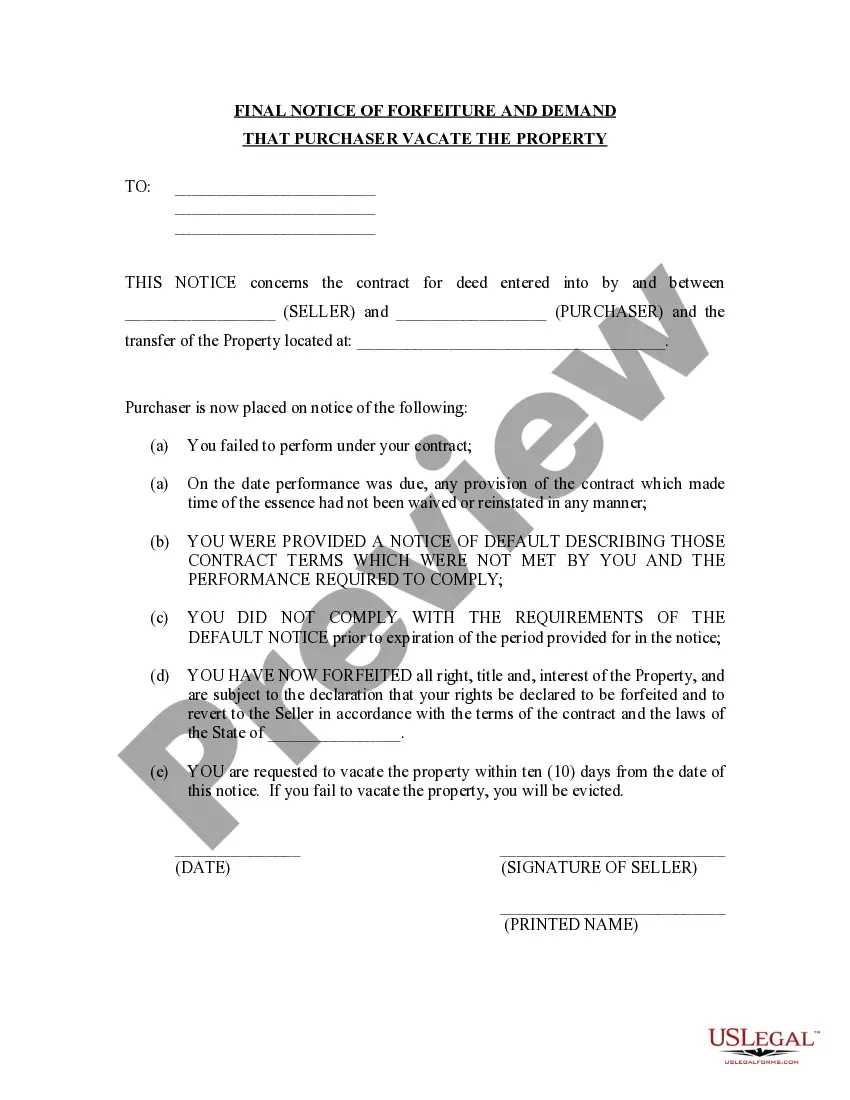
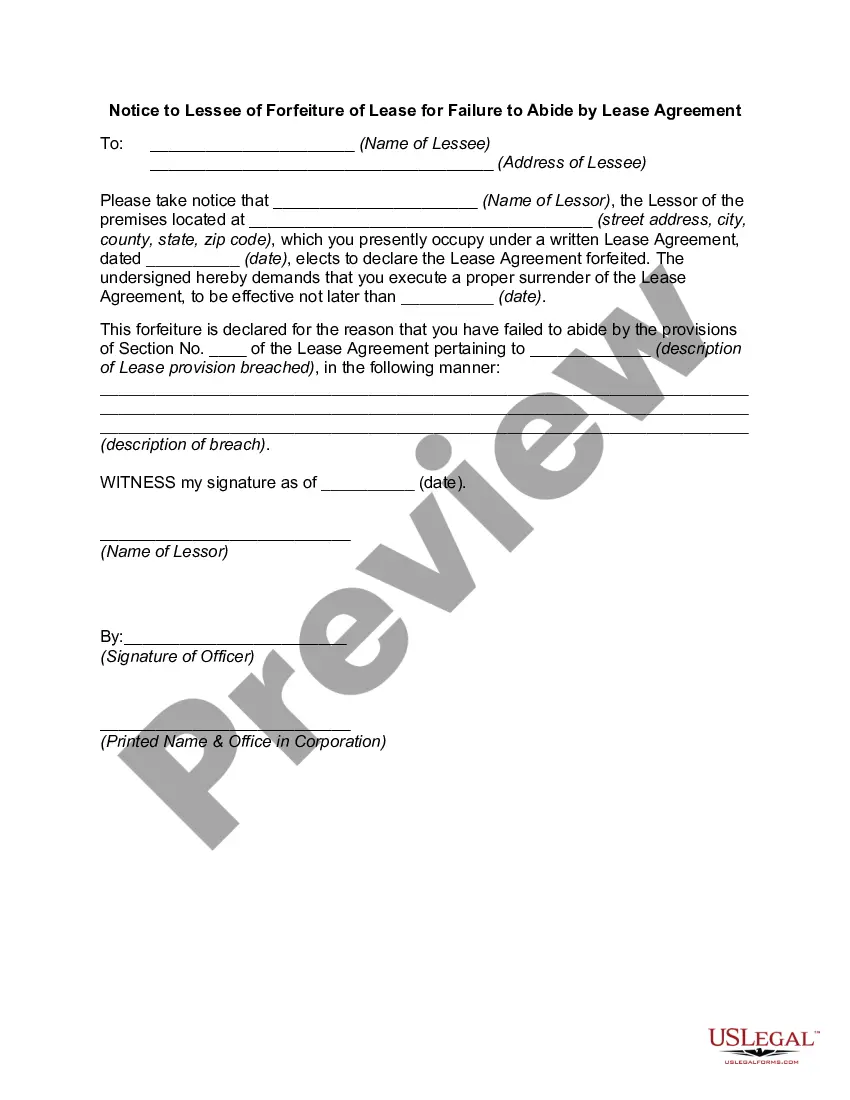
The Final Notice of Forfeiture and Request to Vacate Property under Contract for Deed is a legal document used by a seller to formally notify a buyer that their contract for deed has been canceled. This notice is issued after previous breach notices have expired. The form indicates that any payments made by the buyer are forfeited, and if the buyer remains on the property, further legal action may be pursued. This form is specifically tailored for situations involving property sales under contract for deed, distinguishing it from other eviction or lease termination notices.
Key components of this form
- Identification of the seller and purchaser involved in the contract.
- Description of the property in question.
- Details on prior notices of breach and default.
- Declaration of the cancellation of contract for deed.
- Statement outlining the forfeiture of any payments made by the purchaser.
- Instructions regarding the demand for the buyer to vacate the premises.
Situations where this form applies
This form should be used when a seller has previously notified the buyer of a breach of contract and the buyer has failed to remedy the default. It is appropriate to issue this final notice when the seller wishes to officially cancel the contract for deed and reclaim the property, particularly following multiple attempts to resolve the breach.
Who this form is for
- Sellers engaged in a contract for deed with a buyer who has defaulted on their obligations.
- Real estate professionals handling transactions involving contracts for deed.
- Property owners seeking to enforce their rights against a buyer who has not complied with the contract terms.
Instructions for completing this form
- Identify and enter the full names of the seller and the purchaser.
- Describe the property being affected by the contract for deed.
- Reference any prior notices of breach issued to the buyer.
- Clearly state the cancellation of the contract for deed and the effect on any payments made.
- Include a demand for the buyer to vacate the property, along with any relevant dates.
Does this form need to be notarized?
This form does not typically require notarization unless specified by local law. It is recommended to check local regulations to ensure compliance.
Get your form ready online
Our built-in tools help you complete, sign, share, and store your documents in one place.
Make edits, fill in missing information, and update formatting in US Legal Forms—just like you would in MS Word.
Download a copy, print it, send it by email, or mail it via USPS—whatever works best for your next step.
Sign and collect signatures with our SignNow integration. Send to multiple recipients, set reminders, and more. Go Premium to unlock E-Sign.
If this form requires notarization, complete it online through a secure video call—no need to meet a notary in person or wait for an appointment.
We protect your documents and personal data by following strict security and privacy standards.

Make edits, fill in missing information, and update formatting in US Legal Forms—just like you would in MS Word.

Download a copy, print it, send it by email, or mail it via USPS—whatever works best for your next step.

Sign and collect signatures with our SignNow integration. Send to multiple recipients, set reminders, and more. Go Premium to unlock E-Sign.

If this form requires notarization, complete it online through a secure video call—no need to meet a notary in person or wait for an appointment.

We protect your documents and personal data by following strict security and privacy standards.
Mistakes to watch out for
- Failing to properly identify all parties involved in the contract.
- Not including specific details about prior breach notices.
- Omitting essential information about the property in question.
- Failure to ensure the form is signed by the seller.
Benefits of completing this form online
- Convenient access to legal forms without the need for in-person consultations.
- Quick download and easy editing to meet specific needs.
- Reliability of professionally drafted forms by licensed attorneys.
Legal use & context
- This form serves as a official record of a seller's decision to cancel a contract for deed.
- Ensures that the seller takes necessary legal steps to reclaim the property.
- Failure to complete this process properly may result in challenges in court if eviction is pursued.
Quick recap
- The Final Notice of Forfeiture is essential for sellers who wish to cancel a contract for deed.
- Proper completion and delivery of this form are crucial for legal enforceability.
- Staying informed of state-specific rules can prevent complications during the eviction process.
Looking for another form?
Form popularity
FAQ
To obtain a property to vacate template, you can use online legal services like USLegalForms, which provide customizable templates for various legal documents. These templates are designed to accommodate Florida's specific legal requirements, including those related to a Florida Final Notice of Forfeiture and Request to Vacate Property under Contract for Deed. Accessing a template can save you time and ensure you include all necessary information.
In Florida, you must provide a written notice to the tenant, detailing their obligation to vacate the property. This notice should indicate the reason for vacating, final date, and be delivered in person or via certified mail. A proper notice is vital for a Florida Final Notice of Forfeiture and Request to Vacate Property under Contract for Deed, so ensure all legal requirements are met.
To write a letter to vacate your property, start with your current address, include the date, and address the landlord. Clearly state your intention to vacate, provide a forwarding address, and mention any applicable lease terms. By following the guidelines of a Florida Final Notice of Forfeiture and Request to Vacate Property under Contract for Deed, you can ensure your letter meets legal standards.
An example letter to vacate should include the date, the landlord's address, the tenant's address, and a statement requesting the tenant to vacate the property. It's advisable to specify the reason for the vacate notice and include the intended move-out date. Utilizing a format compliant with a Florida Final Notice of Forfeiture and Request to Vacate Property under Contract for Deed can improve clarity and effectiveness.
Under Florida law, it is generally required to deliver a written notice to vacate in person or via certified mail. Email may not meet the legal requirements for a valid notice. For situations involving a Florida Final Notice of Forfeiture and Request to Vacate Property under Contract for Deed, using a certified mailing ensures there is proof of delivery, protecting both parties.
In Florida, a notice to vacate generally includes the landlord's name, tenant's name, rental property address, and a clear statement requesting the tenant to vacate. It should specify the reason for the notice and the deadline for vacating the property. This document is essential in cases involving a Florida Final Notice of Forfeiture and Request to Vacate Property under Contract for Deed, as it outlines the tenant's obligations.
This means that if you default and can?t make your payments, you lose the property and all of the money you have already paid into it (often including repairs and improvements). Unlike a traditional mortgage, a defaulting buyer in a contact for deed may only have 30-60 days to cure the default or move out.
A disadvantage to the seller is that a contract for deed is frequently characterized by a low down payment and the purchase price is paid in installments instead of one lump sum. If a seller needs funds from the sale to buy another property, this would not be a beneficial method of selling real estate.
The name of the notice that is given to property owners to appear in court to say why the property shouldn't be forfeited.
If a buyer backs out of a transaction without invoking her rights under a contingency, the seller could sue her to force the sale to move forward or for damages. To avoid this risk, most contracts contain a clause that allows the seller to keep the buyer's deposit if the buyer backs out.