Virginia Fiduciary Deed for use by Executors, Trustees, Trustors, Administrators and other Fiduciaries
About this form
The Fiduciary Deed is a legal document used by executors, trustees, trustors, administrators, and other fiduciaries to transfer property on behalf of another individual who may no longer be able to make such transfers. This form differs from standard deeds as it explicitly identifies the fiduciary relationship and the authority granted to the fiduciary to act in the best interests of the property owner.
Key parts of this document
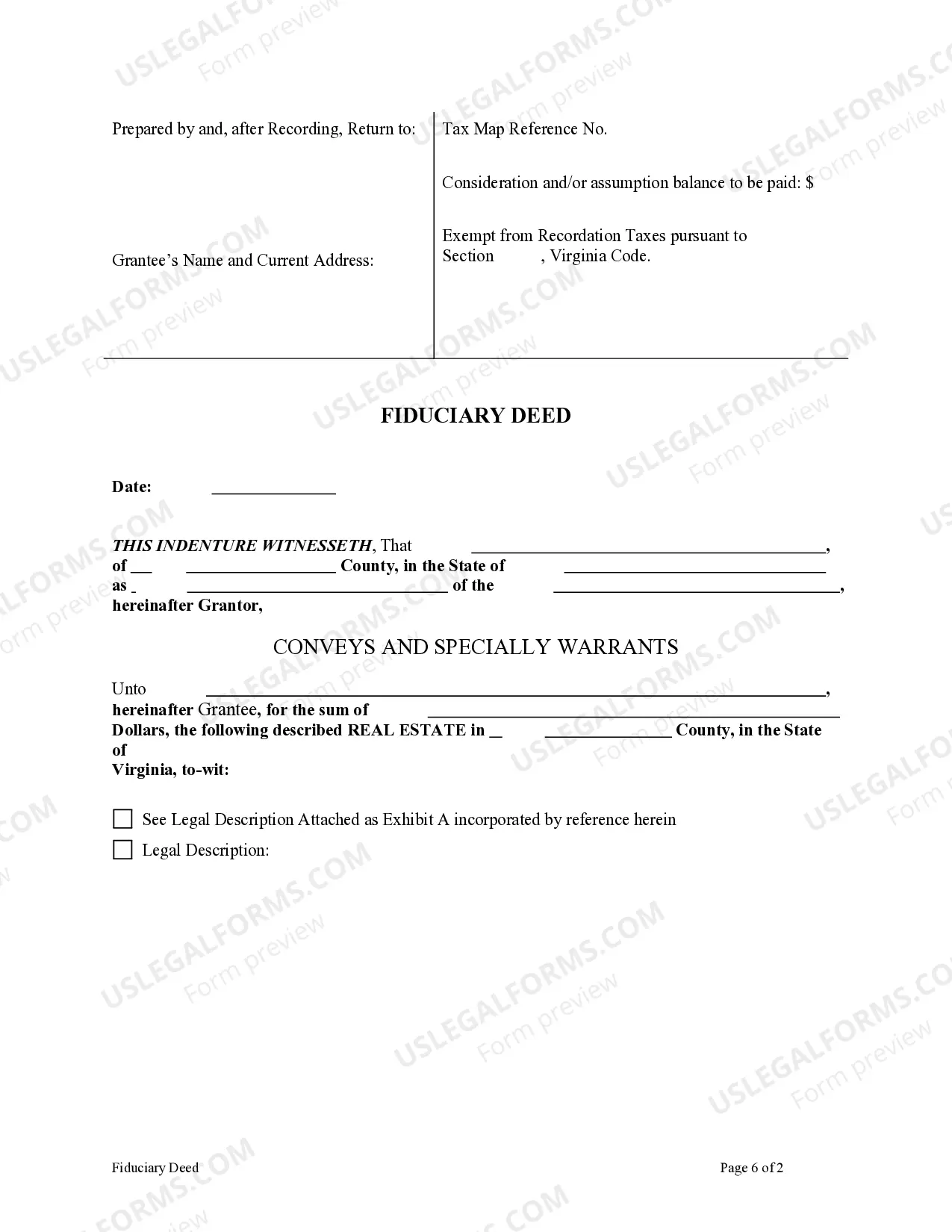
- Identification of the grantor and grantee
- Description of the property being transferred
- Statement of authority from the grantor
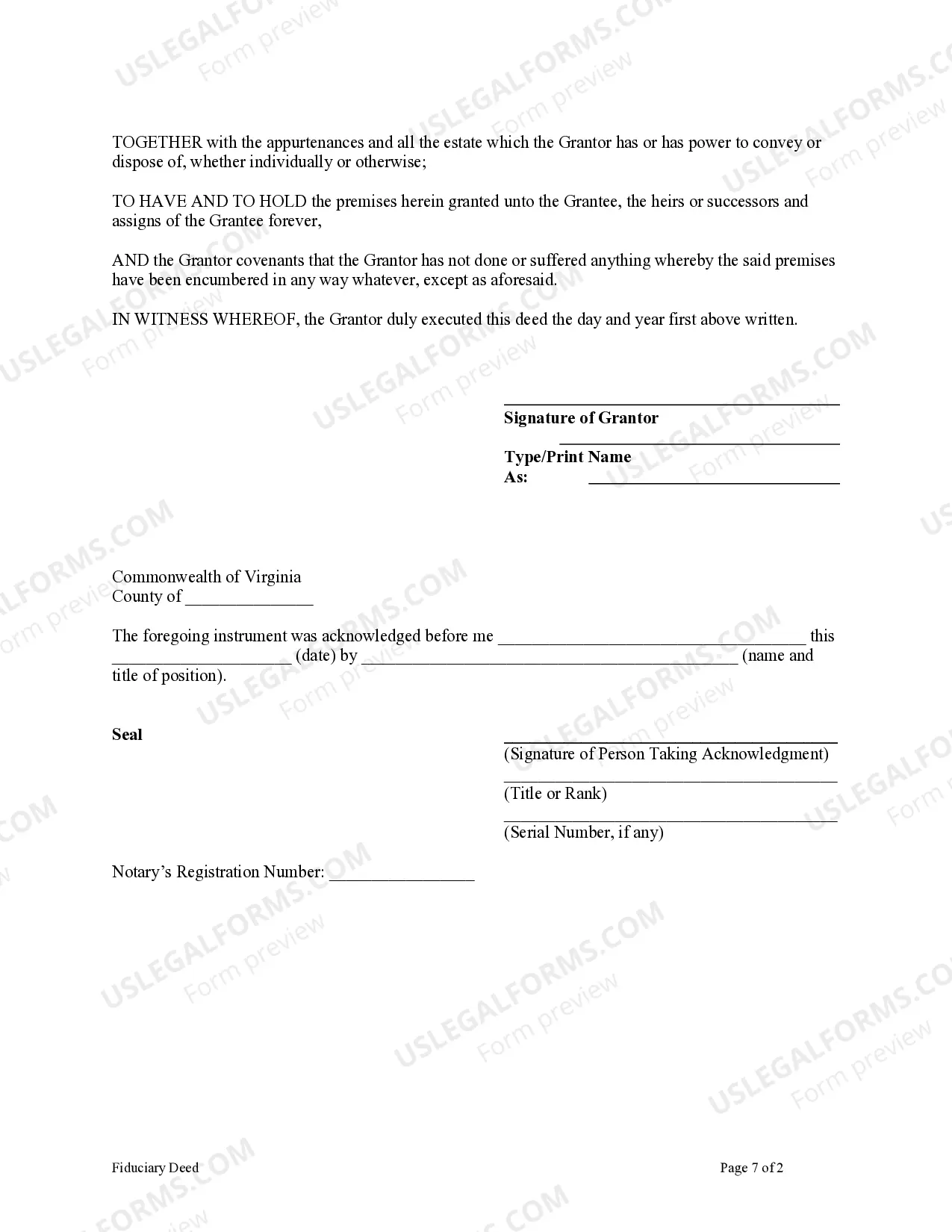
- Notary acknowledgment section
- Signatures of the parties involved in the transaction


When this form is needed
This form should be used when a fiduciary needs to convey real estate, such as when executing a will, fulfilling terms of a trust, or managing assets for individuals who are incapacitated or deceased. It is also applicable during the administration of estates, where the property must be transferred to beneficiaries or sold to settle debts.
Who can use this document
This form is intended for:
- Executors of a will
- Trustees managing a trust
- Guardians or conservators acting on behalf of an individual
- Administrators of estates
- Any other fiduciaries tasked with managing property on behalf of another
How to complete this form
- Identify the grantor (the fiduciary) and the grantee (those receiving the property).
- Provide a detailed description of the property being transferred.
- Clearly state the authority under which the grantor is acting.
- Enter the date of the transfer.
- Obtain signatures from the grantor and any required witnesses.
- Complete the notary section to ensure legal validity.
Does this document require notarization?
This form needs to be notarized to ensure legal validity. US Legal Forms provides secure online notarization powered by Notarize, allowing you to complete the process through a verified video call, available anytime.
Get your form ready online
Our built-in tools help you complete, sign, share, and store your documents in one place.
Make edits, fill in missing information, and update formatting in US Legal Forms—just like you would in MS Word.
Download a copy, print it, send it by email, or mail it via USPS—whatever works best for your next step.
Sign and collect signatures with our SignNow integration. Send to multiple recipients, set reminders, and more. Go Premium to unlock E-Sign.
If this form requires notarization, complete it online through a secure video call—no need to meet a notary in person or wait for an appointment.
We protect your documents and personal data by following strict security and privacy standards.

Make edits, fill in missing information, and update formatting in US Legal Forms—just like you would in MS Word.

Download a copy, print it, send it by email, or mail it via USPS—whatever works best for your next step.

Sign and collect signatures with our SignNow integration. Send to multiple recipients, set reminders, and more. Go Premium to unlock E-Sign.

If this form requires notarization, complete it online through a secure video call—no need to meet a notary in person or wait for an appointment.

We protect your documents and personal data by following strict security and privacy standards.
Mistakes to watch out for
- Failing to accurately identify the property details.
- Not providing proper authorization documentation.
- Neglecting to have the document notarized when required.
- Leaving fields blank or incomplete.
- Not following local recording requirements.
Why use this form online
- Convenient access to professionally drafted forms at any time.
- Edit and personalize the document to meet specific needs.
- Downloadable versions allow for immediate use without delays.
- Reliability from forms created by licensed attorneys.
Looking for another form?

Form popularity
FAQ
The probate of the will can usually wait until a week or so after the funeral. It is recommended that the initial steps in the estate process start within 30 days after death. If any questions exist, call your attorney or your local Circuit Court Clerk's Office.
This form contains personal information about the party which files the divorce including name, date of birth, information about previous marriages and children, etc. This data is used for statistical purposes by the state of Virginia.
Effective July 1, 2020, the pendente lite spousal support guidelines in Virginia are: Cases With Minor Children: 26% x Payor's Income 58% x Payee's Income. Cases With No Minor Children: 27% x Payor's Income 50% x Payee's Income.
To qualify as the executor of an estate in Virginia, the individual must contact the clerk's office in the deceased's county of residence and schedule a meeting with the probate clerk. The potential executor brings all necessary paperwork to the meeting.
The list of heirs is given under oath on a form provided by the Clerk of Court. The heirs identified on the list are the heirs of the decedent as provided under Virginia law for a person who dies without a will. The form requires the name, address, relationship to the decedent, and age of each heir.
Assets of an estate when the total value of the entire personal probate estate as of the decedent's death does not exceed, under current law, $50,000, if certain requirements are met, including an affidavit stating certain facts.
The way to fill out the Vs4 form online: Enter your official identification and contact details. Apply a check mark to point the answer wherever expected. Double check all the fillable fields to ensure complete accuracy. Make use of the Sign Tool to add and create your electronic signature to signNow the Vs4 form.
Before distributing assets to beneficiaries, the executor must pay valid debts and expenses, subject to any exclusions provided under state probate laws.The executor must maintain receipts and related documents and provide a detailed accounting to estate beneficiaries.
To file this lawsuit, you must go to the General District Court Clerk's office. Ask for the proper court form. To sue for return of property, fill out a "Warrant in Detinue." Even though this court form is called a "warrant," it is not used in a criminal case. It is used in a civil (non-criminal) case.