Carbon Dioxide Storage Agreement
Overview of this form
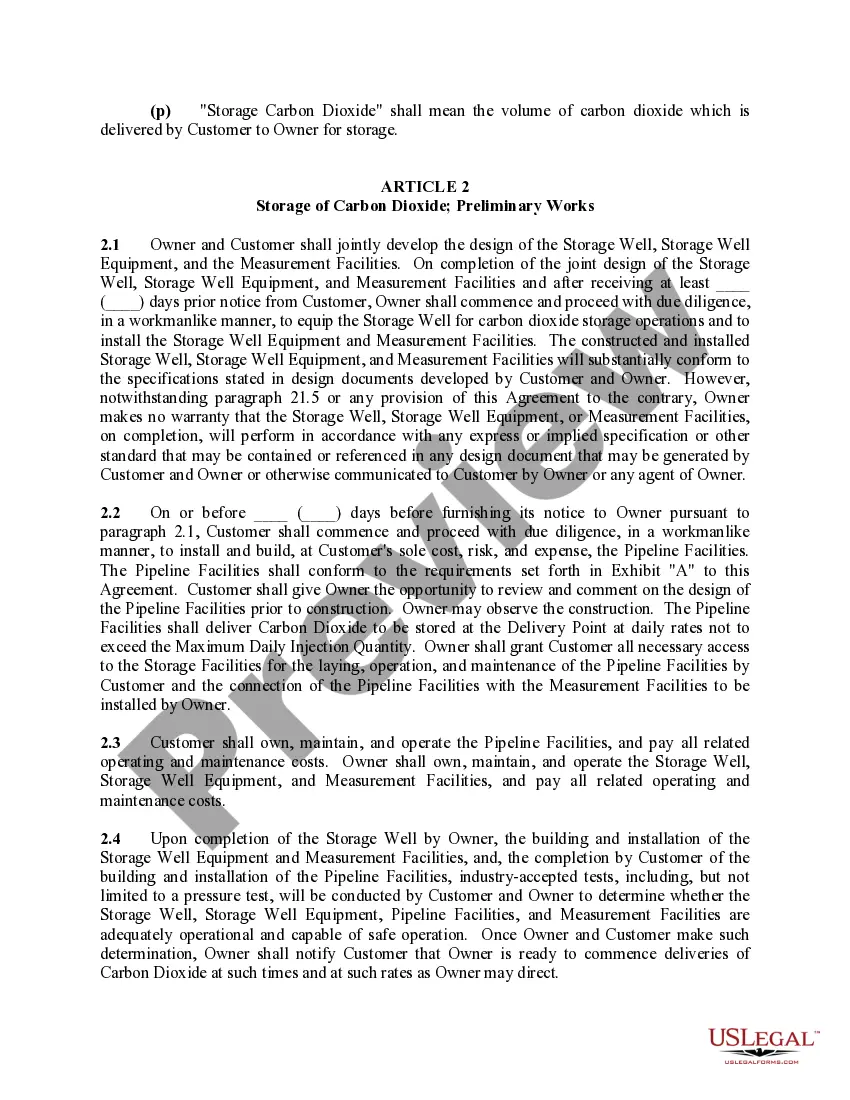
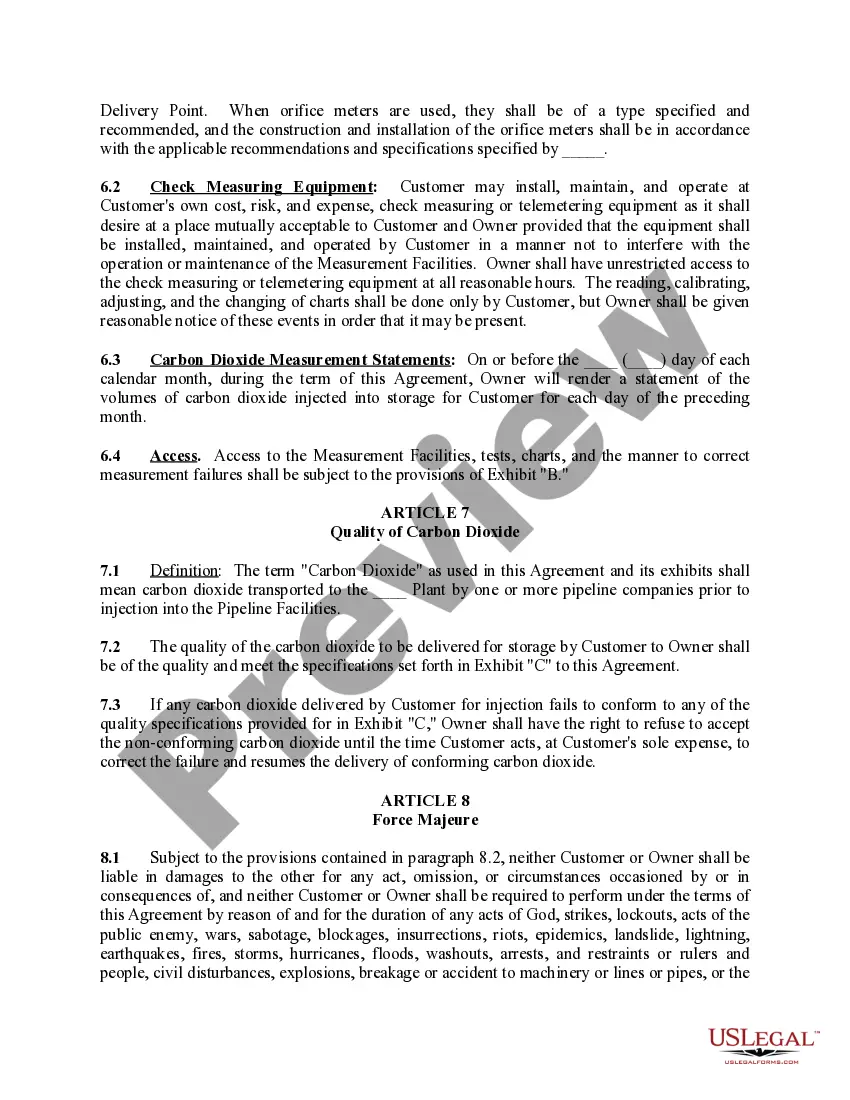
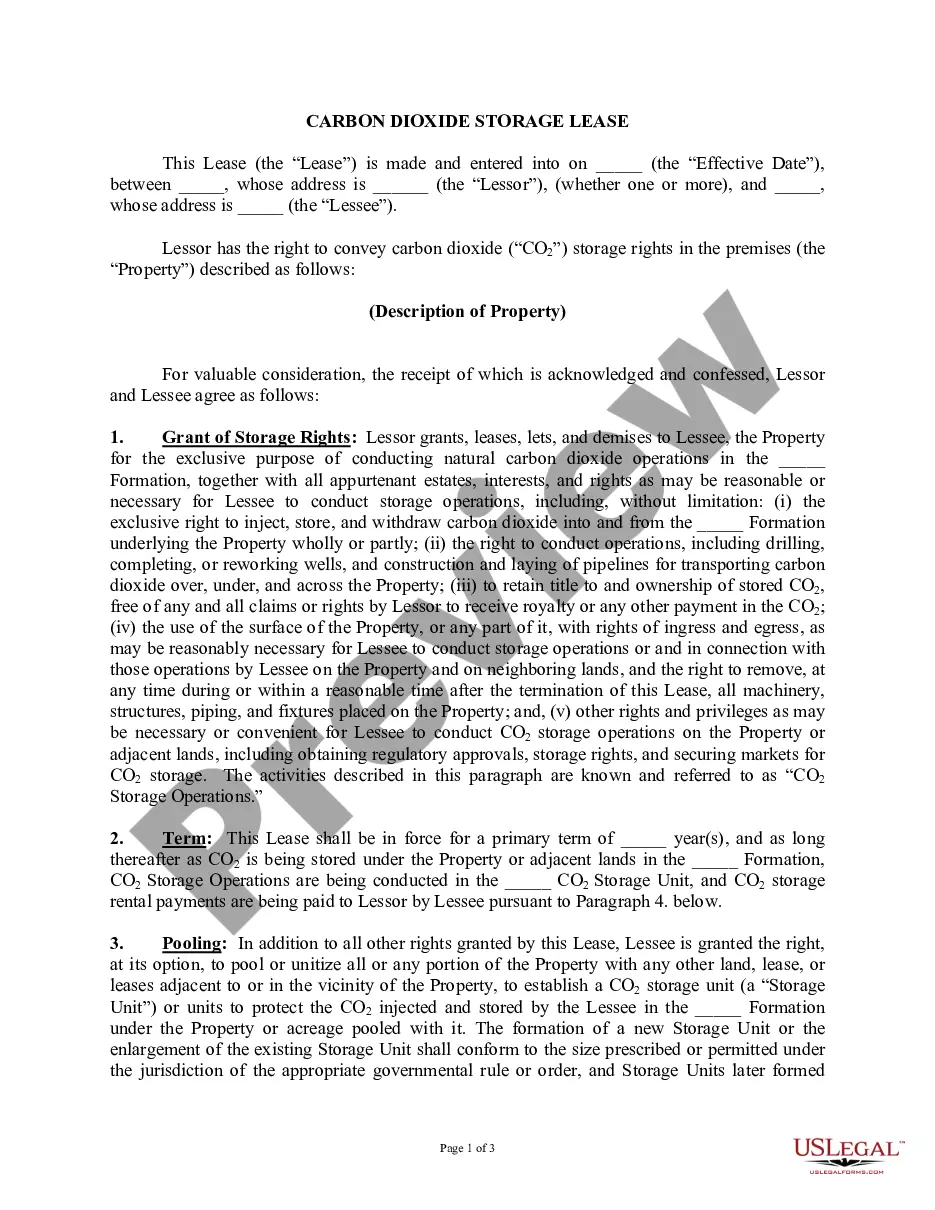
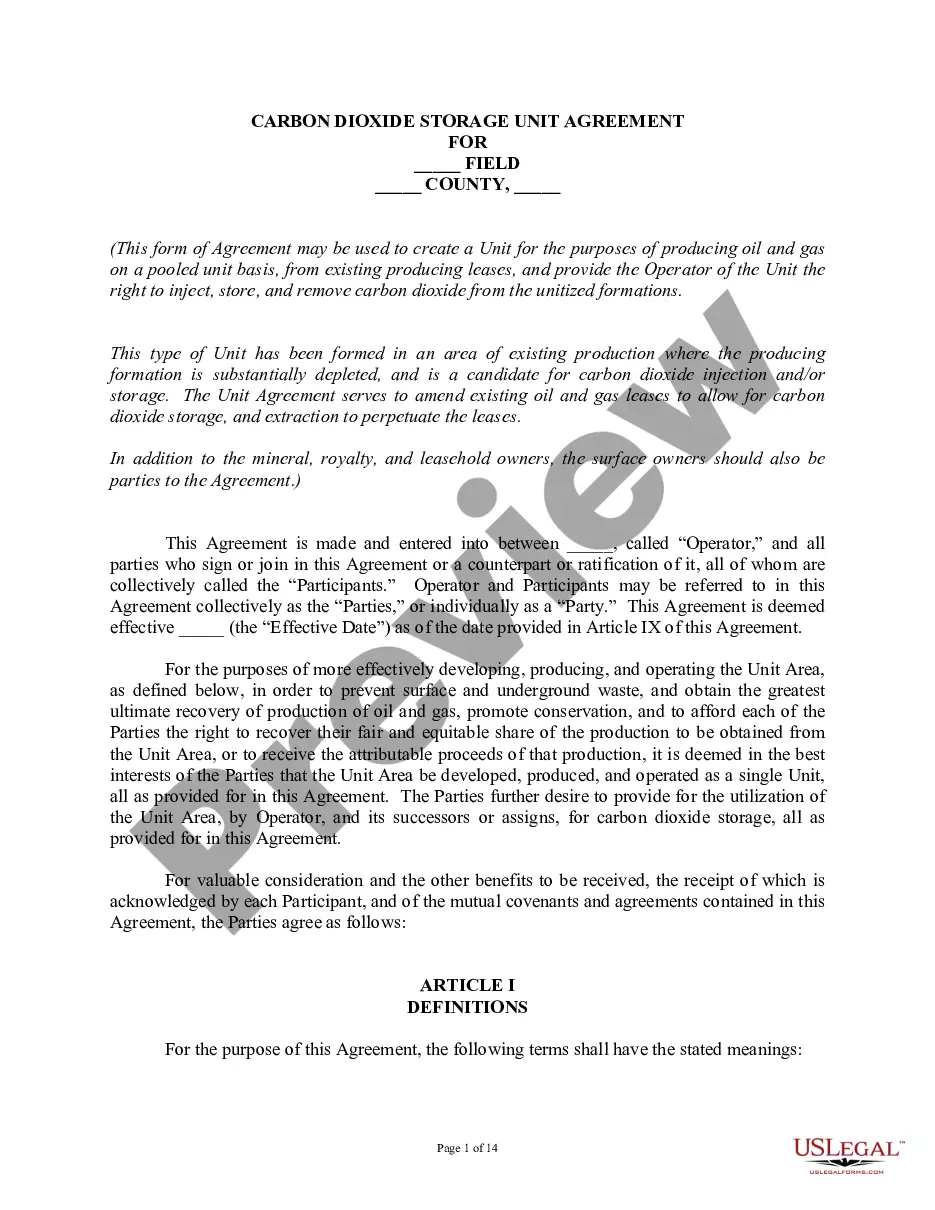
The Carbon Dioxide Storage Agreement is a legal document that outlines the terms for storing carbon dioxide in underground facilities. It establishes the relationship between the owner of the storage facility and the customer needing storage services. Unlike other agreements, this specific form addresses the technical and logistical aspects of carbon dioxide storage, ensuring both parties understand their rights and obligations.
Key components of this form
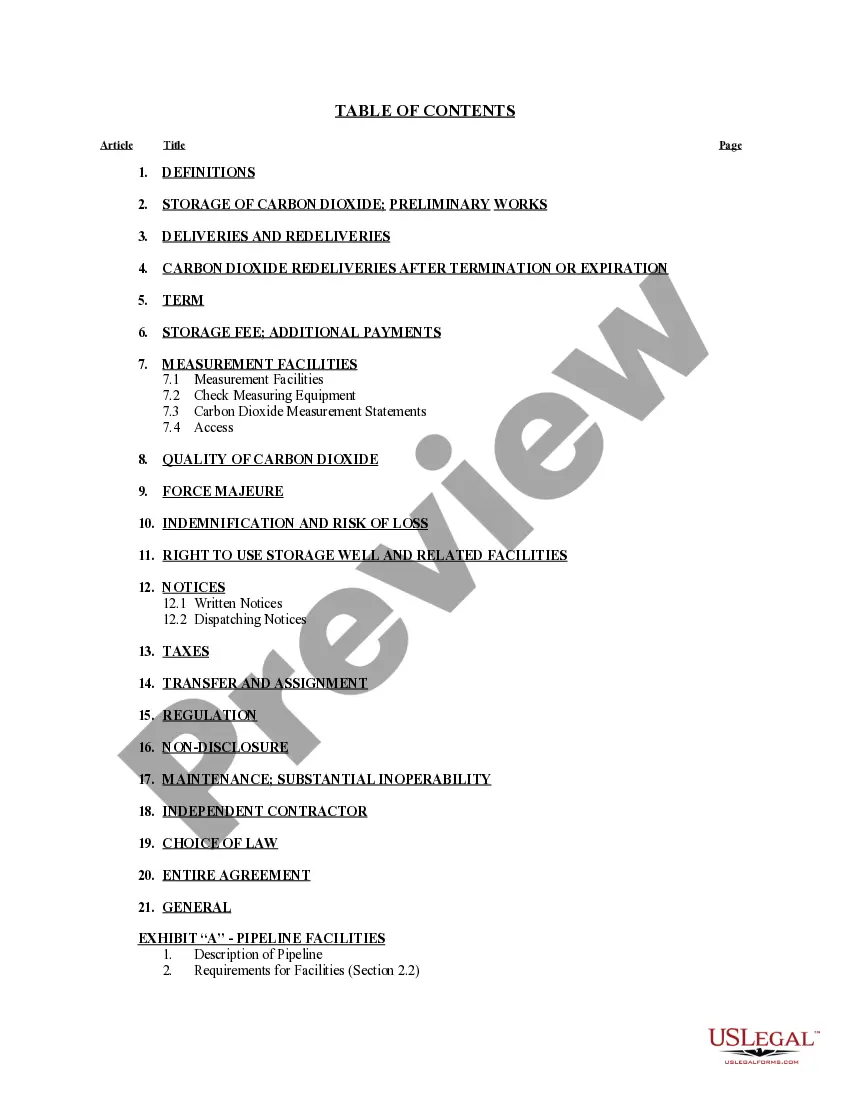
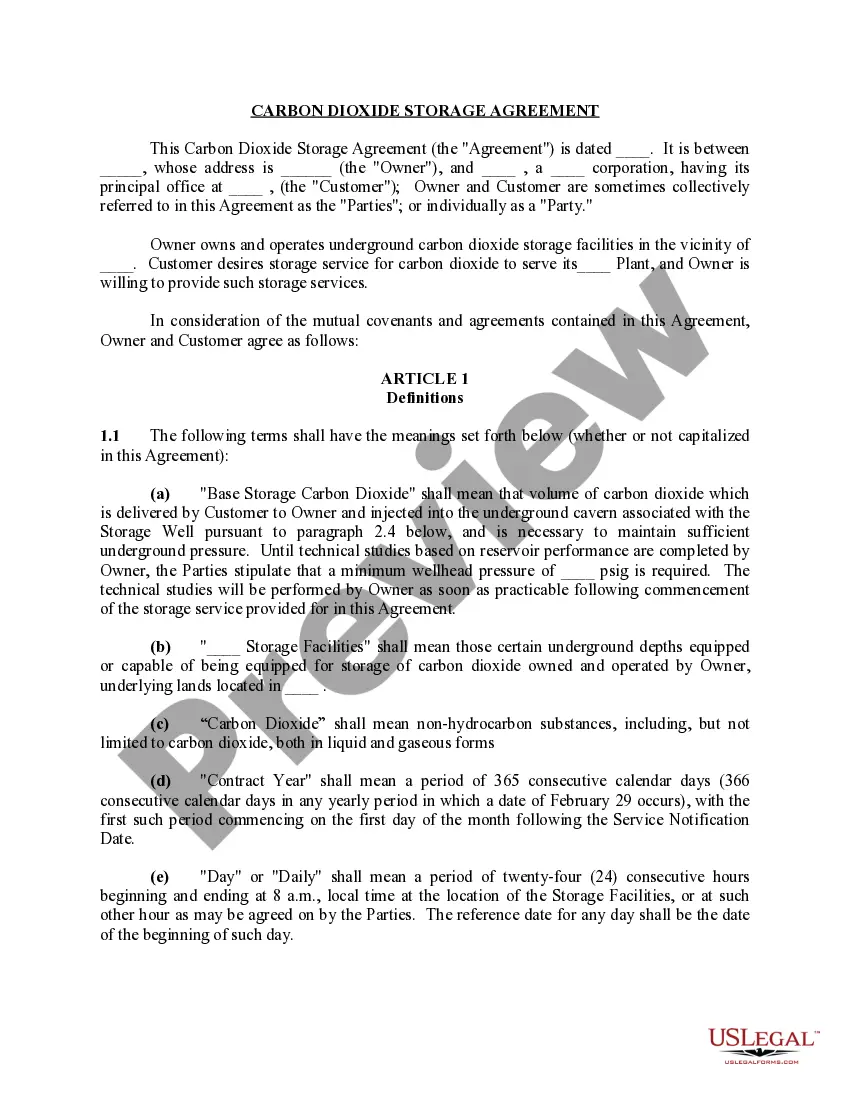
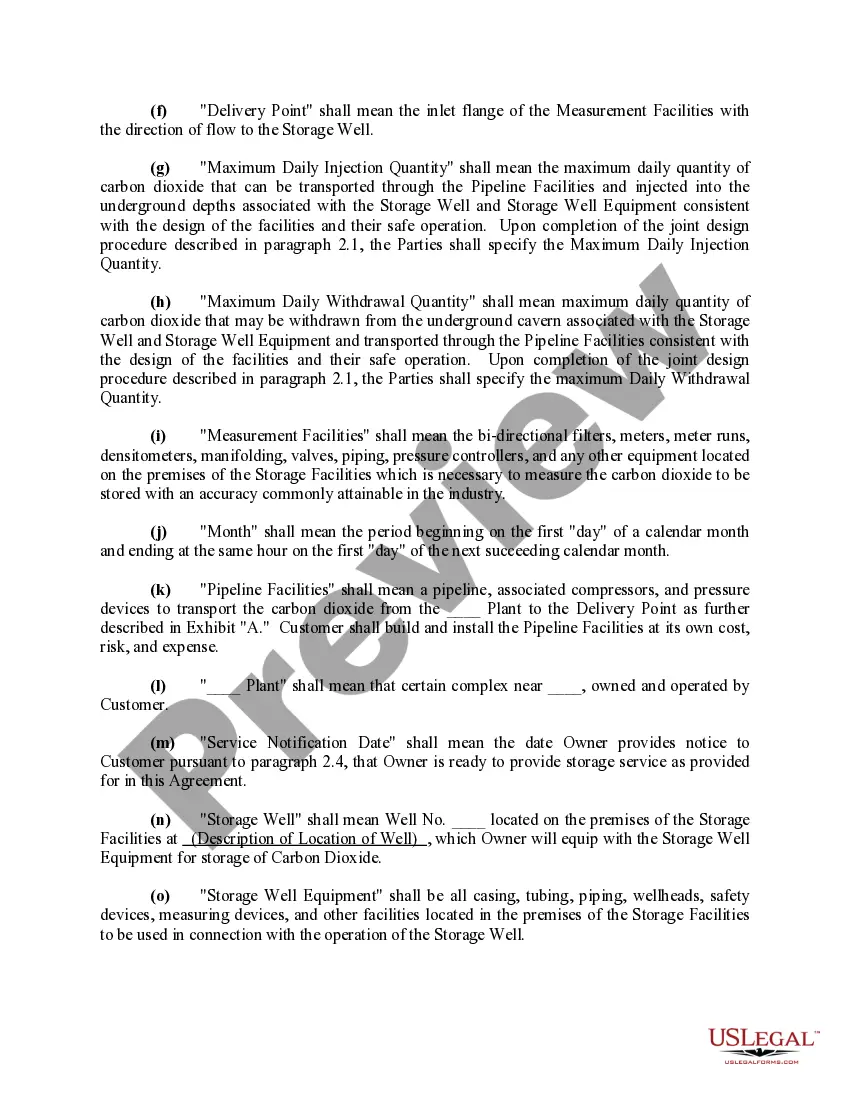
- Definitions: Clarifies key terms used throughout the agreement.
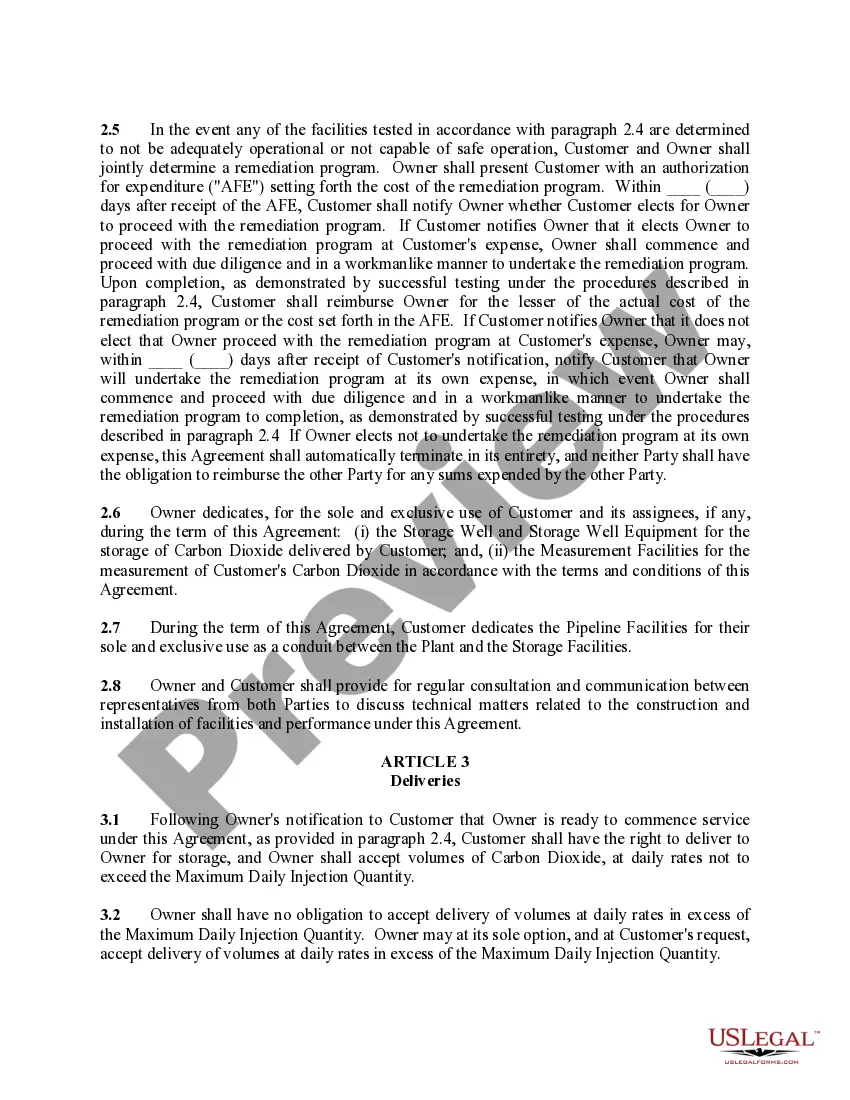
- Storage of Carbon Dioxide: Outlines preliminary works and responsibilities for both parties.
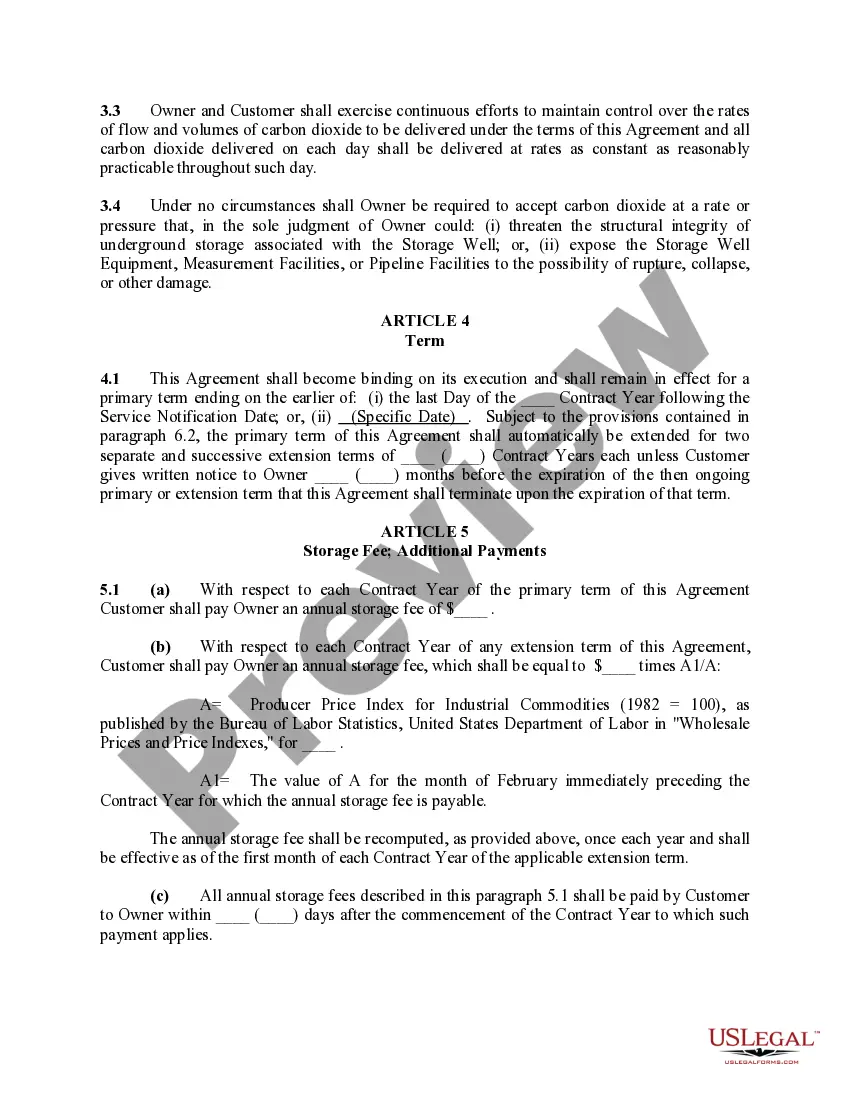
- Deliveries and Redeliveries: Details the processes for delivering carbon dioxide for storage.
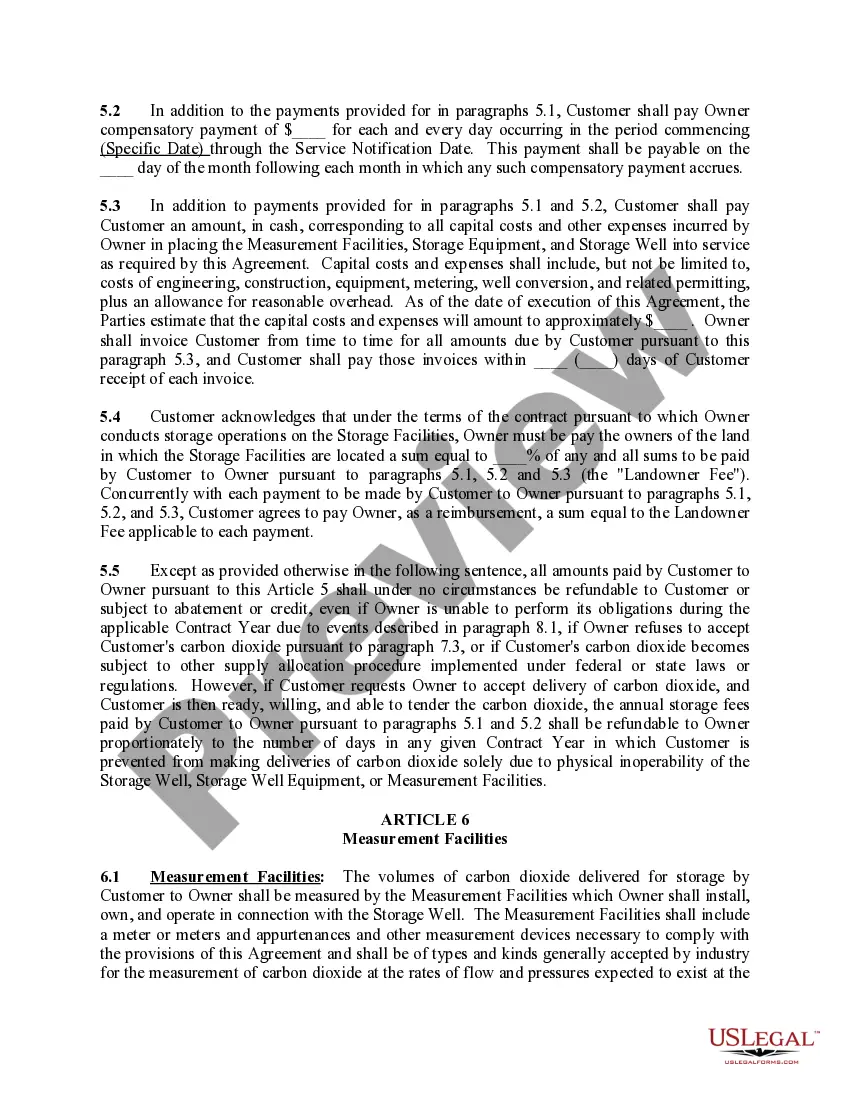
- Storage Fees: Specifies the financial obligations for the customer related to storage services.
- Quality of Carbon Dioxide: Sets quality standards that carbon dioxide must meet for acceptance.
- Indemnification: Addresses liability and risk related to the storage of carbon dioxide.


Common use cases
This form should be used when a customer needs to store carbon dioxide in a designated storage facility operated by another party. It is particularly relevant for industrial operations that generate significant carbon emissions and seek to manage their environmental impact through storage solutions. This agreement ensures compliance with regulatory requirements and defines the technical parameters involved in the storage process.
Who can use this document
- Industrial companies seeking to store carbon dioxide emissions.
- Entities that operate or provide access to underground carbon dioxide storage facilities.
- Environmental organizations focused on carbon capture and storage solutions.
- Legal representatives negotiating carbon dioxide storage agreements on behalf of clients.
Instructions for completing this form
- Identify the parties involved: Enter the names and addresses of both the owner and the customer.
- Define storage details: Specify the location, capacity, and technical requirements for the storage facility.
- Establish payment terms: Detail the storage fee structure and any additional payments required.
- Outline delivery process: Describe how and when carbon dioxide will be delivered for storage.
- Include quality and safety standards: Ensure all specifications for the carbon dioxide's quality are documented in the agreement.
Is notarization required?
In most cases, this form does not require notarization. However, some jurisdictions or signing circumstances might. US Legal Forms offers online notarization powered by Notarize, accessible 24/7 for a quick, remote process.
Get your form ready online
Our built-in tools help you complete, sign, share, and store your documents in one place.
Make edits, fill in missing information, and update formatting in US Legal Forms—just like you would in MS Word.
Download a copy, print it, send it by email, or mail it via USPS—whatever works best for your next step.
Sign and collect signatures with our SignNow integration. Send to multiple recipients, set reminders, and more. Go Premium to unlock E-Sign.
If this form requires notarization, complete it online through a secure video call—no need to meet a notary in person or wait for an appointment.
We protect your documents and personal data by following strict security and privacy standards.

Make edits, fill in missing information, and update formatting in US Legal Forms—just like you would in MS Word.

Download a copy, print it, send it by email, or mail it via USPS—whatever works best for your next step.

Sign and collect signatures with our SignNow integration. Send to multiple recipients, set reminders, and more. Go Premium to unlock E-Sign.

If this form requires notarization, complete it online through a secure video call—no need to meet a notary in person or wait for an appointment.

We protect your documents and personal data by following strict security and privacy standards.
Typical mistakes to avoid
- Failing to clearly define the responsibilities of each party.
- Not specifying the quality standards for carbon dioxide delivery.
- Omitting essential dates and deadlines for performance.
- Neglecting to review state-specific regulations related to carbon dioxide storage.
Advantages of online completion
- Convenience of editing: Users can customize the form to meet specific needs easily.
- Instant access: The form can be downloaded quickly and used without delays.
- Accuracy and reliability: Forms drafted by licensed attorneys help ensure legal compliance and clarity.
Legal use & context
- The agreement is essential for establishing a legally binding relationship between parties involved in carbon dioxide storage.
- It provides clarity regarding the responsibilities and liabilities of both the owner and the customer.
- Compliance with environmental regulations is facilitated through the terms outlined in this agreement.
Looking for another form?







Form popularity
FAQ
Carbon capture, utilization and storage (CCUS), also referred to as carbon capture, utilization and sequestration, is a process that captures carbon dioxide emissions from sources like coal-fired power plants and either reuses or stores it so it will not enter the atmosphere.
In the case of saline aquifers, as well as structural and mineral storage, the CO2 can dissolve into the salty water in a process called 'dissolution storage'. Here, the dissolved CO2 slowly descends to the bottom of the aquifer. In any given reservoir, each (or all) of these processes work to store CO2 indefinitely.
Carbon dioxide is slightly soluble in water and denser than air, so another way to collect it is in a dry, upright gas jar. As the carbon dioxide falls out of the delivery tube and into the gas jar, it pushes the less dense air out of the top of the gas jar.
The three main types of geological storage are oil and gas reservoirs, deep saline formations, and un-minable coal beds. CO2 can for instance be physically trapped under a well-sealed rock layer or in the pore spaces within the rock.
Where can captured carbon dioxide be stored? After capture, carbon dioxide (CO2) is compressed and then transported to a site where it is injected underground for permanent storage (also known as "sequestration"). CO2 is commonly transported by pipeline, but it can also be transported by train, truck, or ship.
The most well-developed approach to storing CO2 is injecting it underground into naturally occurring, porous rock formations such as former natural gas or oil reservoirs, coal beds that can't be mined, or saline aquifers.
There are three basic types of CO2 capture: pre-combustion, post-combustion and oxyfuel with post-combustion. Pre-combustion processes convert fuel into a gaseous mixture of hydrogen and CO2. The hydrogen is separated and can be burnt without producing any CO2; the CO2 can then be compressed for transport and storage.
Once the carbon dioxide has been transported, it is stored in porous geological formations that are typically located several kilometers under the earth's surface, with pressure and temperatures such that carbon dioxide will be in the liquid or supercritical phase. Suitable storage sites include former gas and oil
Direct air capture is the process of chemically scrubbing carbon dioxide directly from the ambient air, and then storing it either underground or in long-lived products.