Permit Agreement for Minerals
Overview of this form
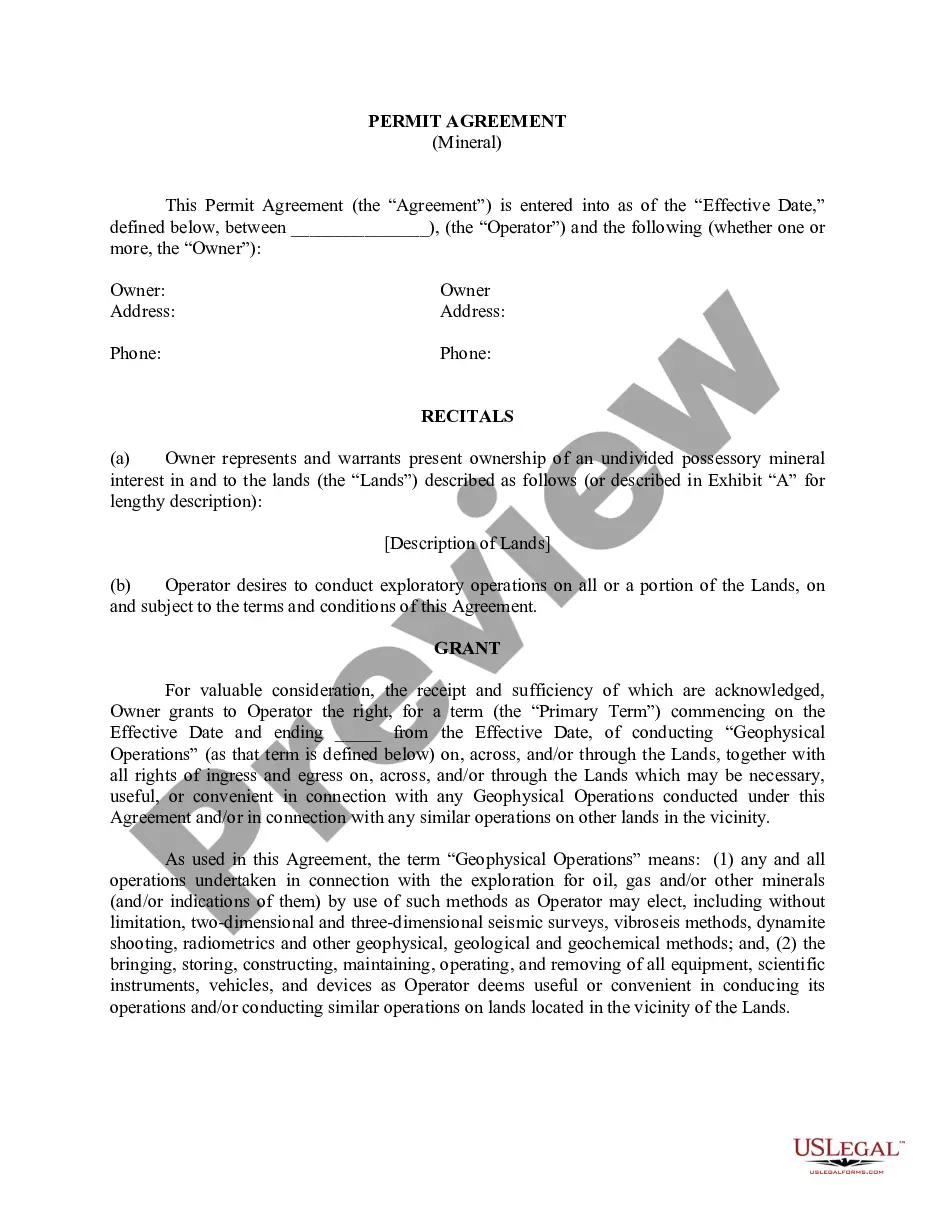
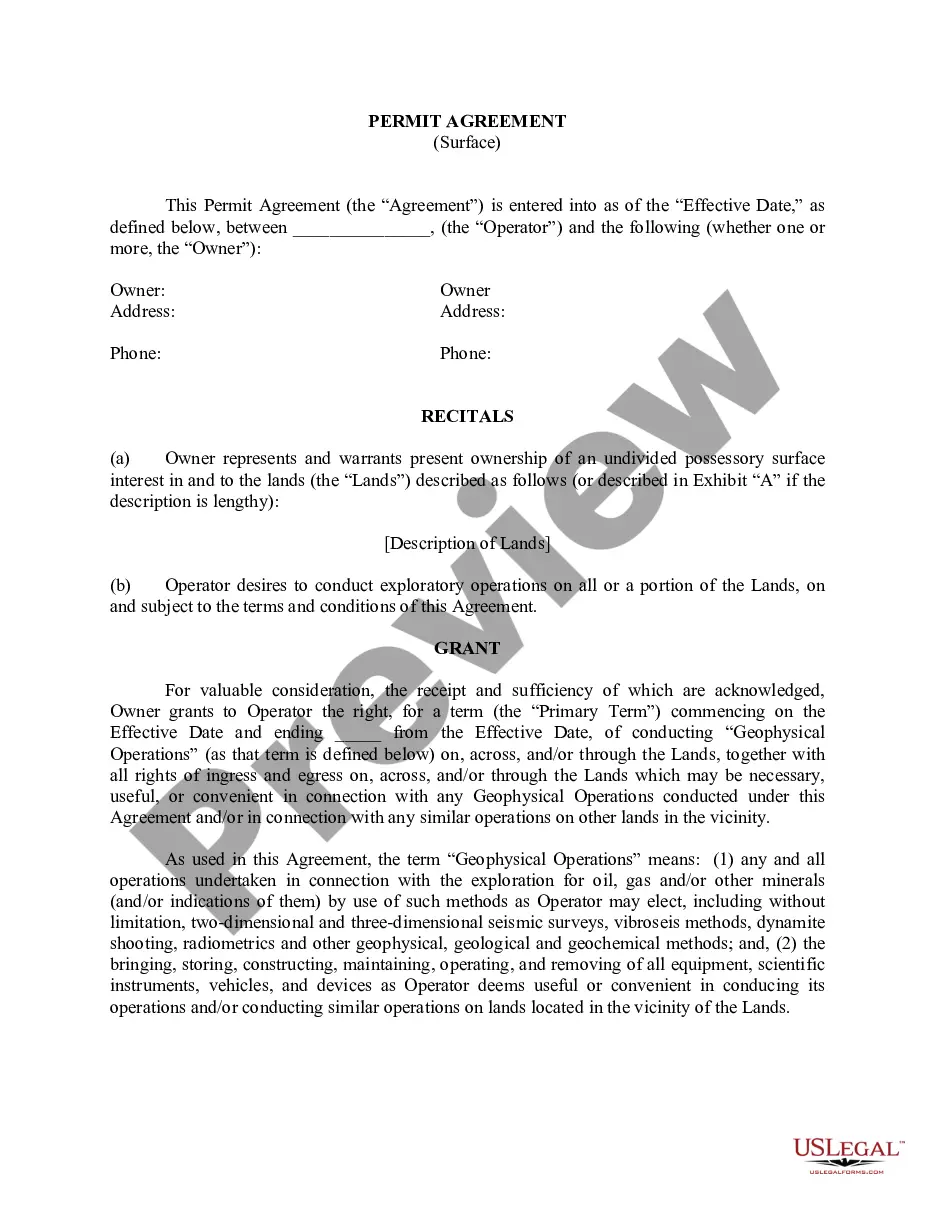
The Permit Agreement for Minerals is a legal document that allows landowners (the Owner) to grant operators (the Operator) permission to explore and extract minerals from their land. This agreement outlines the rights and responsibilities of both parties, particularly concerning the exploration for oil, gas, and other minerals. Unlike general land use agreements, this form specifically governs mineral interests and the activities related to geophysical operations on the property described in the document.
Key components of this form
- Identification of the parties involved: the Owner and the Operator.
- Details of the mineral interest owned by the Owner, including property descriptions.
- Grant of rights for conducting geophysical operations specified in the agreement.
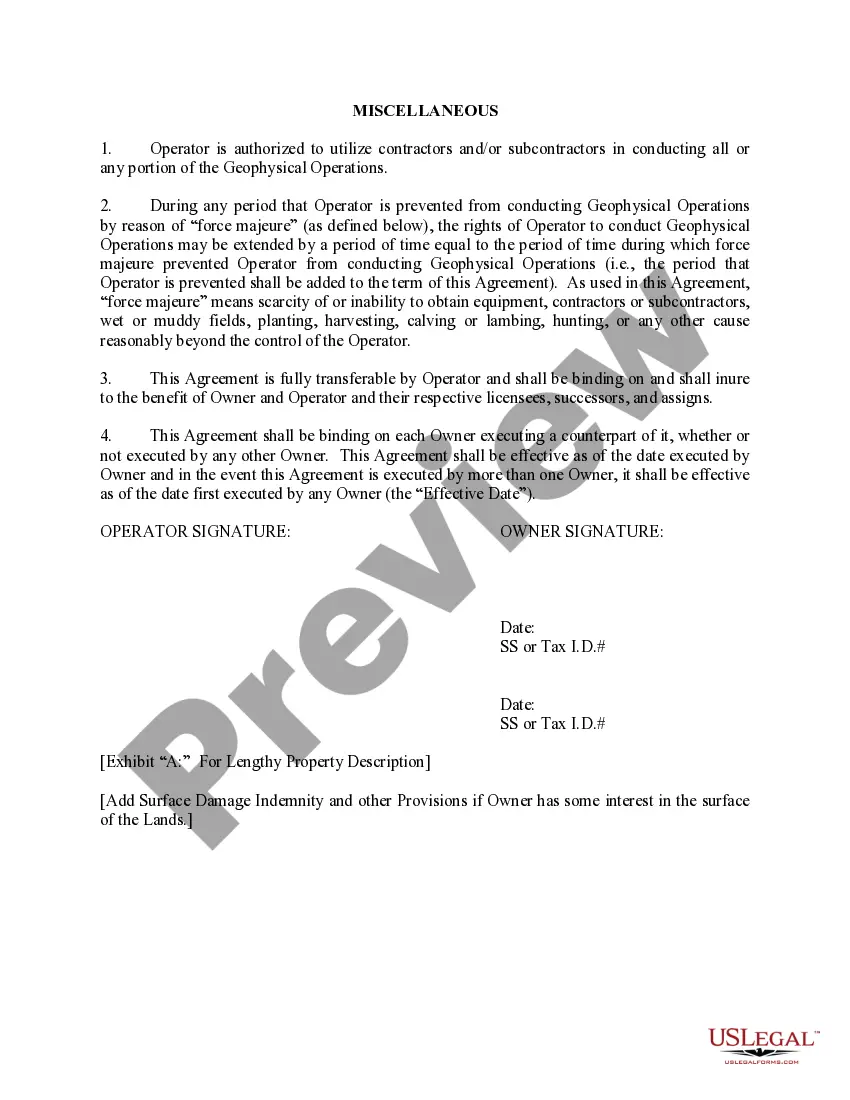
- Provisions for contractor use and force majeure events that may affect operations.
- Signatures of both the Owner and Operator to validate the agreement.
When this form is needed
This form should be used when landowners wish to allow operators to explore for minerals on their property. It is applicable in scenarios such as land development, oil and gas exploration, or any circumstances requiring formal consent for geophysical operations. If you are a property owner and have been approached by an operator seeking to conduct mineral exploration, this agreement will ensure that your interests are protected while granting them the necessary rights.
Intended users of this form
- Landowners who possess undivided possessory mineral interests in their property.
- Operators seeking to explore for oil, gas, or other minerals on private lands.
- Individuals or entities involved in the mineral resources industry.
- Property owners wanting to formalize terms with operators through a legally binding agreement.
Completing this form step by step
- Identify the parties involved by entering the names and addresses of the Owner and Operator.
- Provide a detailed description of the lands where mineral rights exist.
- Clearly define the term of the agreement, including start and end dates for operations.
- Specify the types of geophysical operations that the Operator is authorized to conduct.
- Ensure all parties sign and date the form to make it legally binding.
Does this form need to be notarized?
In most cases, this form does not require notarization. However, some jurisdictions or signing circumstances might. US Legal Forms offers online notarization powered by Notarize, accessible 24/7 for a quick, remote process.
Get your form ready online
Our built-in tools help you complete, sign, share, and store your documents in one place.
Make edits, fill in missing information, and update formatting in US Legal Forms—just like you would in MS Word.
Download a copy, print it, send it by email, or mail it via USPS—whatever works best for your next step.
Sign and collect signatures with our SignNow integration. Send to multiple recipients, set reminders, and more. Go Premium to unlock E-Sign.
If this form requires notarization, complete it online through a secure video call—no need to meet a notary in person or wait for an appointment.
We protect your documents and personal data by following strict security and privacy standards.

Make edits, fill in missing information, and update formatting in US Legal Forms—just like you would in MS Word.

Download a copy, print it, send it by email, or mail it via USPS—whatever works best for your next step.

Sign and collect signatures with our SignNow integration. Send to multiple recipients, set reminders, and more. Go Premium to unlock E-Sign.

If this form requires notarization, complete it online through a secure video call—no need to meet a notary in person or wait for an appointment.

We protect your documents and personal data by following strict security and privacy standards.
Common mistakes
- Failing to provide a detailed description of the property involved.
- Not clearly defining the term of the agreement.
- Omitting signatures or dates, which may render the agreement invalid.
- Neglecting to consult local regulations that may affect mineral rights.
Why use this form online
- Convenience: Downloadable and easy to complete from anywhere.
- Editability: Customize the form to fit your specific needs.
- Reliability: Drafted by licensed attorneys to ensure legal compliance.
- Time-saving: Quick access to necessary documents without delays.
Looking for another form?

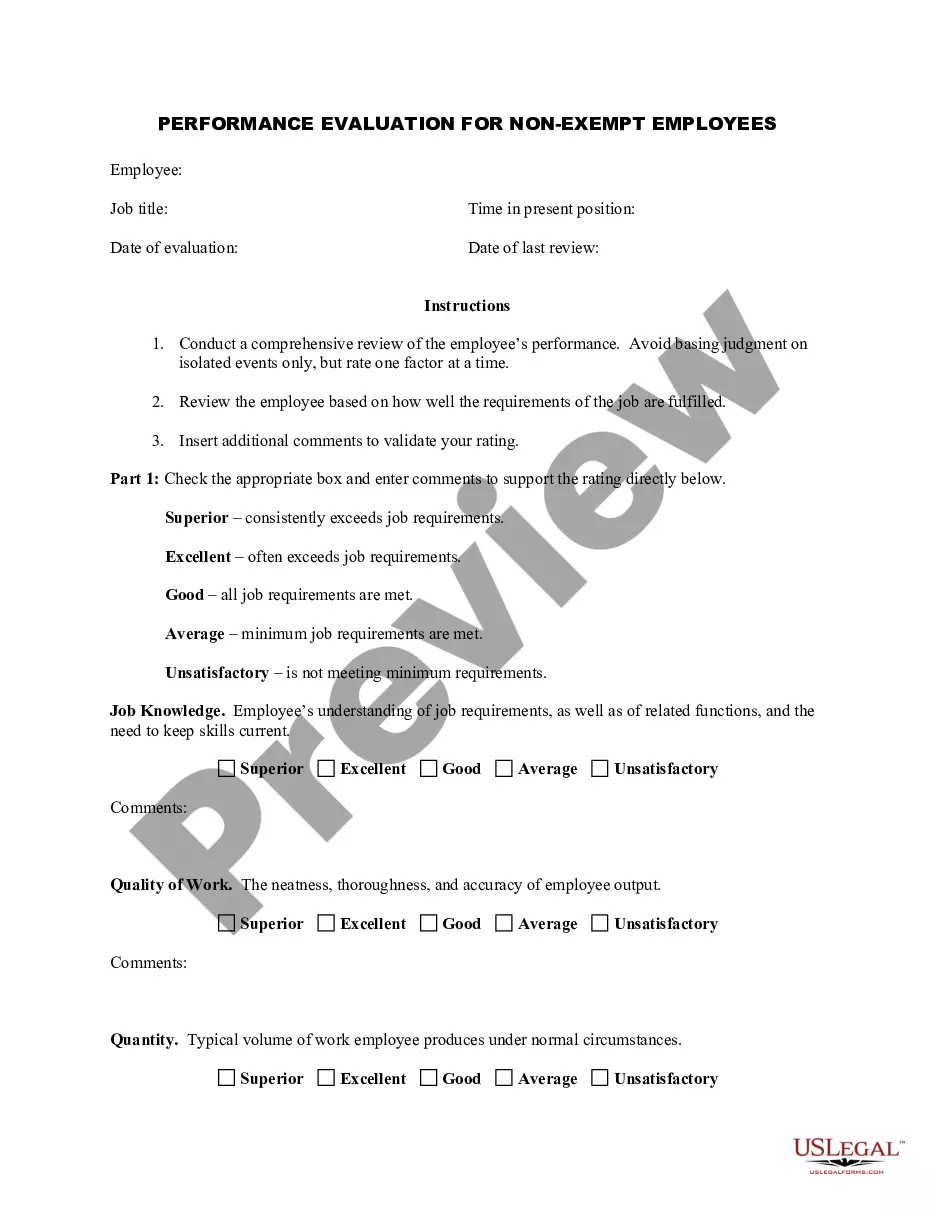

Form popularity
FAQ
As a mineral rights value rule of thumb, the 3X cash flow method is often used. To calculate mineral rights value, multiply the 12-month trailing cash flow by 3. For a property with royalty rights, a 5X multiple provides a more accurate valuation (stout.com).
Investing in mineral rights is a complex investment strategy but can be a profitable real estate venture.Then investing in mineral rights may be a great fit for your next real estate venture. Investing in mineral rights has the potential to provide big returns.
When it comes to mineral rights, the standard admonition has long been consistent and emphatic: Avoid selling them. After all, simply owning mineral rights costs you nothing. There are no liability risks, and in most cases, taxes are assessed only on properties that are actively producing oil or gas.
"Mineral rights" entitle a person or organization to explore and produce the rocks, minerals, oil and gas found at or below the surface of a tract of land. The owner of mineral rights can sell, lease, gift or bequest them to others individually or entirely.
Mineral rights are the ownership rights to underground resources such as fossil fuels (oil, natural gas, coal, etc.), metals and ores, and mineable rocks such as limestone and salt. In the United States, mineral rights are legally distinct from surface rights.
Mineral rights are ownership claims against the natural resources located beneath a plot of land. In the United States, mineral rights are separate from surface rights. 1feff Mineral rights are often "severed" from surface rights in states such as Texas, Oklahoma, Pennsylvania, Louisiana, Colorado, and New Mexico.
Nationally, mineral rights owners can expect anywhere from $100 to $5,000 per acre for their mineral rights lease. The most valuable mineral rights leases are on producing parcels of land that are still expected to hold many more precious minerals.
If you have mineral rights, you have several options available to help you profit from them. These include: 1) leasing the minerals; 2) selling all or a portion of the minerals; and 3) participating in development of the minerals.
Conclusion. If you are ready to list or purchase mineral rights, the best mineral rights value rule of thumb to use is the current market price. Today, your mineral rights may sell for $2,000 an acre, but if the developers drill a few dry wells tomorrow, that value could plummet.