Force Majeure - Long-Form Provision
Overview of this form
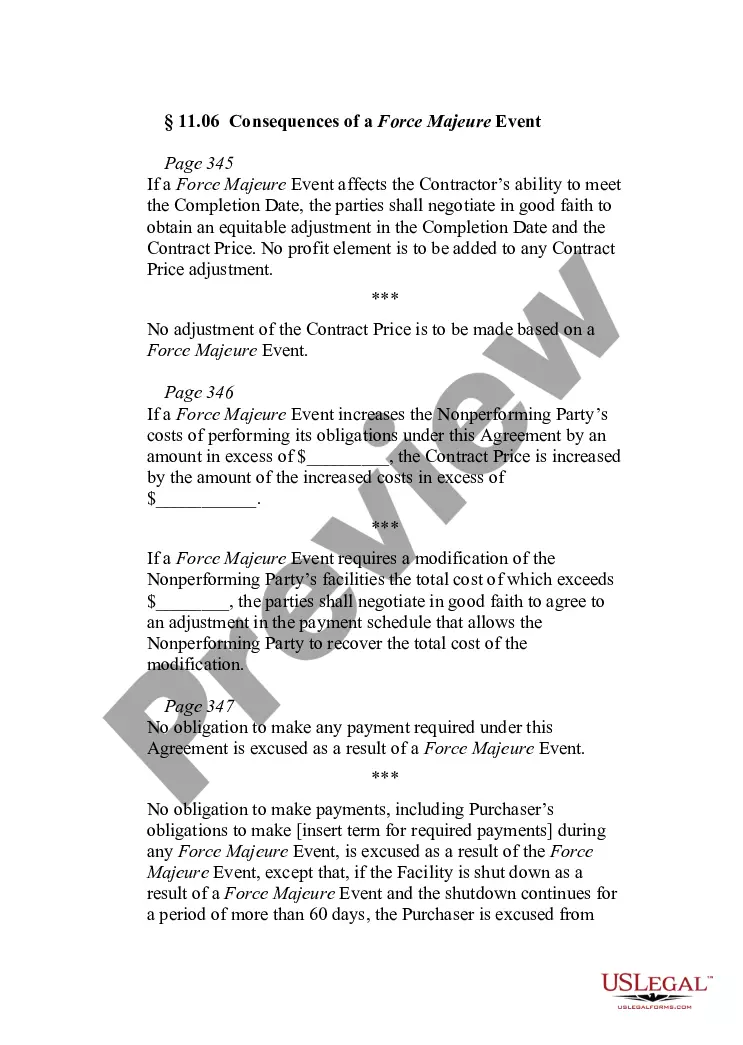
The Force Majeure - Long-Form Provision is a legal document designed to outline the circumstances under which a party may be excused from fulfilling contractual obligations due to unforeseen events, known as Force Majeure events. This form provides a comprehensive structure for defining such events, detailing the required responses, and setting procedures for notification and resolution, differentiating it from simpler Force Majeure clauses by including elaborate conditions and remedies applicable in various scenarios.
What’s included in this form
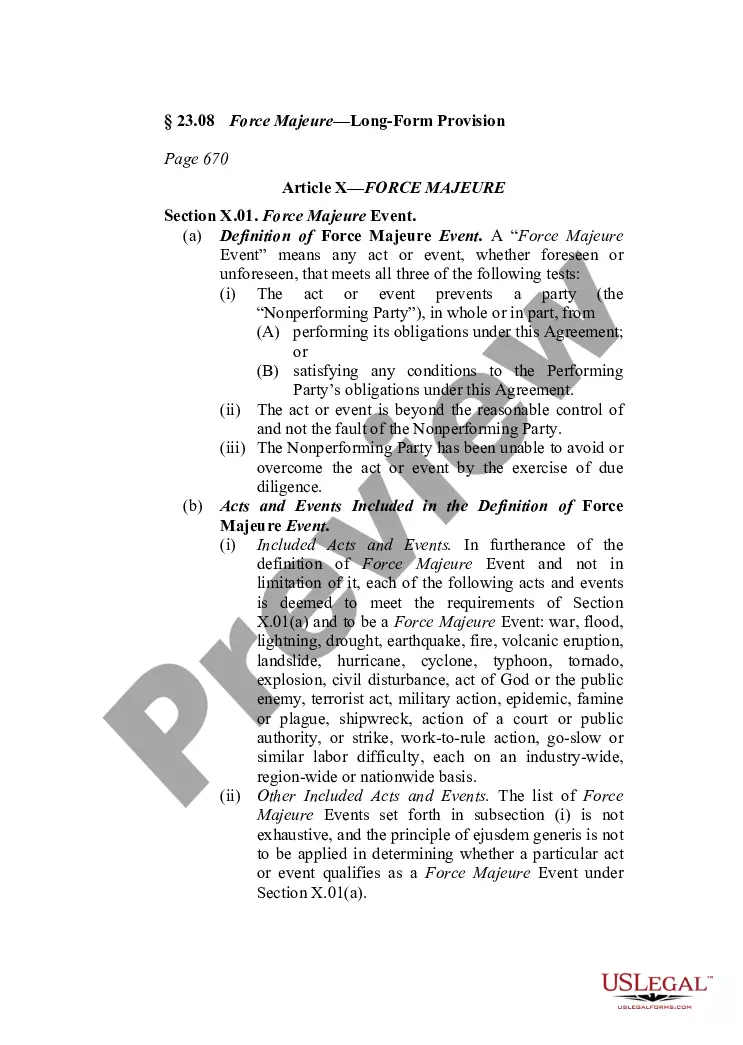
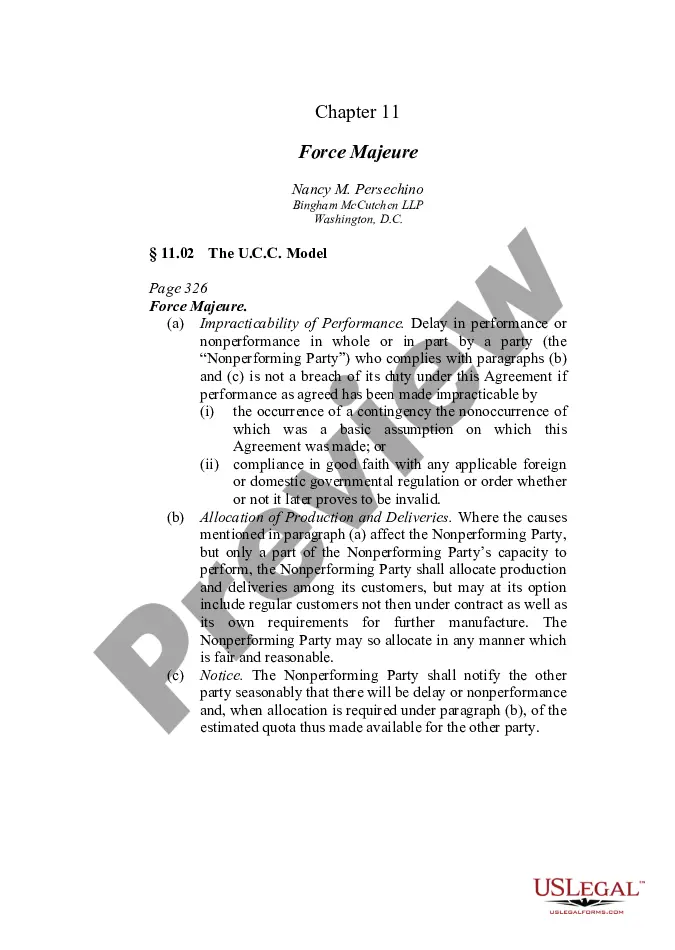
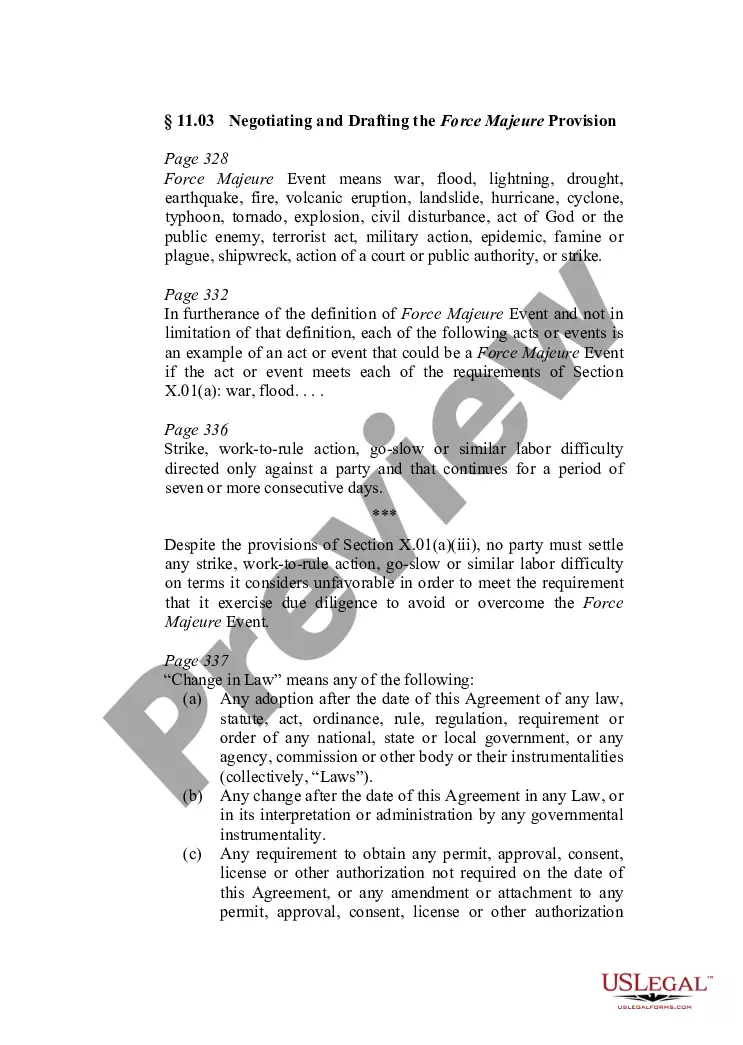
- Definition of Force Majeure events, including examples such as wars, natural disasters, and other unforeseen circumstances.
- Criteria for a party to be excused from performance under the contract.
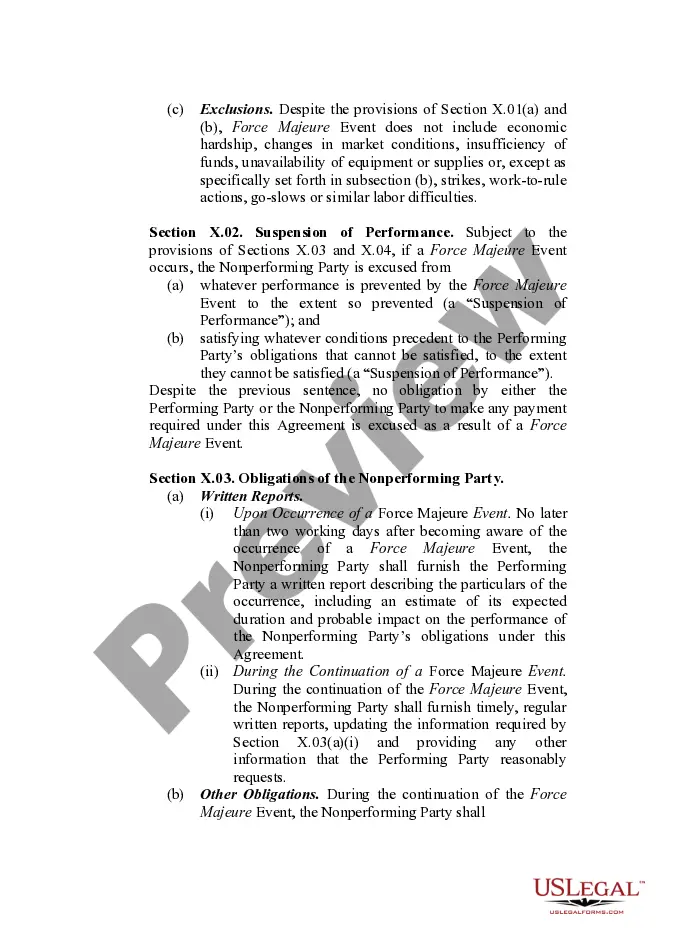
- Requirement for the Nonperforming Party to report the occurrence of a Force Majeure event to the Performing Party.
- Procedure for resuming performance once the Force Majeure event has passed.
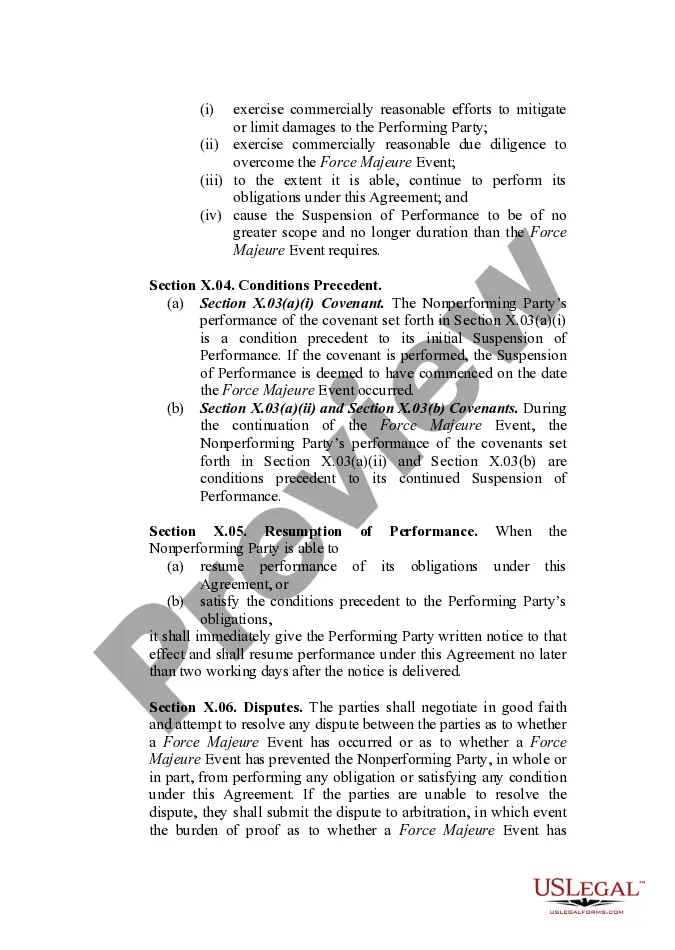
- Process for resolving disputes regarding the occurrence and impact of a Force Majeure event.
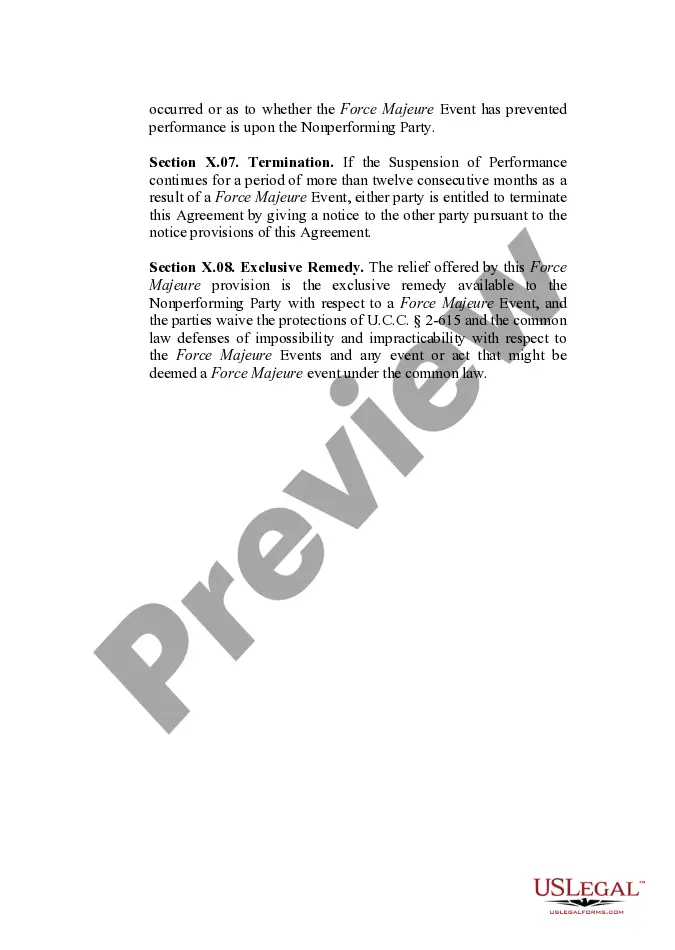
- Termination clauses if the suspension of performance lasts beyond a specified period.
Common use cases
This form should be used in scenarios where parties enter into a contract and need to account for potential disruptions that could prevent one or both parties from meeting their obligations. Examples include contracts for construction projects that may be delayed due to natural disasters, supply agreements that might be affected by strikes or epidemic outbreaks, and any contractual agreements that need clarity regarding unforeseen circumstances impacting performance.
Who needs this form
- Business owners drafting contracts that involve significant performance obligations.
- Contract managers looking to include comprehensive risk management provisions in their agreements.
- Attorneys representing clients in contract formation or disputes related to performance interruptions.
- Individuals and organizations looking to safeguard their interests in situations of unforeseen events affecting contractual obligations.
Steps to complete this form
- Identify the parties involved in the agreement and write their names in the designated fields.
- Clearly define the Force Majeure events relevant to your agreement, referencing any specific examples provided in the form.
- State the obligations of the Nonperforming Party during a Force Majeure event, including reporting and mitigation efforts.
- Include provisions for dispute resolution in the case of disagreements about the occurrence of a Force Majeure event.
- Specify the time frame for notifying the other party regarding the occurrence and the expected duration of the event.
Does this form need to be notarized?
In most cases, this form does not require notarization. However, some jurisdictions or signing circumstances might. US Legal Forms offers online notarization powered by Notarize, accessible 24/7 for a quick, remote process.
Get your form ready online
Our built-in tools help you complete, sign, share, and store your documents in one place.
Make edits, fill in missing information, and update formatting in US Legal Forms—just like you would in MS Word.
Download a copy, print it, send it by email, or mail it via USPS—whatever works best for your next step.
Sign and collect signatures with our SignNow integration. Send to multiple recipients, set reminders, and more. Go Premium to unlock E-Sign.
If this form requires notarization, complete it online through a secure video call—no need to meet a notary in person or wait for an appointment.
We protect your documents and personal data by following strict security and privacy standards.

Make edits, fill in missing information, and update formatting in US Legal Forms—just like you would in MS Word.

Download a copy, print it, send it by email, or mail it via USPS—whatever works best for your next step.

Sign and collect signatures with our SignNow integration. Send to multiple recipients, set reminders, and more. Go Premium to unlock E-Sign.

If this form requires notarization, complete it online through a secure video call—no need to meet a notary in person or wait for an appointment.

We protect your documents and personal data by following strict security and privacy standards.
Mistakes to watch out for
- Failing to clearly define what constitutes a Force Majeure event in the contract.
- Neglecting to outline procedures for reporting and ongoing communication during a Force Majeure event.
- Assuming that economic hardships qualify as Force Majeure events under this provision.
- Not specifying the duration for which the performance may be suspended.
Benefits of completing this form online
- Immediate access to professionally drafted legal language, ensuring clarity and enforceability.
- Easy to customize to meet the specific needs of your agreement and situation.
- No need for in-person consultations, allowing for faster contract completion.
- Downloadable format that can be easily edited and saved for future use.
Legal use & context
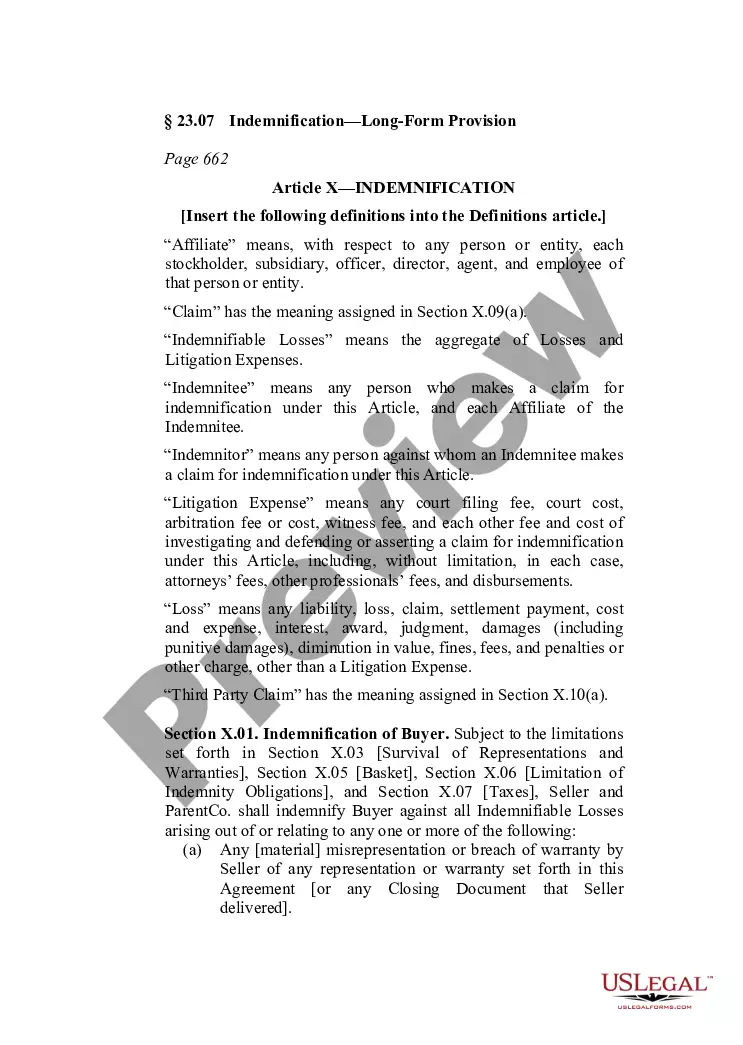
- The form outlines the legal framework for handling Force Majeure events, enhancing contract enforceability.
- It provides a clear process for resolving disputes, which may prevent litigation.
- By using this form, parties can mitigate risks associated with unforeseen circumstances that may affect business operations.
Looking for another form?




Form popularity
FAQ
Under most national laws, force majeure events must meet four criteria: (1) the event must be external to the contract and the parties; (2) the event must render the party0393CAs performance radically different from what the parties originally contemplated; (3) the event must have been unforeseeable; and (4) the
An example of an operative clause is: " . 1 Neither party is responsible for any failure to perform its obligations under this contract, if it is prevented or delayed in performing those obligations by an event of force majeure. .
What is Force Majeure?Examples of events that might trigger a force majeure clause into effect include a declaration of war, a disease epidemic, or a hurricane, earthquake, or other natural disaster events that fall under the legal term, act of God.
1, The company declared force majeure on its shipping commitments. 2, Damage is caused due to force majeure. 4, Any party to natural disasters and other force majeure causes of delay in performance of duty, incomplete or non-performance should not be treated as breach of contract.
For the purpose of this Agreement, an Event of Force Majeure means any circumstance not within the reasonable control of the Party affected, but only if and to the extent that (i) such circumstance, despite the exercise of reasonable diligence and the observance of Good Utility Practice, cannot be, or be caused to be
Force majeure examples There are dozens of circumstances or events that we class as examples of force majeure. War, riots, earthquakes, hurricanes, lightning, and explosions, for example, are force majeure events. The term also includes energy blackouts, unexpected legislation, lockouts, slowdowns, and strikes.
A force majeure clause (1) specifies the events which enable either party to declare a force majeure/act of God event, (2) how a party should notify its counterparty about the occurrence, and (3) the consequences after a force majeure event has occurred.