Engagement Agreement for Single Client Representation
Understanding this form
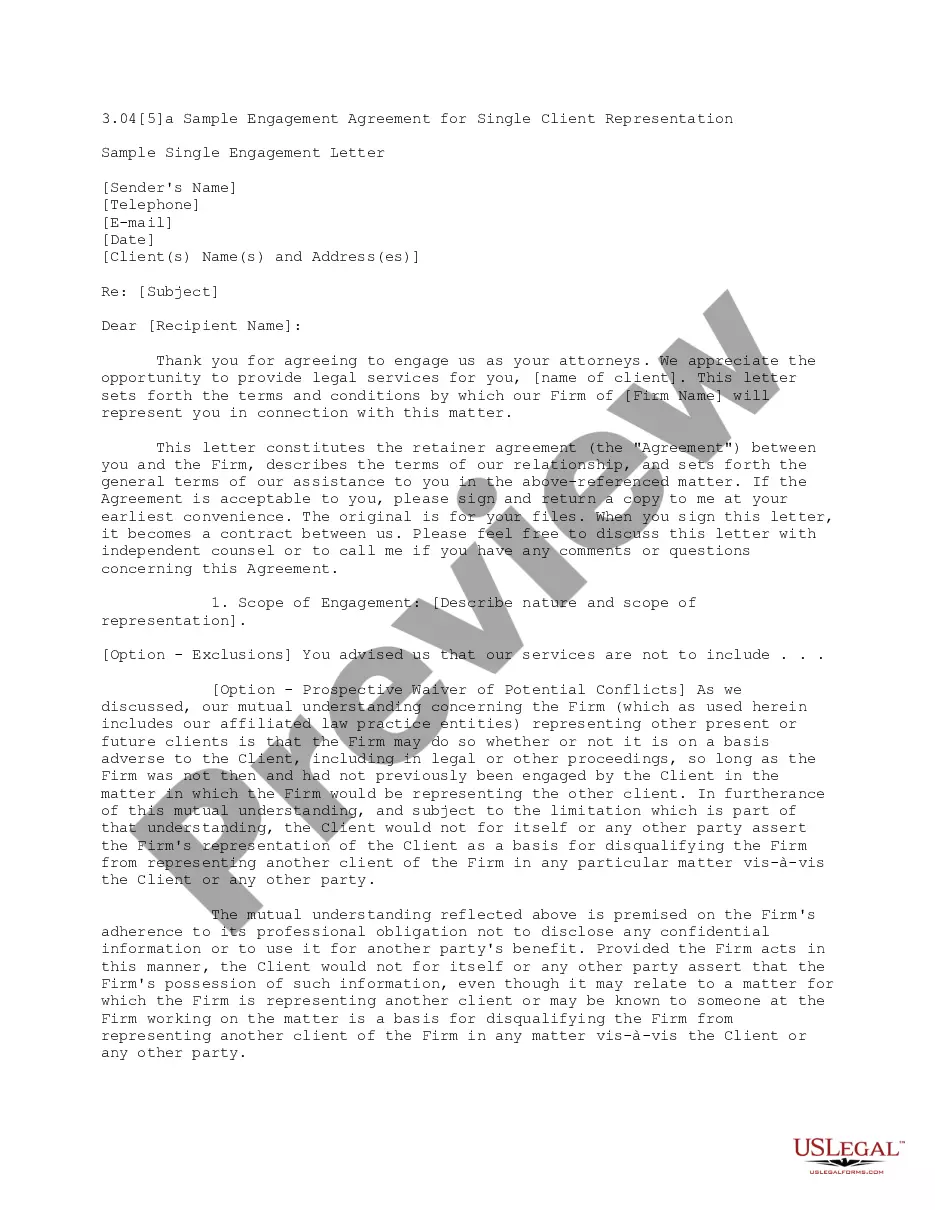
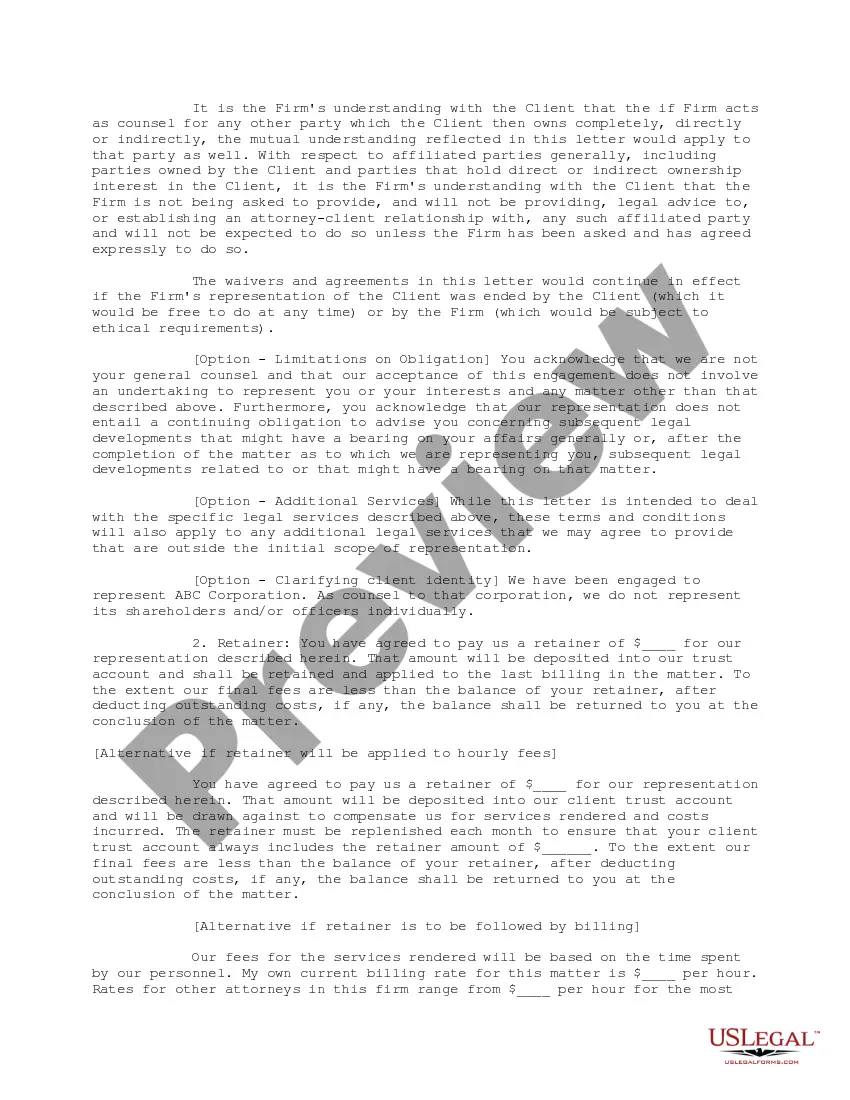
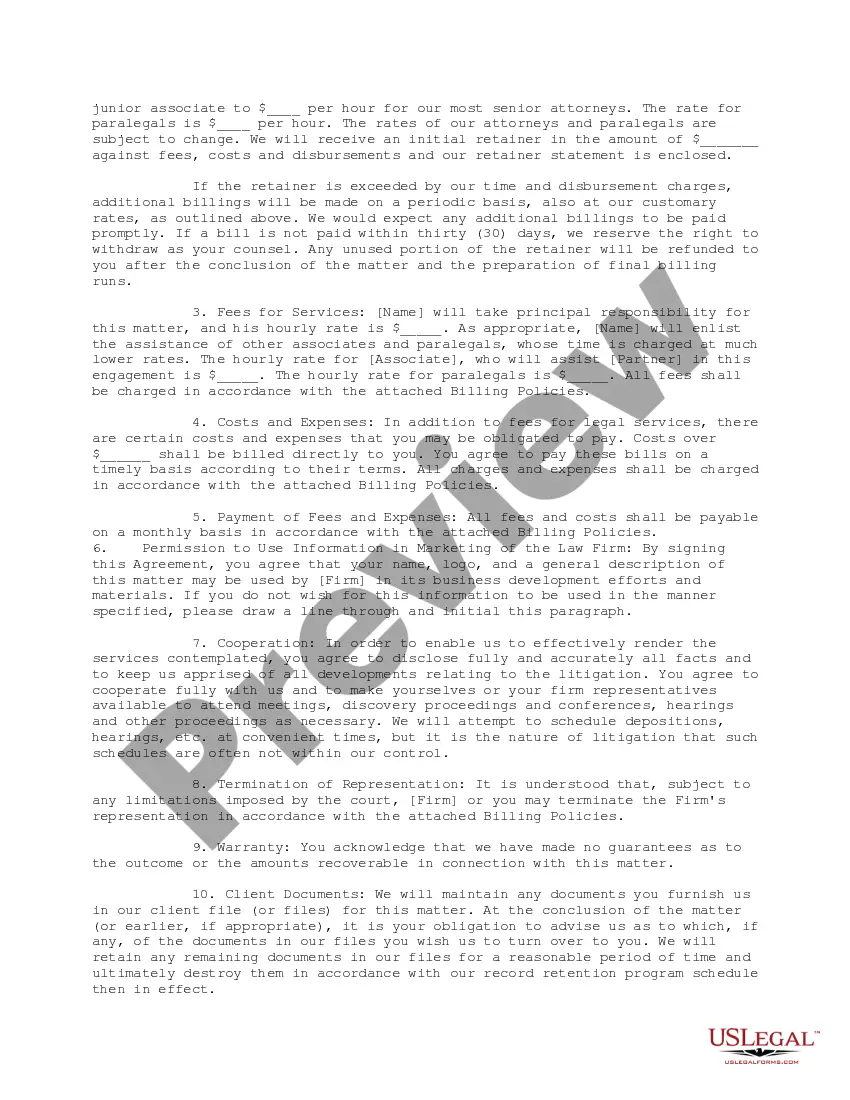
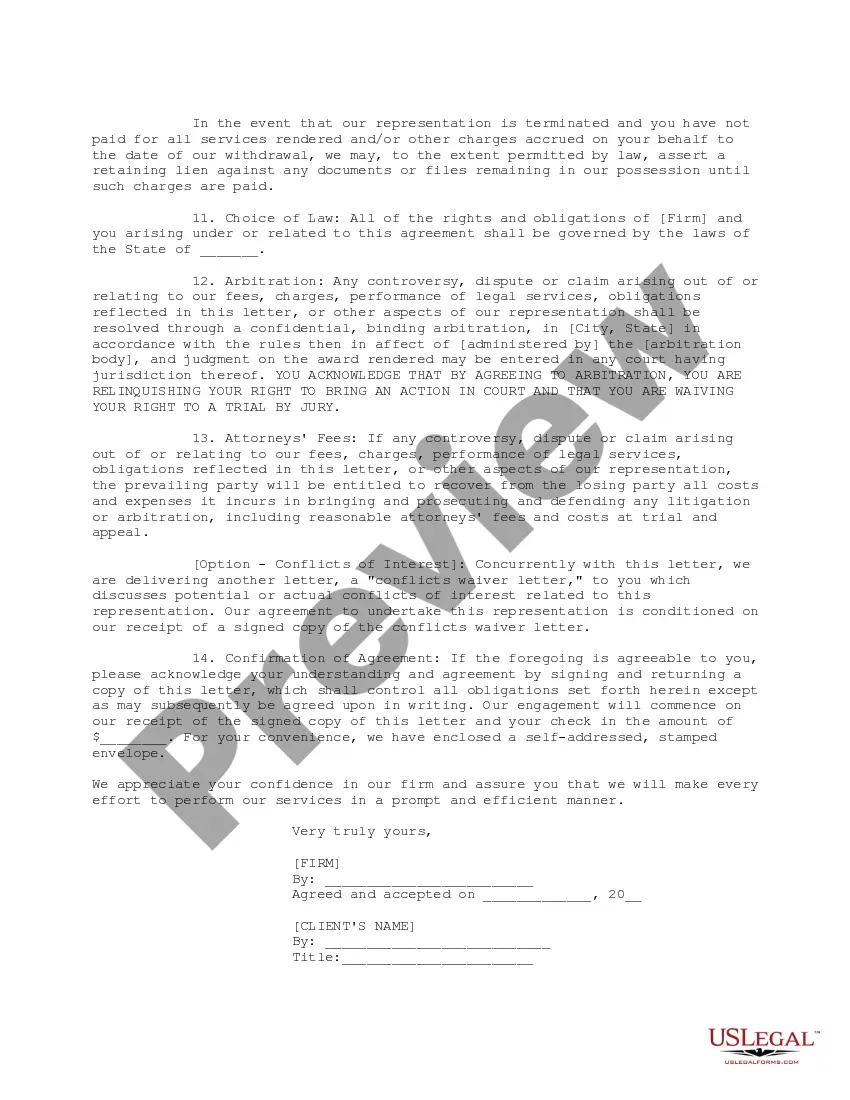
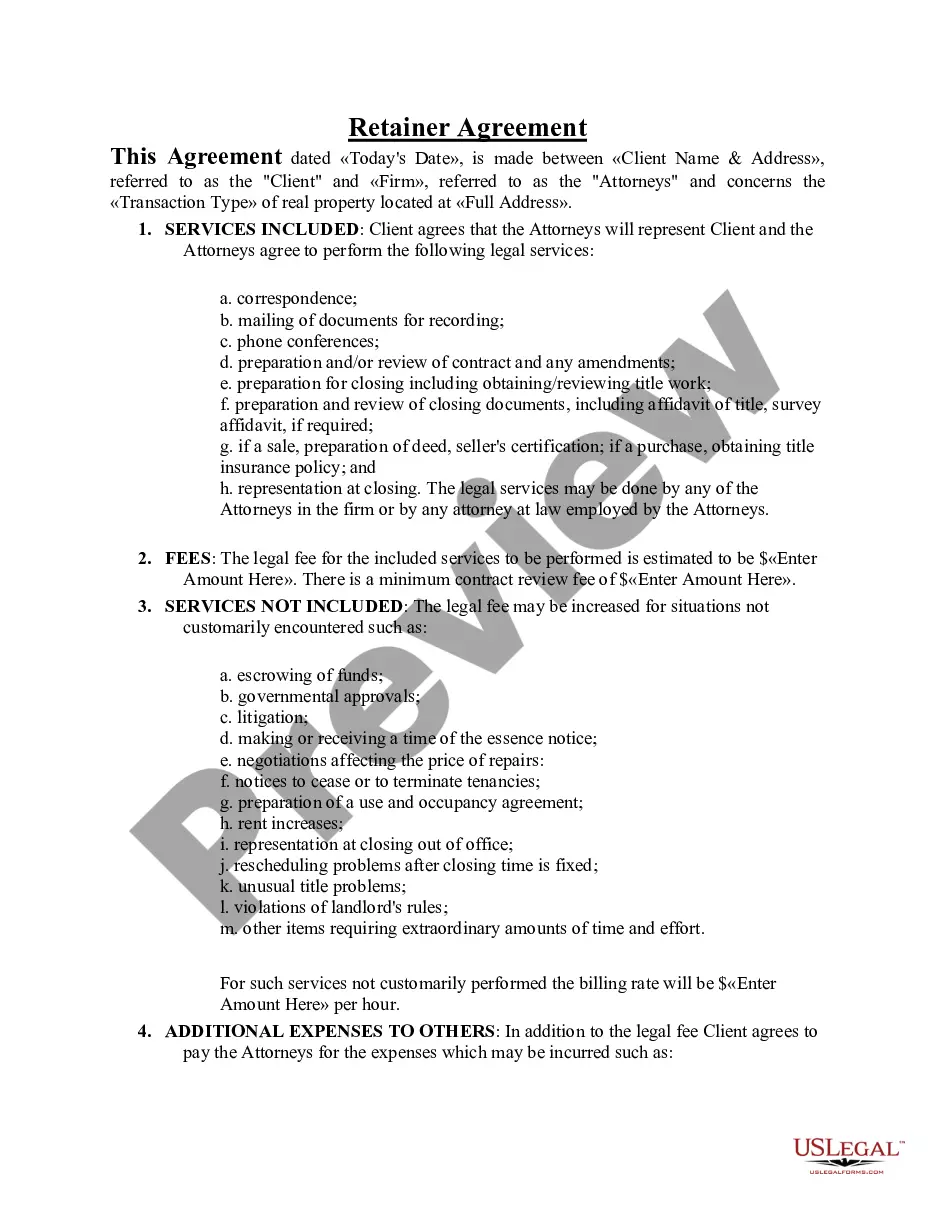
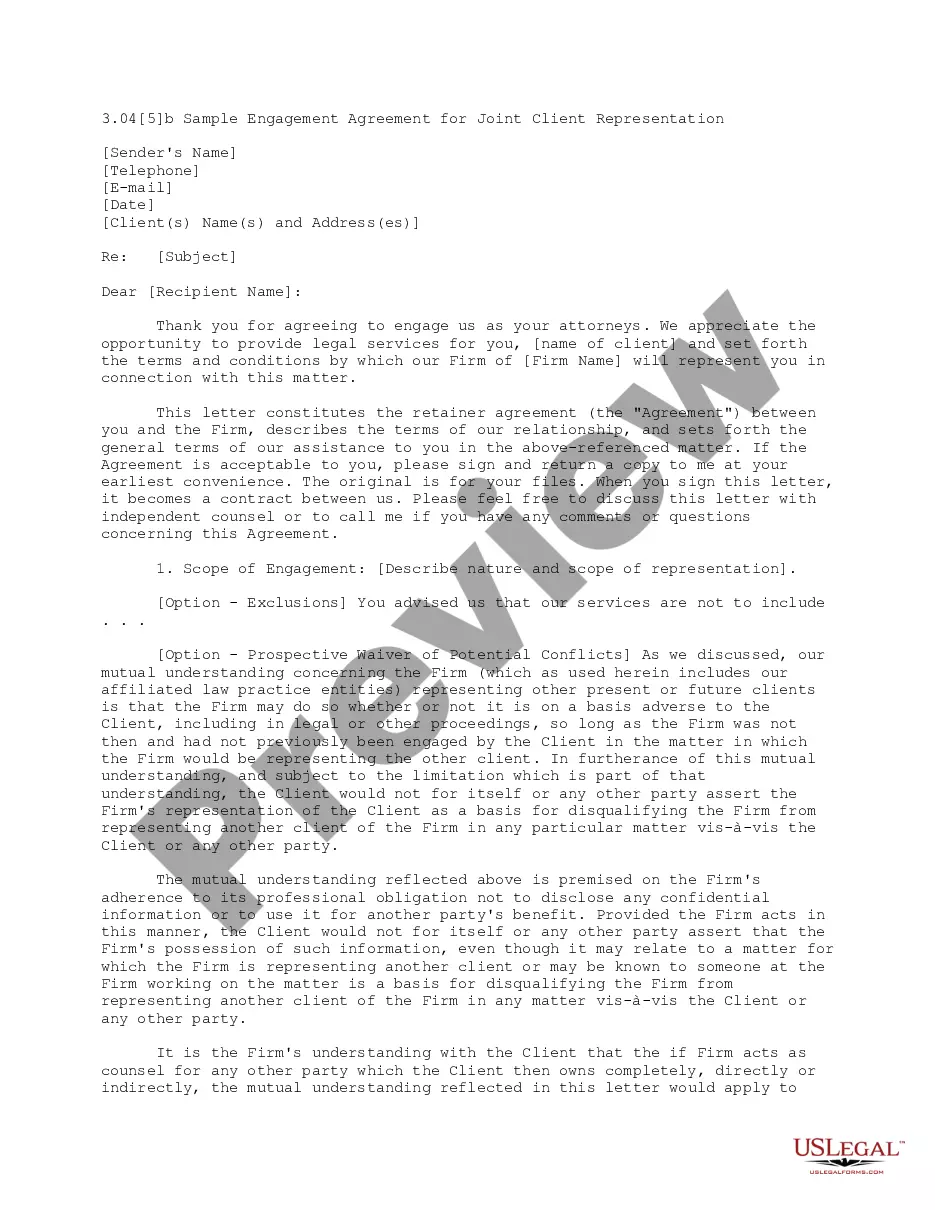
The Engagement Agreement for Single Client Representation is a formal letter establishing a legal relationship between a law firm and an individual client. This document details the scope of representation, fees, retainer requirements, and potential conflicts of interest, distinguishing it from other types of engagement letters by focusing on a single client rather than multiple clients or entities.
Key components of this form
- Scope of engagement: Outlines the specific legal services to be provided.
- Retainer agreement: Details the amount required as a retainer and how it will be applied to fees.
- Fees and billing: Describes the hourly rates for attorneys and paralegals as well as expense policies.
- Confidentiality and conflict waivers: Addresses how potential conflicts of interest are handled and confidentiality is maintained.
- Termination of representation: Provides conditions under which the legal representation can be ended by either party.
When to use this form
This form is used when a client seeks legal representation from a law firm for a specific legal matter. It clarifies the relationship and expectations between the lawyer and the client, making it essential in scenarios such as hiring an attorney for litigation, contract disputes, or personal legal matters where clear terms must be established.
Intended users of this form
- Clients engaging a law firm for a specific legal issue.
- Individuals who want to ensure clarity and mutual understanding of legal services.
- Law firms formalizing the representation of a single client.
How to prepare this document
- Identify the parties: Fill in the names and contact information for both the law firm and the client.
- Define the scope: Clearly describe the nature and extent of legal services to be provided.
- Specify retainer details: Enter the retainer amount, how it will be held, and any replenishment policies.
- Outline fees: List the hourly rates for all attorneys and paralegals involved in the case.
- Include confidentiality clauses: Ensure agreements on confidentiality and potential conflicts are clearly stated.
- Sign and acknowledge: Both parties should sign the document to confirm agreement and understanding.
Does this form need to be notarized?
This form does not typically require notarization unless specified by local law. However, always check local regulations to ensure compliance.
Get your form ready online
Our built-in tools help you complete, sign, share, and store your documents in one place.
Make edits, fill in missing information, and update formatting in US Legal Forms—just like you would in MS Word.
Download a copy, print it, send it by email, or mail it via USPS—whatever works best for your next step.
Sign and collect signatures with our SignNow integration. Send to multiple recipients, set reminders, and more. Go Premium to unlock E-Sign.
If this form requires notarization, complete it online through a secure video call—no need to meet a notary in person or wait for an appointment.
We protect your documents and personal data by following strict security and privacy standards.

Make edits, fill in missing information, and update formatting in US Legal Forms—just like you would in MS Word.

Download a copy, print it, send it by email, or mail it via USPS—whatever works best for your next step.

Sign and collect signatures with our SignNow integration. Send to multiple recipients, set reminders, and more. Go Premium to unlock E-Sign.

If this form requires notarization, complete it online through a secure video call—no need to meet a notary in person or wait for an appointment.

We protect your documents and personal data by following strict security and privacy standards.
Avoid these common issues
- Failing to clearly define the scope of representation, leading to misunderstandings.
- Not specifying the retainer terms or how fees will be billed, which can result in unexpected costs.
- Neglecting to address potential conflicts of interest, potentially compromising the representation.
- Not having both parties sign the engagement agreement, which can make the agreement unenforceable.
Why complete this form online
- Convenience of immediate download and access.
- Editability to customize terms to reflect the specific situation.
- Templates prepared by licensed attorneys ensuring legal validity.
- Easy storage and retrieval of documents digitally.
Looking for another form?


Form popularity
FAQ
The engagement letter documents and confirms the auditor's acceptance of the appointment, the objective and scope of the audit, the extent of the auditor's responsibilities to the client and the form of any reports. Management's responsibility for establishing and maintaining effective internal control.
State the Purpose Start your letter by stating the reason you are writing for. Lawyers and law firms usually have extremely busy schedules. Therefore, make sure you get to the point right away. Provide your authorization for legal representation for yourself or on behalf of another individual or organization.
Date. The very part of the letter is Date. From. One should write the sender's name and address after mentioning the date. To. Below the sender's details, one should write the receiver's name and address. Subject. Salutation. Content or Body of the Letter. Opening Part. Main Part.
What is an Attorney Engagement Letter? An Attorney Engagement Letter is typically the first step in entering into a legally binding relationship between an attorney and a client. It outlines the duties and obligations of both parties, as well as the nature of the relationship.
Engagement letters should be sent before any new attorney-client relationship is established and also before any new matter is entered into.
What Is an Engagement Letter? An engagement letter is a written agreement that describes the business relationship to be entered into by a client and a company.An engagement letter is a less formal than a contract, but still a legally-binding document that can be used in a court of law.
In the legal profession, an Engagement Letter or Disclosure Agreement is mandatory.It may be that even Agents who already have Engagement Letters may need a separate such Letter, specifically to deal with the Code.
A Good Introduction. Identify the Scope of Work. Identify How Long It Will Take. Write Out the Payment Terms. Include What You Need from the Client. Include What the Client Needs from You. Obtain Signatures from Both Parties.
Generally, Engagement Letters are less formal than a contract. However, they are still legally binding. Importantly, Engagement Letters reduce liability and clearly outline the roles and responsibilities of both your business and its customers.