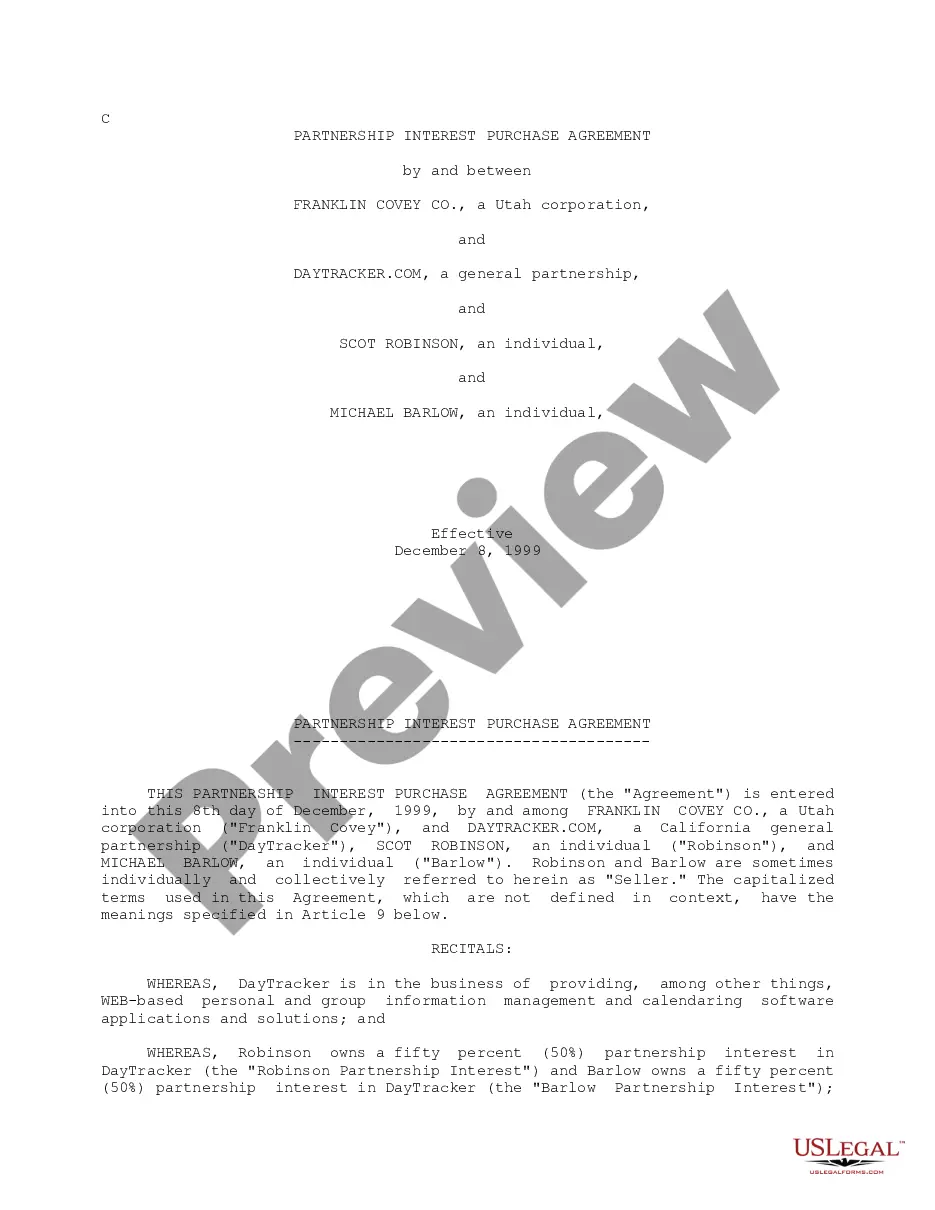
Sample Partnership Interest Purchase Agreement between Franklin Covey Company, Daytracker.com, et al
What is this form?
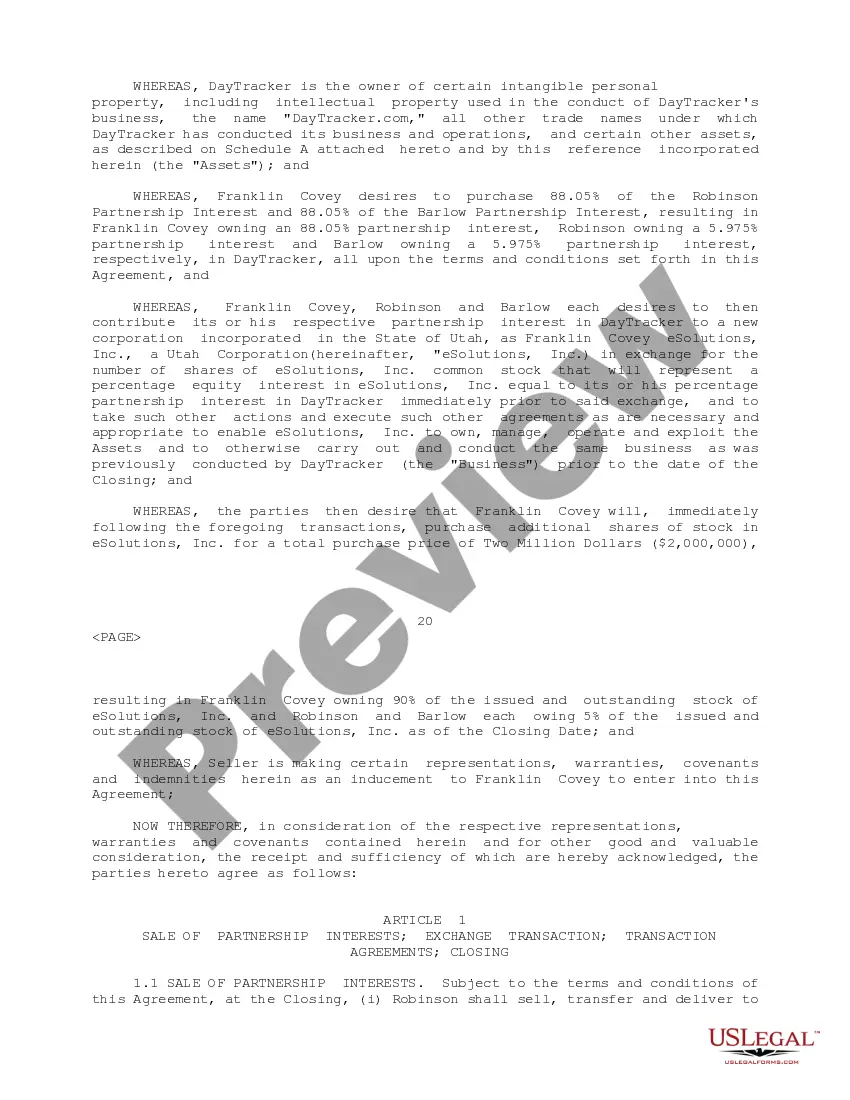
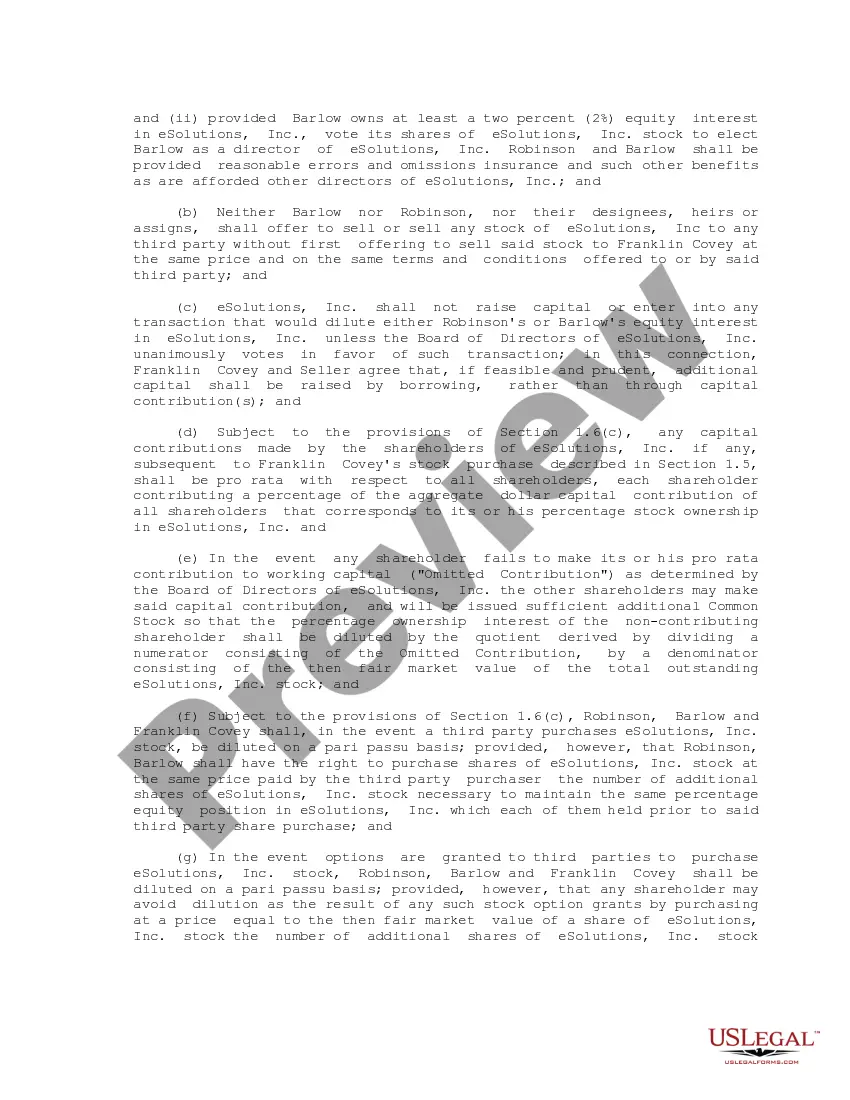
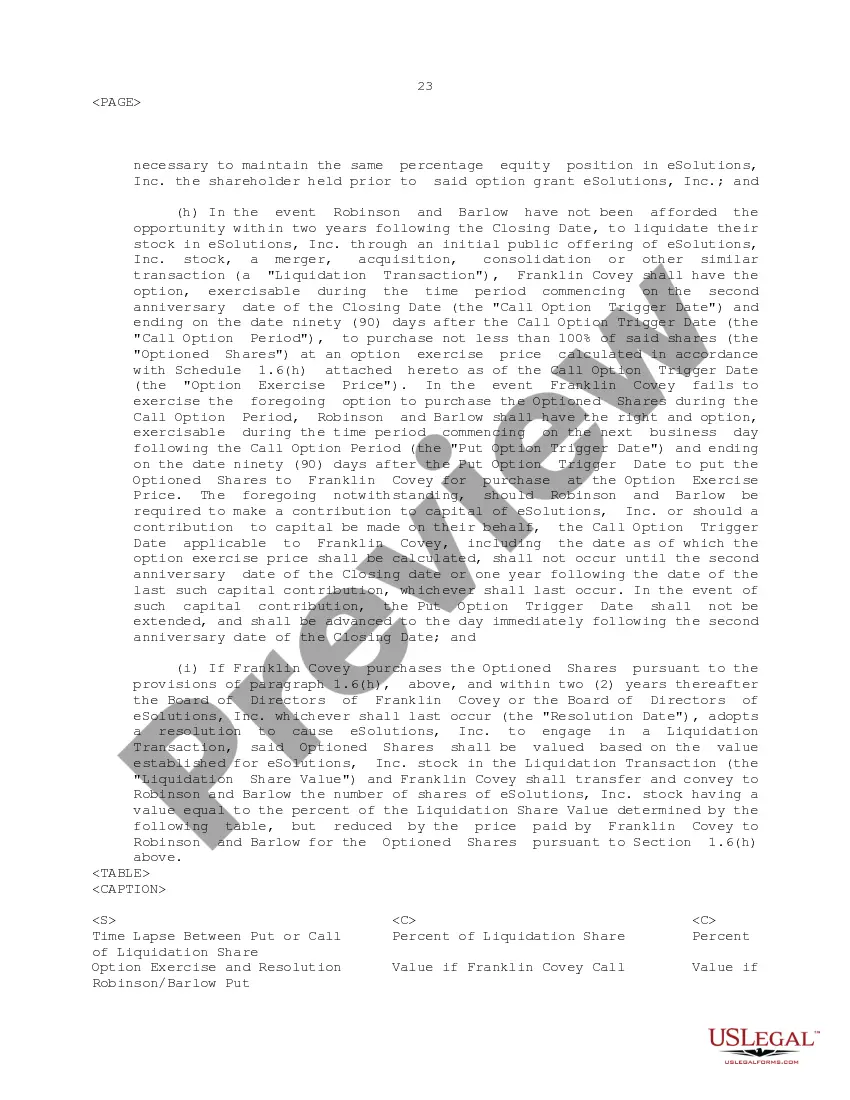
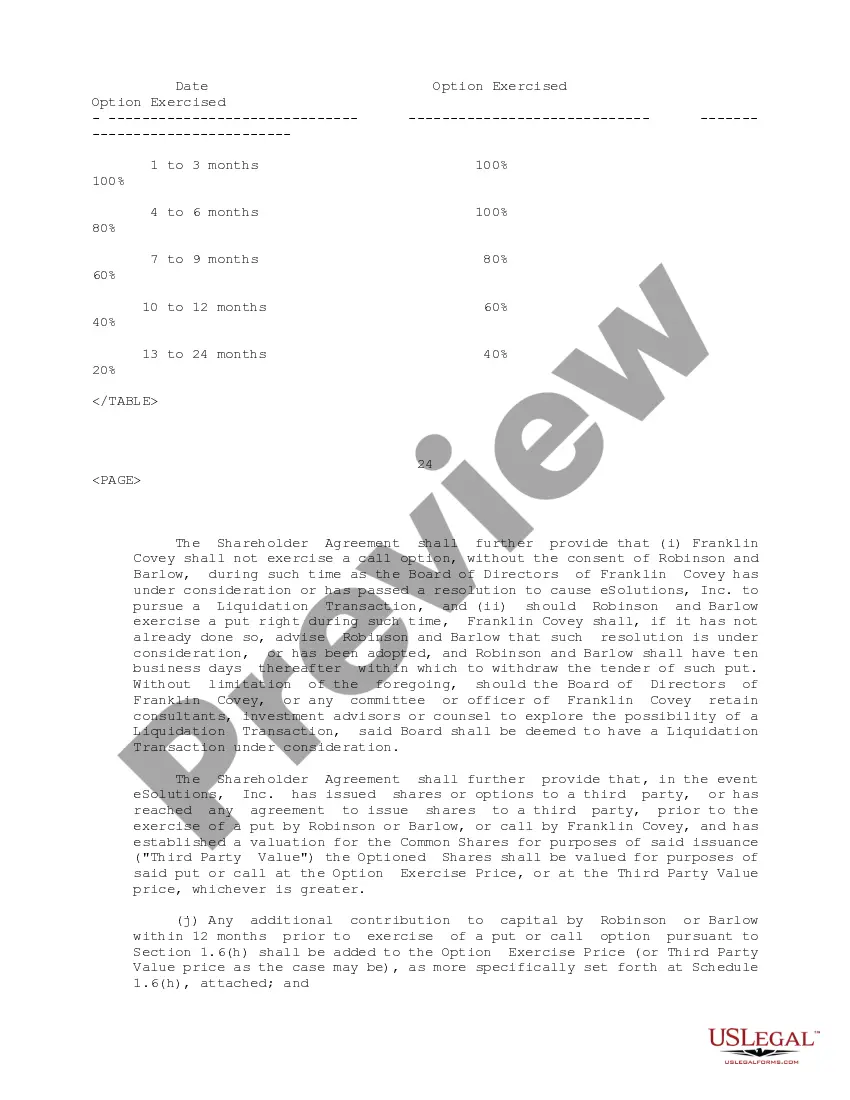
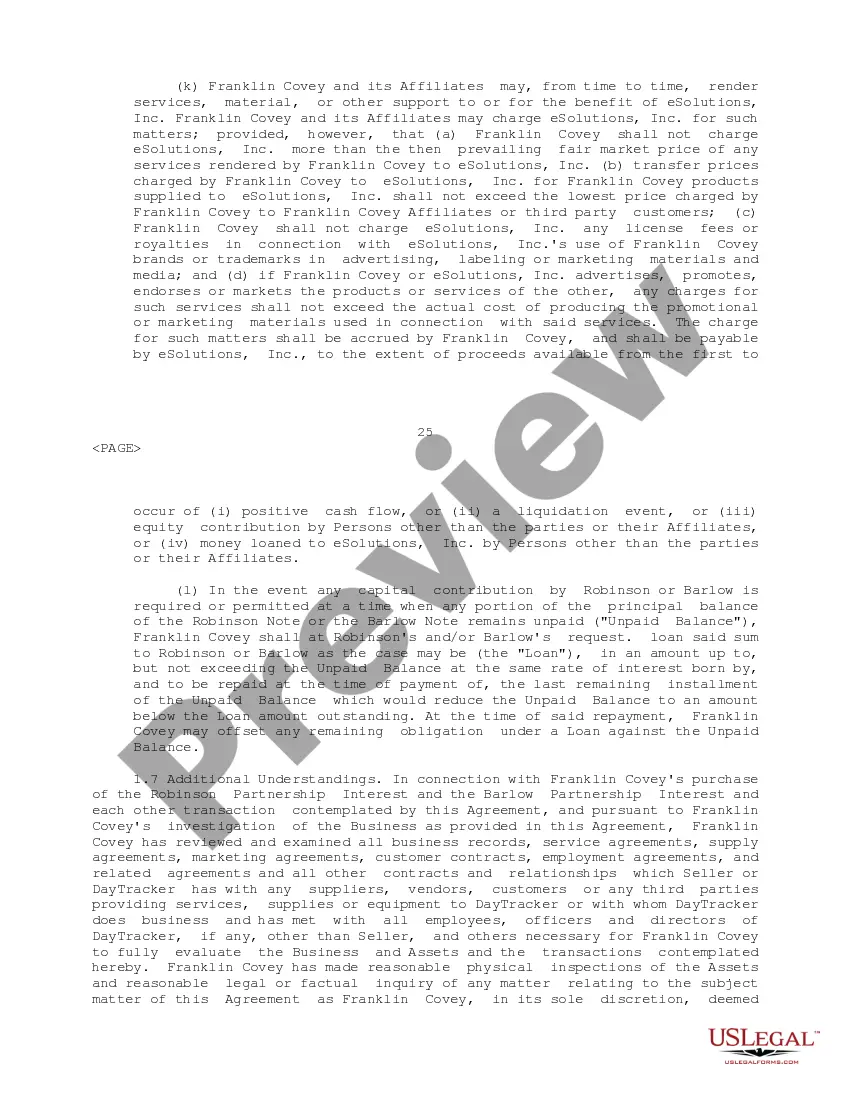
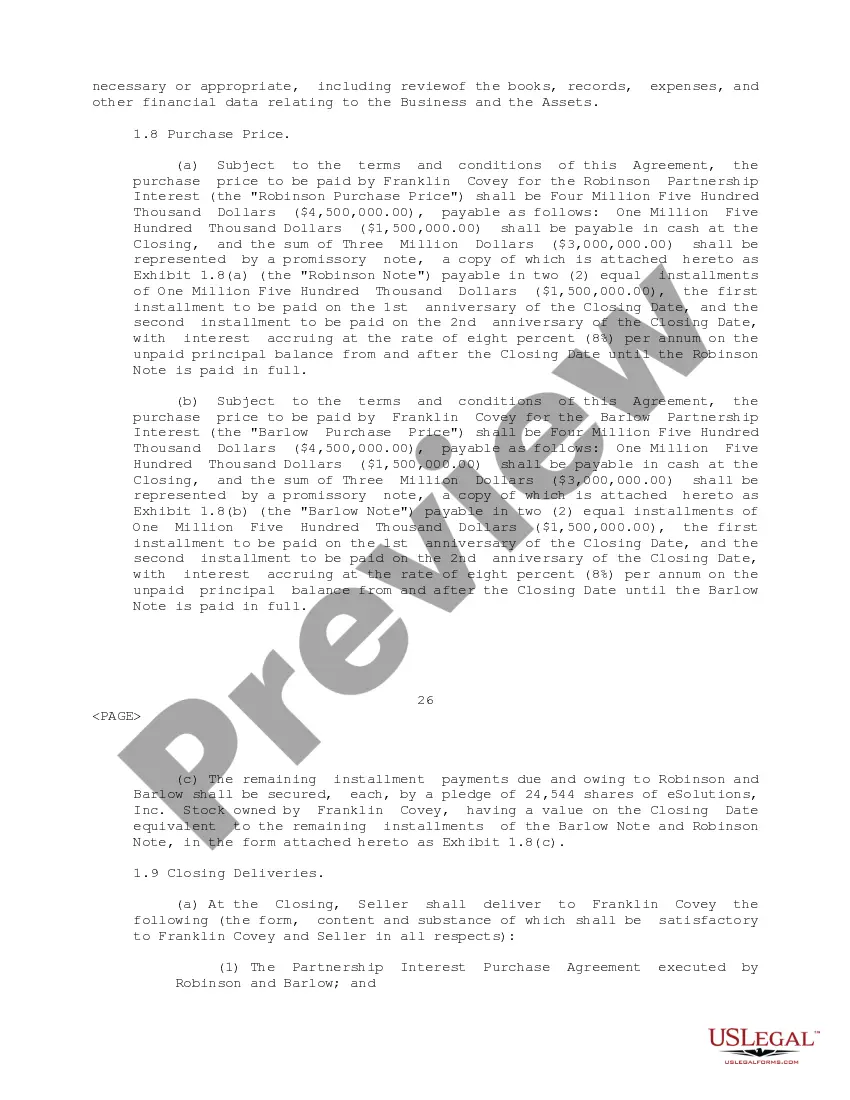
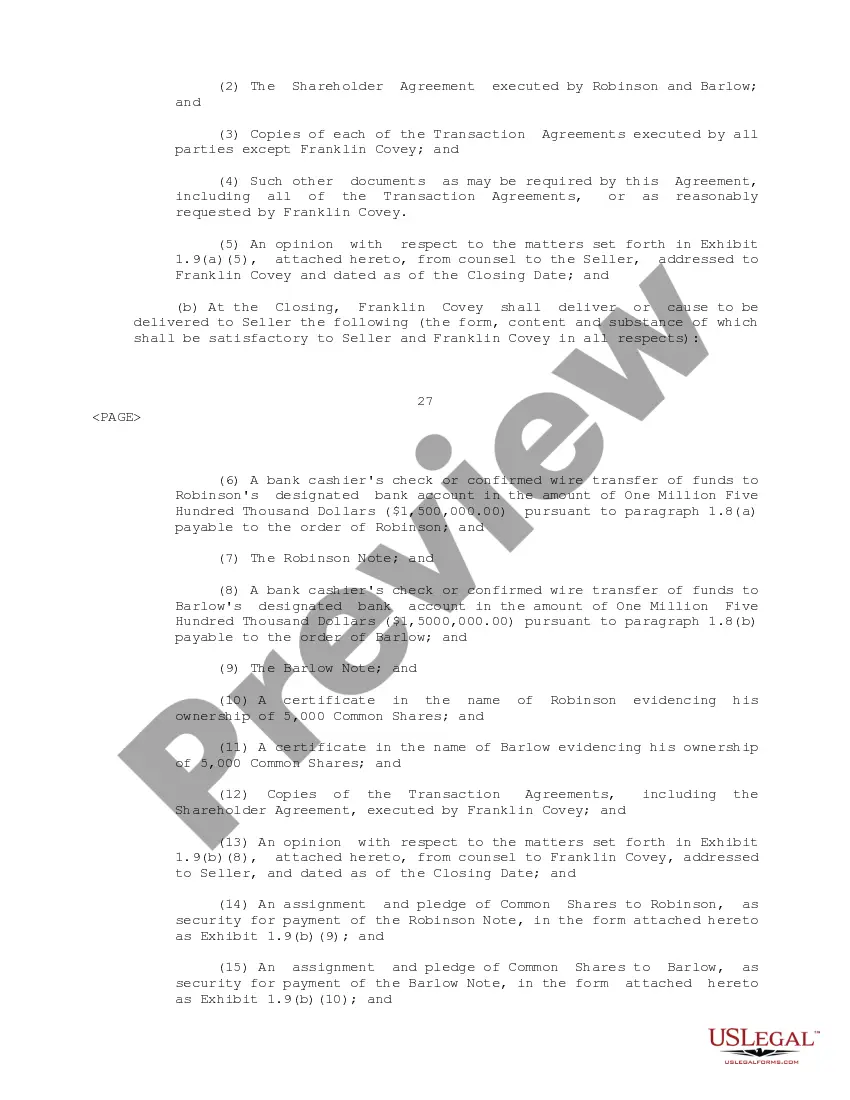
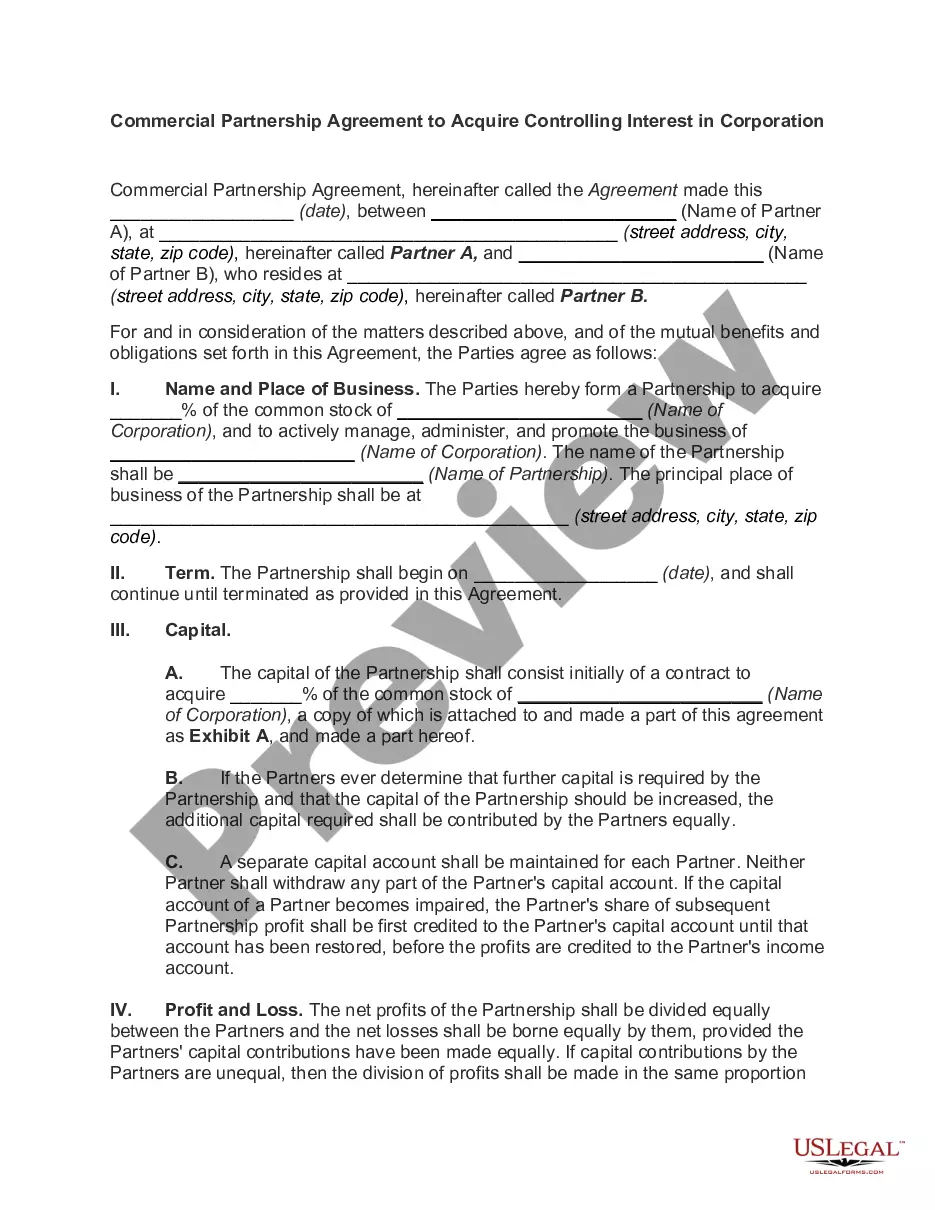
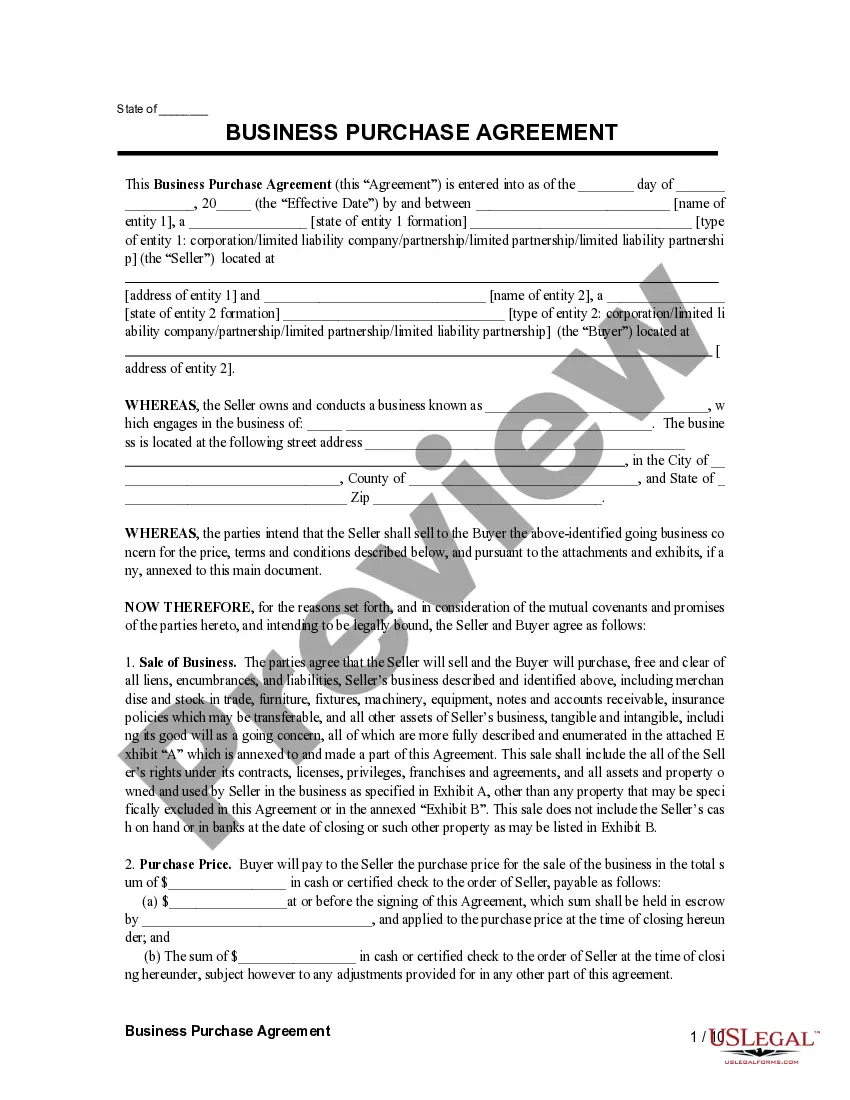
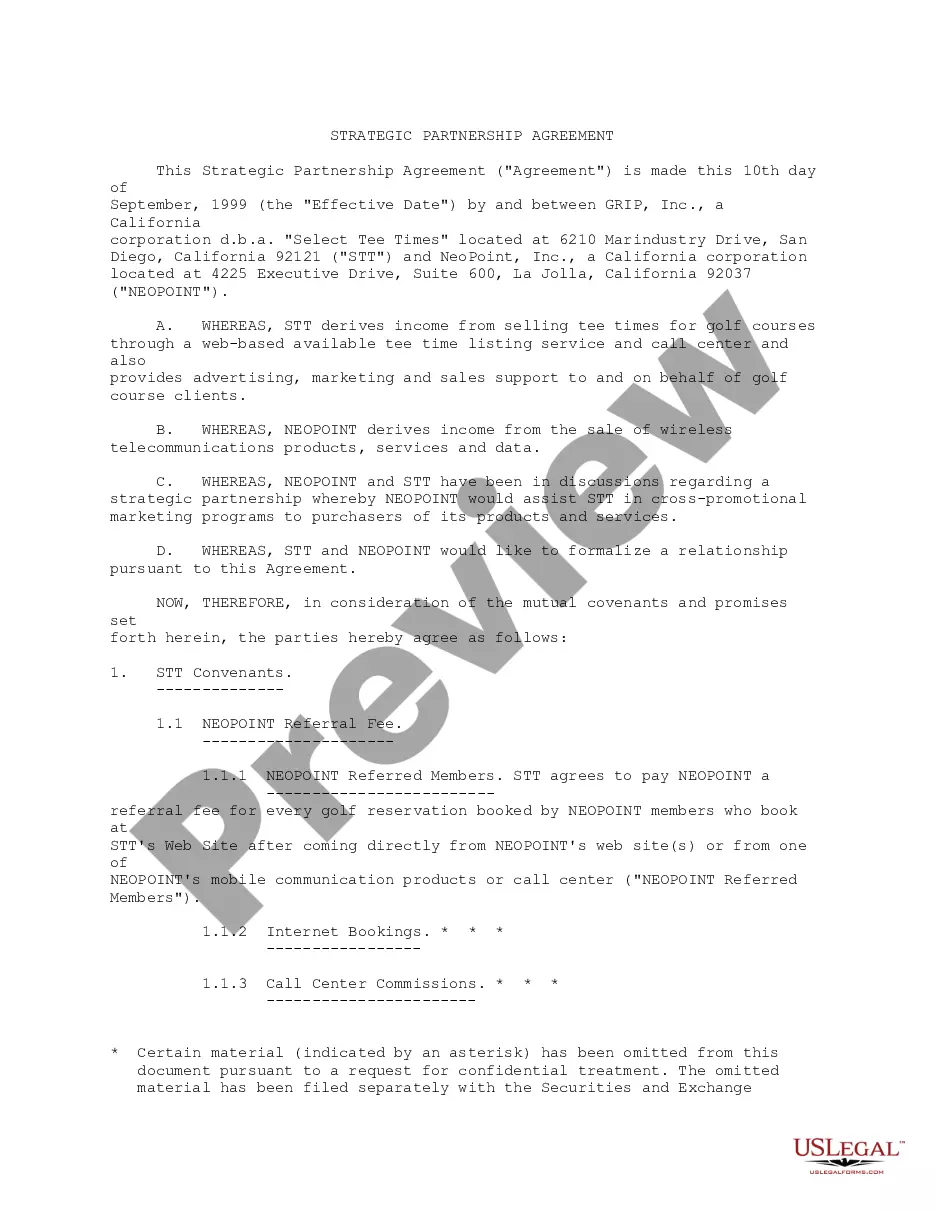
The Sample Partnership Interest Purchase Agreement is a legally binding document that outlines the terms and conditions for the purchase of partnership interests between entities and individuals. Specifically, this agreement involves the Franklin Covey Company, Daytracker.com, Scot Robinson, and Michael Barlow, detailing their respective partnership interests and the transition into a new corporation. This agreement is essential for parties involved in a partnership to officially document changes in ownership and obligations. Unlike other partnership agreements, this purchase agreement specifically addresses the acquisition of existing interests rather than the establishment of a new partnership.
What’s included in this form
- Identification of the parties involved in the agreement, including their roles as sellers or purchasers.
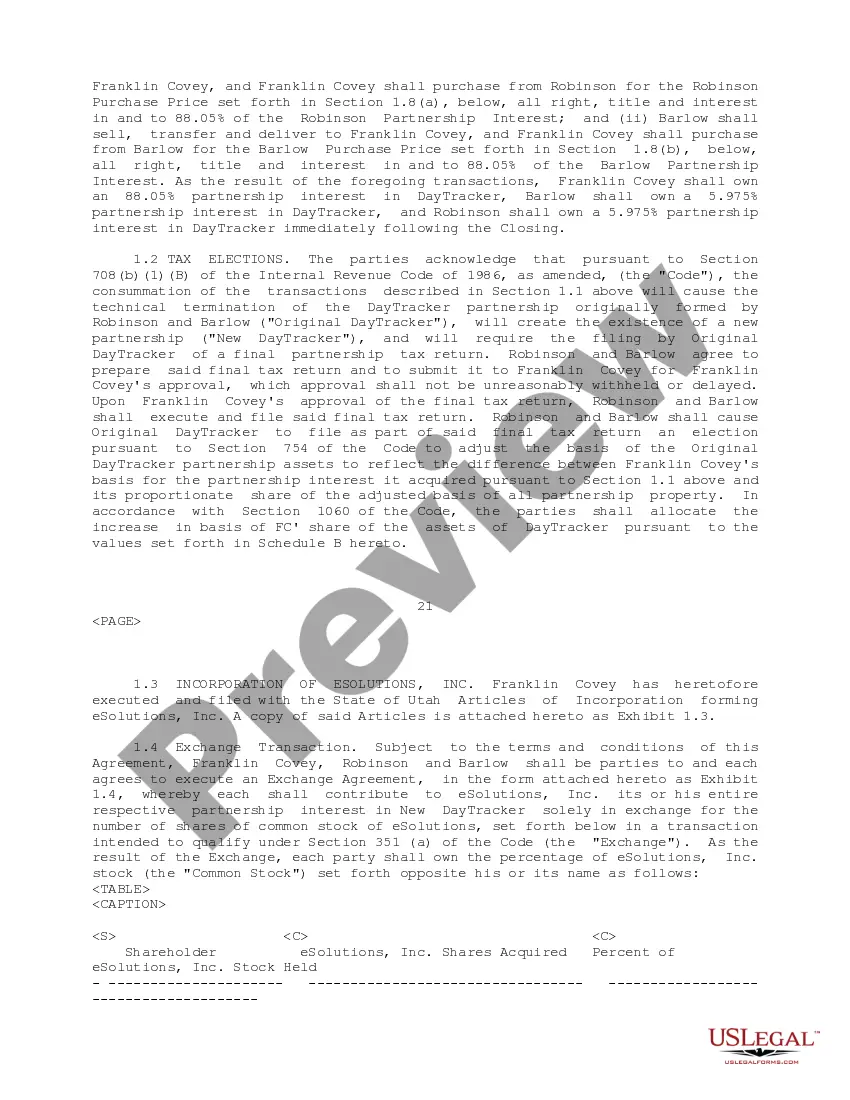
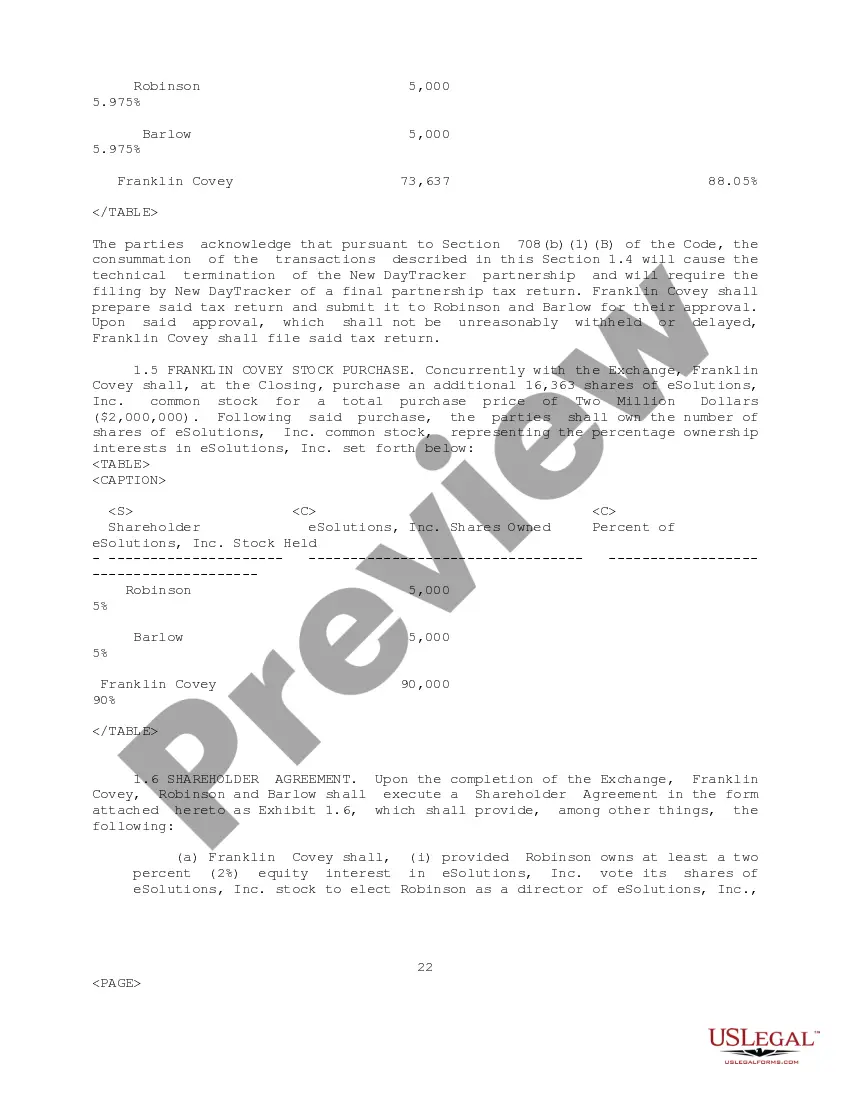
- Detailed description of the partnership interests being sold, including specific percentages owned by each seller.
- Terms of the sale, including purchase price, payment structure, and any promissory notes involved.
- Indemnification clauses outlining responsibilities and liabilities related to the agreement.
- Provisions regarding the assignment of the acquired interests to a newly formed corporation.
- Conditions precedent that must be fulfilled before the closing of the transaction.

When this form is needed
This form should be used when individuals or companies involved in a partnership decide to buy or sell their interests in that partnership. It is particularly relevant in scenarios where one firm intends to consolidate ownership by acquiring the interests of existing partners or when restructuring to improve business management and operations.
Who needs this form
- Businesses looking to formalize the acquisition of partnership interests.
- Individuals seeking to sell their ownership stake in a partnership.
- Lawyers or legal representatives facilitating partnership buyouts.
- Investors who wish to acquire a stake in a partnership as part of a strategic business move.
Instructions for completing this form
- Identify the parties involved in the transaction and clearly state their roles (seller, purchaser).
- Specify the percentage of partnership interests each party is buying or selling.
- Detail the purchase price and any payment methods, including promissory notes if applicable.
- Include provisions for indemnification and conditions that need to be fulfilled before finalizing the agreement.
- Sign and date the document in the presence of witnesses if required by state law.
Does this form need to be notarized?
This form does not typically require notarization unless specified by local law.
Get your form ready online
Our built-in tools help you complete, sign, share, and store your documents in one place.
Make edits, fill in missing information, and update formatting in US Legal Forms—just like you would in MS Word.
Download a copy, print it, send it by email, or mail it via USPS—whatever works best for your next step.
Sign and collect signatures with our SignNow integration. Send to multiple recipients, set reminders, and more. Go Premium to unlock E-Sign.
If this form requires notarization, complete it online through a secure video call—no need to meet a notary in person or wait for an appointment.
We protect your documents and personal data by following strict security and privacy standards.

Make edits, fill in missing information, and update formatting in US Legal Forms—just like you would in MS Word.

Download a copy, print it, send it by email, or mail it via USPS—whatever works best for your next step.

Sign and collect signatures with our SignNow integration. Send to multiple recipients, set reminders, and more. Go Premium to unlock E-Sign.

If this form requires notarization, complete it online through a secure video call—no need to meet a notary in person or wait for an appointment.

We protect your documents and personal data by following strict security and privacy standards.
Common mistakes
- Failing to specify the exact ownership percentages being transferred.
- Not ensuring all parties sign and date the agreement.
- Neglecting to include all relevant conditions necessary for the closing.
- Ignoring state-specific legal requirements that could invalidate the agreement.
Benefits of using this form online
- Convenient access to legal forms from anywhere at any time.
- Editable templates that allow customization based on specific needs.
- Guidance through the form-filling process to reduce errors and misunderstandings.
- Ease of storage and retrieval when kept in digital format.
Looking for another form?




Form popularity
FAQ
Transfer of interest or we can say ownership is possible in case of business as you can transfer your business to any other person with some legal formalities, if applicable. On the other hand, in case of profession, you can not transfer your professional certificate to someone else.
"Partnership interest" means a partner's share of the profits and losses of a limited partnership and the right to receive distributions of partnership assets.
A transfer of partnership interest happens when a business partner relinquishes their ownership rights and responsibilities to another individual or company.
A partner's interest in a partnership is considered personal property that may be assigned to other persons. In addition, an assignment of the partner's interest does not give the assignee any right to participate in the management of the partnership.
The securities laws define security to include an investment contract and general partnership interest could be considered an investment contract.
If a partner's entire interest in a partnership is liquidated or redeemed, he or she recognizes gain to the extent any money or marketable securities received exceeds his or her basis in the partnership interest immediately before the distribution ( Code Sec.
The federal income tax rules for partnership payments to buy out an exiting partner's interest are tricky, but they also open up tax planning opportunities. Payments made by a partnership to liquidate (or buy out) an exiting partner's entire interest are covered by Section 736 of the Internal Revenue Code.
Because the Agreement of Limited Partnership is considered an investment contract, the SEC classifies LP units as securities. If the partnership is sold to the public, then they must be registered under the Securities Act of 1933.
Hence, a general partnership interest is not necessarily or even typically securities unless the Animal Farm1 rule applies, i.e., some general partners have much greater power and/or control of the information so that the other general partners are seen more like relatively passive investors.
A partner can transfer his interest so as to substitute the transferee in his place as the partner, without the consent of all the other partners; a member of company cannot transfer his share to any one he likes.