Dividend Equivalent Shares
What is this form?
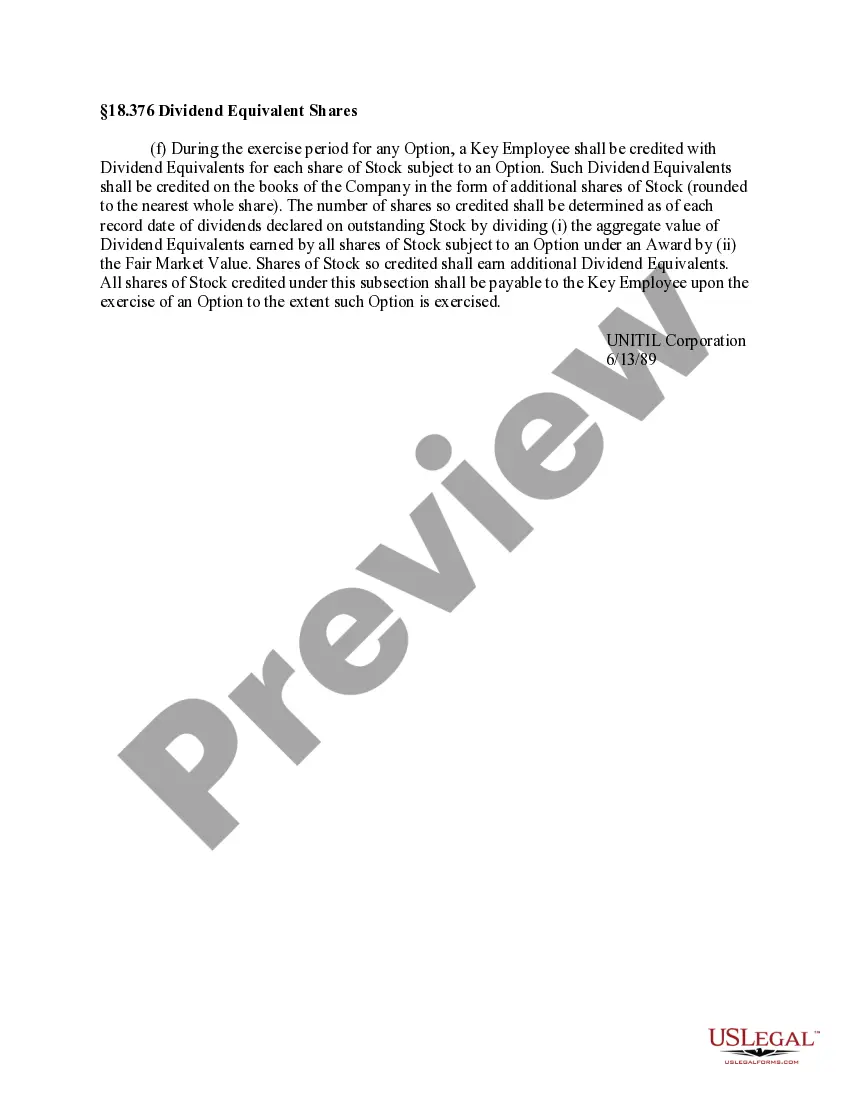
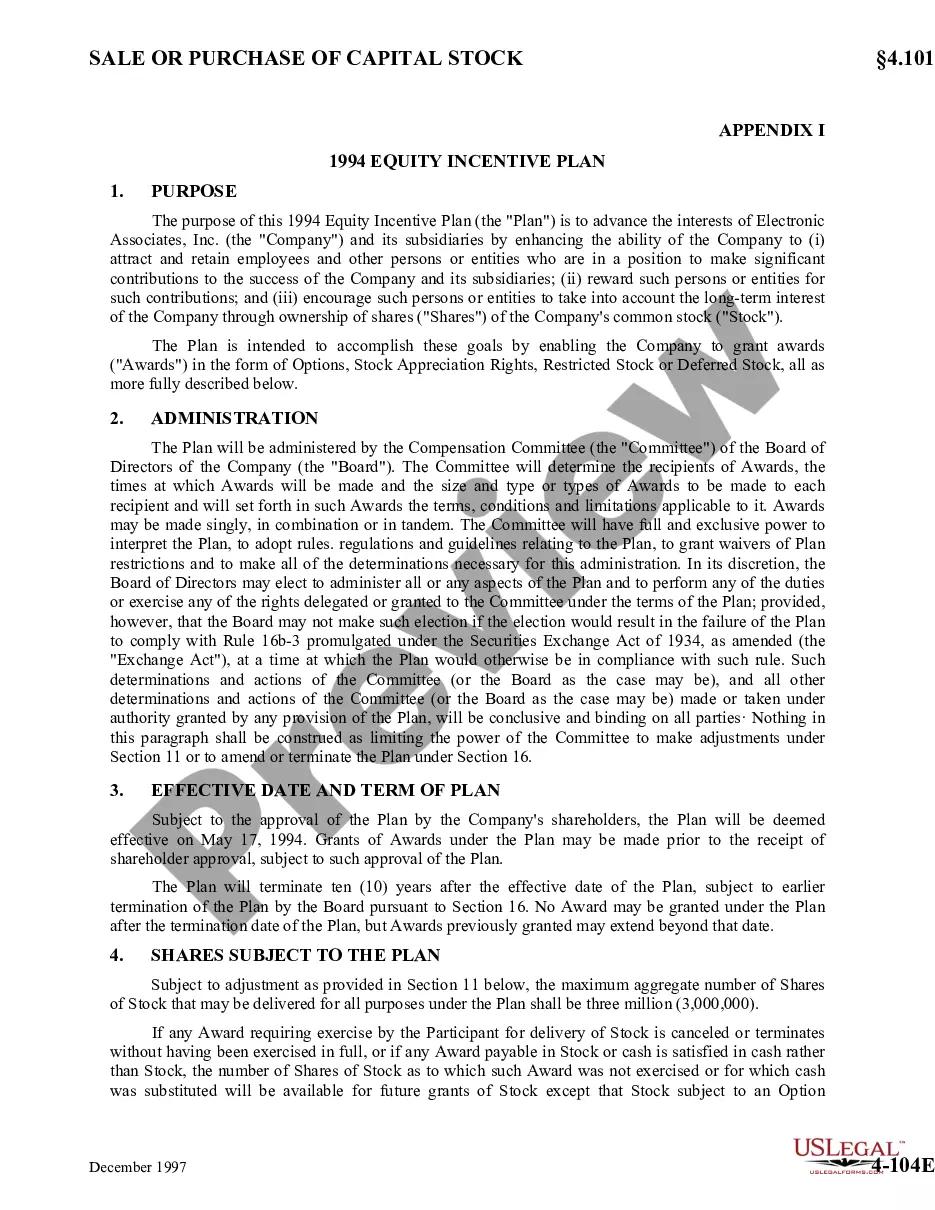
The Dividend Equivalent Shares form is a legal document used in corporate matters to outline how dividend equivalents are calculated and credited to key employees during an option exercise period. It establishes the framework for converting these equivalents into additional shares of stock, thus differentiating it from standard stock option agreements. This form is particularly useful for companies looking to incentivize employees through equity participation while ensuring compliance with legal and corporate governance standards.
What’s included in this form
- Credit of Dividend Equivalents for each share of stock subject to an option.
- Calculation of dividend equivalents based on the aggregate value of dividends declared on outstanding stock.
- Determination of credited shares as of each record date of declared dividends.
- Ability for credited shares to earn additional dividend equivalents.
- Provision for payment of credited shares to the key employee upon the exercise of an option.

When this form is needed
This form should be used when a company wants to provide dividend equivalents to key employees as part of an equity compensation plan. It is relevant during the exercise period of stock options, allowing employees to benefit from dividends without needing to hold the shares until they are exercised. Companies should utilize this form when structuring incentive plans to align employee interests with shareholder value.
Who needs this form
- Corporate executives and key employees involved in stock options.
- Human resources professionals managing employee compensation packages.
- Legal teams within corporations ensuring compliance with corporate governance.
- Shareholder representatives aiming to create equity incentives for employees.
Steps to complete this form
- Identify the key employee entitled to receive dividend equivalents.
- Specify the stock options associated with the dividend equivalents.
- Determine the record dates for dividends declared on outstanding stock.
- Calculate the aggregate value of dividend equivalents to be credited.
- Confirm the conversion of credited dividends into additional shares of stock.
Is notarization required?
This form does not typically require notarization unless specified by local law. However, it is important to check any applicable state regulations to ensure compliance.
Get your form ready online
Our built-in tools help you complete, sign, share, and store your documents in one place.
Make edits, fill in missing information, and update formatting in US Legal Forms—just like you would in MS Word.
Download a copy, print it, send it by email, or mail it via USPS—whatever works best for your next step.
Sign and collect signatures with our SignNow integration. Send to multiple recipients, set reminders, and more. Go Premium to unlock E-Sign.
If this form requires notarization, complete it online through a secure video call—no need to meet a notary in person or wait for an appointment.
We protect your documents and personal data by following strict security and privacy standards.

Make edits, fill in missing information, and update formatting in US Legal Forms—just like you would in MS Word.

Download a copy, print it, send it by email, or mail it via USPS—whatever works best for your next step.

Sign and collect signatures with our SignNow integration. Send to multiple recipients, set reminders, and more. Go Premium to unlock E-Sign.

If this form requires notarization, complete it online through a secure video call—no need to meet a notary in person or wait for an appointment.

We protect your documents and personal data by following strict security and privacy standards.
Typical mistakes to avoid
- Failing to correctly calculate the amount of dividend equivalents based on the total value of declared dividends.
- Omitting to specify the record dates for declared dividends.
- Not keeping the form up to date with changes in corporate bylaws or state regulations.
Benefits of using this form online
- Convenience of downloading and completing the form from anywhere.
- Editability allows for customization according to specific corporate needs.
- Reliable legal language drafted by licensed attorneys ensuring compliance and clarity.
Legal use & context
- Dividend equivalents are recognized and enforceable under corporate law but may require adherence to state-specific regulations.
- This form is legally sound if properly completed and maintained according to company policy.
- It's important to consult with a legal professional to ensure that the implementation meets all statutory requirements.
Looking for another form?






Form popularity
FAQ
You typically receive the shares after the vesting date. Only then do you have voting and dividend rights. Companies can and sometimes do pay dividend equivlent payouts for unvested RSUs.Unlike stock options, RSUs always have some value to you, even when the stock price drops below the price on the grant date.
Shares outstanding include shares of unvested restricted stock.Shares of unvested restricted stock are excluded from our calculation of basic weighted average shares outstanding, but their dilutive impact is added back in the calculation of diluted weighted average shares outstanding.
RSUs are taxed as income to you when they vest. If you sell your shares immediately, there is no capital gain tax, and the only tax you owe is on the income. However, if the shares are held beyond the vesting date, any gain (or loss) is taxed as a capital gain (or loss).
With restricted stock and restricted stock units, upon job termination you almost always forfeit whatever stock has not vested. Exceptions can occur, depending on the vesting terms of your employment agreement or stock plan, such as special provisions for disability, retirement, or an acquisition.
IPO Lock-Up Period and Long Term Capital Gains In most scenarios when your RSUs vest you can sell them immediately and there is almost no tax impact.However, if the stock reverts to the original IPO/Vesting date price, don't hesitate to sell since there will be no additional tax benefit.
Dividend equivalents paid on restricted stock units are treated as compensation income and will be subject to federal income tax when paid to the employee.When dividend equivalents are paid on a current basis, they are subject to federal income tax at the time of the payment.
Dividend Equivalents means a right, granted to a Participant under the Plan, to receive cash, shares, other Awards or other property equal in value to dividends paid with respect to shares of Stock.
A dividend equivalent payment is any gross amount that references the payment of a dividend on a U.S. equity and that is used to compute any net amount transferred to or from the long party, even if the long party make a net payment to the short party or the net payment is zero.
RSUs do not offer voting rights until actual shares are issued at vesting. No Dividends. RSUs cannot pay dividends, because no actual shares are used (employers can pay cash dividend equivalents if they choose). No Section 83(b) Election.