Equity Compensation Plan
What is this form?
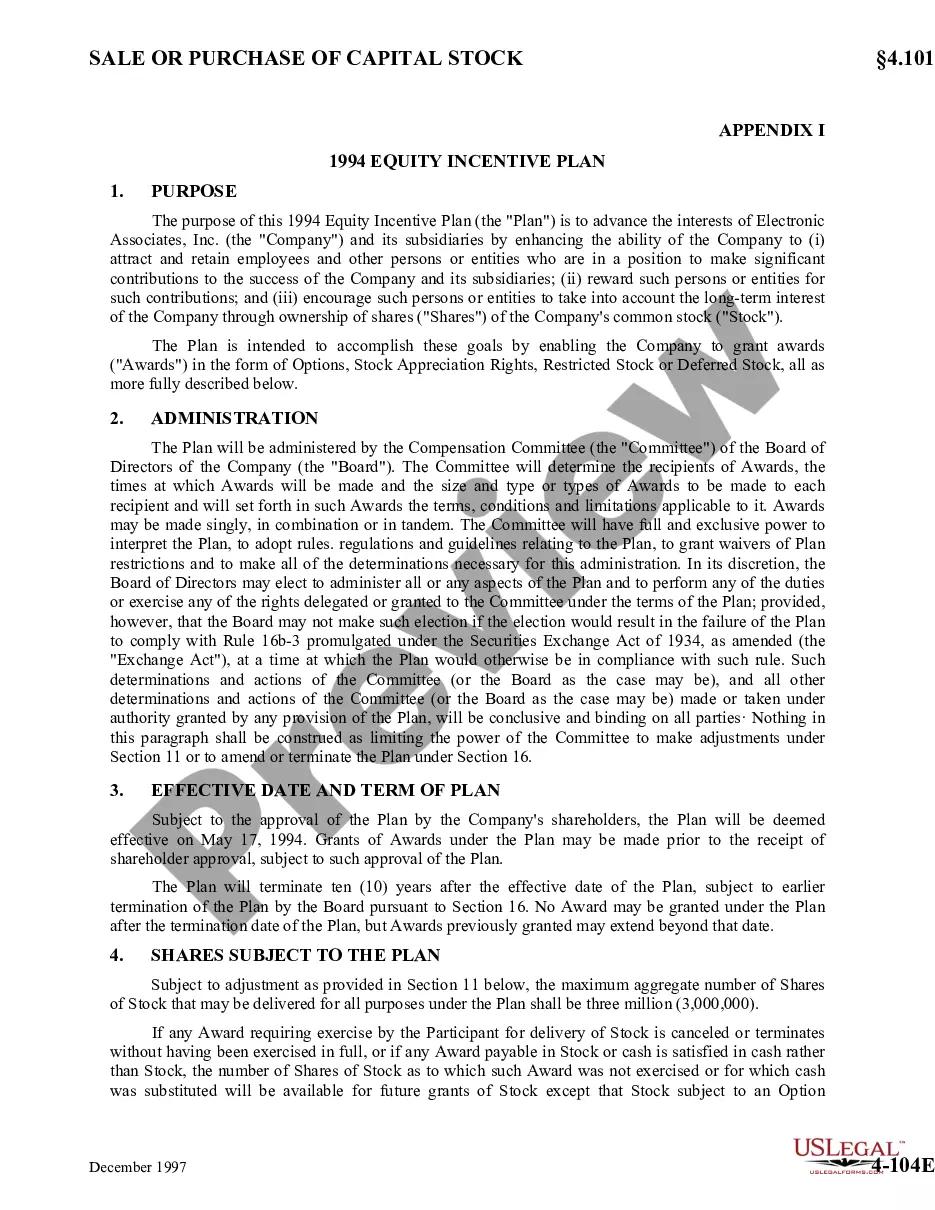
The Equity Compensation Plan is a corporate document that outlines how a company compensates its employees through equity stakes, such as stock options and restricted stock grants. This plan is different from similar forms as it specifically focuses on the administration, grants, and eligibility of equity awards to motivate employees and align their interests with that of shareholders.
Key parts of this document
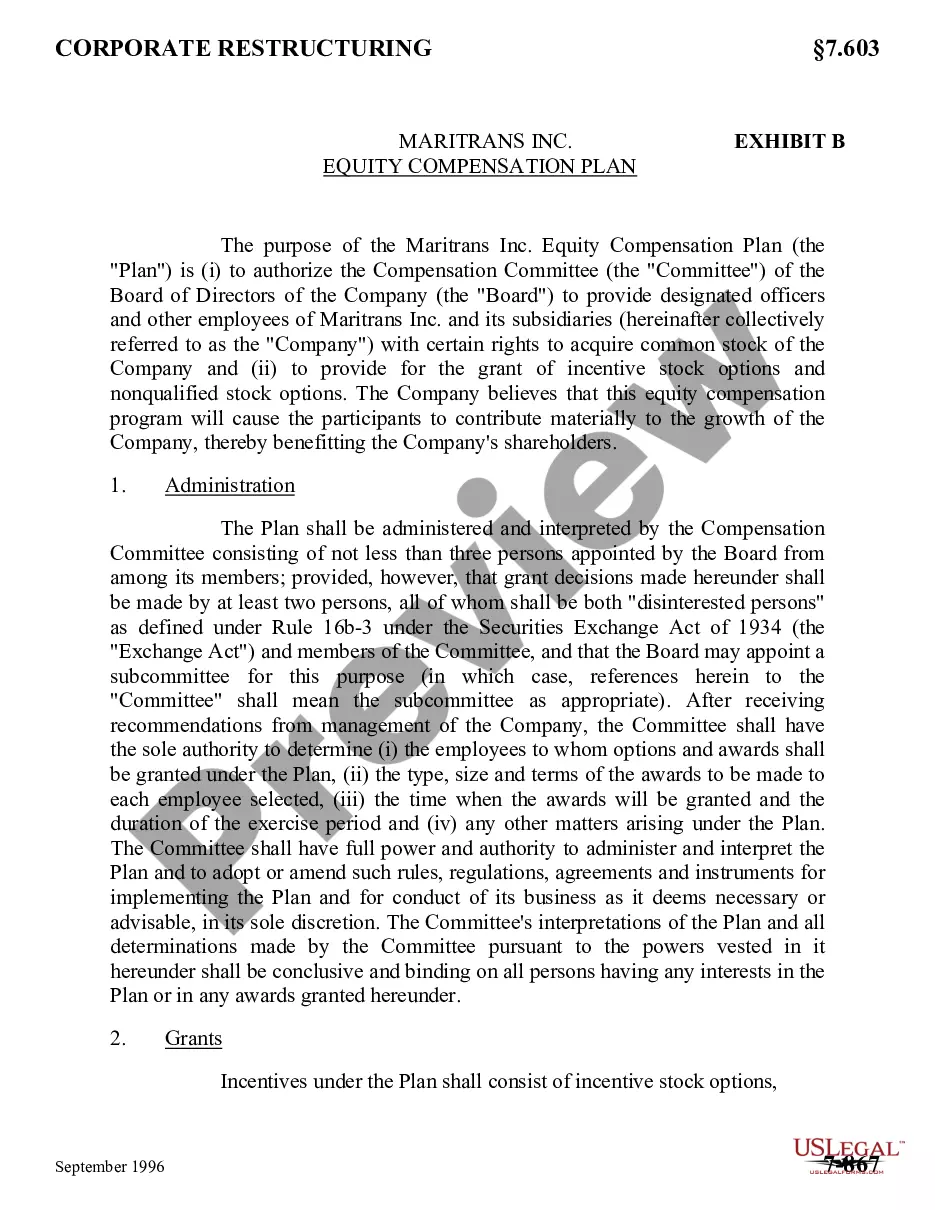
- Administration by the Compensation Committee, which decides on the terms and conditions of grants.
- Details about types of grants including incentive stock options, nonqualified stock options, and restricted stock grants.
- Eligibility criteria for participants, typically officers and employees of the company.
- Vesting schedules and exercise periods for the options granted.
- Provisions concerning changes in control of the company and implications for grants.


When to use this form
This form should be used when a company wishes to implement an equity compensation program to reward employees, attract talent, or retain key personnel. It is particularly useful in scenarios involving start-ups or companies looking to enhance their compensation packages with stock options or shares in the company.
Who should use this form
- Corporate boards looking to establish or revise equity compensation programs.
- Human resources professionals involved in employee compensation planning.
- Finance departments managing stock option grants and evaluations.
- Legal advisors ensuring compliance with corporate and securities laws regarding employee compensation.
Completing this form step by step
- Draft the plan terms including the types of grants and eligibility requirements.
- Specify the authority of the Compensation Committee in overseeing and administering the plan.
- Determine the total number of shares available for grants and stipulate the conditions for their issuance.
- Outline the vesting schedules and exercise periods for the different types of equity awards.
- Ensure the plan is reviewed and approved by the companyâs board of directors before implementation.
Notarization requirements for this form
This form usually doesn’t need to be notarized. However, local laws or specific transactions may require it. Our online notarization service, powered by Notarize, lets you complete it remotely through a secure video session, available 24/7.
Get your form ready online
Our built-in tools help you complete, sign, share, and store your documents in one place.
Make edits, fill in missing information, and update formatting in US Legal Forms—just like you would in MS Word.
Download a copy, print it, send it by email, or mail it via USPS—whatever works best for your next step.
Sign and collect signatures with our SignNow integration. Send to multiple recipients, set reminders, and more. Go Premium to unlock E-Sign.
If this form requires notarization, complete it online through a secure video call—no need to meet a notary in person or wait for an appointment.
We protect your documents and personal data by following strict security and privacy standards.

Make edits, fill in missing information, and update formatting in US Legal Forms—just like you would in MS Word.

Download a copy, print it, send it by email, or mail it via USPS—whatever works best for your next step.

Sign and collect signatures with our SignNow integration. Send to multiple recipients, set reminders, and more. Go Premium to unlock E-Sign.

If this form requires notarization, complete it online through a secure video call—no need to meet a notary in person or wait for an appointment.

We protect your documents and personal data by following strict security and privacy standards.
Common mistakes
- Failing to define clear eligibility criteria for participants can lead to confusion and disputes.
- Overlooking tax implications for different types of stock options granted to employees.
- Neglecting to align grant terms with the companyâs overall compensation strategy.
- Inadequately detailing the vesting schedules, which can impact employee motivation.
Why complete this form online
- Convenience in accessing legal forms at any time, from any location.
- Editability allows users to customize the plan to fit specific corporate needs and regulatory requirements.
- Reliable templates created by licensed attorneys ensure compliance with legal standards.
Legal use & context
- This form serves as a binding agreement between the company and its employees regarding granted equity compensation.
- Compliance with IRS regulations is necessary to ensure that stock options receive favorable tax treatment.
- Properly drafted equity compensation plans may enhance employee retention and satisfaction.
Quick recap
- The Equity Compensation Plan is essential for corporations offering stock options and other equity awards.
- It is critical to involve legal counsel to ensure compliance with all applicable laws.
- Clear communication of the terms and conditions to all participants is key to the plan's success.
- Regular review and amendments can help keep the plan aligned with corporate goals and regulatory changes.
Looking for another form?
Form popularity
FAQ
Under US GAAP, stock based compensation (SBC) is recognized as a non-cash expense on the income statement. Specifically, SBC expense is an operating expense (just like wages) and is allocated to the relevant operating line items: SBC issued to direct labor is allocated to cost of goods sold.
If you're granted a restricted stock award, you have two choices: you can pay ordinary income tax on the award when it's granted and pay long-term capital gains taxes on the gain when you sell, or you can pay ordinary income tax on the whole amount when it vests.At that time, the stock is worth $20 per share.
Equity compensation is non-cash pay that is offered to employees.Equity compensation allows the employees of the firm to share in the profits via appreciation and can encourage retention, particularly if there are vesting requirements. At times, equity compensation may accompany a below-market salary.
Equity compensation is non-cash pay that is offered to employees.Equity compensation allows the employees of the firm to share in the profits via appreciation and can encourage retention, particularly if there are vesting requirements. At times, equity compensation may accompany a below-market salary.
Under US GAAP, stock based compensation (SBC) is recognized as a non-cash expense on the income statement. Specifically, SBC expense is an operating expense (just like wages) and is allocated to the relevant operating line items: SBC issued to direct labor is allocated to cost of goods sold.
Overall, the total amount of equity you set aside will typically be around 515%.
Monthly market salary = $5000. monthly company salary = $1500. total employee investment = ($5000 $1500) 48 = $168 000. company valuation = $4 000 000. employee equity = $168 000 / $4 000 000 100%= 4.2%
Option Pool. Stock option agreement. Shareholders' Agreement. Administration. Shares Reserved for Issuance. RSU Grant Agreement. Vesting. Employment.
This could include reception, clerical employees, etc. Then you multiply the employee's base salary by the multiplier to get to a dollar value of equity. Let's say your VP Product is making $175k per year. Then the dollar value of equity you offer them is 0.5 x $175k, which is equal to $87.5k.