Employee Evaluation Form (Upon Separation)
What this document covers
The Employee Evaluation Form (Upon Separation) is a crucial document used by employers to assess an employee's performance after they have left the organization. This evaluative process helps companies record important information about the employee's job performance, skills, and reasons for separation. Unlike general employee evaluations, this form is specifically designed to be completed after an employee has resigned or been terminated, ensuring a focus on the employee's entire tenure with the organization.
Main sections of this form
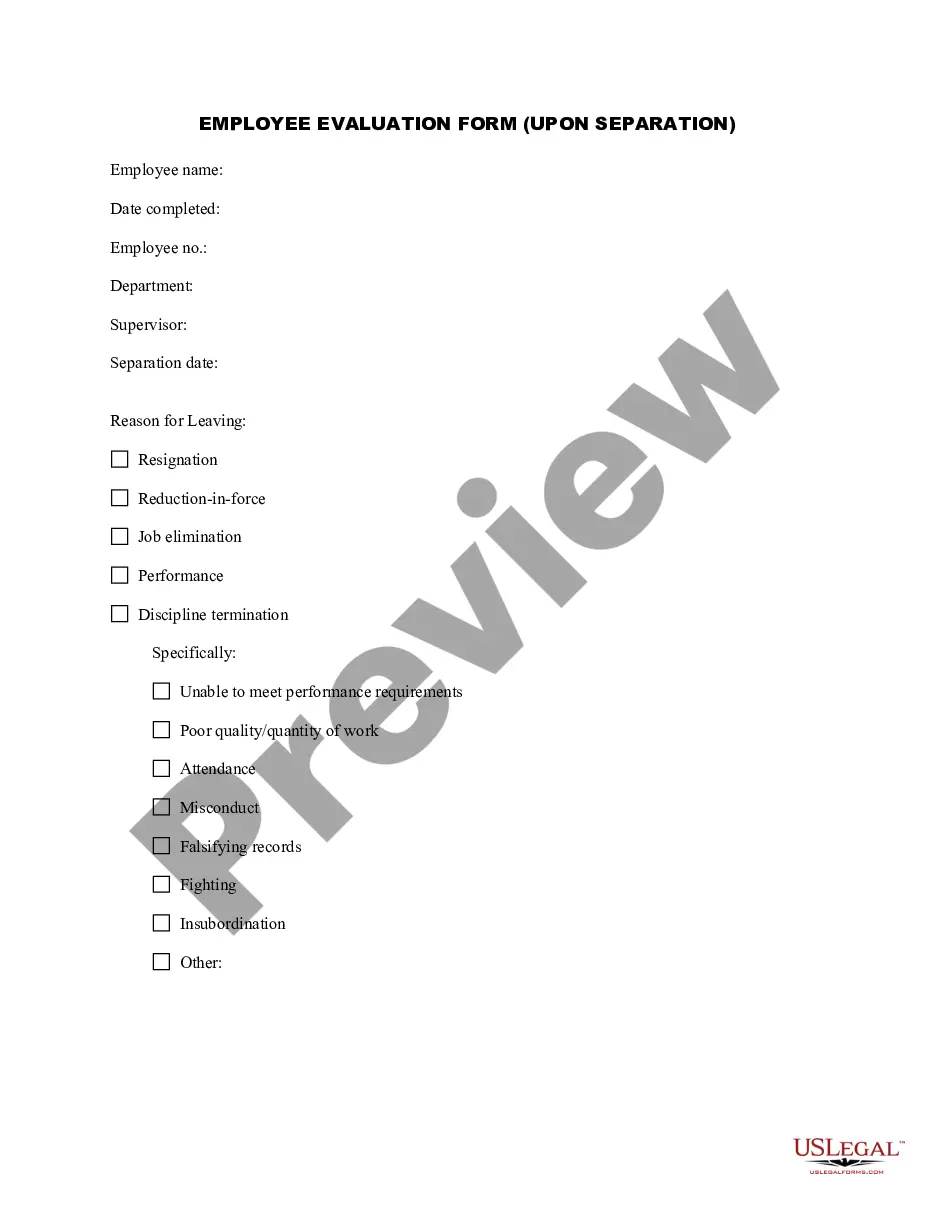
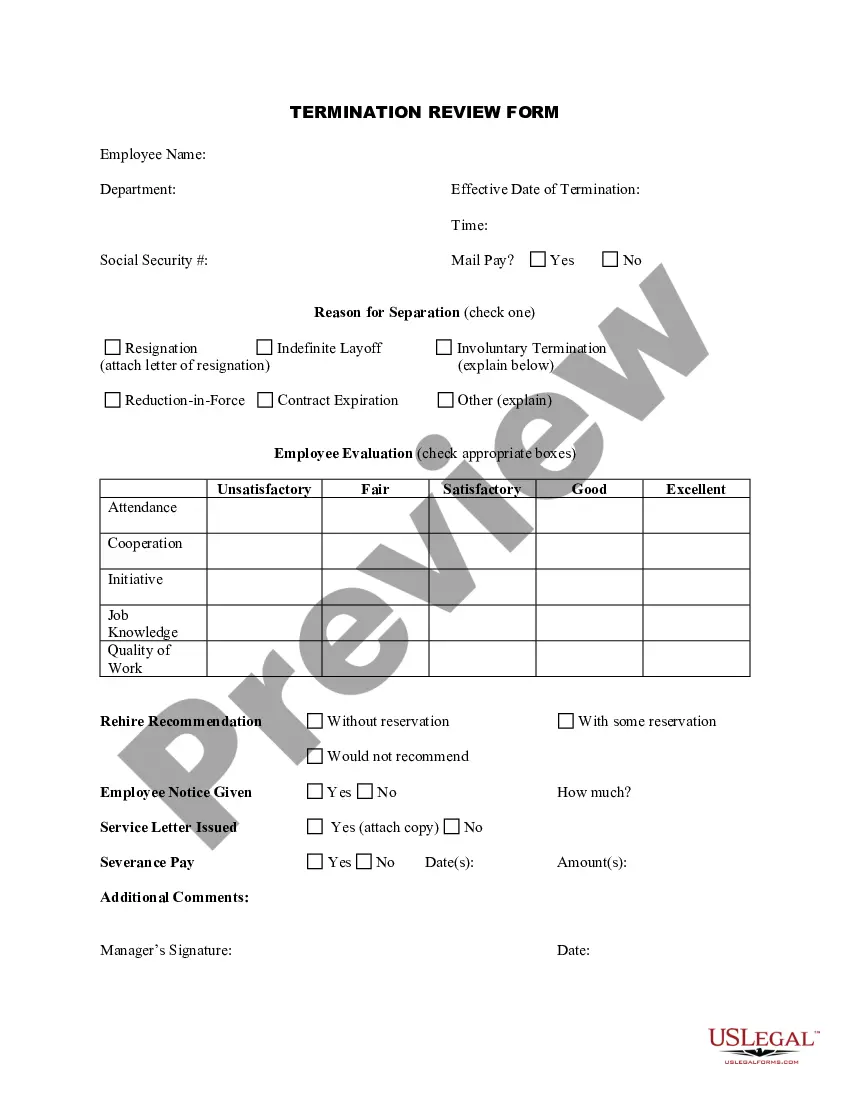
- Employee information: Includes fields for the employeeâs name, ID number, department, and supervisor.
- Separation details: Records the specific date of separation and the reason for leaving.
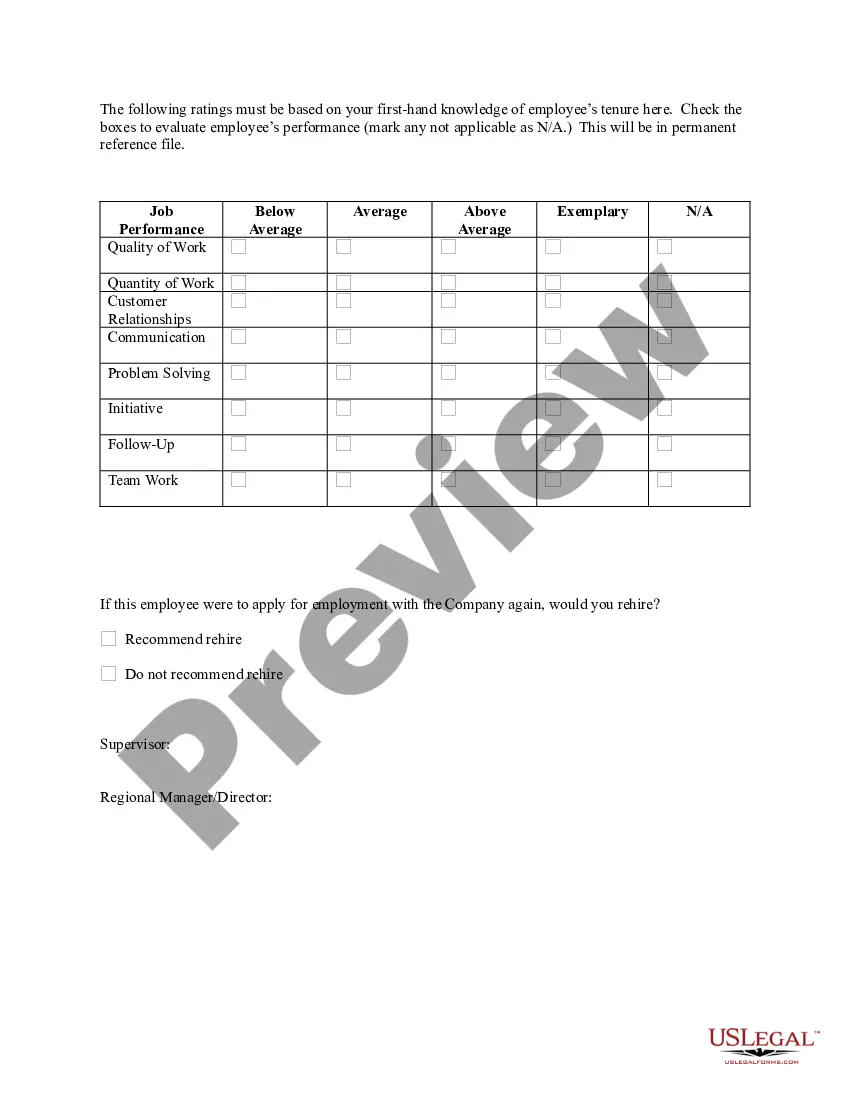
- Evaluation criteria: Covers performance aspects such as quality of work, teamwork, problem-solving skills, and communication.
- Rehire recommendation: Indicates whether or not the supervisor would rehire the employee.
- Signatures: Designed for completion by the supervisor and may require additional approvals.

Common use cases
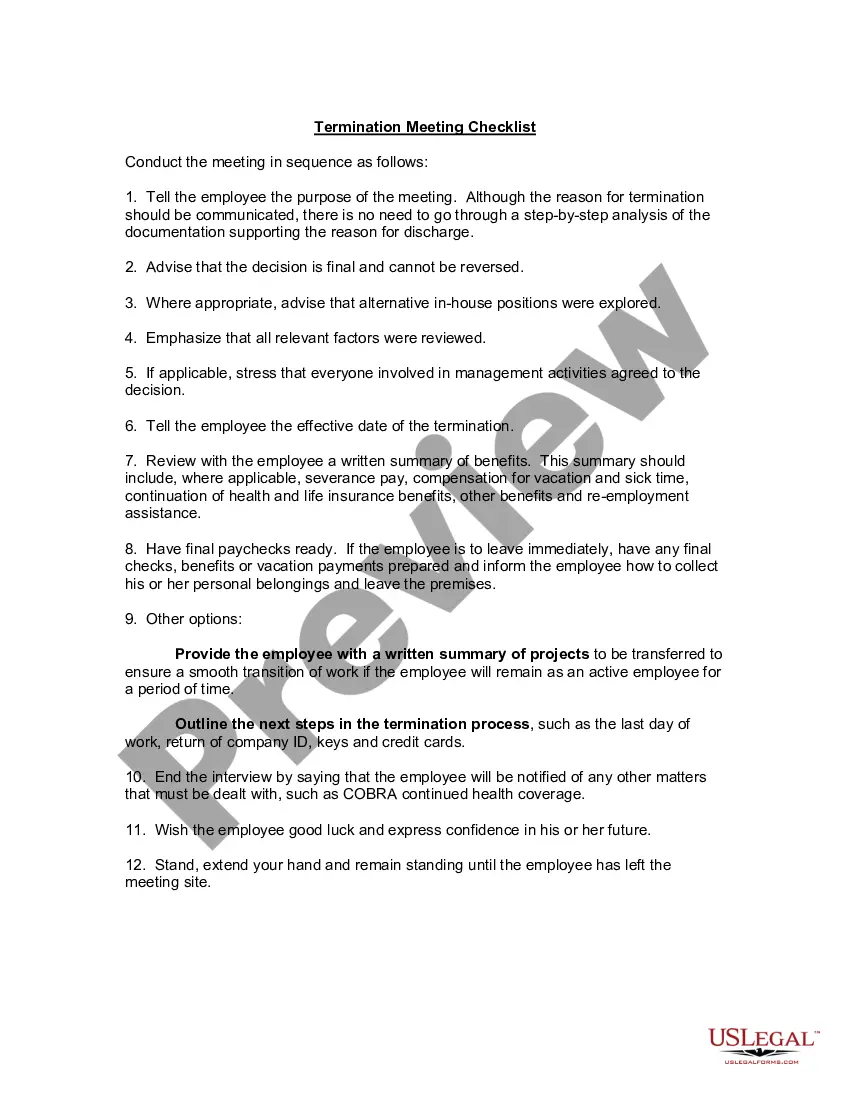
This form should be used during the exit process of an employee who is leaving the organization, whether through resignation, layoffs, or termination. Completing this evaluation helps provide a comprehensive view of the employee's contributions, performance levels, and any areas that may require improvement within the company. It can also serve as a reference for future hiring considerations or employee training needs.
Who should use this form
The following individuals should utilize this form:
- Human resources professionals responsible for managing employee separations.
- Supervisors or managers conducting the performance evaluations of departing employees.
- Organizations aiming to maintain a thorough record of employee performance history for future reference.
Steps to complete this form
- Fill in the employee's current information including their name, ID, department, and supervisor's details.
- Record the date of separation along with the reason for the employee's departure, selecting from the provided options or specifying others.
- Evaluate the employeeâs performance across various categories, checking boxes that correspond to the evaluation criteria.
- Indicate whether the supervisor would recommend rehiring the employee, based on the evaluation.
- Ensure that the supervisor signs the form and includes their title, confirming the accuracy of the evaluation.
Is notarization required?
This form does not typically require notarization unless specified by local law. Ensure to check specific state laws regarding documentation requirements for employee evaluations.
Get your form ready online
Our built-in tools help you complete, sign, share, and store your documents in one place.
Make edits, fill in missing information, and update formatting in US Legal Forms—just like you would in MS Word.
Download a copy, print it, send it by email, or mail it via USPS—whatever works best for your next step.
Sign and collect signatures with our SignNow integration. Send to multiple recipients, set reminders, and more. Go Premium to unlock E-Sign.
If this form requires notarization, complete it online through a secure video call—no need to meet a notary in person or wait for an appointment.
We protect your documents and personal data by following strict security and privacy standards.

Make edits, fill in missing information, and update formatting in US Legal Forms—just like you would in MS Word.

Download a copy, print it, send it by email, or mail it via USPS—whatever works best for your next step.

Sign and collect signatures with our SignNow integration. Send to multiple recipients, set reminders, and more. Go Premium to unlock E-Sign.

If this form requires notarization, complete it online through a secure video call—no need to meet a notary in person or wait for an appointment.

We protect your documents and personal data by following strict security and privacy standards.
Common mistakes
- Failing to complete all required fields, especially the reason for leaving.
- Not providing specific feedback when evaluating performance.
- Ignoring the requirement for supervisor signatures or necessary approvals.
Why complete this form online
- Convenience of electronic completion and submission from anywhere, reducing paperwork.
- Ability to easily edit and update information as necessary.
- Access to templates created by licensed attorneys, ensuring legal compliance and accuracy.
Quick recap
- The Employee Evaluation Form (Upon Separation) is essential for documenting an employeeâs performance after they leave.
- Accurate completion of this form can provide valuable insights for future hiring and employee management.
- Always ensure the form is properly signed and all relevant information is included to avoid common errors.
Looking for another form?
Form popularity
FAQ
Communication. Collaboration and teamwork. Problem-solving. Quality and accuracy of work. Attendance, punctuality and reliability. The ability to accomplish goals and meet deadlines.
Gather information. List employee responsibilities. Use objective language. Use action verbs. Compare performance ratings. Ask open-ended questions. Use a point system.
1 Know how the self-evaluation is going to be used. 2 Write out a list of your accomplishments. 3 Gather analytics if you can. 4 Write out a list of your struggles. 5 Narrow your accomplishments list down. 6 Don't forget to align your review with your manager's or team's goals.
Employee and reviewer information. The form must have basic information about both parties involved. Review period. An easy-to-understand rating system. Evaluation points. Goals. Extra space for comments. Signatures. Scorecard.
Review the employee's job description. Get a current copy of each person's job description and review the requirements. Highlight areas of improvement. Compare strengths and weaknesses. Recommend actionable goals. Provide constructive feedback. Welcome employee input.
Some reasons for voluntary separation include: Better opportunities: Many people leave jobs because there is better job available elsewhere. When that happens, employees may offer their managers the opportunity to top the better job offer.
Employee separation is a sensitive issue for any organization. Usually, an employee leaves the organization after several years of service.An employee may be separated as consequence of resignation, removal, death, permanent incapacity, discharge or retirement.
Separation of an employee exists when the service of an employee comes to an end because of one reason or other. Separation arises due to resignation; lay off, dismissal and retirement. Types of separation: i) Resignation: when the employee himself initiates the separation then it is termed as separation.
Employment separation occurs when the employment contract or at-will agreement between an employee and his or her company comes to an end. Some terminations will be forced by an employer, including getting fired or laid off. Other separations, like retirement or resignation, will be voluntary.