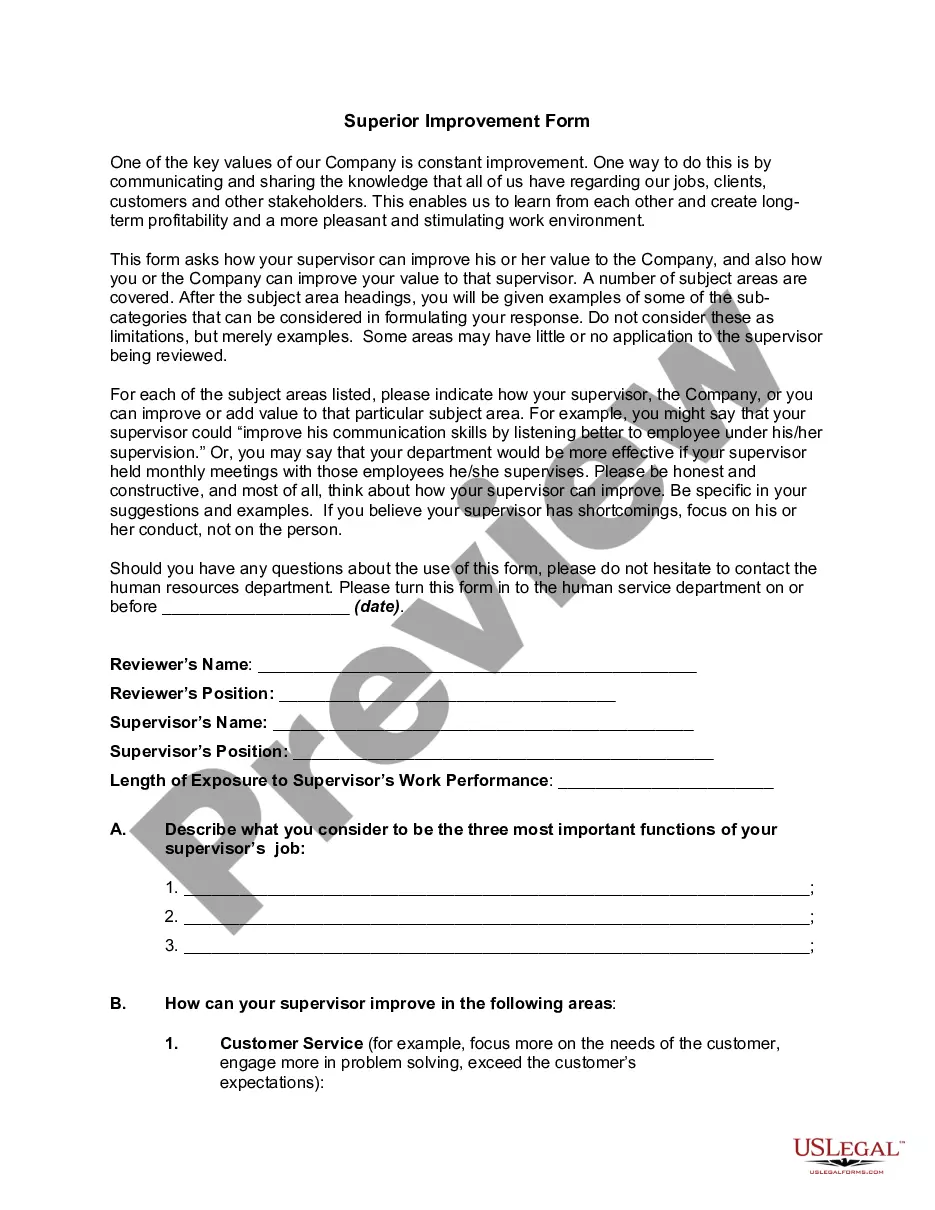
Superior Improvement Form
Overview of this form
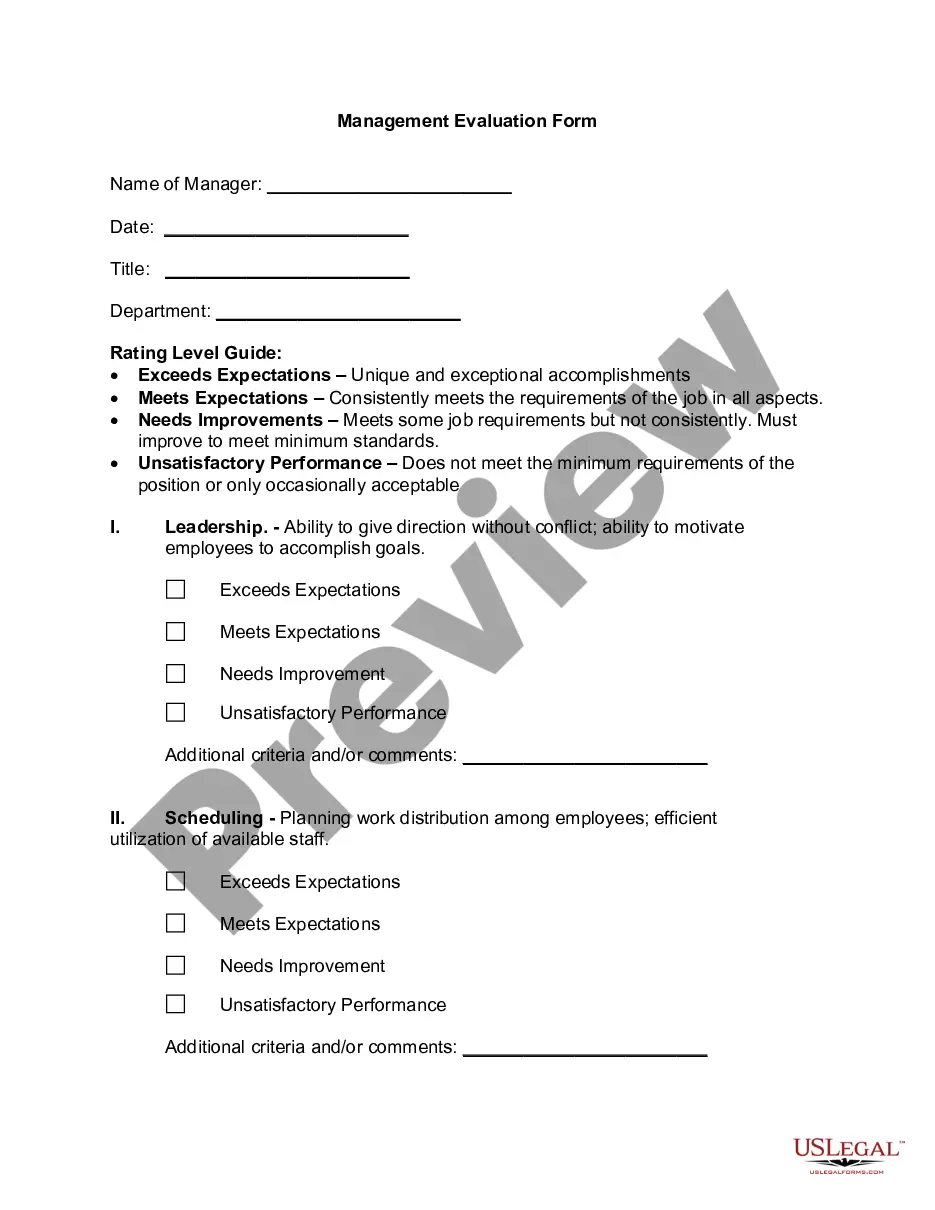
The Superior Improvement Form is a valuable tool designed for employees to provide constructive feedback about their supervisors. This form focuses on assessing various aspects of supervisory performance and encourages open communication for improvement. Unlike typical performance reviews, this form emphasizes both the supervisor's growth and how the employee can contribute to the supervisory role, fostering a culture of continuous improvement within the organization.
Main sections of this form
- Employee information: Includes the name and position of the reviewer.
- Supervisor information: Covers the name and position of the supervisor being assessed.
- Critical functions: Identifies the three most important functions of the supervisor's job.
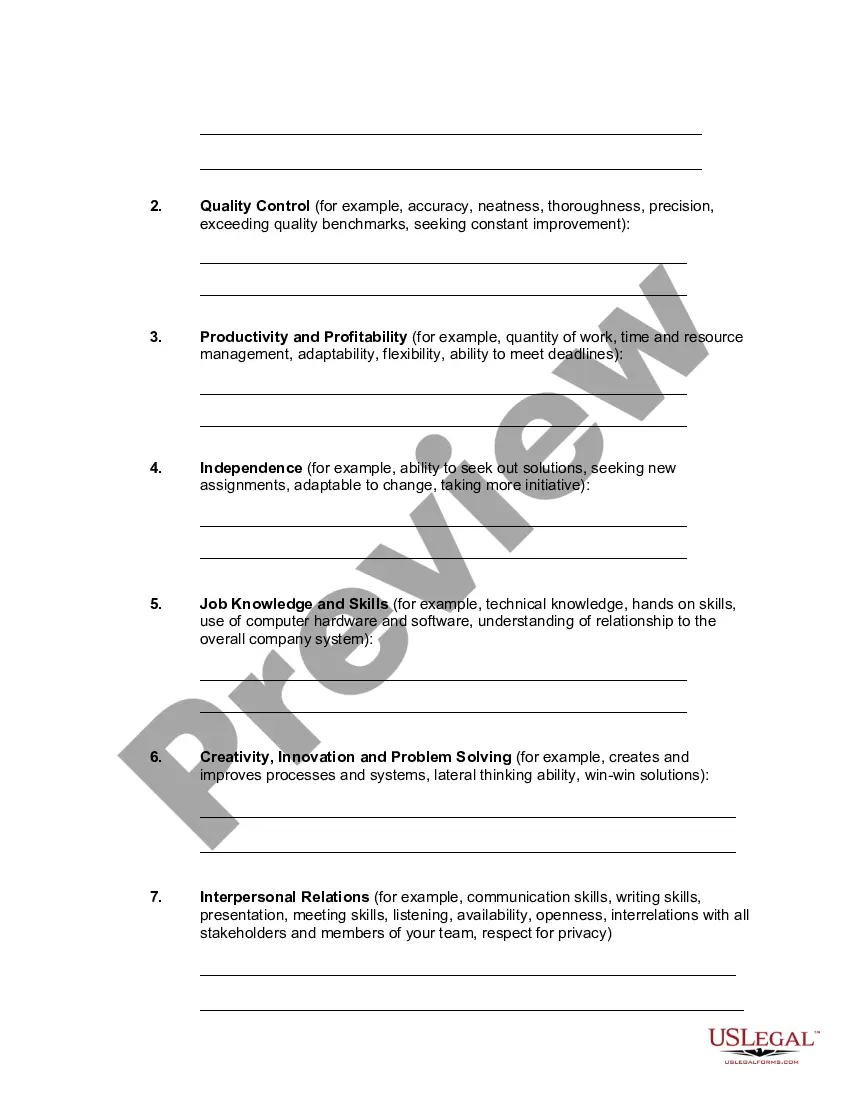
- Improvement areas: Provides specific categories where the supervisor can enhance performance, such as customer service and leadership ability.
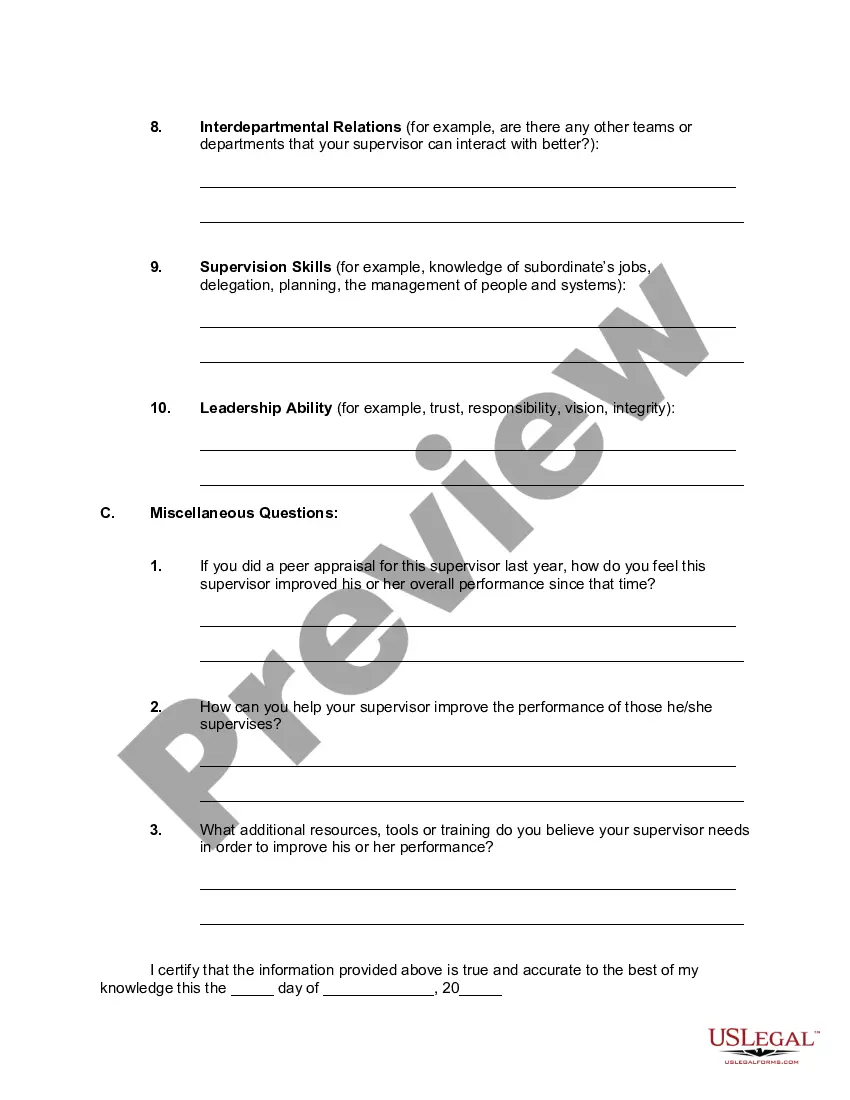
- Constructive feedback: Encourages detailed suggestions for improvement across various competencies.
- Certification: Requires the employee's signature to verify the accuracy of the information provided.
Common use cases
This form is essential for employees seeking to provide structured feedback on their supervisors as part of a formal appraisal process. It is particularly useful during performance review periods or when an organization is implementing initiatives aimed at employee feedback and development. Additionally, the form can be applied at any time a supervisor's performance is evaluated, allowing employees to communicate specific suggestions for improvement.
Who needs this form
- Employees who work directly under a supervisor and have sufficient experience with their management style.
- Human resources professionals looking to gather feedback for performance evaluations.
- Organizations aiming to foster an environment of open communication and continuous improvement.
- Teams interested in assessing leadership effectiveness to enhance workplace relationships.
How to prepare this document
- Enter your name and position in the designated fields at the top of the form.
- Fill in the supervisor's name and position to identify who is being reviewed.
- Describe the three most critical functions of your supervisor's role as you see them.
- Provide specific suggestions for improvement in the outlined areas such as customer service and leadership.
- Complete the miscellaneous questions to reflect on past performance and potential support needed for the supervisor.
- Sign and date the form to certify the accuracy of your feedback, and submit it to human resources by the specified deadline.
Notarization guidance
In most cases, this form does not require notarization. However, some jurisdictions or signing circumstances might. US Legal Forms offers online notarization powered by Notarize, accessible 24/7 for a quick, remote process.
Get your form ready online
Our built-in tools help you complete, sign, share, and store your documents in one place.
Make edits, fill in missing information, and update formatting in US Legal Forms—just like you would in MS Word.
Download a copy, print it, send it by email, or mail it via USPS—whatever works best for your next step.
Sign and collect signatures with our SignNow integration. Send to multiple recipients, set reminders, and more. Go Premium to unlock E-Sign.
If this form requires notarization, complete it online through a secure video call—no need to meet a notary in person or wait for an appointment.
We protect your documents and personal data by following strict security and privacy standards.

Make edits, fill in missing information, and update formatting in US Legal Forms—just like you would in MS Word.

Download a copy, print it, send it by email, or mail it via USPS—whatever works best for your next step.

Sign and collect signatures with our SignNow integration. Send to multiple recipients, set reminders, and more. Go Premium to unlock E-Sign.

If this form requires notarization, complete it online through a secure video call—no need to meet a notary in person or wait for an appointment.

We protect your documents and personal data by following strict security and privacy standards.
Common mistakes
- Providing vague feedback instead of specific examples.
- Focusing on personal biases rather than professional observations.
- Neglecting to address both strengths and areas for improvement.
- Forgetting to submit the form by the deadline.
- Not signing the form, potentially invalidating the feedback provided.
Why complete this form online
- Convenience of accessing the form anytime from any device.
- Ability to edit responses and provide detailed feedback with ease.
- Secure storage and submission to maintain confidentiality.
- Prompt access to updates and versions of the form as needed.
Legal use & context
- The Superior Improvement Form serves as a formal record of feedback, aiding in employee performance evaluation.
- Encourages a transparent process for supervisory assessments, enhancing workplace accountability.
- Overall feedback can be used for training and development initiatives within the organization.
Summary of main points
- The Superior Improvement Form facilitates constructive feedback about supervisors.
- It encourages a culture of continuous improvement and open communication.
- Employees should provide specific, actionable suggestions for enhancement.
- Completing this form is crucial for meaningful performance reviews.
Looking for another form?

Form popularity
FAQ
Make it easy to use. Ensure that the information your evaluation form seeks is clear and concise. Determine the focus of the form. There needs to be a clear purpose. Establish a clearly defined rating scale.
1 Know how the self-evaluation is going to be used. 2 Write out a list of your accomplishments. 3 Gather analytics if you can. 4 Write out a list of your struggles. 5 Narrow your accomplishments list down. 6 Don't forget to align your review with your manager's or team's goals.
Employee and reviewer information. The form must have basic information about both parties involved. Review period. An easy-to-understand rating system. Evaluation points. Goals. Extra space for comments. Signatures. Scorecard.
Choose your topic. As with any essay, this is one of the first steps . Write a thesis statement. This is a key element of your essay as it sets out the overall purpose of the evaluation. Determine the criteria used to assess the product. Look for supporting evidence. Draft your essay. Review, revise & rewrite.
Some examples of positive feedback are contractions in child birth and the ripening of fruit; negative feedback examples include the regulation of blood glucose levels and osmoregulation.
Communication. Collaboration and teamwork. Problem-solving. Quality and accuracy of work. Attendance, punctuality and reliability. The ability to accomplish goals and meet deadlines.
Develop an evaluation form. Identify performance measures. Set guidelines for feedback. Create disciplinary and termination procedures. Set an evaluation schedule.
Gather information. List employee responsibilities. Use objective language. Use action verbs. Compare performance ratings. Ask open-ended questions. Use a point system.
Reflect on feedback. Make a list of your top accomplishments and identify areas for improvements. Gather analytics to show impact. Make a commitment to improve. Set a SMART goal for yourself. Create a plan of action. Communication. Job Performance.