Biological Material Storage Consent Form Future Use
Understanding this form
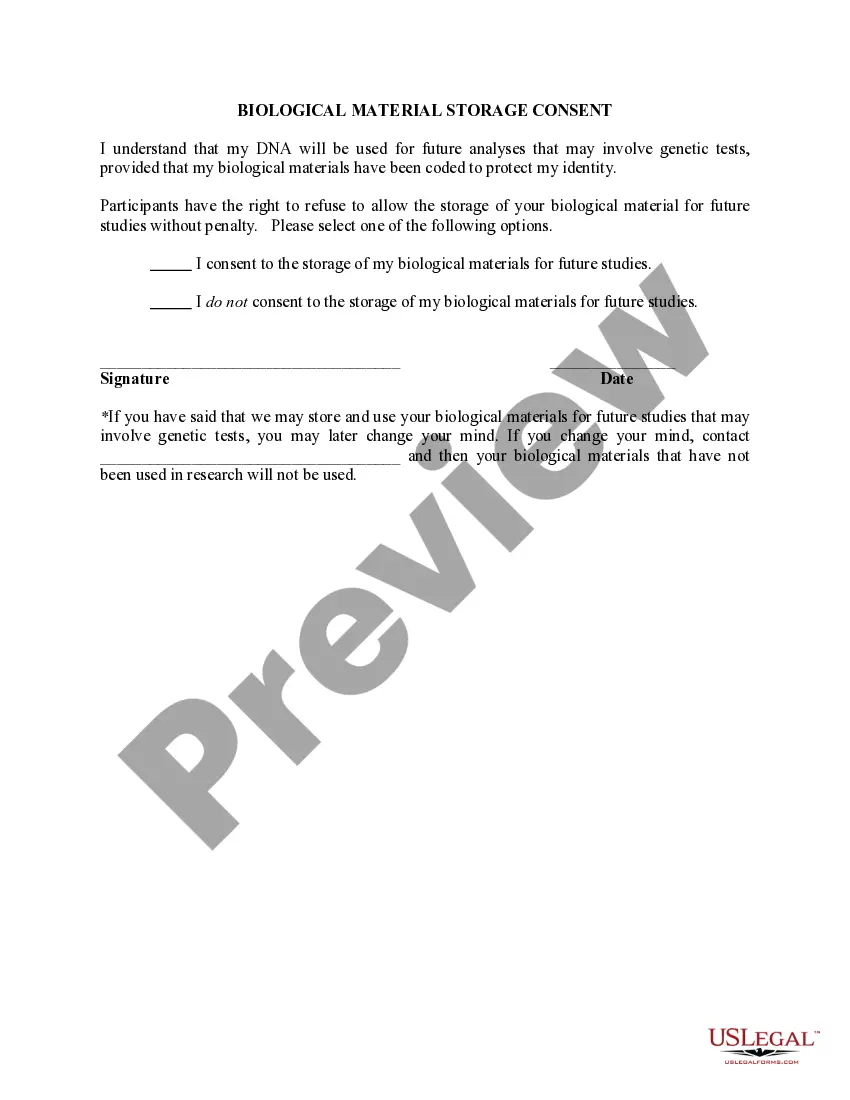
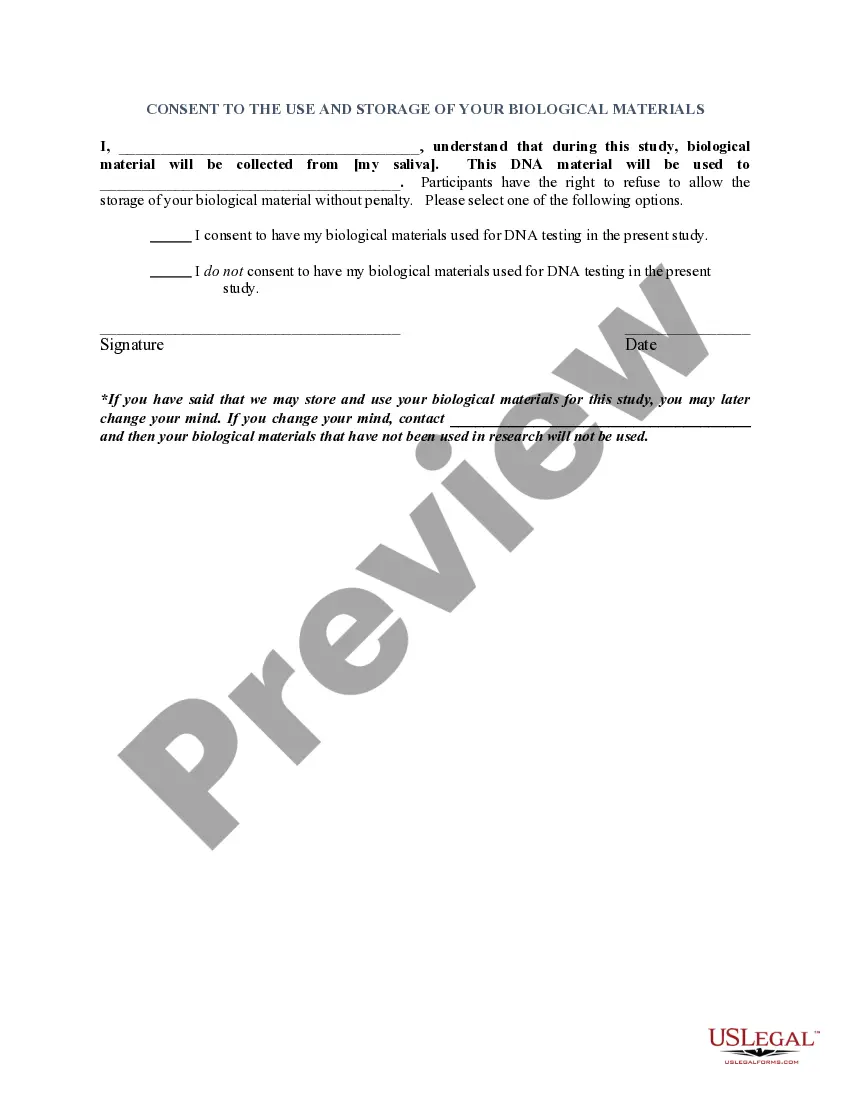
The Biological Material Storage Consent Form for Future Use is a legal document that allows research participants to consent to the storage of their biological materials, such as DNA, for future research studies. This form specifically ensures that any biological materials collected during a research study can be used later while protecting the identity of the participants by coding their samples. It differs from other research consent forms by focusing exclusively on the future use of biological materials rather than immediate research applications.
Main sections of this form
- Consent statement indicating agreement or refusal for storage of biological materials.
- Clear identification of the participant's signature and date.
- Information on the option to withdraw consent later.
- Contact information for participants wishing to change their consent.
When to use this document
This form is used when a participant agrees to the storage of their biological materials for future research that may involve genetic testing. It is typically required in research studies that may utilize DNA samples or other biological materials for ongoing or future studies, ensuring that participants have control over how their samples are used.
Intended users of this form
- Individuals participating in research studies involving biological materials.
- Research institutions or organizations seeking to comply with ethical standards regarding participant consent.
- Researchers planning to use biological materials for future studies.
Instructions for completing this form
- Read the consent statement carefully to understand the implications of storage and future use.
- Select the appropriate option indicating whether you consent or do not consent to the storage of your biological materials.
- Sign and date the form to formalize your decision.
- If consenting, keep the contact information handy for future reference in case you change your mind.
Notarization requirements for this form
This form does not typically require notarization unless specified by local law. Participants should check local regulations to ensure compliance with any notarization requirements.
Get your form ready online
Our built-in tools help you complete, sign, share, and store your documents in one place.
Make edits, fill in missing information, and update formatting in US Legal Forms—just like you would in MS Word.
Download a copy, print it, send it by email, or mail it via USPS—whatever works best for your next step.
Sign and collect signatures with our SignNow integration. Send to multiple recipients, set reminders, and more. Go Premium to unlock E-Sign.
If this form requires notarization, complete it online through a secure video call—no need to meet a notary in person or wait for an appointment.
We protect your documents and personal data by following strict security and privacy standards.

Make edits, fill in missing information, and update formatting in US Legal Forms—just like you would in MS Word.

Download a copy, print it, send it by email, or mail it via USPS—whatever works best for your next step.

Sign and collect signatures with our SignNow integration. Send to multiple recipients, set reminders, and more. Go Premium to unlock E-Sign.

If this form requires notarization, complete it online through a secure video call—no need to meet a notary in person or wait for an appointment.

We protect your documents and personal data by following strict security and privacy standards.
Common mistakes to avoid
- Not reading the consent statement thoroughly before signing.
- Failing to select an option indicating consent or refusal.
- Neglecting to date the form, which may lead to confusion about the consent period.
Why use this form online
- Immediate access to the latest version of the form, ensuring compliance with current regulations.
- Convenient download and print options for easy completion.
- Clear instructions that simplify the consent process.
Quick recap
- The Biological Material Storage Consent Form allows participants to consent to the future use of their biological materials.
- Participants can withdraw consent at any time by contacting the designated party.
- This form is vital for ethical research practices involving human biological materials.
Looking for another form?


Form popularity
FAQ
In the revised Common Rule, "broad consent" is an alternative consent process only for the storage, maintenance, and secondary use of identifiable private information or identifiable biospecimens for future, yet-to-be-specified research.
As we have argued, broad consent in biobank research is not merely a pragmatic solution but a morally valid, legitimately informed model when used as part of a framework of research governance. This also implies that 'more information' in itself does not necessarily make a consent more informed.
Secondary means the re-use of identifiable information and identifiable biospecimens that are collected from some other ?primary? or ?initial? activity. In other words, data that were not collected for the purpose of the specific proposed study.
In the revised Common Rule, "broad consent" is an alternative consent process only for the storage, maintenance, and secondary use of identifiable private information or identifiable biospecimens for future, yet-to-be-specified research.
A document with important information about a medical procedure or treatment, a clinical trial, or genetic testing. It also includes information on possible risks and benefits. If a person chooses to take part in the treatment, procedure, trial, or testing, he or she signs the form to give official consent.
The Final Rule allows broad consent for either a specific type of specified future research (for example, prostate cancer research) or a broader scope of research (for example, any biomedical research). The Final Rule did not contain any templates for broad consent forms.
Consent for future use of data and tissue in research Extended consent involves participants providing consent for the future use of their data/ samples and includes participants providing consent to being contacted again in the future.
Ultra-low temperature (ULT) freezers provide the necessary conditions for storing biological specimens. Storage at -80 °C preserves biological specimens by slowing or stopping natural functions.