Adverse Inference
Understanding this form
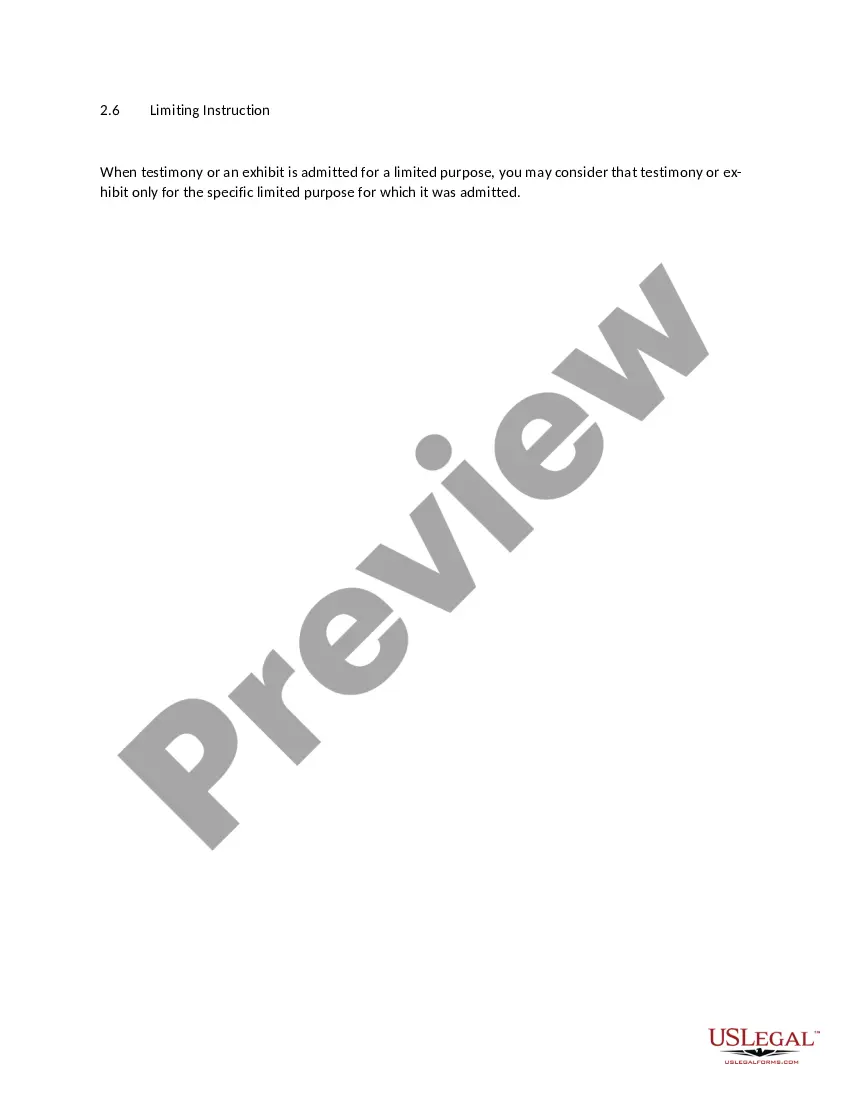
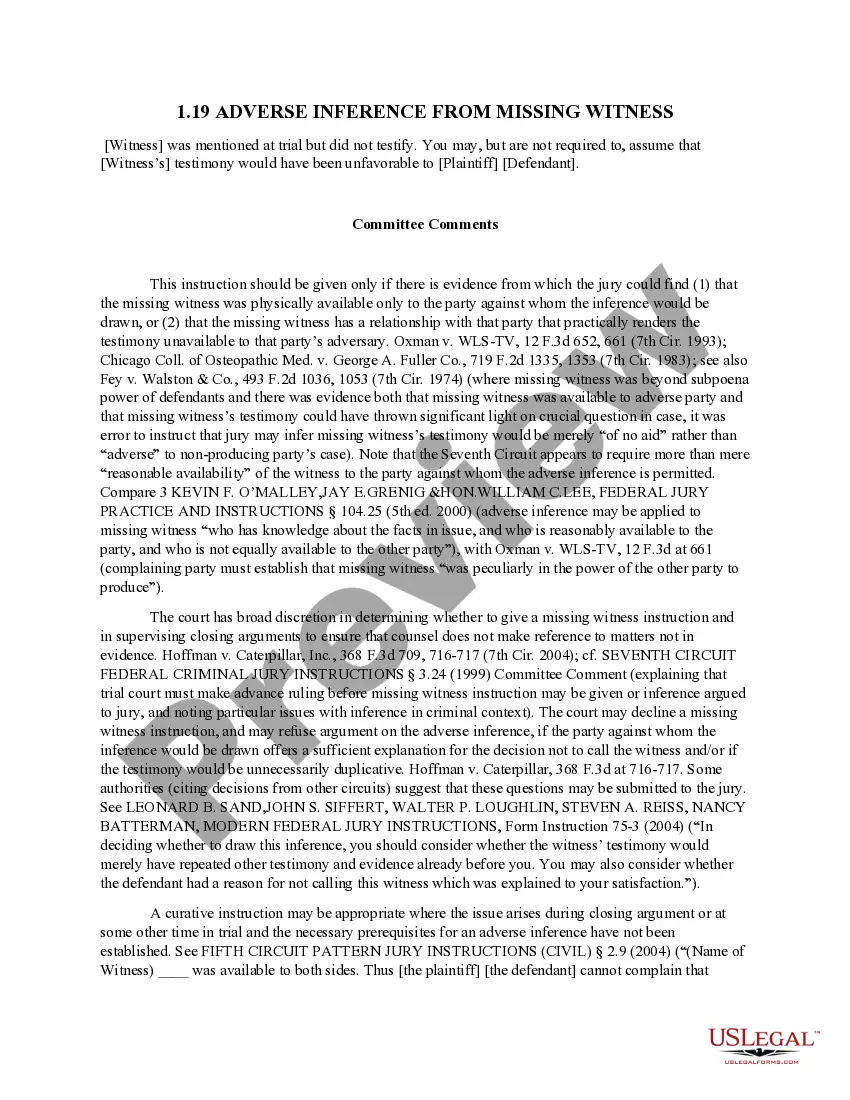
The Adverse Inference form is a legal document used during legal proceedings to address situations where a party fails to produce evidence that is expected. This form helps establish assumptions against the non-compliant party based on their lack of evidence, thereby potentially influencing the outcome of a case. It differs from other legal forms by specifically focusing on the implications of missing evidence rather than the direct presentation of a case itself.
Form components explained
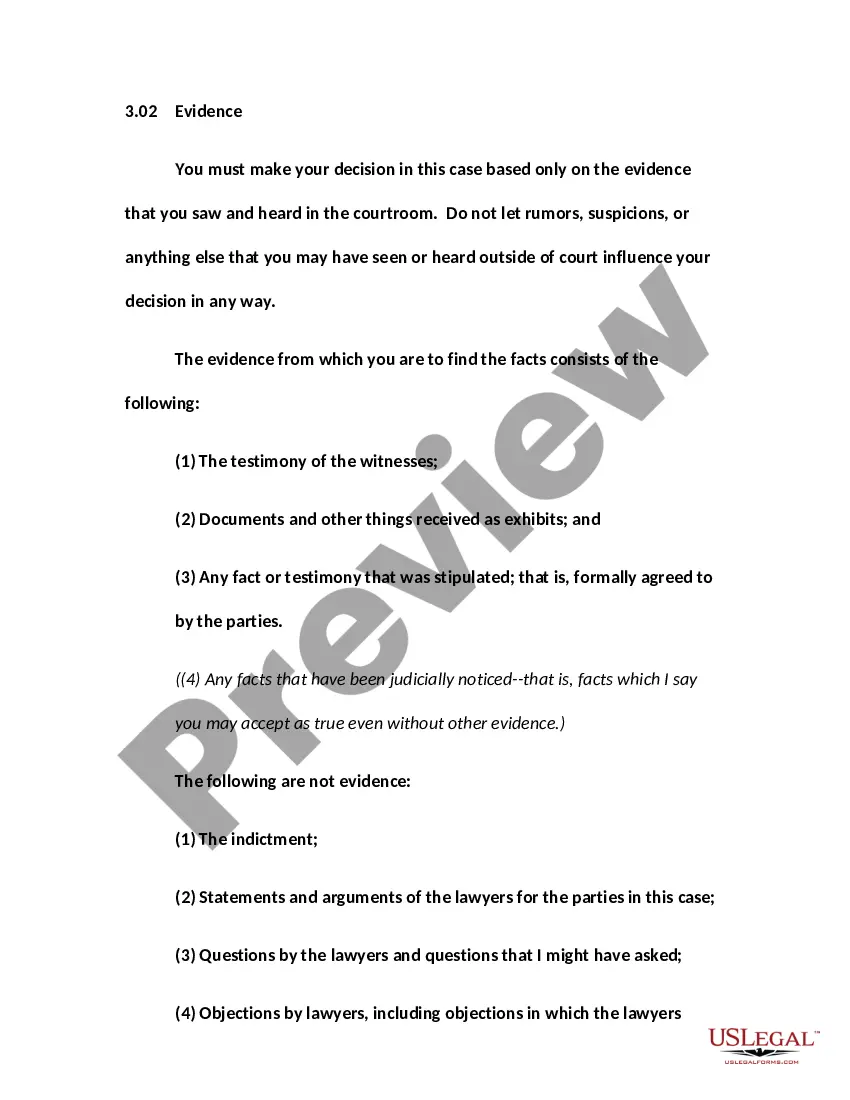
- Limiting instruction clause: guides the court on how to consider testimony or exhibits admissively for restricted purposes.

When to use this document
This form is typically used in civil litigation cases where one party has not provided requested documents or evidence. It can also be applied when a party fails to comply with court orders for disclosure, leading to potential prejudicial impacts on the opposing party's case. Using this form can help ensure that the court acknowledges the implications of such non-compliance.
Who needs this form
- Litigants involved in civil lawsuits who seek to address missing evidence.
- Attorneys representing clients who have encountered non-compliance from opposing parties.
- Parties in legal proceedings aiming to ensure fair treatment and acknowledgment of evidence-related issues in court.
Steps to complete this form
- Identify the case where evidence is missing.
- Specify the party that failed to provide the evidence.
- Clearly state the type of evidence that was not produced.
- Cite any relevant court orders that pertain to evidence disclosure.
- Include any additional instructions or specific language recommended by legal counsel.
Does this document require notarization?
This form does not typically require notarization to be legally valid. However, some jurisdictions or document types may still require it. US Legal Forms provides secure online notarization powered by Notarize, available 24/7 for added convenience.
Get your form ready online
Our built-in tools help you complete, sign, share, and store your documents in one place.
Make edits, fill in missing information, and update formatting in US Legal Forms—just like you would in MS Word.
Download a copy, print it, send it by email, or mail it via USPS—whatever works best for your next step.
Sign and collect signatures with our SignNow integration. Send to multiple recipients, set reminders, and more. Go Premium to unlock E-Sign.
If this form requires notarization, complete it online through a secure video call—no need to meet a notary in person or wait for an appointment.
We protect your documents and personal data by following strict security and privacy standards.

Make edits, fill in missing information, and update formatting in US Legal Forms—just like you would in MS Word.

Download a copy, print it, send it by email, or mail it via USPS—whatever works best for your next step.

Sign and collect signatures with our SignNow integration. Send to multiple recipients, set reminders, and more. Go Premium to unlock E-Sign.

If this form requires notarization, complete it online through a secure video call—no need to meet a notary in person or wait for an appointment.

We protect your documents and personal data by following strict security and privacy standards.
Typical mistakes to avoid
- Failing to identify the specific evidence that is missing, which can weaken the argument for an adverse inference.
- Not adhering to the local rules regarding evidence presentation and objections, leading to potential rejection of the form.
- Using vague language that does not clearly communicate the non-compliance issue.
Advantages of online completion
- Convenient access: download the form instantly without needing a lawyer's appointment.
- Editability: easily fill in the necessary sections to fit specific case needs.
- Reliability: use professionally drafted forms created by licensed attorneys, ensuring compliance with legal norms.
Legal use & context
- Adverse inference can play a key role in the legal process, establishing grounds for assumptions about a party's evidence.
- Courts may enforce adverse inference against parties that fail to meet their evidentiary obligations.
- Properly utilizing this form can strengthen a party's position in litigation by highlighting non-compliance.
Looking for another form?

Form popularity
FAQ
An adverse inference may be drawn against a party who has destroyed evidence only if: (1) the spoliation was intentional; (2) the destroyed evidence was relevant to the issue or matter for which the party seeks the inference; and (3) the party who seeks the inference acted with due diligence with respect to the
The principle of 'adverse inference' is relatively simple arising where a party fails to testify, or fails to lead evidence, the court may presume that the reason for absence is that such evidence would negatively affect the party in control of such evidence.
An adverse inference is a discretionary 1 tool available to tribunals, and a remedy for the parties to seek, to discharge a party from its burden of proof in the face of non-disclosure of evidence by the opposing party (see also Document production).
He said that they must draw no adverse inference from the mere fact that he had elected not to give evidence. The amendment provides that the court may ?not must?draw an adverse inference in such circumstances. If an adverse inference was drawn in such a case, it would be a wholly unjust result.
In civil litigation in federal court, a witness's invocation of the Fifth Amendment may give rise to an adverse inference ?when independent evidence exists of the fact to which the party refuses to answer.?
Negative inference means that if the parent chooses to exercise their right to remain silent and not testify, the court is free to infer that parents are ?hiding? something.
Under the New York Pattern Jury Instructions an adverse inference charge is one form of sanction for a party's failure to produce physical evidence.
Adverse inference is a legal inference, adverse to the concerned party, drawn from silence or absence of requested evidence. It is part of evidence codes based on common law in various countries. ing to Lawvibe, "the 'adverse inference' can be quite damning at trial.