Jury Instruction - Caution - Multiple Defendants - Single Count
What is this form?
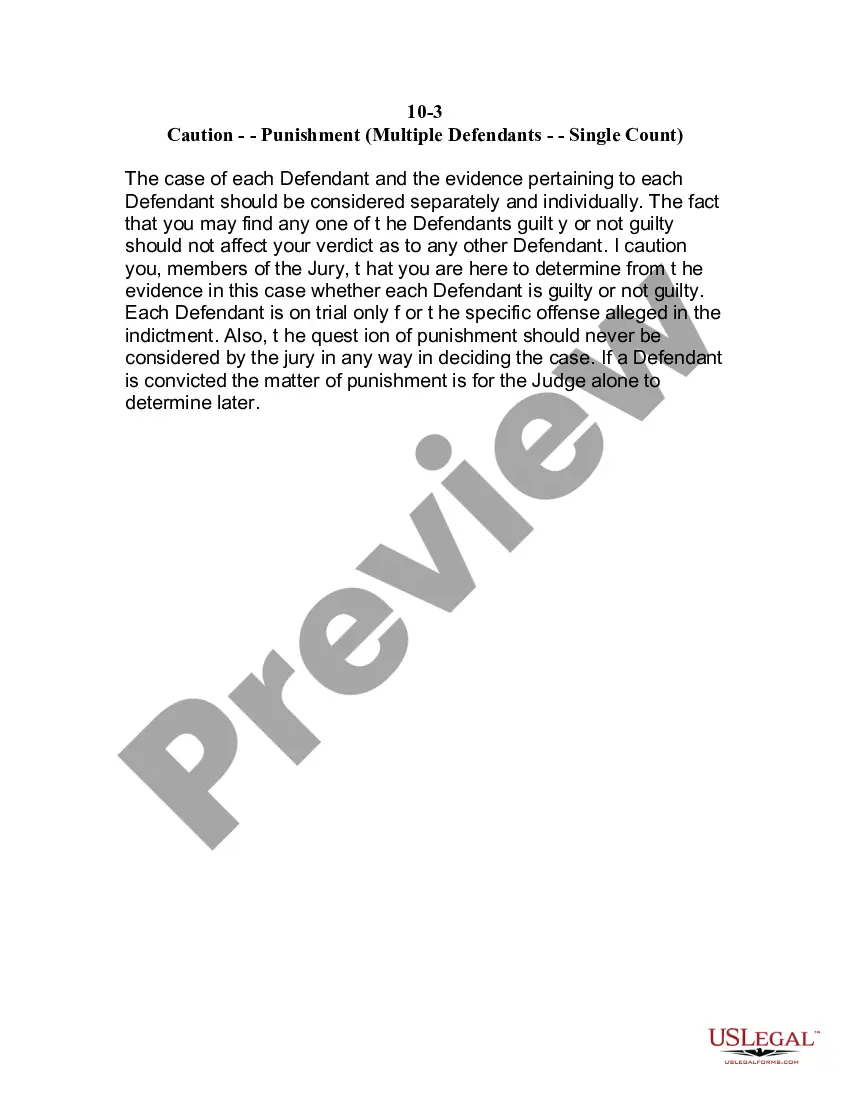
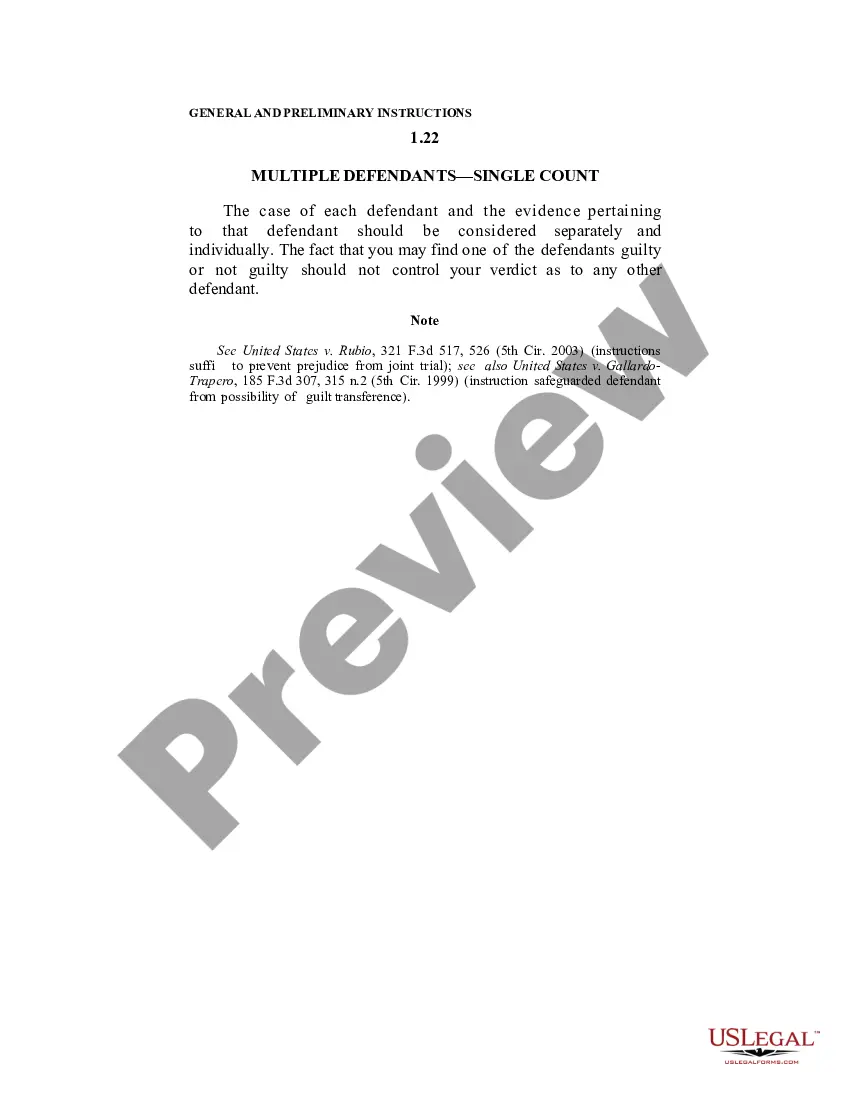
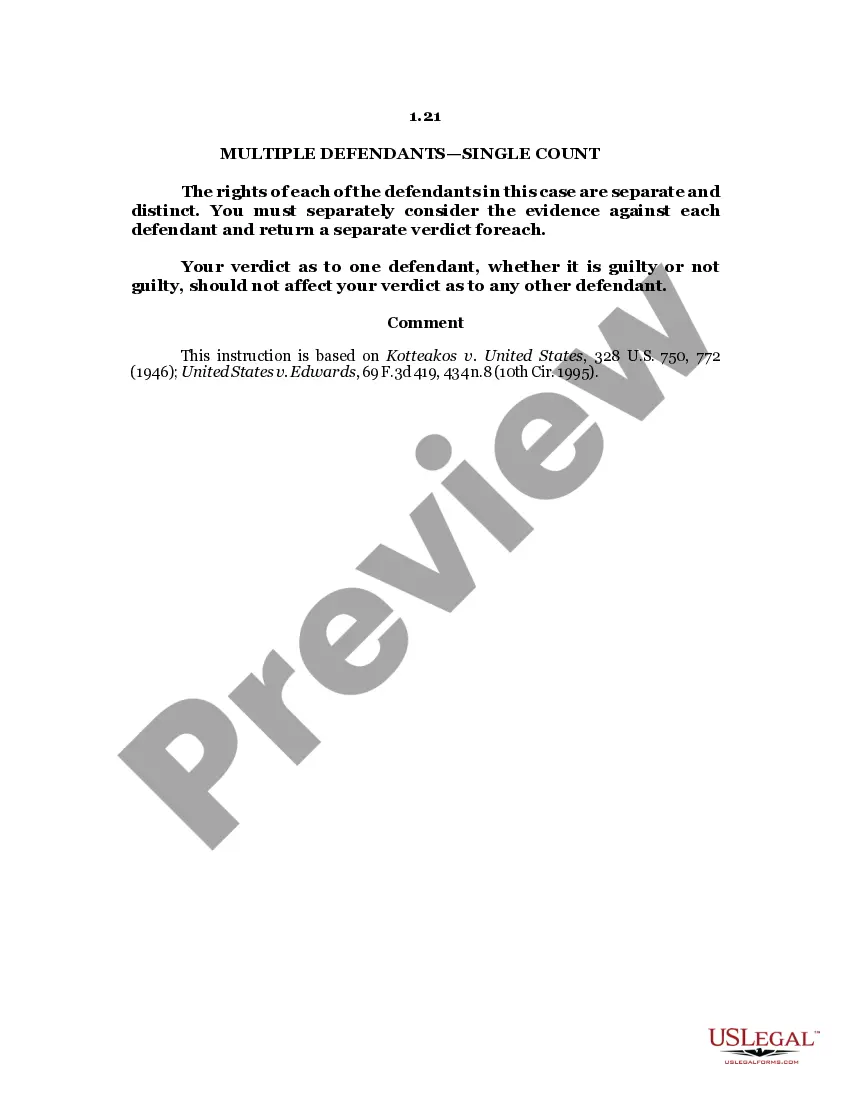
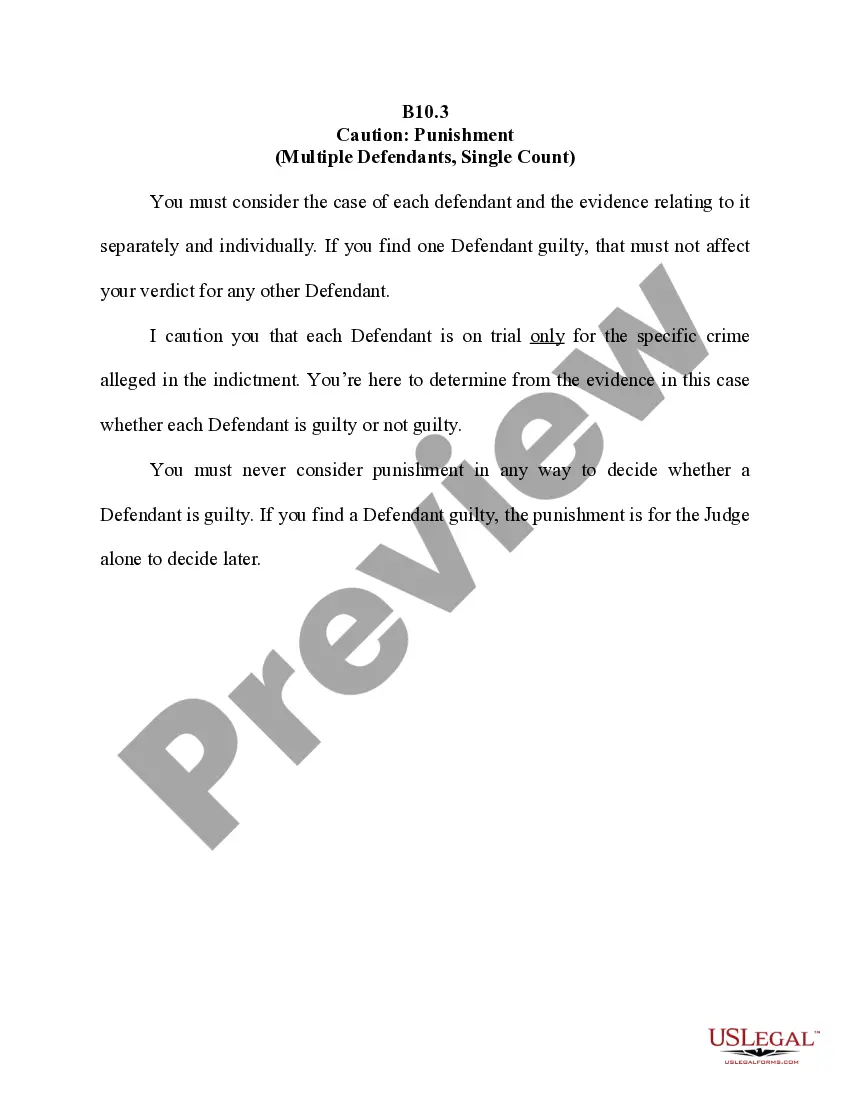
The Jury Instruction - Caution - Multiple Defendants - Single Count form provides sample jury instructions designed to guide juries in cases involving multiple defendants charged with a single count. This form emphasizes the importance of considering each defendant's case individually, ensuring that the verdict for one does not influence the verdict for another. It serves as a crucial resource for legal professionals to create tailored instructions that align with the specific circumstances of their case.
What’s included in this form
- Instructions for the jury to evaluate each defendant separately.
- Clarification that the punishment should not influence the verdict.
- Guidance on focusing solely on the specific offense charged against each defendant.
- Legal precedent to support the necessity of cautionary instructions.

When to use this document
This form is typically used in criminal cases where there are multiple defendants being tried for a single count. It is essential when jury instructions need to clarify that each defendant's guilt or innocence must be decided independently based on the evidence presented, ensuring that jurors do not allow their feelings about one defendant to affect their judgment on another.
Who can use this document
- Attorneys representing defendants in a criminal trial.
- Judges providing instructions to a jury in cases involving multiple defendants.
- Legal educators developing instructional materials for law students.
- Legal assistants involved in trial preparation and jury instructions.
Instructions for completing this form
- Identify the specific offense charged against each defendant.
- Review the evidence presented for each defendant separately.
- Adjust the sample instructions to fit the unique aspects of the case.
- Ensure clear language that jurors can easily understand.
- Provide the finalized instructions to the jury at the appropriate time during the trial.
Notarization guidance
Notarization is not commonly needed for this form. However, certain documents or local rules may make it necessary. Our notarization service, powered by Notarize, allows you to finalize it securely online anytime, day or night.
Get your form ready online
Our built-in tools help you complete, sign, share, and store your documents in one place.
Make edits, fill in missing information, and update formatting in US Legal Forms—just like you would in MS Word.
Download a copy, print it, send it by email, or mail it via USPS—whatever works best for your next step.
Sign and collect signatures with our SignNow integration. Send to multiple recipients, set reminders, and more. Go Premium to unlock E-Sign.
If this form requires notarization, complete it online through a secure video call—no need to meet a notary in person or wait for an appointment.
We protect your documents and personal data by following strict security and privacy standards.

Make edits, fill in missing information, and update formatting in US Legal Forms—just like you would in MS Word.

Download a copy, print it, send it by email, or mail it via USPS—whatever works best for your next step.

Sign and collect signatures with our SignNow integration. Send to multiple recipients, set reminders, and more. Go Premium to unlock E-Sign.

If this form requires notarization, complete it online through a secure video call—no need to meet a notary in person or wait for an appointment.

We protect your documents and personal data by following strict security and privacy standards.
Common mistakes to avoid
- Failing to emphasize the need for jurors to consider each defendant independently.
- Including discussions of punishment in the jury instructions.
- Not tailoring the instructions to reflect the specific facts of the case.
- Relying solely on generic templates without reviewing for clarity.
Benefits of using this form online
- Convenient access to professionally drafted instructions that can be customized.
- Easy editing capabilities to tailor the language to specific trial needs.
- Reliability or assurance due to being drafted by licensed attorneys.
Legal use & context
- These instructions are based on established legal principles ensuring fairness in jury deliberation.
- They are vital in preventing juror bias when multiple defendants are involved.
- This form can be referenced in legal arguments regarding jury instructions.
Looking for another form?


Form popularity
FAQ
Q - Do all the jury members have to agree on the verdict? A - In a criminal trial the jury verdict must be unanimous, that is all 12 jurors must agree.It is up to the Crown to decide whether to apply for a new trial. A jury that cannot agree on a verdict is called a 'hung' jury.
Grand juries are made up of approximately 16-23 members. Their proceedings can only be attended by specific persons. For example, witnesses who are compelled to testify before the grand jury are not allowed to have an attorney present. At least twelve jurors must concur in order to issue an indictment.
When this happens and it only takes one juror it's called a hung jury. If the jury is hung on any of the counts, it's considered a mistrial on that count. That means the case can be re-tried on any of the charges on which the jury was hung.
There are several ways that a defendant may benefit from a hung jury. First, the government may choose not to have a second trial and may dismiss the case instead. This is only likely to happen if the jury that deadlocked had more votes for not-guilty than guilty.
If the jury cannot agree on a verdict on one or more counts, the court may declare a mistrial on those counts. A hung jury does not imply either the defendant's guilt or innocence. The government may retry any defendant on any count on which the jury could not agree."
There is no limit on the number of times that the prosecution may retry a case in the event of a hung jury. It is up to the prosecution. On one hand, a hung jury might force the prosecution to make a more reasonable plea offer.
If the jury cannot agree on all counts as to any defendant, the jury may return a verdict on those counts on which it has agreed. . . . If the jury cannot agree on a verdict on one or more counts, the court may declare a mistrial on those counts. A hung jury does not imply either the defendant's guilt or innocence.
In 12 percent of single-defendant cases, the jury hung on at least one count, but that figure increased to 27 percent when multiple defendants were tried. As predicted by the researchers, the number of counts affected the likelihood of a hung jury.
When there are insufficient jurors voting one way or the other to deliver either a guilty or not guilty verdict, the jury is known as a hung jury or it might be said that jurors are deadlocked.In the event of a mistrial, the defendant is not convicted, but neither is the defendant acquitted.