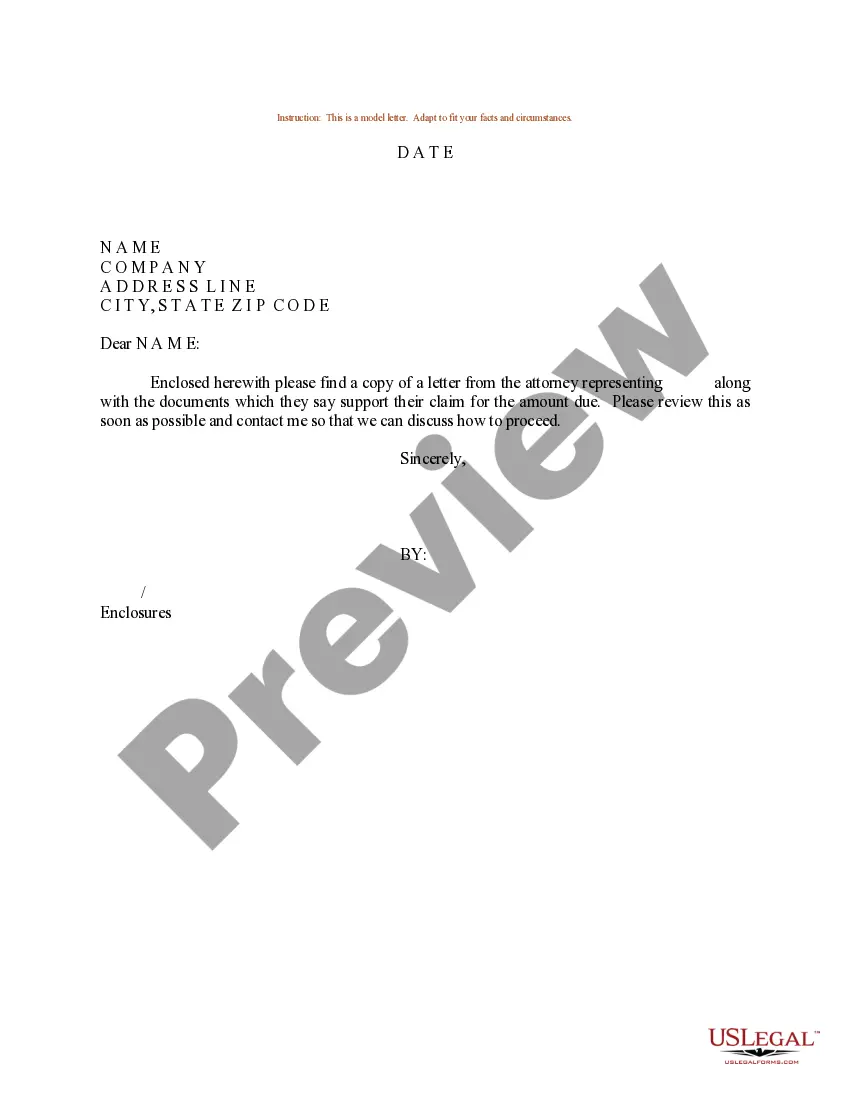
Sample Letter Notifying Client of Opposing Attorney's Correspondence
Understanding this form
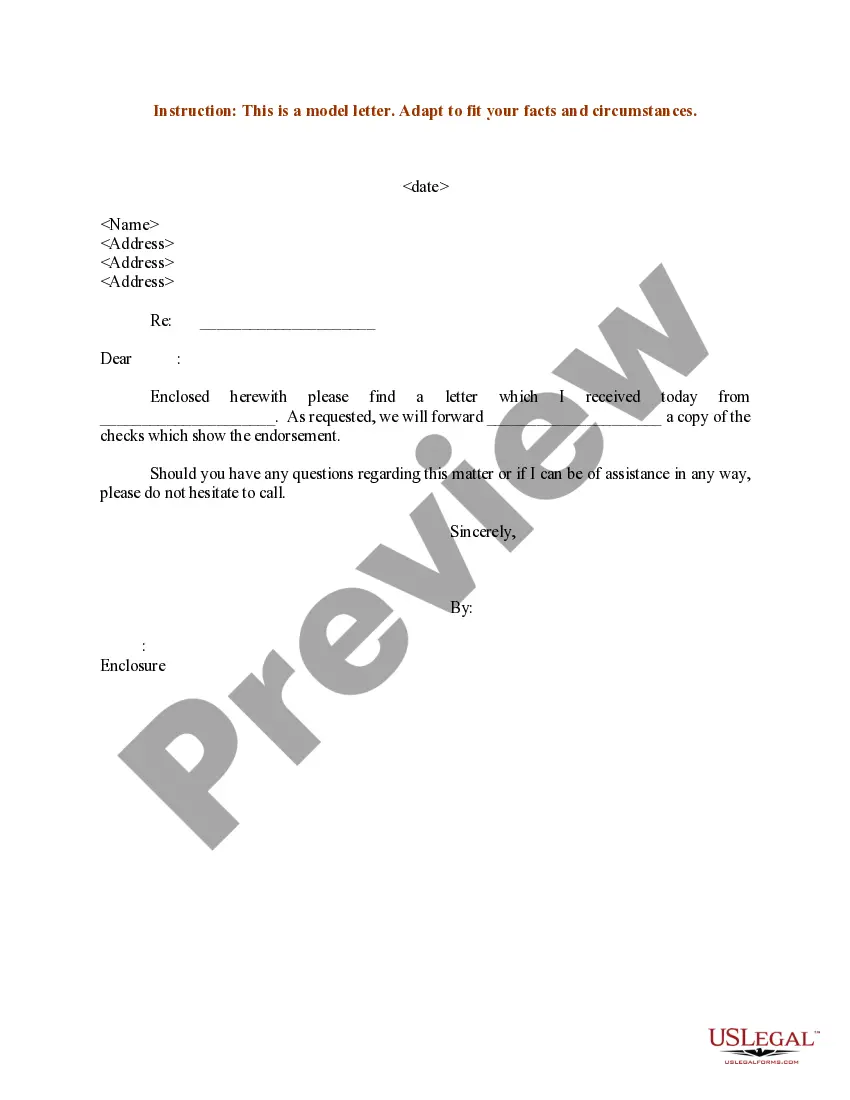
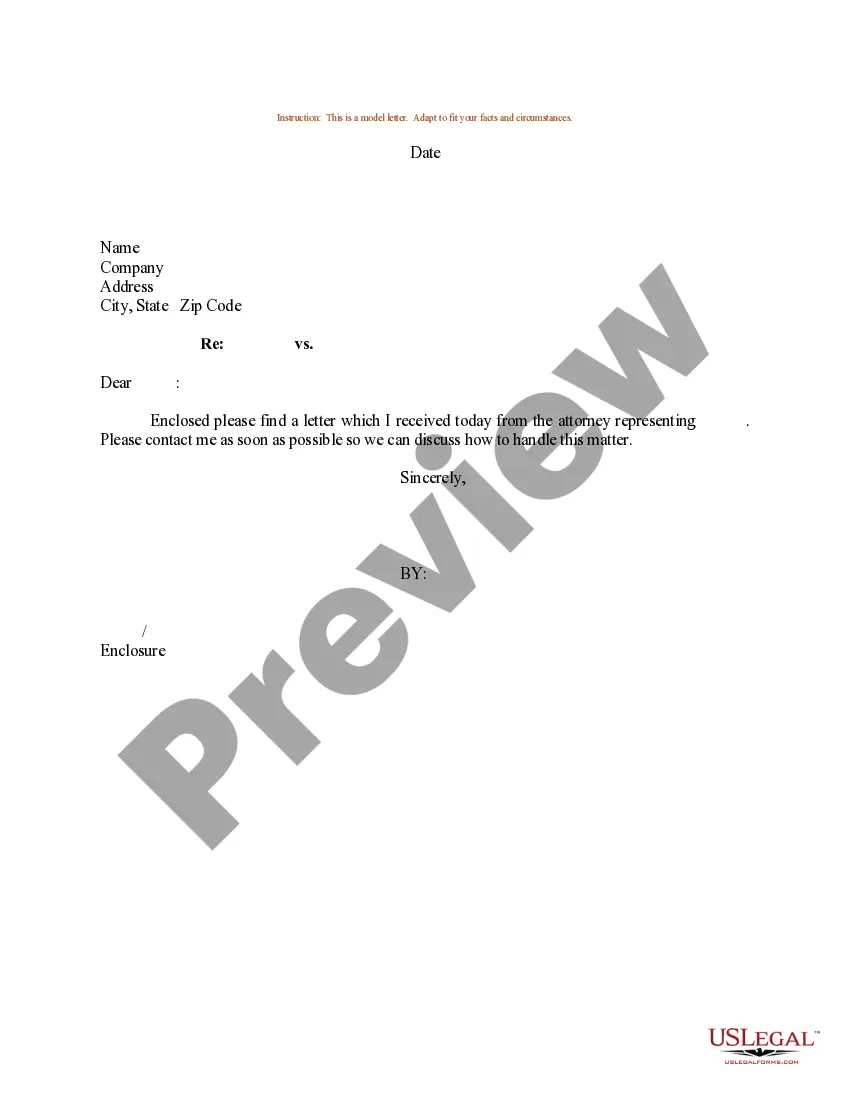
This Sample Letter Notifying Client of Opposing Attorney's Correspondence is a template designed to formally inform a client about a communication received from the opposing attorney. It serves as a record of the correspondence and ensures that the client is kept informed about relevant legal matters. Unlike general letters, this form specifically addresses notifications relating to legal disputes and can be tailored to various scenarios.
Key components of this form
- Date of the correspondence.
- Senderâs information, including name and address.
- Recipientâs name and contact details.
- Salutation and introduction of the subject matter.
- Details of the opposing attorney's correspondence.
- Closing statement and signature space.
When to use this document
This form is used when a client needs to be informed about any significant correspondence from the opposing attorney. It is important in situations such as legal disputes, negotiations, or settlement discussions, helping ensure that all parties remain informed about ongoing matters.
Who can use this document
- Attorneys who need to communicate with their clients about opposing counsel's correspondence.
- Clients who wish for their attorneys to formally document communications received from opposing attorneys.
- Law firms managing multiple clients and cases requiring formal notifications.
Completing this form step by step
- Enter the date at the top of the letter.
- Fill in your name, company, and address details.
- Include the client's name and address below your information.
- Write a proper salutation to the client.
- Summarize the content of the opposing attorney's correspondence.
- Conclude the letter with a closing statement and provide space for your signature.
Does this document require notarization?
This form does not typically require notarization unless specified by local law. It is advisable to check the legal requirements of your jurisdiction to ensure compliance.
Get your form ready online
Our built-in tools help you complete, sign, share, and store your documents in one place.
Make edits, fill in missing information, and update formatting in US Legal Forms—just like you would in MS Word.
Download a copy, print it, send it by email, or mail it via USPS—whatever works best for your next step.
Sign and collect signatures with our SignNow integration. Send to multiple recipients, set reminders, and more. Go Premium to unlock E-Sign.
If this form requires notarization, complete it online through a secure video call—no need to meet a notary in person or wait for an appointment.
We protect your documents and personal data by following strict security and privacy standards.

Make edits, fill in missing information, and update formatting in US Legal Forms—just like you would in MS Word.

Download a copy, print it, send it by email, or mail it via USPS—whatever works best for your next step.

Sign and collect signatures with our SignNow integration. Send to multiple recipients, set reminders, and more. Go Premium to unlock E-Sign.

If this form requires notarization, complete it online through a secure video call—no need to meet a notary in person or wait for an appointment.

We protect your documents and personal data by following strict security and privacy standards.
Mistakes to watch out for
- Failing to include the correct date of correspondence.
- Not providing complete contact information for both parties.
- Using unclear language that doesn't effectively communicate the details of the opposing attorney's correspondence.
Benefits of completing this form online
- Easy to download and edit to fit specific needs.
- Convenient access to templates that save time and effort.
- Reliable source of professionally drafted legal forms.
Key takeaways
- This form is a Sample Letter Notifying Client of Opposing Attorney's Correspondence.
- It is essential for informing clients about opposing party communications.
- Customization in details is crucial for effective communication.
Looking for another form?




Form popularity
FAQ
A lawyer is not prohibited from calling another party's attorney or another member of the party's attorney's firm as a witness, either in discovery or at trial, where such attorney may have unprivileged knowledge relevant to the case or unprivileged knowledge reasonably calculated to lead to the discovery of admissible
Prepare to write your letter. Before you begin writing, think about your audience, what you need to say, and what tone of voice you should use. Briefly explain the purpose of the letter. Make each point in a separate paragraph. Ask the recipient to do something.
But by default, communications to the other side are addressed to the designated attorney-in-charge/top-named lawyer, with cc's to everyone else. In a rare situation where you are sending a letter specifically to multiple attorneys as opposed to the other side as a whole, it's Dear Messrs. Smith and Jones, Dear Ms.
A letter to an attorney should be written in a formal letter format with the attorney's name, law firm and address at the top near the date, addressed using a salutation and signed off with a closing such as "Very Truly Yours" or "Sincerely."
Never Refer To Counsel In Argument Resist the impulse in Court to address opposing counsel directly always address through the Court. It will keep you more civil and calmer (and it's what the Court wants anyway).
Date; Address to whom the letter is sent to; The subject of the letter; Content or body of the letter. Briefly explaining why the lawyer is writing the letter and the general claim and damages. Signature.
Never Refer To Counsel In Argument Resist the impulse in Court to address opposing counsel directly always address through the Court. It will keep you more civil and calmer (and it's what the Court wants anyway).
Opposing counsel call each other 'friend' in increasingly popular SCOTUS lingo. The Supreme Court under the leadership of Chief Justice John G. Roberts Jr. is increasingly using the word friend to refer to opposing counsel in oral arguments, a term also picked up by the lawyers appearing before the court.
What Is a Representation Letter? What? The Letter of Representations is a letter written from the Association to its accountant representing that the financial statements for the time period covered by the engagement are the responsibility of "management".