Beneficiary Deed
What this document covers
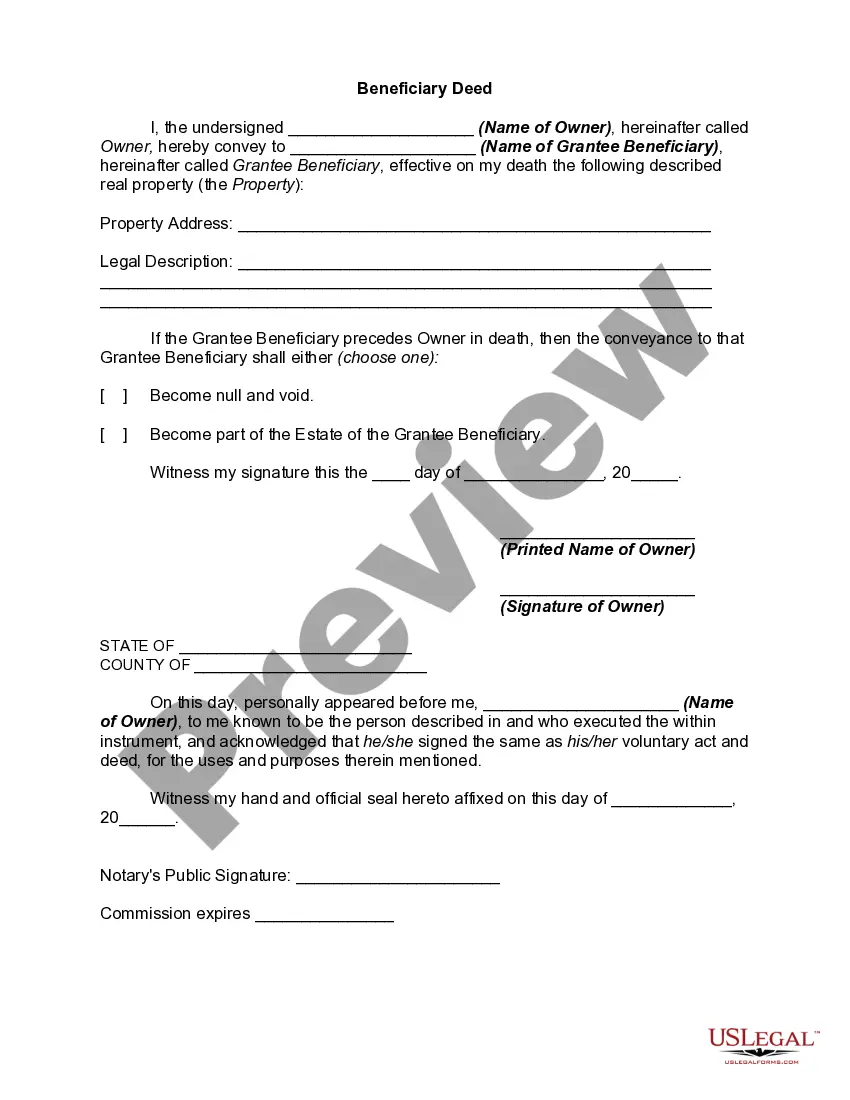
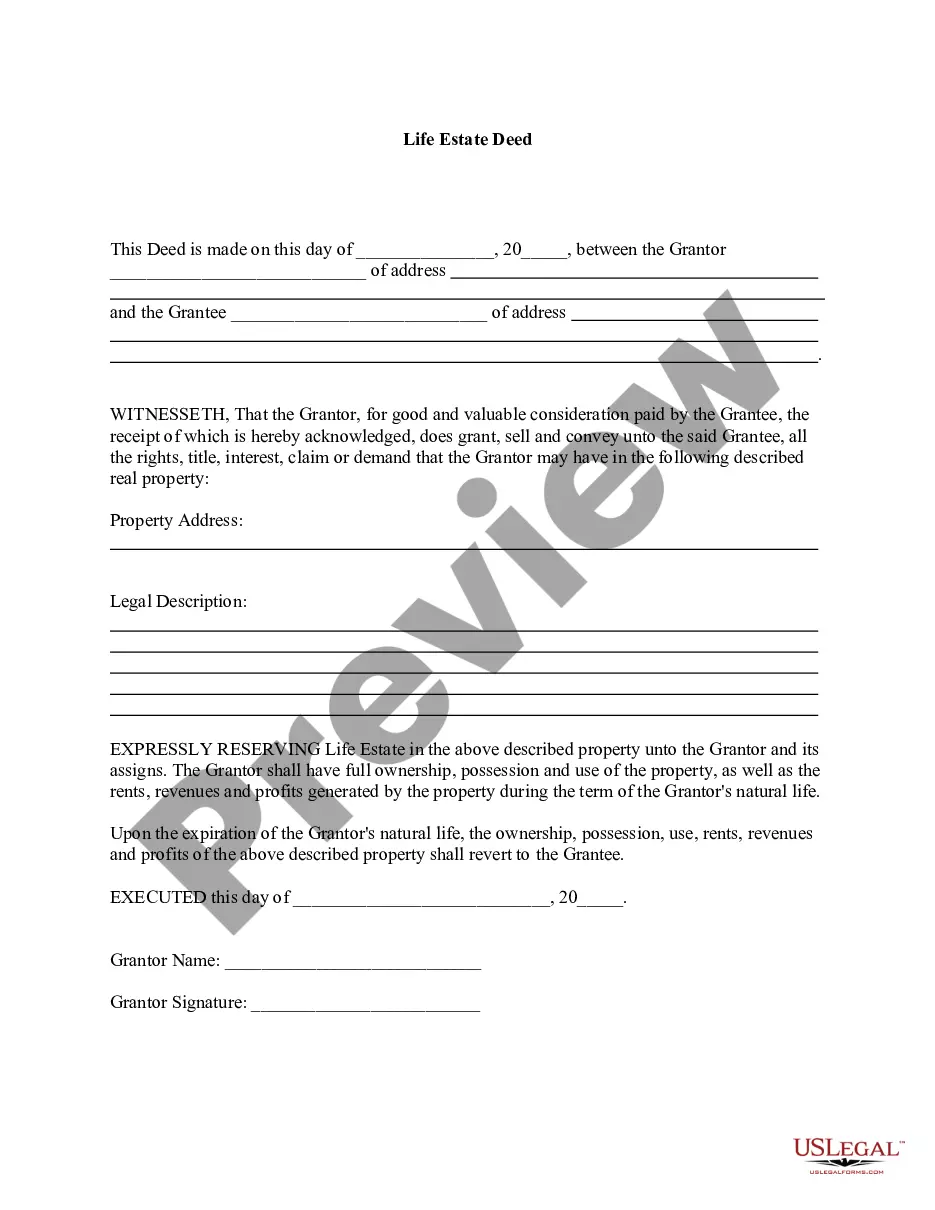
A beneficiary deed is a specific type of real property deed that allows an owner to transfer their property interests to designated individuals or entities upon their death. Unlike traditional property transfers, a beneficiary deed does not take effect until the owner's passing, ensuring that the transfer occurs automatically by law. This form is distinct from a typical will, as it allows for a smoother transition of property without the need for probate proceedings.
Key components of this form
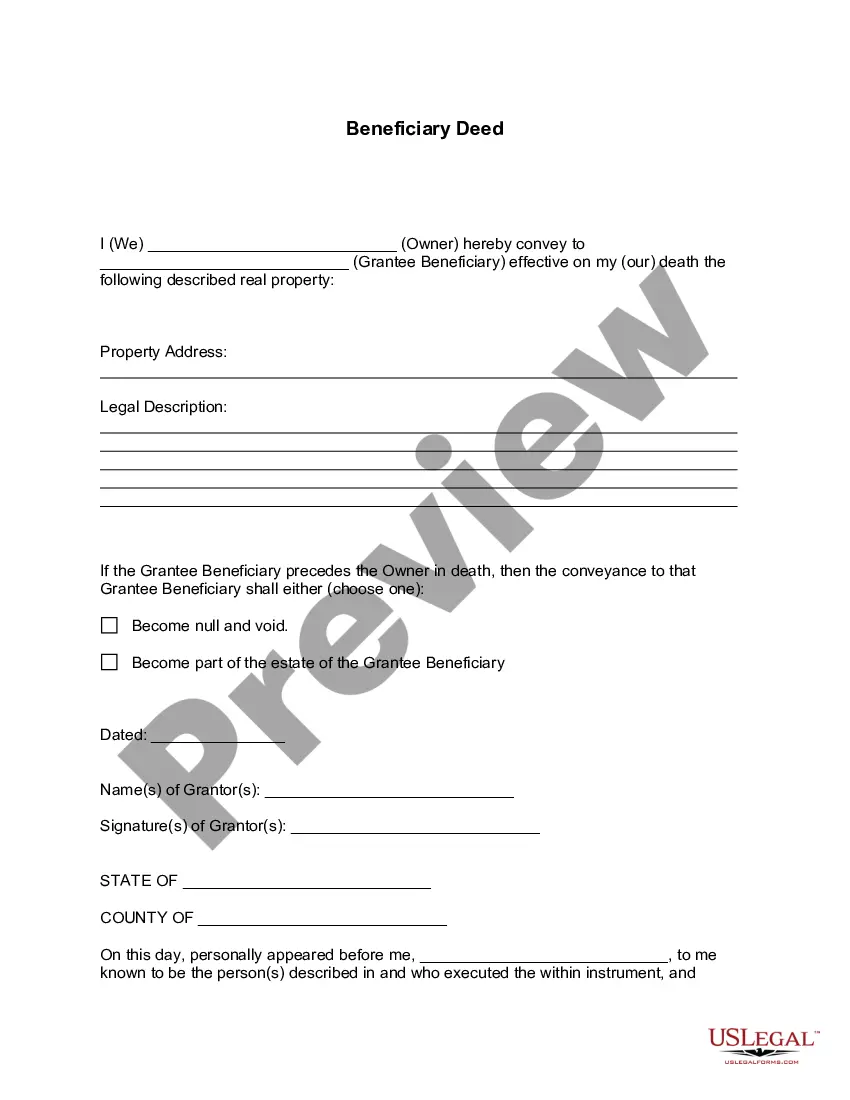
- Name of the property owner (Owner)
- Name of the grantee beneficiary (Grantee Beneficiary)
- Description of the real property being transferred
- Provisions for what happens if the grantee beneficiary predeceases the owner
- Signature and date of the property owner
- Notary acknowledgment section


Situations where this form applies
You would use a beneficiary deed when you want to ensure that your real estate is automatically transferred to a specific person or entity after your death without going through probate. This form is especially beneficial for individuals looking to bypass the complications of estate administration for their property and provide clear instructions regarding its transfer.
Who needs this form
- Property owners wanting to manage the transfer of their real estate after death
- Individuals seeking to simplify the inheritance process for their heirs
- Homeowners who want to designate a specific beneficiary for their property
How to complete this form
- Identify and enter the name of the property owner.
- Specify the name of the individual or entity designated as the grantee beneficiary.
- Provide a detailed description of the real property, including the address and legal description.
- Select the option regarding the grantee beneficiary's death before the owner.
- Have the property owner sign and date the form.
- Complete the notary acknowledgment section for legal validation.
Does this form need to be notarized?
To make this form legally binding, it must be notarized. Our online notarization service, powered by Notarize, lets you verify and sign documents remotely through an encrypted video session.
Get your form ready online
Our built-in tools help you complete, sign, share, and store your documents in one place.
Make edits, fill in missing information, and update formatting in US Legal Forms—just like you would in MS Word.
Download a copy, print it, send it by email, or mail it via USPS—whatever works best for your next step.
Sign and collect signatures with our SignNow integration. Send to multiple recipients, set reminders, and more. Go Premium to unlock E-Sign.
If this form requires notarization, complete it online through a secure video call—no need to meet a notary in person or wait for an appointment.
We protect your documents and personal data by following strict security and privacy standards.

Make edits, fill in missing information, and update formatting in US Legal Forms—just like you would in MS Word.

Download a copy, print it, send it by email, or mail it via USPS—whatever works best for your next step.

Sign and collect signatures with our SignNow integration. Send to multiple recipients, set reminders, and more. Go Premium to unlock E-Sign.

If this form requires notarization, complete it online through a secure video call—no need to meet a notary in person or wait for an appointment.

We protect your documents and personal data by following strict security and privacy standards.
Avoid these common issues
- Failing to provide an accurate legal description of the property.
- Not signing the document in front of a notary public.
- Leaving sections of the form incomplete.
- Making assumptions about the implications of a named grantee without consulting legal advice.
Why use this form online
- Convenience of accessing and completing the form from home.
- Editability allows for easy adjustments to meet your specific needs.
- Reliable templates drafted by licensed attorneys ensure legal compliance.
Summary of main points
- A beneficiary deed facilitates the transfer of property to designated beneficiaries upon the owner's death without going through probate.
- Ensure accurate information is provided to prevent legal issues.
- Notarization is typically required for the deed to be enforceable.
Looking for another form?

Form popularity
FAQ
All you need to do is fill out a simple form, provided by the bank, naming the person you want to inherit the money in the account at your death. As long as you are alive, the person you named to inherit the money in a payable-on-death (POD) account has no rights to it.
The California TOD deed form allows property to be automatically transferred to a new owner when the current owner dies, without the need to go through probate. It also gives the current owner retained control over the property, including the right to change his or her mind about the transfer.
In most cases, the surviving owner or heir obtains the title to the home, the former owner's death certificate, a notarized affidavit of death, and a preliminary change of ownership report form. When all these are gathered, the transfer gets recorded, the fees are paid, and the county issues a new title deed.
The California TOD deed form allows property to be automatically transferred to a new owner when the current owner dies, without the need to go through probate. It also gives the current owner retained control over the property, including the right to change his or her mind about the transfer.
If you'd like to avoid having your property going through the probate process, it's a good idea to look into a transfer on death deed. A transfer on death deed allows you to select a beneficiary who will receive your property, but only when you've passed away.
Get a Deed Form or Prepare Your Own. You can buy a state-specific TOD deed form for your state or type up your own document. Name the Beneficiary. Describe the Property. Sign the Deed. Record the Deed.
1Get a Deed Form or Prepare Your Own. You can buy a state-specific TOD deed form for your state or type up your own document.2Name the Beneficiary.3Describe the Property.4Sign the Deed.5Record the Deed.
When a joint owner dies, the process is relatively simple you just need to inform the Land Registry of the death. You should complete a 'Deceased joint proprietor' form on the government's website and then send the form to the Land Registry, with an official copy of the death certificate.