Employee Complaint Form
What this document covers
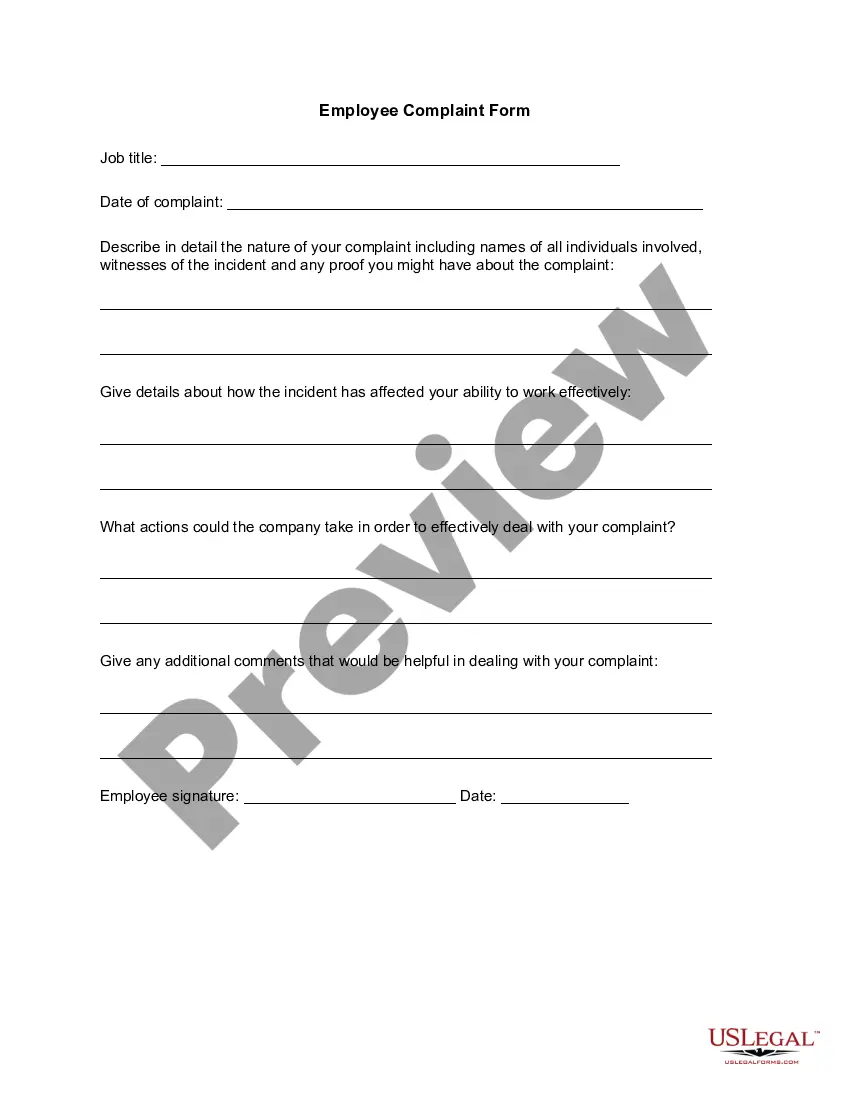
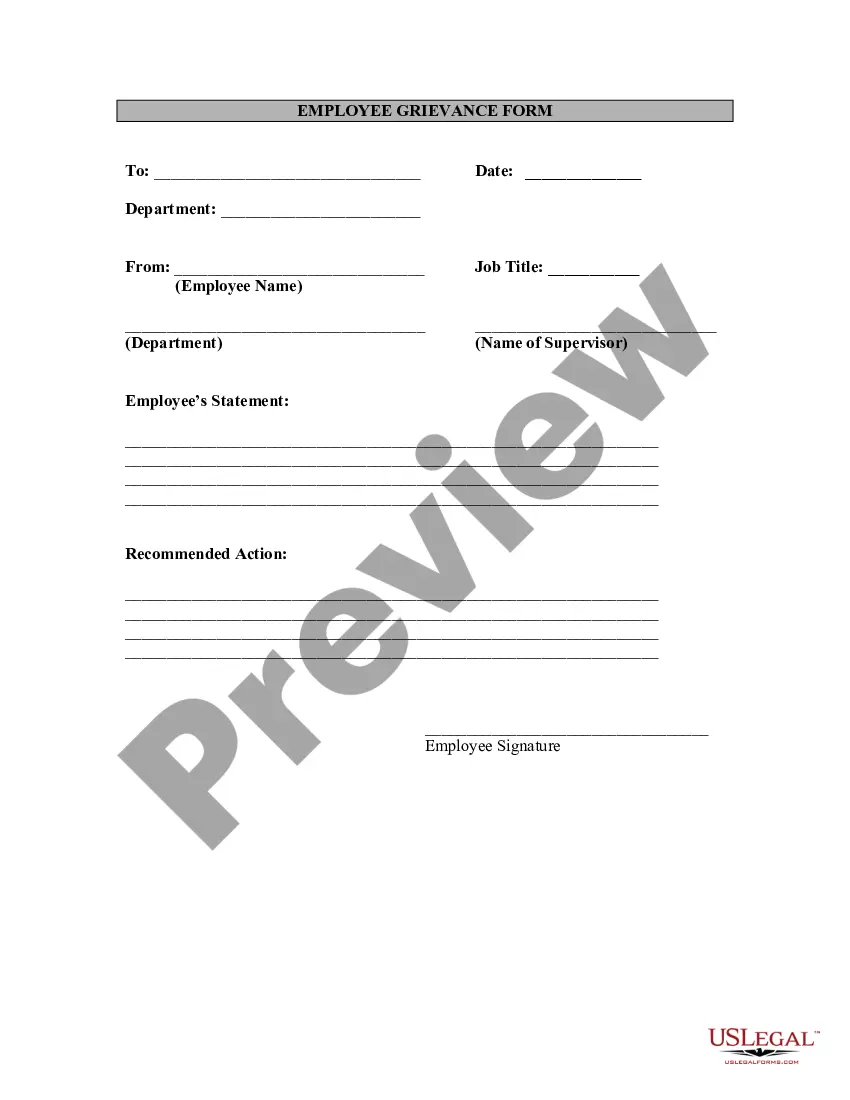
The Employee Complaint Form is a document used by employees to formally submit grievances regarding workplace issues. This form enables employees to clearly outline their complaints, document the impact on their work, and suggest potential resolutions. Unlike informal complaint channels, this structured approach ensures that issues are officially recorded and addressed by management.
What’s included in this form
- Job title: section to state the employee's position.
- Date of complaint: field to indicate when the complaint was filed.
- Description of complaint: detailed account of the grievance, including names of individuals involved and any witnesses.
- Impact of incident: explanation of how the complaint has affected the employee's work performance.
- Suggested actions: space for the employee to propose how the company can resolve the issue.
- Additional comments: area for any further information that may assist in addressing the complaint.
- Employee signature and date: confirmation that the information provided is accurate.
Common use cases
Use the Employee Complaint Form when you need to report workplace issues such as harassment, discrimination, unsafe working conditions, or conflicts with colleagues. If you feel that informal discussions have not resolved the issue, this form serves as an official record that can prompt management to take appropriate action.
Who can use this document
This form is intended for:
- Current employees seeking to address workplace grievances.
- Individuals who have experienced misconduct or violations of company policy.
- Employees wishing to ensure that their complaints are documented for future reference.
How to complete this form
- Enter your job title and the date you are submitting the complaint.
- Describe the nature of your complaint in detail, including the names of individuals involved and any witnesses.
- Detail how the incident has impacted your work effectiveness.
- Suggest actions that the company can take to address your complaint.
- Add any additional comments that may help in resolving your issue.
- Sign and date the form to confirm the information is accurate.
Is notarization required?
This form usually doesn’t need to be notarized. However, local laws or specific transactions may require it. Our online notarization service, powered by Notarize, lets you complete it remotely through a secure video session, available 24/7.
Get your form ready online
Our built-in tools help you complete, sign, share, and store your documents in one place.
Make edits, fill in missing information, and update formatting in US Legal Forms—just like you would in MS Word.
Download a copy, print it, send it by email, or mail it via USPS—whatever works best for your next step.
Sign and collect signatures with our SignNow integration. Send to multiple recipients, set reminders, and more. Go Premium to unlock E-Sign.
If this form requires notarization, complete it online through a secure video call—no need to meet a notary in person or wait for an appointment.
We protect your documents and personal data by following strict security and privacy standards.

Make edits, fill in missing information, and update formatting in US Legal Forms—just like you would in MS Word.

Download a copy, print it, send it by email, or mail it via USPS—whatever works best for your next step.

Sign and collect signatures with our SignNow integration. Send to multiple recipients, set reminders, and more. Go Premium to unlock E-Sign.

If this form requires notarization, complete it online through a secure video call—no need to meet a notary in person or wait for an appointment.

We protect your documents and personal data by following strict security and privacy standards.
Avoid these common issues
- Failing to include all relevant details about the incident.
- Not specifying how the complaint has affected job performance.
- Skipping the signature or date section.
- Using vague language instead of clear, specific statements.
Why use this form online
- Convenient access allows for immediate completion and submission.
- Editability enables users to revise responses before finalizing.
- Reliable templates ensure compliance with legal standards.
Legal use & context
- This form is legally recognized as a formal record of employee grievances.
- Completing this form may be necessary for any claims related to workplace issues.
- It helps organizations demonstrate compliance with employment regulations.
Summary of main points
- The Employee Complaint Form allows formal documentation of workplace grievances.
- It is essential for creating a clear record that can aid in resolution.
- Proper completion of the form can enhance the chances of effective complaint handling.
Looking for another form?





Form popularity
FAQ
Investigate with Purpose. Respond Quickly But Be Prepared. Create an Investigation Plan. Take Interim Action. Protect the Complainant. Protect the Accused. Document Everything. Get External Help.
Step 1: Is an investigation necessary? For lower-risk workplace grievances, it may be more effective to resolve matters informally without commencing a formal investigation. Step 2: Plan, plan, plan. Step 3: Fact-finding. Step 4: Assess and report. Step 5: Discipline and follow-up.
Identify Your Rights. Review Company Policies and Procedures. Write an Introductory Paragraph. Outline a Chronology of Events. Request Action.
Decide whether to investigate. Take immediate action, if necessary. Choose an investigator. Plan the investigation. Conduct interviews. Gather documents and other evidence. Evaluate the evidence. Take action.
Keep the contents of your letter to the point. Stick to the facts and never make accusations or allegations when you don't have evidence. Use professional language only, never use profanities, offensive or abusive language as this might put the reader off.
An individual grievance is a complaint that an action by management has violated the rights of an individual as set out in the collective agreement or law, or by some unfair practice. Examples of this type of grievance include: discipline, demotion, classification disputes, denial of benefits, etc.
Contact the HR department. If the salary is not paid by your employer, you must first contact the HR department of your company to know why you have not received salaries. Send legal notice to your employer. Go for Arbitration. Approach the labour commissioner. File your complaint in a labour court:
Identify exactly the kind of workplace harassment that took place. Write down the details about the harassment. Introduce yourself and your purpose. Present the facts of the harassment. Explain in great detail how you responded. Proffer a solution to the issue. Avoid using offensive language.
Keep the contents of your letter to the point. Stick to the facts and never make accusations or allegations when you don't have evidence. Use professional language only, never use profanities, offensive or abusive language as this might put the reader off.